Western Chips Are Powering Russia's Precision Strikes Despite Export Controls
Ukraine's HUR War&Sanctions portal documents 6,284 foreign-made electronic components across 213 Russian weapon systems, including an Nvidia Jetson Orin inside a new Russian cruise missile. The export control regime is not a firewall.
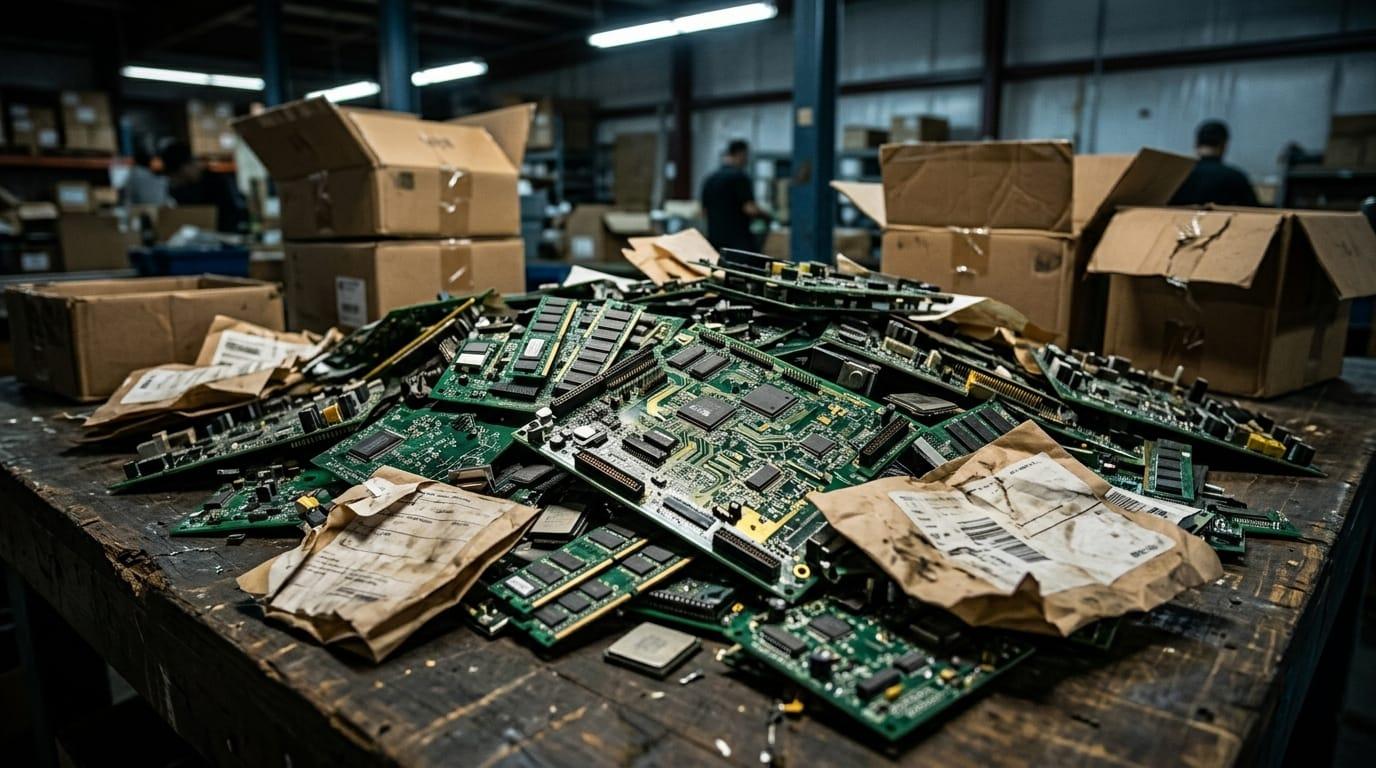
Ukraine's military intelligence has catalogued 6,284 foreign-made components inside Russian weapon systems, including an Nvidia Jetson Orin pulled from a live cruise missile.
Key takeaways
- Ukraine's HUR War&Sanctions portal now documents 6,284 foreign-produced electronic components across 213 Russian weapon systems, the most comprehensive open database of its kind.
- An Nvidia Jetson Orin computer module was identified inside Russia's new S-71 Monochrome air-launched cruise missile, which carries autonomous optical-targeting capability, per Ukraine's Defense Intelligence (HUR) reporting from August 2026.
- Russia routes controlled chips through China, Kazakhstan, Kyrgyzstan, and the UAE using shell companies and consumer-grade re-export schemes, a structural gap the existing control regime has no answer for.
Ukraine's Defense Intelligence (HUR) has documented 6,284 foreign-produced electronic components inside 213 Russian weapon systems, per the live War&Sanctions portal, the world's only open database tracking Western parts in Russian arsenals. The chips include components from Nvidia, AMD, Texas Instruments, Analog Devices, Micron, and Broadcom, running in the Kinzhal, Iskander, Kalibr, Kh-101, and Geran-2 weapons that have been striking Ukrainian cities since 2022.
The database was built to show exactly this finding.
An Nvidia Module Inside a New Russian Cruise Missile
On August 12, 2026, Kyiv Post first reported that HUR had pulled an Nvidia Jetson Orin computer module out of Russia's new S-71 Monochrome, an air-launched cruise missile with autonomous targeting driven by optical sensors and onboard computing. HUR identified 35 foreign electronic components in the same weapon.
HUR's statement on the discovery was direct: "The discovery of the Nvidia Jetson in a new Russian missile once again demonstrates the need for increased sanctions pressure and coordination of the efforts of the civilized world."
Nvidia told The Register that its chips are not available in Russia and are not designed for military purposes, while acknowledging there are plenty of ways for Russia to get ahold of the chips that are out of its control. That is a precise description of the problem.
The Kyiv Post followed this reporting with a broader feature, "NVIDIA, AMD, Intel: Inside the Chips Powering Russia's War," analyzing the full supply chain behind Russia's precision strike arsenal using the HUR War&Sanctions database.
How the Evasion Works
The route is not complicated. Russian procurement networks buy consumer-grade chips in small batches through shell companies registered in China, Kazakhstan, Kyrgyzstan, and the UAE. The chips travel through Central Asian transshipment hubs, the Bureau of Industry and Security (BIS) classifies Turkey, UAE, Armenia, and Kazakhstan as high-risk transshipment jurisdictions, and then get soldered into guidance systems. The GUR's October 2025 release documented the same pattern in components pulled from missiles targeting Ukrainian energy infrastructure.
Export controls as written assume a world where the controlled party cannot access a parallel supply chain. That assumption broke down across consumer electronics the moment chips became globally commoditized. The Jetson Orin is a commercial AI computing module. It is in drones, robotics labs, and autonomous vehicles worldwide.
Keeping it out of Russia requires enforcement at every downstream node in a chain that runs through dozens of jurisdictions that have no obligation to cooperate.
The pattern is not unique to chips. The export control failures around Nvidia hardware routed through cloud leases and Chinese-state-linked data centers follow the same logic: controlled hardware moves through compliant-looking intermediaries who do not ask inconvenient questions, and the controls generate paperwork rather than outcomes.
What This Proves and What to Watch
The thesis here is blunt: Western semiconductor export controls function as compliance theater. They impose costs on legitimate actors, generate enforcement revenue (Applied Materials paid BIS a $252 million penalty -- the second-highest in BIS history -- in February 2026 for illegal semiconductor equipment exports), and reroute Russia's supply chain through Shenzhen and Central Asia rather than actually depriving Moscow of the hardware it needs to run precision strikes. The post-Cold War assumption that you can weaponize a globalized tech supply chain selectively is empirically broken. The HUR database is the receipt.
The trigger that disproves this: if BIS and allied agencies demonstrate, with transaction-level data, that secondary sanctions on Central Asian transshipment hubs have materially reduced controlled chip flows into Russian weapons production, and if the War&Sanctions portal stops identifying new Western components in recovered Russian weapons, the controls are working. Watch the portal's component count. If it plateaus or falls, enforcement is biting. As of November 9, 2026, it stands at 6,284 and rising.
The policy debate consistently skips a second-order effect. State-issued control mechanisms fail upward against adversaries and fail downward against compliant actors. Russia gets the chips anyway. The legitimate semiconductor company pays the nine-figure fine. The shell company in Almaty closes and reopens under a different name next quarter.
The settlement layer that cannot be rerouted through a shell company, that cannot be turned into a weapon against the people it is supposed to serve, operates on permissionless rails that do not have a Kazakhstan exemption. The geopolitical instability this chip story represents, the breakdown of the rules-based order, the arms race in dual-use AI hardware, the war economy bleeding into civilian tech, is the exact macro environment that makes hard, neutral money not an ideological preference but a practical necessity.
What Comes Next
HUR's War&Sanctions portal will continue updating as Ukrainian forces recover weapons and strip them for analysis. The component count has only moved in one direction since the portal launched.
Meanwhile, Russia's parallel moves to build state-supervised financial rails suggest Moscow is operating on the same read: the existing control architecture is porous, and states that understand that are building around it. The enforcement question is whether BIS and allied agencies move from penalty collection to genuine transshipment-node interdiction. Nothing in the current enforcement record suggests they will.
Sources
Frequently Asked Questions
How do Russian military manufacturers get around US semiconductor export controls?
Russia uses a multi-layered transshipment network. Shell companies in China, Kazakhstan, Kyrgyzstan, and the UAE purchase controlled chips in small consumer-grade batches, keeping individual orders below reporting thresholds, and re-export them into Russia. BIS classifies several of these jurisdictions as high transshipment risk but cannot compel their cooperation. The chips are then integrated into guidance and targeting systems in Russian weapons.
What is Ukraine's War&Sanctions portal and what has it found?
The War&Sanctions portal, maintained by Ukraine's Defense Intelligence (HUR) at war-sanctions.gur.gov.ua, is the only open government database tracking foreign-made components recovered from Russian weapons systems. As of November 9, 2026, it documents 6,284 foreign-produced components across 213 Russian weapon units, including chips from Nvidia, AMD, Texas Instruments, Analog Devices, Micron, and Broadcom.
Why does the chip evasion story matter beyond the Ukraine war?
It demonstrates a structural limit of state-controlled chokepoints: they impose costs on compliant actors while adversaries route around them. Every sanction that fails to stop Russia from acquiring Nvidia Jetson chips confirms that selective weaponization of globalized supply chains does not work as designed. The same logic applies to SWIFT exclusions, dollar-denominated payment rails, and any other state-controlled financial infrastructure.