Scotland's AI Data Centers Could Become Country's Biggest Polluter by 2030
Environmental campaigners told Holyrood on October 29 that 23 proposed AI data center projects could expand Scotland's data center capacity 182-fold, emit 14 million tonnes of greenhouse gases annually by 2030, and consume more than half of the country's entire remaining carbon budget.
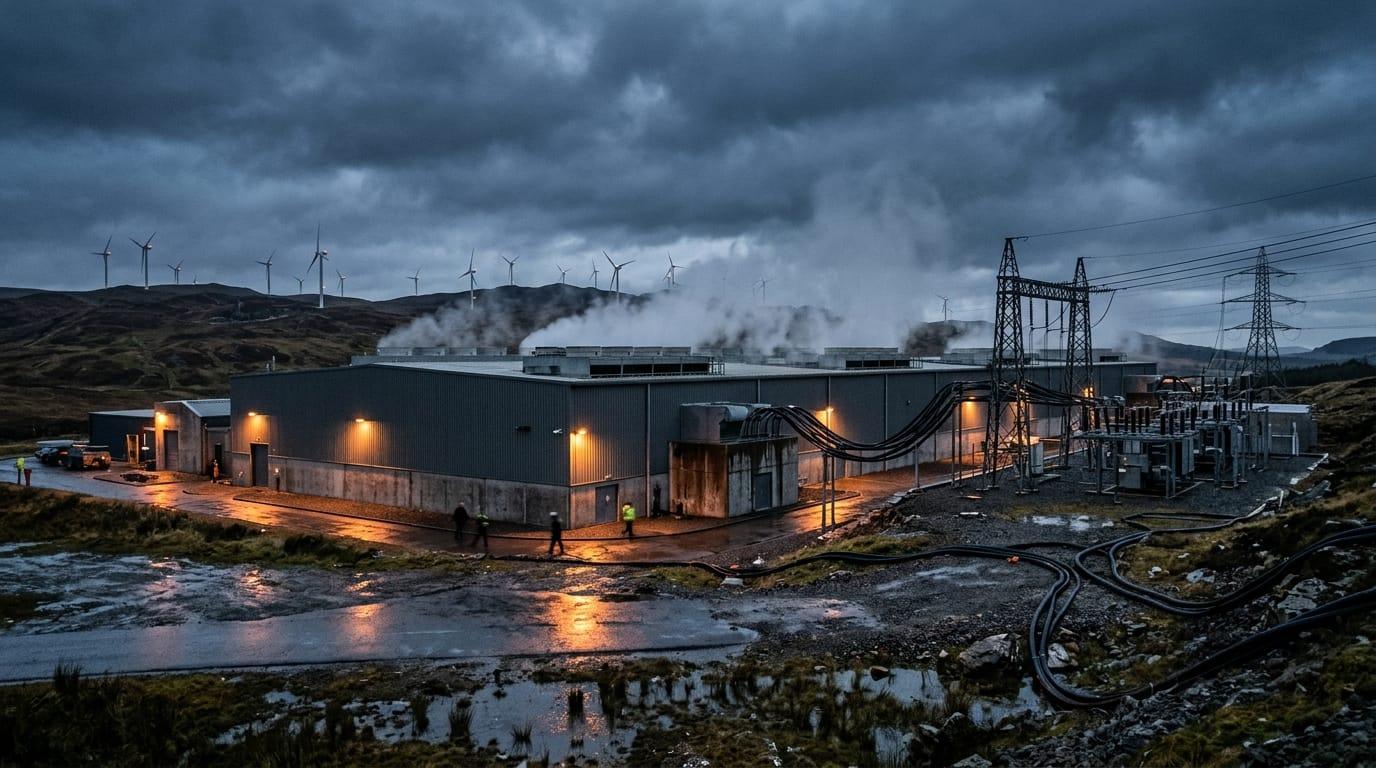
Environmental campaigners warn 23 proposed projects would expand capacity 182-fold and consume more than half of Scotland's remaining carbon budget.
Key takeaways
- Friends of the Earth Scotland told Holyrood's Climate Action Committee on October 29 that all 23 proposed AI data center projects, if approved, would generate 14 million tonnes of greenhouse gases annually by 2030 and consume 51% of Scotland's total carbon budget through 2045.
- The proposed buildout would take Scotland from roughly 50 MW of data center capacity to 9,100 MW, a 182-fold increase that already exceeds the country's entire winter peak electricity demand.
- AI data centers require firm, continuous power; Scotland paid £343 million in 2025 to curtail wind farms it cannot absorb. The mismatch between the "green data center" pitch and the physics of grid capacity is where bad energy policy gets made.
Friends of the Earth Scotland (FoES) and Action to Protect Rural Scotland (APRS) testified before Holyrood's Climate Action Committee on October 29, warning that 23 proposed AI data center projects across Scotland could become the country's single largest source of greenhouse gas emissions by 2030. The testimony puts hard numbers on a collision between AI's power appetite and one of Europe's most aggressive statutory carbon targets.
The numbers from the FoES press release are stark: 14 million tonnes of GHG emissions annually by 2030 if all 23 projects are approved, and 208 million tonnes of cumulative lifetime emissions against Scotland's total remaining carbon budget of 406 million tonnes from 2026 to 2045, per FoES analysis presented to the committee. That is 51% of the entire budget, consumed by data centers alone.
The Physics Do Not Support the Pitch
Scotland currently has roughly 50 MW of data center capacity. The 23 proposed projects would bring that to 9,100 MW, a 182-fold increase. Scotland's current winter peak electricity demand is just over 4,000 MW, per the National Energy System Operator. The proposed data center buildout, by itself, already exceeds total national demand.
That gap between the marketing and the physics is where the story gets interesting. Scottish wind farms were paid £343 million in 2025 to stop generating because the grid cannot move curtailed power south to England, according to Energy Voice. AI developers are racing to co-locate next to that cheap, stranded electricity and call it "green." But adding 9,100 MW of continuous, firm-load demand to a grid that is already capacity-constrained does not consume curtailed energy. It cannibalizes grid headroom and forces backup fossil generation or expensive new infrastructure.
Kim Pratt, Senior Campaigner at FoES, put it plainly in her committee testimony: "It would be a reckless dereliction of duty of the Scottish Government to continue allowing billionaire tech companies to push these enormous, polluting AI data centres across Scotland without understanding the impacts they will have on our environment and our communities." Dr. Kat Jones, Director of APRS, added: "They are so big that even one would blow completely apart our climate targets."
This is not a niche concern. The IEA's April 2026 Energy and AI report projects global data center electricity consumption reaching roughly 945 TWh by 2030, up from 485 TWh in 2025, with AI as the primary driver. Scotland is a microcosm of that pressure hitting a grid that was not built to absorb it.
The volume of phantom AI load circulating in global capex forecasts already raised questions about whether announced demand is real. Scotland's version of the problem is real: 23 planning applications, concrete capacity numbers, and a parliamentary inquiry trying to figure out what to do before the grid cracks.
Bitcoin's Load Profile vs. AI's Load Profile
There is a pointed comparison buried in this story that most coverage skips.
Bitcoin miners operate as interruptible, price-responsive load. When the grid is stressed, miners cut. When power is curtailed and cheap, miners absorb it.
That is the difference between monetizing stranded energy and cannibalizing grid capacity. AI training and inference workloads require continuous uptime. They cannot throttle with the grid. Scotland is now discovering what that distinction means in practice: a country with abundant curtailed wind and a constrained grid is precisely the wrong place to anchor firm, non-interruptible load at hyperscale.
The power shortfall Morgan Stanley identified across U.S. data centers through 2028 reflects the same structural mismatch at continental scale. Scotland is the compressed version. And Scotland's parliament has effectively been operating a de facto moratorium on new hyperscale data centers. The Scottish Government has pledged new planning guidance before year-end but has stopped short of a formal ban.
For comparison: Finland recently halted a major Google AI data center project over missing environmental reviews. The pattern of regulators in energy-sensitive jurisdictions reaching for stop-work mechanisms is consistent and accelerating.
The falsifiable thesis here: AI's hyperscale buildout consumes marginal and constrained power in ways that force grid expansion or carbon backsliding, while Bitcoin's interruptible load does not. That thesis breaks if even one of the 23 proposed Scottish data centers can demonstrate it is powered by genuinely additive renewable generation, not curtailed wind already on the grid, and operates without drawing fossil-backed baseload. It also breaks if hyperscale AI operators move to demand-flexible load-shifting at scale, operating the way miners do. Neither is happening in Scotland's planning applications today.
What to Watch
The Scottish Government's planning guidance, promised before year-end 2026, is the near-term trigger. If that guidance formalizes capacity limits or carbon-impact thresholds for data center approvals, it becomes a template other grid-constrained jurisdictions can copy. The language used to justify any restrictions will matter: if policymakers draw lines around "firm, non-interruptible load," Bitcoin's dispatchability argument becomes a regulatory differentiator. If the restrictions target all large power consumers indiscriminately, that is a different kind of problem worth watching.
Sources
Frequently Asked Questions
Why is Scotland specifically targeted for AI data center development?
Scotland offers two things hyperscale operators want: a cool climate that reduces cooling costs and abundant curtailed wind power that grid constraints prevent from moving south to England. The irony is that the same constraint making power cheap also means the grid cannot absorb large new firm loads without major expansion or fossil backup.
How does Bitcoin mining differ from AI data centers in terms of grid impact?
Bitcoin miners operate as interruptible load. They can shut down or throttle when the grid is stressed and absorb power when it is curtailed and cheap, effectively monetizing stranded energy. AI training and inference workloads require continuous uptime and cannot respond to grid signals the same way. That difference is showing up in real planning disputes in Scotland and elsewhere.
What is Scotland's remaining carbon budget, and who calculated these numbers?
Scotland's Climate Change Plan sets a total emissions allowance. FoES analysis presented to the Climate Action Committee on October 29 calculated that 23 proposed data centers would account for 208 million tonnes of Scotland's remaining carbon budget over the period to 2045, consuming 51% of the 406 million tonne figure FoES used in its testimony. These are campaigner-generated estimates presented to parliament, not government-verified figures.