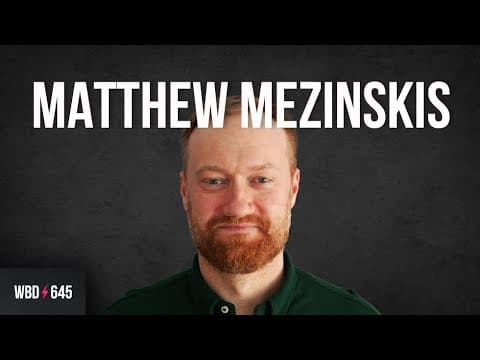
Matthew Mežinskis

Guest

Matthew Mežinskis

Creator of Porkopolis Economics · Host of Crypto Voices

Matthew Mežinskis is the creator of Porkopolis Economics and the Crypto Voices podcast. He researches the global monetary base and Bitcoin's adoption through long-run charts, including the power curve he has tracked since 2018. His twenty-four TFTC appearances since 2018 include a recurring quarterly review of central-bank money and Bitcoin.

Research
Porkopolis Economics
Podcast
Crypto Voices, created in 2017
Porkopolis
Created January 2023
Method
Global monetary-base comparisons
Known for
Bitcoin power-curve analysis since 2018
On TFTC
8 interviews · Mar 2023 – Jul 2026
Updated

Mežinskis works in corporate finance and brings a balance-sheet discipline to monetary arguments. Porkopolis separates money that settles a claim from the claim itself, then compares national currencies with gold and Bitcoin on that basis. He created Crypto Voices in January 2017 and Porkopolis Economics in January 2023. The method matters as much as the chart: comparing Bitcoin with bank deposits, currency in circulation or central-bank reserves answers different questions, even when all of them are called money.

The quarterly TFTC conversations began as a survey of monetary supply and increasingly became an examination of two different growth processes. He describes fiat finance as exponential and Bitcoin as a network growing along a power curve, with high but declining percentage growth. By July 2026 the conversation was also a defense of the model against criticism after a sharp drawdown. Eight interviews have written TFTC pages below; the feed records twenty-four distinct conversations, including the older monetary-base updates.


On TFTC · 8 interviews

Matthew Mežinskis and Marty Bent discussing Bitcoin power curve and global monetary base charts on the TFTC podcast

Latest

Bitcoin's Power Curve: Generational Bottom or Broken Model?

Matthew Mežinskis is back for the quarterly data walk. Bitcoin is sitting near the zeroth percentile of its power curve, the global monetary base is coiling after four years of tightening, and Powell left Warsh a lot of room to monetize. Plus the civilizational stakes: does Bitcoin pull TradFi onto

424: Q1 2023 Monetary Base Update with Matthew Mežinskis

424: Q1 2023 Monetary Base Update with Matthew Mežinskis

Matthew Mežinskis is back on the show to give us the latest update on where bitcoin stands in the pecking order of the global monetary base, how insane the financial system has become, and a distillation of full reserve banking.

What Matthew argues

Positions drawn from Matthew’s TFTC appearances, grouped by theme. Quotes are from TFTC’s own recordings and are dated.

Start with the money that settles the claim

His monetary-base work begins with a distinction that broad money totals can obscure. A bank balance is a claim on another balance sheet; base money is the settlement layer underneath it. He compares Bitcoin with that layer, alongside the historical roles of gold and silver. On TFTC in August 2023 he used the distinction to explain why the size of the central-bank monetary base is the relevant comparator for his charts, rather than treating every deposit as another unit of final money.

“So it's called outside money, so that's why Bitcoin is also outside money.”

“Gold and silver as well are analogous to this in history.”

A power curve grows differently from compound interest

Mežinskis argues that the shape of Bitcoin's growth has remained distinct from traditional financial assets. Exponential growth holds a percentage rate constant; a power curve scales with the age of the network, so the percentage growth rate declines as the network gets older. His claim is descriptive and testable against price history. It does not say Bitcoin doubles every fixed number of years forever, even when the current slope implies a rapid doubling time.

“We're probably increasing the rate of exponential growth. But Bitcoin is still following a power law.”

“Bitcoin is not growing like other stuff, it grows proportional to itself.”

The model is a statistical description of adoption

His strong claim is that network adoption explains most of Bitcoin's long-run price movement. He points to a high regression fit and the persistence of a similar curve when the calculation uses older data. In July 2026 he contrasted that with exponential and stock-to-flow projections that had moved far away from the observed price. The fit is evidence for his interpretation of the data; it cannot establish that future returns are guaranteed or that every short-term move has one cause.

“This is a 96% R². This is better than your stock-to-flow meme.”

“The power curve is consistently painting the same numbers, it means it's stable and it has the highest R-squared, which is about 96%.”

Cheap relative to a trend can still get cheaper

The July 2026 conversation came after Bitcoin had moved toward the bottom of his historical bands. He explained that those bands expand when a new extreme arrives, and that drawing a neat channel backward from today's data can conceal how uncertain the chart looked at the time. He considered the level attractive over a long horizon while expressly allowing another fall. That distinction is necessary to understand the optimistic language in the older episode titles.

“So I'm making no predictions of where we can be, but statistically, long-term, not financial advice, but statistically, we are in a very, very bullish phase of Bitcoin's growth relative to the power curve.”

“Could we go down and paint another low in this zeroth percentile, as I call it, which is really, it's 0.0001 percentile.”

The four-year cycle is a separate question

A long-run adoption curve does not settle whether the familiar halving cycle still controls market timing. In September 2025 Mežinskis attached a concrete year-end threshold to his willingness to keep the four-year framework. In December, after the selloff, his emphasis returned to where the price sat relative to the longer trend. Keeping those statements dated preserves the difference between an observation about adoption and a forecast about when a market cycle should accelerate.

“If we don’t get above 170K by year end, time to rethink the four-year cycle.”

“The price right now has only been this low 30% of the time.”

Fiat and Bitcoin cannot keep growing apart forever

The question he repeatedly puts to the audience is what happens when an exponentially expanding financial system holds an asset growing along a slower percentage path. His July 2025 discussion put a possible crossover with fiat base money in the 2040s. He treated the result as a tension between two systems, not a date for the overnight end of fiat. In his view, contracts and expectations around interest would have to change if Bitcoin became the measuring unit.

“What happens when the TradFi world starts to buy an asset that moves in power?”

“Compound interest is incompatible with power law growth. That will reshape contracts, debt, and finance.”

A monetary asset whose units cannot be printed

Mežinskis's interest in the curve sits alongside a more basic monetary argument. Bitcoin gives its holder a defined share of a supply that cannot be expanded to satisfy a bank or a government. That makes custody part of the analysis, not a detail to leave until after a price forecast. In the December 2024 and December 2025 conversations he returned to the difference between holding the asset and trusting an institution to provide it later.

“For the first time, we have an asset where you don’t need to trust the custodian.”

“You cannot print Satoshis like you can print dollars.”

The practical instruction is to stop trading the noise

The tone of the quarterly updates can be exuberant, but his closing advice has been unusually consistent. He wants listeners to understand the monetary trend well enough to stop treating each daily candle as a verdict on Bitcoin. Building a business and spending time with family are the activities he recommends in place of staring at a chart. His model supplies perspective for that choice, without promising a return in the next quarter.

“Twitter is not real life. Spend time with your family. Stack sats.”

“Spend time with your family. Don’t freak out over a $5,000 candle.”

Elsewhere

Notable appearances on other shows, newest first.

Common questions

Who is Matthew Mežinskis?
Matthew Mežinskis is a monetary researcher and corporate-finance professional who created Crypto Voices and Porkopolis Economics. He surveys the global monetary base and studies Bitcoin's adoption using long-run data. His work distinguishes final settlement money from bank claims and is known for its analysis of Bitcoin's power curve.
What is Porkopolis Economics?
It is the research project Mežinskis created in January 2023. It publishes charts of monetary supply and financial assets, with definitions and methodology explaining which forms of money can be compared. His Bitcoin power-curve work and quarterly monetary-base reviews are part of the same effort to put monetary claims against observable data.
What does he mean by the monetary base?
The settlement money beneath the commercial banking system, rather than the total of all bank deposits. His methodology compares national base-money systems with assets such as gold and Bitcoin. The distinction prevents a claim on money from being confused with the money used to settle that claim.
What is the Bitcoin power curve?
A statistical relationship between Bitcoin's age and its price that appears as a roughly straight line when both axes use logarithmic scales. Mežinskis interprets it as evidence of network adoption. It implies a declining percentage growth rate over time, unlike a constant-rate exponential projection. It remains a model of historical data, with uncertainty around future observations.
Does the power curve guarantee a Bitcoin price?
No. On TFTC in July 2026 Mežinskis said he was making no prediction about the immediate price and acknowledged that another low was possible. His percentile bands and trend values describe a range in the data. They do not make a short-term price target certain or remove the risk of a drawdown.
How many times has Matthew Mežinskis been on TFTC?
Twenty-four distinct interviews from December 2018 through July 2026 in the full TFTC feed. Eight have written episode pages listed here. The feed also contains other guests called Matthew, including Matthew Black, Matthew Pines, Matthew Lysiak, Matthew Lohmeier and Matthew Sigel; their episodes are excluded from his record.
Where can I follow his work?
His research and methodology are at porkopolis.io, Crypto Voices is his podcast, and he posts as @1basemoney on X. His name also appears without the diacritic as Matthew Mezinskis.

Matthew’s own work