OpenAI Locks 3.2 GW Under 25-Year Gas Contract in Georgia
OpenAI's Project Camellia, a $20B, 3.2-GW campus in Effingham County, Georgia, claims one-third of Georgia Power's PSC-approved capacity expansion under a 25-year contract powered primarily by new natural gas generation. Bitcoin miners now compete for dispatchable power against a company with $750B
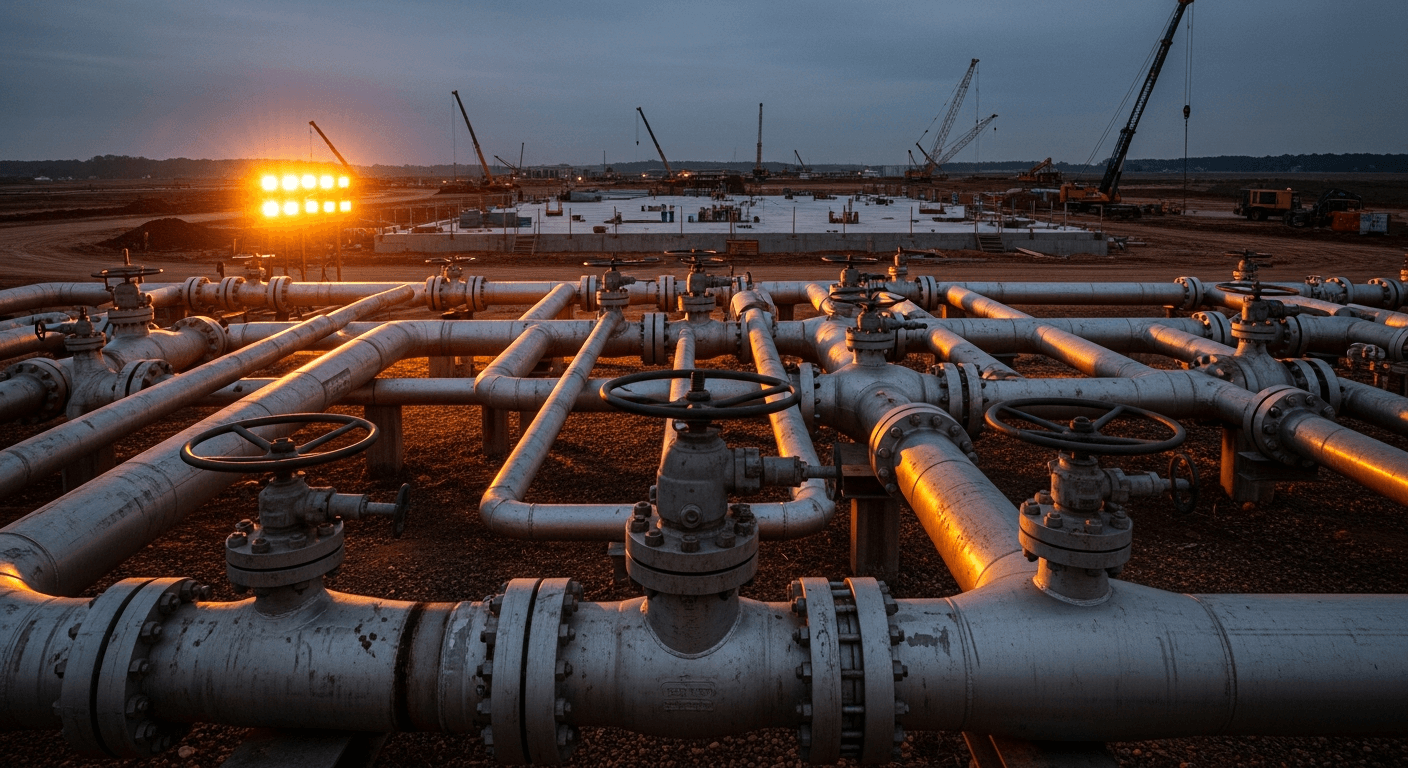
OpenAI just became the marginal buyer setting the price of dispatchable U.S. power, and it did it in a single announcement.
Key takeaways
- OpenAI announced Project Camellia on July 22, 2026: a $20B, 1,400-acre data center campus in Effingham County, Georgia, powered by a 25-year Georgia Power contract delivering up to 3.2 GW, predominantly from new natural gas generation.
- That single deal accounts for roughly one-third of the 9,885 MW Georgia Power received PSC approval to build in December 2025, making OpenAI the dominant marginal buyer of new dispatchable capacity in the state.
- Bitcoin miners who built their business model on cheap, stranded natural gas now face a competitor with $750 billion in committed infrastructure capex through 2030 and the political clout to run 25-year utility agreements through state regulators.
OpenAI announced Project Camellia on July 22, 2026: a campus spanning 1,400 acres in the Savannah Gateway Industrial Hub of Effingham County, Georgia, with four data center buildings totaling roughly 4.4 million square feet. It is the first data center OpenAI has designed and built itself, departing from its prior model of leasing capacity from Oracle, AWS, and others. The company committed a minimum of $20 billion to qualify for a local incentive package; OpenAI VP of Compute Strategy Sachin Katti told Bloomberg the full build-out will likely exceed $30 billion.
Power comes from Georgia Power, a Southern Company subsidiary, under a 25-year agreement. Delivery is phased: several hundred MW arrive in 2028, with the full 3.2 GW online by 2032. OpenAI also committed up to 1,000 MW of flexible demand response, meaning it will curtail usage during peak grid stress before residential customers are affected. Per OpenAI's own statement: "Georgia families will not subsidize this project. OpenAI will pay the full cost of the infrastructure and electric-service costs required to serve it." The campus is projected to employ 400 workers at its 2028 opening, growing to roughly 1,000 by 2032 in six-figure salary ranges. Effingham County approved a 50% property tax abatement for 15 years; OpenAI is still projected to become the county's largest taxpayer.
The Capacity Math That Matters
Georgia Power's fuel mix for this expansion is predominantly natural gas. The Georgia Public Service Commission approved 9,885 MW of new capacity in December 2025, with roughly 5.8 GW of that as new gas generation, which would more than double the utility's existing gas fleet. Approximately 25% of the new gas capacity consists of simple-cycle turbines, the dirtier, peaker-grade units.
OpenAI's 3.2 GW contract claims roughly one-third of that entire approved expansion. One company. One announcement. One-third of the state's grid buildout spoken for.
That number is what separates Project Camellia from ordinary data center deals. Project Camellia is part of OpenAI's broader Stargate infrastructure program, which has been repricing power beneath Bitcoin miners for months. Project Camellia is Stargate logic applied at utility scale, with a 25-year lock attached. AI labs contracting multi-gigawatt utility deals earlier this year showed the same dynamic. Now OpenAI has raised the stakes again.
OpenAI's total infrastructure capex commitment now sits at $750 billion through 2030, up from roughly $600 billion earlier this year, per reporting from TechCrunch. A company deploying capital at that rate does not lose utility contract negotiations.
What This Means for Bitcoin Miners
The thesis Bitcoin miners have operated on for a decade: find stranded, flared, or curtailed natural gas that is uneconomic to pipe to market, put a data center on top of it, monetize molecules that would otherwise go to waste. The miner who built behind-the-meter on cheap Appalachian gas was capturing value the grid couldn't reach.
That moat is compressing. Not because regulators killed it. Because the demand side just got a new buyer with a balance sheet that dwarfs the entire mining sector. When AI labs are contracting utilities to build 5.8 GW of new gas generation under 25-year agreements, the marginal cost of dispatchable power infrastructure moves up, not down. The grid is being repriced in real time, from state utility commissions approving new gas generation to growing opposition to data center buildout in communities across the country.
Miners retain one structural advantage AI data centers do not: location agnosticism. A mining operation can pick up and move to the next stranded-gas field. A 4.4-million-square-foot campus in Effingham County cannot. That flexibility becomes more valuable as the most accessible dispatchable capacity gets locked into long-term contracts by labs that can afford to hold the paper.
The falsifiable thesis: AI labs and Bitcoin miners occupy different parts of the power stack, and competition stays manageable as long as Appalachian and Gulf Coast gas production continues to outpace demand. That thesis breaks if AI capex causes utilities to build out generation fast enough to tighten the market for stranded molecules, or if labs move toward owning generation directly rather than contracting through utilities, pulling the same supply miners target. Watch how many more utility-scale, multi-decade contracts get announced before year-end.
What Comes Next
OpenAI policy chief Chris Lehane has been explicit that community buy-in is the price of admission: "At the end of the day, you're only going to get approvals to be able to build these projects if you're actually doing right by these communities." That framing, $80 million in community benefits, $71 million in Codex AI credits for Georgia college students, a rate-ring-fence for existing customers, is a template other labs will copy to move projects through state regulators. New York Governor Kathy Hochul signed an executive order imposing a one-year moratorium on large tech data centers the week before the Project Camellia announcement; Georgia went the opposite direction. That divergence will shape where the next 3.2 GW announcement lands.
Update, August 12, 2026
Riot Platforms just handed the clearest data point yet on what happens when AI capex meets Bitcoin mining infrastructure. Riot disclosed Monday that it signed a 20-year agreement to supply 191 MW of capacity from its Rockdale, Texas campus to what it called a "leading frontier AI lab," with Bloomberg reporting the customer is Anthropic. The base-term contract value is $9.1 billion, running through June 2048, with two five-year extension options that could push the total to $16.1 billion.
Riot built Rockdale to mine Bitcoin. It is now a landlord collecting long-duration AI rent. Riot mined 1,587 Bitcoin in Q2 2026 alone, but the company is actively repositioning itself as a real estate operator for computing systems.
CEO Jason Les noted that over the past six months, Riot signed lease agreements totaling 241 MW of capacity, generating approximately $9.8 billion in long-term contracted revenue from leading AI players.
This is the flywheel the base article described playing out in real time. Miners spent years accumulating sites with heavy-draw grid agreements to run mining rigs; now that AI compute pays more per megawatt than mining does, those same interconnection positions are worth leasing to Anthropic, Microsoft, or Google instead. The miner moat did not disappear -- it got repriced and sold to the highest bidder, which right now is a frontier AI lab with a multi-decade appetite for locked-in power.
Update, August 30, 2026
The Georgia Public Service Commission staff formally approved the Georgia Power-OpenAI contract on August 27, closing a review process that nearly derailed the deal entirely. The approval came after what observers called a tumultuous and secretive process, and notably passed without a direct vote from the commission itself.
Under a rule the PSC passed in April 2025, Georgia Power must submit all new data center contracts over 100 MW at least 30 days before execution, and as the August 14 deadline approached, PSC staff had objections. Georgia Power bought additional time to address them, and the final joint statement was filed just before a hard deadline on August 27.
PSC Chairman Jason Shaw said in a statement that staff "ensured this contract has some of the strongest residential ratepayer protections in the nation."
The contract includes new protections for residential and business ratepayers, according to a letter filed with the PSC and signed by its staff and Georgia Power attorneys. On the economics, Georgia Power customers are expected to see savings of at least $15 per month beginning in 2029, up from a prior commitment of $102 per year, driven by approximately $950 million in annual incremental revenue from new large-load customers.
Environmental and consumer groups are not satisfied. Critics noted the approval letter "is full of 'ifs' that leave open the possibility that incremental costs could be shifted to other ratepayers in future proceedings."
Commissioner Peter Hubbard put the stakes plainly: "The magnitude of this contract, the single contract, it is far larger than what we typically approve in the commission under integrated resource plans when we're planning out 20 years into the future for load growth."
The full terms of the contract are considered trade secrets; the copy released to the public was fully redacted and will remain secret even after the contract is executed. A 3.2 GW commitment running 25 years, insulated from public scrutiny, approved by staff rather than elected commissioners, is the template regulators just rubber-stamped for every AI lab that comes next.
Sources
Frequently Asked Questions
What is Project Camellia and where is it located?
Project Camellia is OpenAI's first self-designed and self-built data center campus, announced July 22, 2026. It is located in the Savannah Gateway Industrial Hub in Effingham County, Georgia. The campus covers 1,400 acres with approximately 4.4 million square feet of built space across four data center buildings.
Will OpenAI's Georgia data center raise electricity bills for local residents?
No, per OpenAI's own commitment. The company states it will pay the full cost of electrical infrastructure and service required for the project. Georgia Power confirmed no rate increase for existing customers is associated with the deal. OpenAI also committed up to 1,000 MW of demand response, meaning it will curtail usage before residential customers face supply constraints during peak grid events.
How does OpenAI's Project Camellia affect Bitcoin miners?
The deal puts roughly one-third of Georgia Power's entire PSC-approved capacity expansion under a single 25-year contract. Miners competing for natural gas power infrastructure in the Southeast now face a counterparty with $750 billion in committed capex through 2030. The miner's structural edge remains location flexibility: mining operations can relocate to stranded-gas sources that large, fixed data centers cannot reach. Whether that edge holds depends on how fast AI capex tightens the market for dispatchable gas generation broadly.