PwC Projects $31.6 Trillion in AI Data Center Capex Through 2050
PwC's Global Data Centre Outlook, modeled by Oxford Economics across 46 countries, projects $31.6 trillion in cumulative global data center capex through 2050. Power availability is the single most decisive constraint, which puts Bitcoin miners at the center of the AI buildout, not at its margins.
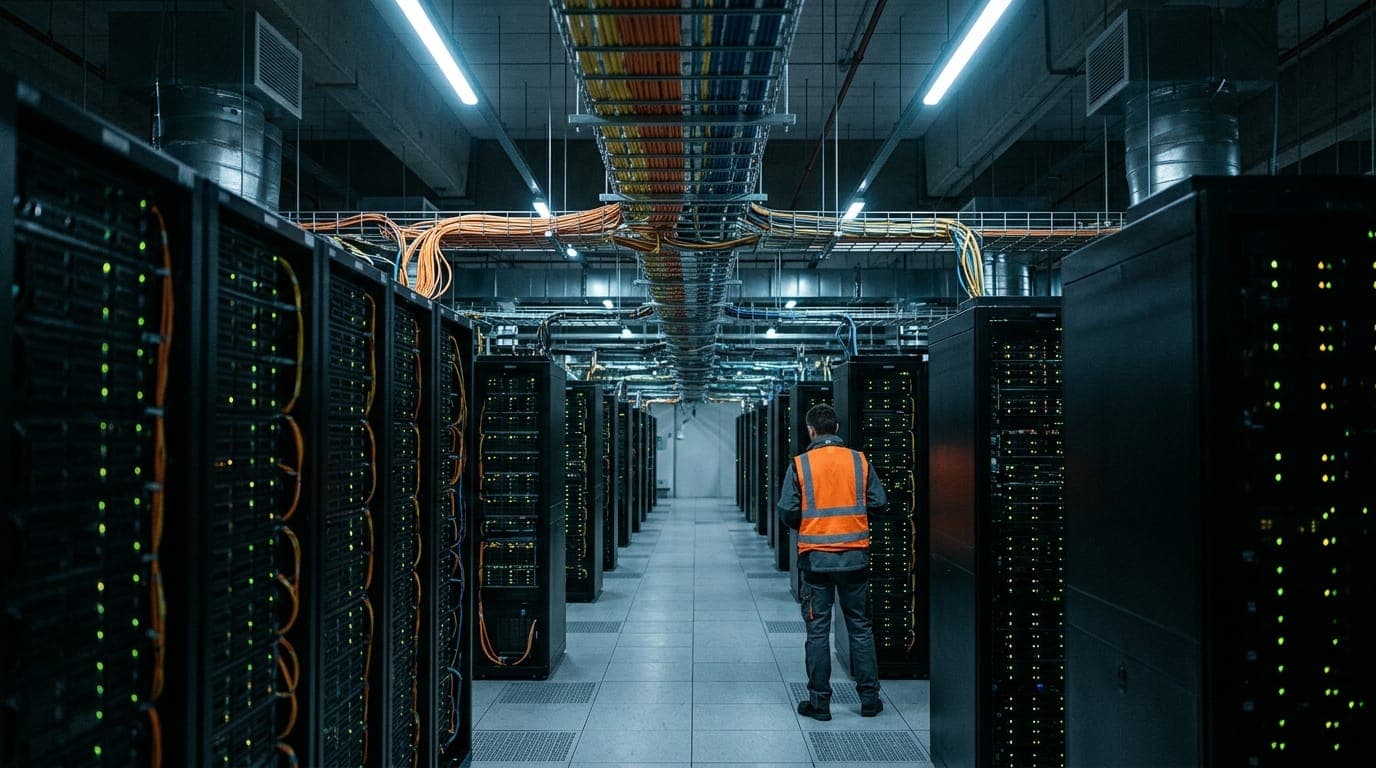
Power availability, not capital, not chips, is what decides where the AI buildout lands.
Key takeaways
- PwC's Global Data Centre Outlook, modeled by Oxford Economics across 46 countries, projects $31.6 trillion in cumulative global data center capex through 2050, with a plausible upside of nearly $50 trillion if AI adoption accelerates beyond the central forecast.
- PwC identifies power availability as the single most decisive factor shaping where AI investment lands, a finding that puts grid-embedded, flexible-load operators, Bitcoin miners among them, at the center of the infrastructure story, not its margins.
- Unlike railways or fiber, AI infrastructure requires GPU and server refreshes every 4 to 6 years, making this a perpetual capex supercycle rather than a one-time build, with annual spend rising from roughly $800 billion in 2026 to $1.8 trillion by 2050.
PwC released its Global Data Centre Outlook on September 2, 2026, projecting $31.6 trillion in cumulative global data center capital expenditure through 2050. The number is on par with current U.S. annual GDP and dwarfs every prior infrastructure buildout in recorded history.
The report models three scenarios. The central case lands at $31.6 trillion. An accelerated-AI-adoption upside reaches approximately $50 trillion. A downside constrained by chip export controls compresses to roughly $25.5 trillion, about 20 percent below the central forecast. Annual capex runs from approximately $800 billion today to $1.1 trillion by 2030 and $1.8 trillion by 2050, per the PwC data page.
Where the $31.6 Trillion Lands
The U.S. captures $15.1 trillion, close to half the global total. Asia-Pacific follows at $8.2 trillion, Europe at $5.6 trillion, the Middle East at $1.1 trillion, and Africa at $255 billion.
The geographic split is not arbitrary. PwC's modeling, commissioned from Oxford Economics and covering 46 countries and territories, ties investment concentration directly to one variable above all others: power availability. Markets with reliable, scalable electricity supply attract the capital. Markets without it do not.
Gartner's separate June 2026 research puts numbers on the power demand side: global data center power demand sits at 132 GW in 2026 and rises to 290 GW by 2030. That is more than a doubling in four years, onto a grid that is already strained in the corridors where AI investment is concentrating. Texas has already seen the pressure. The ERCOT grid audit that halted 1,800 AI data center projects is the early-stage version of what PwC is describing at a $31.6 trillion scale.
PwC's own language on the distribution of investment: "The AI buildout is not a rising tide that will naturally lift all boats."
The Grid Math Bitcoin Miners Already Know
AI capex goes from $800 billion annually today to $1.8 trillion by 2050. Bitcoin mining runs at a small fraction of that. The ratio is not close, and it grows wider every year. In constrained power markets, AI will outbid most competitors for grid capacity.
Bitcoin miners are either positioned as the counterparty AI needs or as the load class that gets pushed to stranded-power margins.
The structural case for miners as partners is real. A grid absorbing 290 GW of new AI load by 2030 while managing intermittent renewables needs a large, interruptible, dispatchable buyer to balance it. That is Bitcoin mining's core operational profile. PwC's own finding, that power availability is the decisive constraint, validates the grid-balancing role without naming it.
The PJM curtailment rule that would cut AI data centers first during shortages, and Nvidia's investment in Texas power infrastructure alongside existing Bitcoin miners, are early signals of how that dynamic plays out in practice.
The miners who hold long-term contracted or owned generation are sitting on assets AI hyperscalers need. TeraWulf and Cipher are already converting and co-locating with AI compute, per Data Center Dynamics reporting from July 2026. That M&A and partnership wave is going to accelerate as the $31.6 trillion forecast compresses into real site acquisition decisions.
The falsifiable thesis: the miner-as-grid-anchor argument holds as long as hyperscalers keep partnering with and acquiring Bitcoin mining infrastructure rather than building greenfield past it. It breaks if state-level or FERC-level regulatory decisions begin curtailing Bitcoin mining loads specifically to free capacity for AI, without market-rate buyout or load-flexibility compensation. The SoftBank debt-on-debt capex machine and the OpenAI power-trading hire both signal that hyperscalers are building in-house energy expertise fast. Whether they build around miners or over them is the variable to watch.
One more thing worth naming: $31.6 trillion in capex over 24 years, the vast majority of it dollar-denominated and debt-financed, in a fiscal environment already running $2 trillion-plus annual deficits. This supercycle does not get funded without significant monetary expansion. Every dollar printed to underwrite hyperscaler build-outs is a dollar that makes fixed-supply Bitcoin harder money by comparison.
What to Watch
PwC's downside scenario, $25.5 trillion under chip export control pressure, is the only pathway that materially slows power demand growth. Absent that, the $800 billion in annual capex already flowing in 2026 makes the grid pressure documented in Texas and PJM the norm, not the exception. Watch whether FERC formalizes load-priority rules that treat Bitcoin mining as inferior to AI data centers. That regulatory call, more than any market dynamic, is the trigger that determines whether miners are grid partners or grid casualties in the AI era.
Sources
Frequently Asked Questions
How does the PwC $31.6 trillion AI data center forecast affect Bitcoin mining operations?
The forecast intensifies competition for grid capacity in power-rich corridors, particularly the U.S. (projected at $15.1 trillion of the global total). Miners with long-term contracted or owned generation are insulated. Those on spot-market power in constrained grids face real pressure as AI data centers arrive with substantially more capital. The operational profile of Bitcoin mining (interruptible, dispatchable, large-scale) also makes miners the most natural flexible-load counterparty for grids absorbing fast-growing AI demand.
What happens to Bitcoin miners if AI data centers outbid them for grid power?
In specific constrained markets, some miners will get priced out of premium locations. The broader outcome depends on regulatory posture: if grid operators and FERC treat Bitcoin mining as a dispatchable load partner (a balancing resource), miners benefit from the AI buildout. If regulators explicitly deprioritize mining loads to clear capacity for AI without compensation, the "grid partner" thesis breaks and miners get pushed toward stranded or marginal power indefinitely.
Why does PwC identify power availability, not capital, as the key constraint on AI data center growth?
Capital is abundant. The SoftBank debt gap and hyperscaler balance sheets show that financing exists for the buildout.
What financing cannot create is permitted, connected, reliable electricity supply on the timelines AI deployment requires. Interconnection queues run years long in most major markets. That physical bottleneck, not access to capital, is what determines where the $31.6 trillion actually lands.