Hyperscale Data Kills Bitcoin Mining at Dowagiac, Converts 617K-Sq-Ft Site to AI
Hyperscale Data (NYSE: GPUS) shut off every Bitcoin miner at its Dowagiac, Michigan campus on September 1, 2026, pivoting the 617,000 sq ft site to a $1.2 billion AI colocation agreement. The move reveals which miners AI capex displaces first.
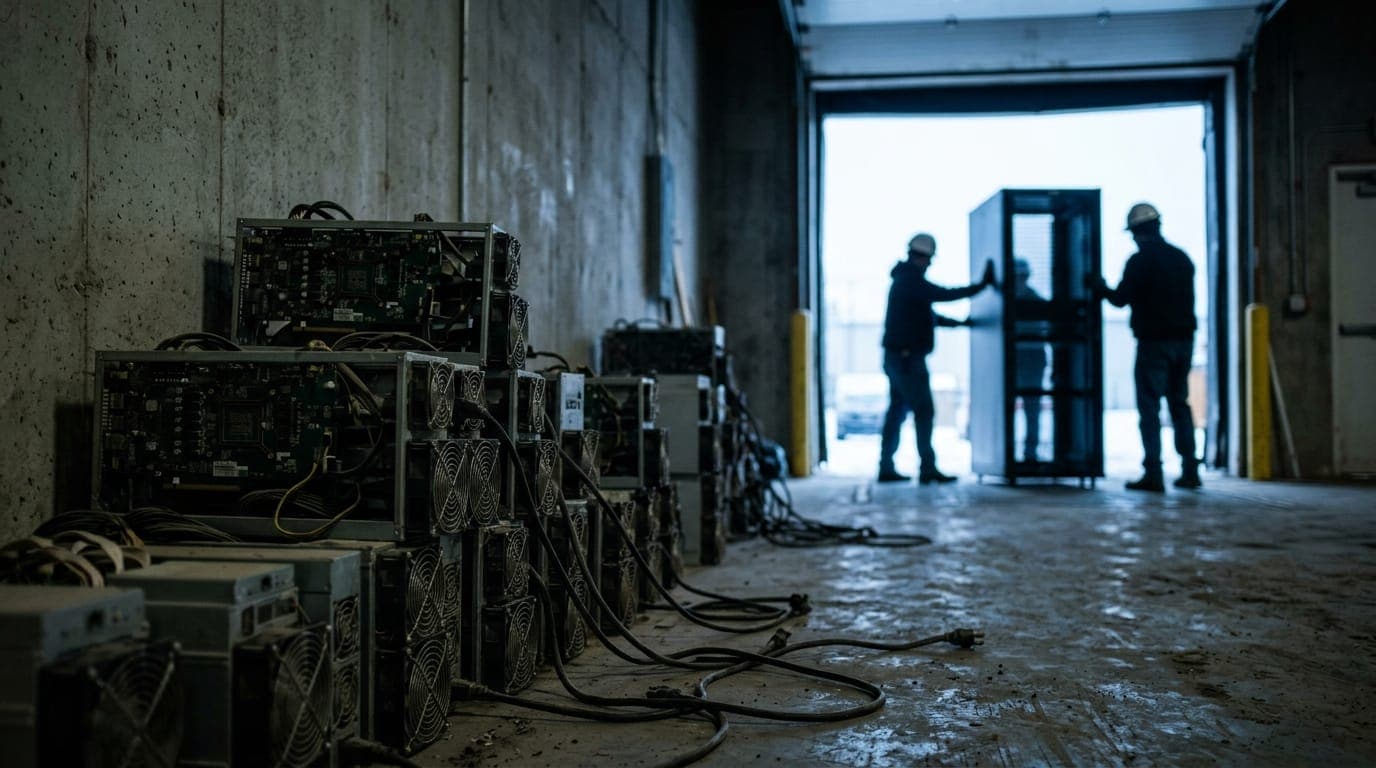
AI colocation rates have crossed the threshold where grid-connected miners can't compete for their own power.
Key takeaways
- Hyperscale Data (NYSE: GPUS) shut down all Bitcoin mining at its 617,000 sq ft Dowagiac, Michigan facility on September 1, 2026, redirecting site power to a $1.2 billion Master Services Agreement with an unnamed California-based neocloud provider.
- The company liquidated the large majority of its Bitcoin treasury, falling from approximately 1,106 BTC in late July to approximately 215 BTC by August 30, to fund the AI buildout, converting mined bitcoin into AI infrastructure. (PR Newswire, Sept. 1, 2026)
- The pivot is a facility-level proof that grid-connected, high-visibility mining operations are the first casualties when AI capex competes for the same power, while energy-sovereign and stranded-gas miners face far less displacement pressure.
Hyperscale Data, Inc. (NYSE: GPUS) confirmed September 2 that its subsidiary Alliance Cloud Services, LLC ceased all Bitcoin mining operations at 415 East Prairie Ronde Street in Dowagiac, Michigan on September 1, 2026. Every ASIC at the site went offline to make room for an AI colocation customer whose contract is worth approximately $1.2 billion over ten years.
The Deal Behind the Shutdown
The MSA was signed June 23, 2026, and disclosed in an SEC Form 8-K the following day. The contract covers an initial 20 MW of AI compute capacity targeted for operational status in Q4 2026, to be delivered in two phases: Phase 1 targeting 10 MW within 90 days of signing, and Phase 2 targeting an additional 10 MW within 180 days of signing. The term runs 10 years with two 5-year extension options, carrying a potential value of up to approximately $3 billion if a 32 MW option is exercised across those extensions.
The customer is a California-based neocloud provider. Hyperscale has not disclosed the name in any SEC filing or press release.
The Dowagiac campus spans 617,000 sq ft across 34.5 acres, with total potential power capacity described in SEC filings as up to approximately 300 MW. The initial contracted 20 MW represents a small fraction of that capacity, leaving significant room for the customer to scale under the existing agreement. Hyperscale's H1 2026 revenue came in at approximately $80 million, up 57% year-over-year, with full-year guidance of $180 to $200 million, per a July 29 8-K.
CEO William Horne was direct about the operational logic: "The immediate shutdown of the Bitcoin mining operations allows our team to focus the Facility's power, infrastructure and resources in preparing the Facility for its usage by our Customer."
What This Signals for the Mining Industry
Hyperscale didn't just flip a switch. The company drew down its Bitcoin treasury from approximately 1,106 BTC in late July to approximately 215 BTC by August 30, liquidating the large majority of its holdings to fund the AI buildout. (PR Newswire, Sept. 1, 2026) That is capital allocated by a mining company away from bitcoin accumulation and toward GPU infrastructure.
The market has not rewarded the bet yet. GPUS shares trade at well under a dollar, a steep discount to pure-play data center comparables, which is either a signal that the market is skeptical the unnamed neocloud customer deploys on schedule, or that Hyperscale's execution risk is being priced heavily.
The more important dynamic sits underneath the corporate finance. The facility in Dowagiac had been the subject of a pending class-action suit over noise complaints from local residents, with a public meeting held July 13, 2026. (WWMT, July 14, 2026) The operation was visible, audible, regulated, and politically exposed. That profile, grid-connected, community-adjacent, dependent on permitted power access, is exactly the profile that AI capex can outbid.
A 10-year, $1.2 billion contract from a well-capitalized neocloud customer simply beats ASIC margin at current economics.
This is not an isolated corporate story. The AI data center capex cycle is structurally repricing power for anyone competing for it on the open grid. Grid-connected miners who need permitted interconnection, who generate community friction, and who operate at the margin of profitability are the first to get displaced. The operations that survive this pressure are the ones AI can't reach: stranded-gas sites, flare-capture operations, behind-the-meter deployments where the power has no alternative buyer.
There is a second-order effect on grid dynamics worth noting. Bitcoin miners have historically served as flexible demand-response resources. ASICs curtail cleanly during grid stress events. GPU inference clusters running latency-sensitive AI workloads do not curtail the same way.
As sites convert from ASIC to GPU, that grid-curtailment flexibility disappears, and the mining industry's longstanding argument about being a grid-friendly load becomes harder to make for the broader data center sector.
What to Watch
The falsifiable test here is straightforward. If Bitcoin's price rises enough to push mining revenue per MW above what AI colocation rates pay for comparable power, the economic incentive to exit mining weakens and conversions slow. Alternatively, if the unnamed neocloud customer fails to deploy in Q4 2026 and Hyperscale's share price deteriorates further, it would signal these AI colocation deals are more speculative than durable. The Q4 2026 operational deadline for the first 20 MW is the near-term trigger to watch.
Sources
- Hyperscale Data mining cessation press release, Sept. 2, 2026
- SEC Form 8-K, June 24, 2026, MSA disclosure
- Hyperscale Data MSA press release, June 24, 2026
- SEC Form 8-K, July 29, 2026, H1 2026 revenue and guidance
- Hyperscale Data Bitcoin treasury update, Sept. 1, 2026 (PR Newswire)
- WWMT, Hyperscale CEO addresses Dowagiac residents at public meeting, July 14, 2026
Frequently Asked Questions
Why is converting a Bitcoin mine to an AI data center so expensive?
The infrastructure gap between ASIC mining and GPU inference is substantial. ASIC miners run at relatively low rack power densities. GPU clusters for AI inference require 10 to 40 times that density, along with high-speed networking (InfiniBand), precision cooling, and power delivery infrastructure rebuilt from the ground up. Even a facility with existing grid power and physical footprint requires significant capital before a single GPU goes online.
Who is the unnamed neocloud customer at the Dowagiac facility?
Hyperscale Data has not disclosed the customer's identity in any SEC filing or press release. The 8-K and the company's public announcements describe the counterparty only as a California-based neocloud provider. That information remains undisclosed as of the time of publication.
Does this hurt Bitcoin's hashrate or network security?
Not materially in isolation. Bitcoin's hashrate has absorbed far larger shocks than one facility going offline. The structural point is directional: if AI capex continues displacing grid-connected mining operations, the composition of hashrate shifts toward energy-sovereign miners operating on stranded or associated gas, behind-the-meter power, or other sources that AI colocation cannot outbid. That shift changes who mines bitcoin, not whether bitcoin gets mined.