RBA Hikes Into Collapse: Australian Housing Falls 8.1% at 40-Year Record Pace
Australian national dwelling values fell 1.2% in October, the seventh consecutive monthly decline, with capital cities now 8.1% below their March 2026 peak, the fastest pace of decline in 40 years. The RBA is expected to hike anyway.
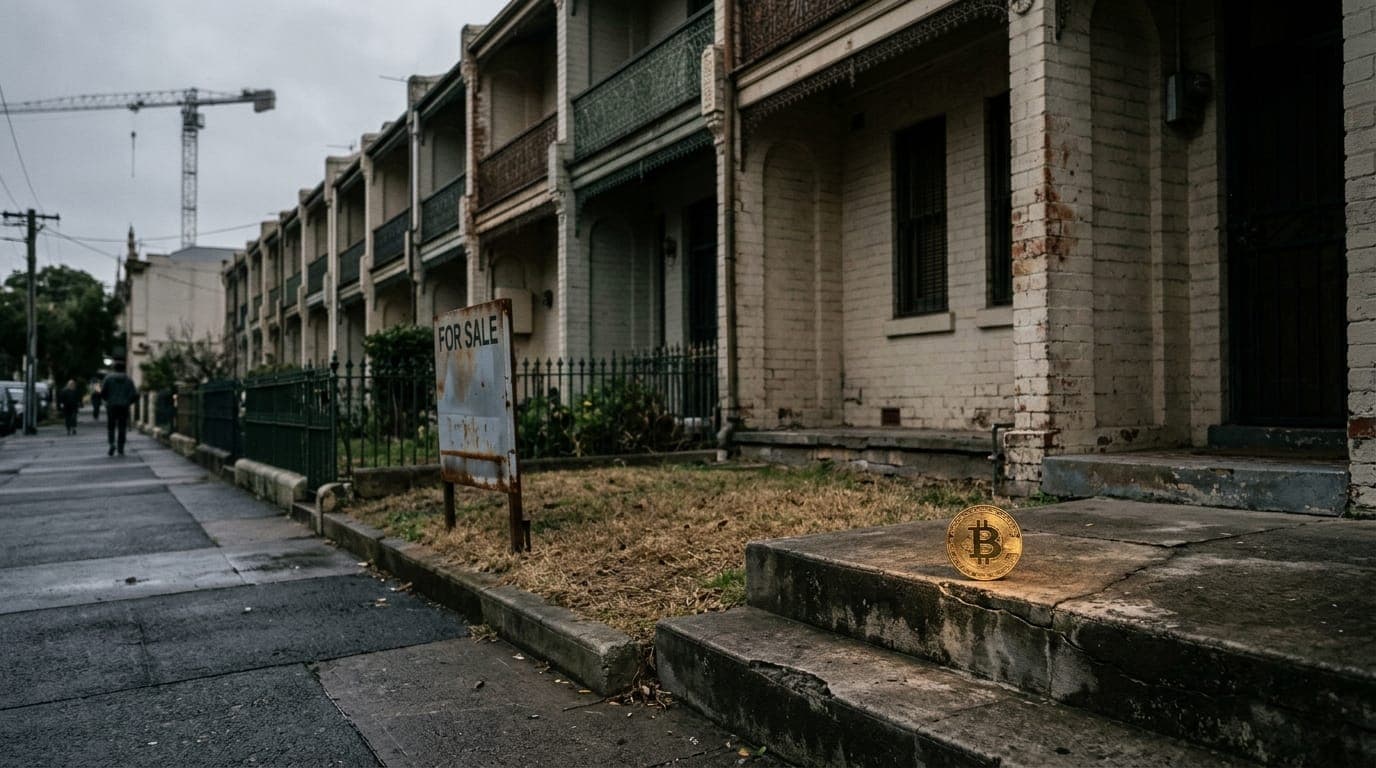
Australia's housing market is unwinding at the fastest pace in four decades, and the central bank is about to pull the trigger again.
Key takeaways
- Australian national dwelling values fell 1.2% in October, the seventh consecutive monthly decline, with the national median now sitting at approximately A$884,855, down 6.7% from the March 2026 peak.
- Capital-city values have dropped 8.1% in seven months, the sharpest pace of decline in 40 years; the RBA is widely expected to hike its cash rate to 4.85% on 3 November, the highest level since 2008.
- Goldman Sachs has downgraded its peak-to-trough forecast twice in two months, now projecting -12%; Morgan Stanley calls for -10% to -15%, which would make this Australia's largest nominal housing downturn in over 40 years.
Cotality's November 2026 Home Value Index shows national dwelling values fell 1.2% in October, the seventh straight monthly decline, knocking approximately A$63,400 off the median dwelling value since March. Capital cities led the drop at -1.4% for the month, accelerating from a downwardly revised -1.3% in September.
The Reserve Bank of Australia meets Tuesday at 2:30pm AEDT. All four major Australian banks, CBA, ANZ, NAB, and Westpac, unanimously forecast a 25 basis-point hike to 4.85%, the highest cash rate since the global financial crisis. Market futures price roughly 79-82% probability of the move.
The Anatomy of a 40-Year Record
The scale of the unwind is not subtle. Capital-city values are down 8.1% from their March 2026 peak, surpassing the prior worst pace of monthly decline of -7.0% recorded in the 2022-23 cycle. That 8.1% cumulative peak-to-trough drop is also closing in on the 8.6% peak-to-trough total that stood as Cotality's worst previously recorded decline (November 2017 to May 2019), with the current downturn on pace to break that record by late November. Brisbane posted the steepest single-month fall in October, down 2.0%, overtaking Sydney; Perth fell 1.7%.
Cotality Research Director Tim Lawless put it plainly: "The mid-sized capitals, where home values recorded extreme growth conditions over the past six years, are now well and truly in a correction. Virtually every suburb across Brisbane, Perth and Adelaide has recorded a drop in values over the past three months."
Capital-city inventory is 23.1% higher than a year ago (Cotality October HVI, data to 30 September). The median vendor discount to list price is 4.4%, the widest in Cotality's five-year data series.
Three policy shocks converged to produce this. The RBA began hiking in February 2026, now four consecutive increases. The Hormuz energy shock pushed Australian fuel prices to records, keeping inflation elevated and the RBA's hand forced. Then Treasurer Jim Chalmers' 12 May budget restricted negative gearing for established residential properties purchased after budget night, with new builds remaining exempt, removing the tax subsidy that had long underpinned the investor bid for existing dwellings. The combination drained demand from multiple directions at once.
Collateral-Base Implosion, Not a Clean Correction
Goldman Sachs has revised its peak-to-trough forecast downward twice in roughly two months: first from -5% to -9%, then again to -12%, while simultaneously cutting its 2027 GDP growth forecast to 1.6% and raising its unemployment peak estimate to 4.9% by end-2027. Morgan Stanley is calling -10% to -15%, describing it as "Australia's largest nominal housing downturn in over 40 years."
No RBA cut is expected until late 2027.
This is not a normal property correction, and the exposure is not confined to homeowners. Australian households hold an enormous share of their wealth in residential property. When that collateral base deflates at this speed, bank balance sheets reprice. Australia's major banks are heavily concentrated in residential mortgage lending. The private credit funds that stepped in to finance overlevered developers, where marks are rarely updated in real time, represent an additional layer of opacity. When those marks move, the pain transmits nonlinearly.
The RBA's dilemma is not uniquely Australian. Inflation from the Hormuz energy shock forces continued tightening even as the demand-side is already collapsing. Cutting to arrest the housing decline risks re-igniting inflation. Hiking accelerates the collateral unwind. There is no clean exit. The same structural trap faces every central bank that printed aggressively through 2020-21 and now sits with a bloated collateral base repricing against higher rates.
Asset-price deflation precedes fiat crises, not the other way around. Collateral-base erosion forces central banks toward the eventual backstop: monetization. The sequence is playing out in real time.
The falsifiable version of that thesis: if the RBA pauses or cuts at the November or December meeting, inflation falls below 3% by Q1 2027, and dwelling values stabilize within 3% of current levels without a material rise in mortgage defaults or unemployment beyond 4.5%, this is a managed correction and the debt-deflation loop does not close.
What to Watch Tuesday and Beyond
The RBA decision at 2:30pm AEDT Tuesday is the immediate catalyst. A hike to 4.85% is nearly fully priced. The statement language matters more than the move itself: any acknowledgment of financial stability risk or housing drag would mark a significant shift from the Board's stated position that it "would do what is necessary, including increasing the cash rate target further if needed" (RBA September 2026 Board minutes). Goldman's revised forecasts suggest the Bank's own models are already behind the curve. Monthly Cotality data will be the scoreboard through the end of the year.
Sources
- Cotality Home Value Index, insights hub
- RBA monetary policy, official cash rate and board decisions
- RBA Board Minutes, September 2026
- Australian Federal Budget 2026, budget.gov.au
- Tim Lawless quote, InDaily, 2 November 2026
- Goldman Sachs research note, Andrew Boak team, paywalled; attributed as Goldman Sachs research
- Morgan Stanley peak-to-trough forecast, paywalled; secondary coverage via The Courier
Frequently Asked Questions
Is this Australia's worst housing downturn on record?
It is on pace to be. Cotality's worst previously recorded peak-to-trough decline was 8.6% (November 2017 to May 2019). Capital-city values are already down 8.1% in seven months, and Goldman's base case of -12% peak-to-trough would break every record in Cotality's 40-year dataset by a wide margin.
Will the RBA cut rates to stop the housing crash?
No, not soon. Inflation pressure from the Hormuz energy shock keeps the RBA's hand forced. The consensus across major bank forecasts is that cuts will not arrive until late 2027. The RBA's own guidance through the September minutes showed no deviation toward financial-stability concerns, despite the pace of the decline.
What does this mean for Australian banks?
Australia's major banks are heavily concentrated in residential mortgage lending. A 10-12% peak-to-trough decline compresses the collateral cushion on millions of mortgages. Private credit funds that financed developers during the boom do not mark positions to market daily; when those marks finally move, credit contraction follows. That is the transmission mechanism from a housing correction to a broader economic drag that the rate forecasts alone do not capture.