Iran Bans Sinokor Fleet From Hormuz, Threatening 37% of Gulf Crude
Iran's Persian Gulf Strait Authority issued its first-ever fleet-wide ban on a single shipowner, targeting South Korea's Sinokor effective November 1. Sinokor alone moved roughly 37% of Persian Gulf crude in September and more than 50% of VLCC traffic in early October.
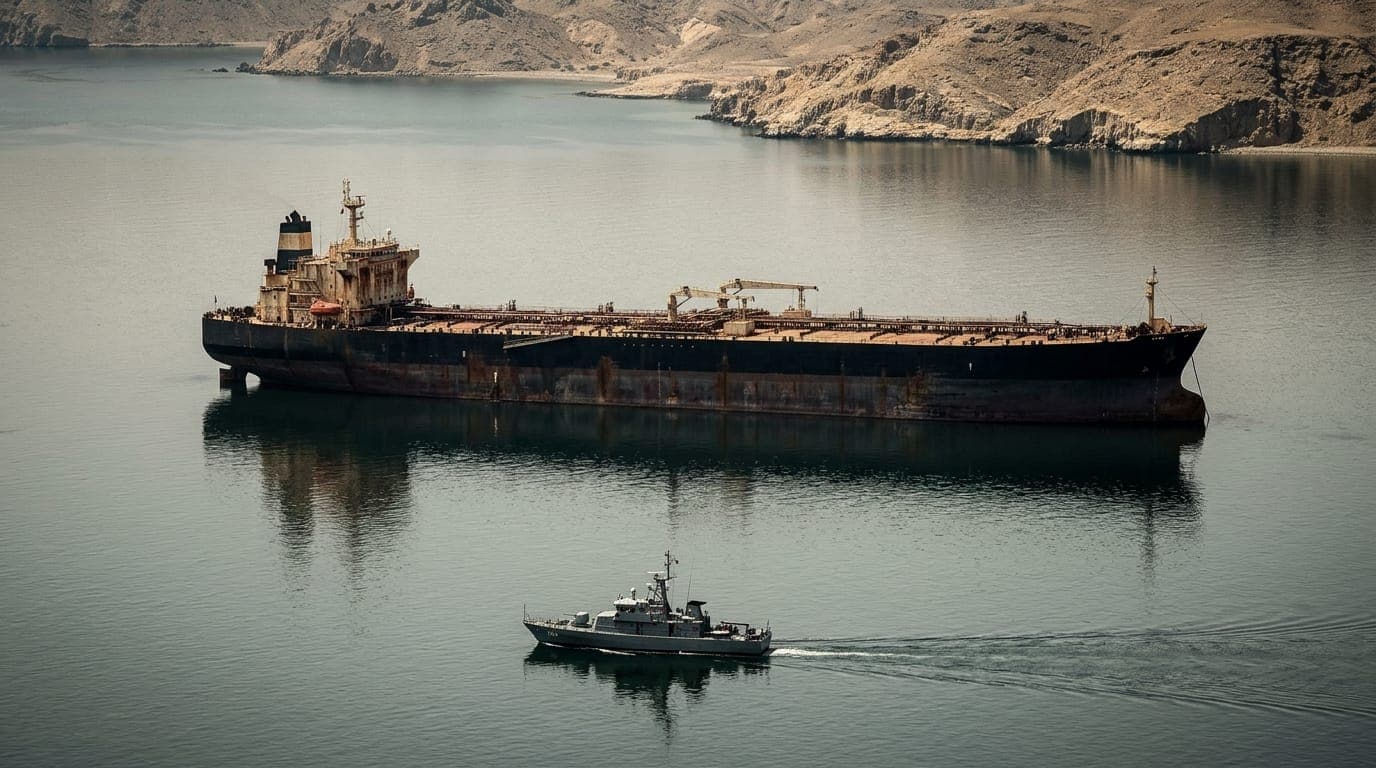
Iran's first fleet-wide shipping ban puts the world's dominant VLCC operator in the crosshairs, and war-risk insurance tells you exactly what the market thinks happens next.
Key takeaways
- Iran's Persian Gulf Strait Authority announced on October 27, 2026, that all Sinokor vessels face "legal action" effective November 1, the first time PGSA has blacklisted an entire shipowner's fleet rather than individual vessels.
- Sinokor moved roughly 37% of Persian Gulf crude by volume in September 2026 and more than 50% of VLCC transits in the first ten days of October, per Lloyd's List Intelligence data, carrying more crude than the next three major operators combined.
- War-risk insurance for a Hormuz transit has gone from roughly $250,000 pre-war to $6 million to $10 million per voyage on a $100 million tanker, a cost that flows straight through the supply chain to every consumer downstream.
Iran's Persian Gulf Strait Authority issued a blanket warning on October 27, 2026, threatening "legal action" against every vessel in Sinokor Shipping Company's fleet starting November 1, according to PGSA's official statement relayed by Mehr News Agency and Tasnim News Agency. This is the first time the authority, established in May 2026, has targeted an entire shipowner rather than naming individual hulls.
The PGSA's statement was direct:
"The vessels belonging to Sinokor Shipping Company have committed the highest number of crossing violations over the past 3 months, and so far, appropriate enforcement actions have been taken against at least 7 of them."
It followed with a warning to the entire industry:
"All cargo owners, stakeholders, and insurance service providers are hereby warned that as of November 1, legal action will be taken against all vessels of this company."
Bloomberg first reported the warning on October 27, 2026.
Sinokor Is the Market.
The scale of what is being threatened cannot be overstated. According to Lloyd's List Intelligence analysis published October 21, Sinokor accounted for roughly 37% of crude oil volume transiting Hormuz in September 2026 (approximately 105.6 million barrels out of 286.3 million total) and 47% of VLCC transits that month. In the first ten days of October, that VLCC share climbed above 50%. Sinokor carried more crude than Bahri, KOTC, and ADNOC combined.
The company acquired 72 to 73 VLCCs in 2026 for approximately $5.854 billion, per Veson Nautical data cited by Seatrade Maritime. Clarksons figures put Sinokor's owned VLCC fleet at 93 vessels as of August 2026.
There is no substitute fleet waiting to absorb that capacity overnight. If Iran moves from warning to enforcement, the market is losing the dominant operator in the world's most critical crude chokepoint, at the worst possible moment. October 2026 has already been the worst month for confirmed shipping attacks since the conflict began: 30 confirmed incidents on the IMO list of confirmed incidents versus 20 in March 2026, per Seatrade Maritime.
The Korea Shipowners' Association stated, per Reuters, that the flagged vessels were not beneficially owned by Sinokor, had been re-chartered to an overseas oil company, and carried foreign crews. Sinokor was reported to be investigating the warning. That distinction may matter legally. Whether PGSA respects it is another question.
The Insurance Math Is the Hidden Inflation Engine
Before the Iran war began on February 28, 2026, war-risk insurance for a Hormuz transit typically ran 0.15% to 0.25% of hull value, per Lloyd's List from March 11, 2026. By early October 2026, brokers were quoting 6% to 10% per voyage, according to the Financial Times. On a $100 million tanker, that means a premium of roughly $250,000 pre-war versus $6 million to $10 million today, for a single transit, before separate cargo cover.
That cost does not evaporate at the shipping company's balance sheet. It flows through to every barrel loaded, every refinery contract, every retail energy price downstream. It is a chokepoint tax, extracted in real time, paid by consumers who have no idea the Strait of Hormuz is repricing their energy bill.
Central banks will read the resulting inflation as a supply shock and respond with the same broken toolkit they always reach for. The Fed's own framing on supply-shock inflation already admits the limits of monetary policy here. Rate tools do not unclog a strait. They do not replace seized hulls. They do not conjure a substitute VLCC fleet.
The Hormuz disruption has been compressing flows for months. Saudi Aramco has been pre-positioning crude in Singapore precisely because the industry has priced in some probability of sustained chokepoint closure. The Sinokor ban is the existing crisis escalating to a new threshold.
The OFAC Double-Bind and What to Watch
Every operator transiting Hormuz now faces a structural trap. Paying PGSA transit fees to comply with Iranian authority may itself trigger U.S. OFAC sanctions. Refusing to pay puts vessels on the non-compliance list, currently running over 123 entries per Seatrade Maritime. Two sovereigns are simultaneously weaponizing financial access over the same chokepoint, and every shipping company caught in between has to choose which sanction regime it fears more.
This is exactly the scenario that makes a sovereign, neutral, non-confiscatable monetary asset legible to people who previously considered it abstract. The infrastructure of dollar-settled commodity trade is being used as a weapon by multiple parties at once. Iraq is already devaluing its currency to make payroll as Hormuz war costs drain reserves. The second-order fiscal damage is spreading.
The falsifiable thesis here: if Iran takes zero enforcement action against Sinokor vessels after November 1, no seizures, no detentions, no attributable attacks, then this warning is theater and the chokepoint threat does not fire. Watch the first 72 hours of November closely. If even one Sinokor hull is detained or struck under PGSA authority, the dynamic shifts from threat to operational blockade against the dominant player in Persian Gulf crude transit, and insurance markets will reprice again before the week is out.
Sources
- PGSA statement via Mehr News Agency, October 27, 2026
- PGSA statement via Tasnim News Agency, October 27, 2026
- Lloyd's List Intelligence: Sinokor VLCC transit analysis, October 21, 2026
- Seatrade Maritime: PGSA Sinokor fleet blacklist coverage
- Financial Times war-risk insurance reporting, early October 2026
Frequently Asked Questions
What happens to global oil supply if Sinokor stops transiting Hormuz?
Sinokor moved roughly 37% of Persian Gulf crude by volume in September 2026 and more than 50% of VLCC transits in the first ten days of October. It carried more crude than the next three largest operators combined. There is no immediately available substitute fleet at that scale. A forced stand-down or sustained Iranian enforcement against Sinokor vessels would remove a substantial portion of Persian Gulf export capacity with no short-term replacement, accelerating the supply shock already visible in energy prices.