Will Harris: How Fiat Food Is Destroying America
Will Harris of White Oak Pastures joins the show to walk through how industrial agriculture replaced 'make the best product' with 'meet the minimum standard', and what the regenerative exit actually looks like.

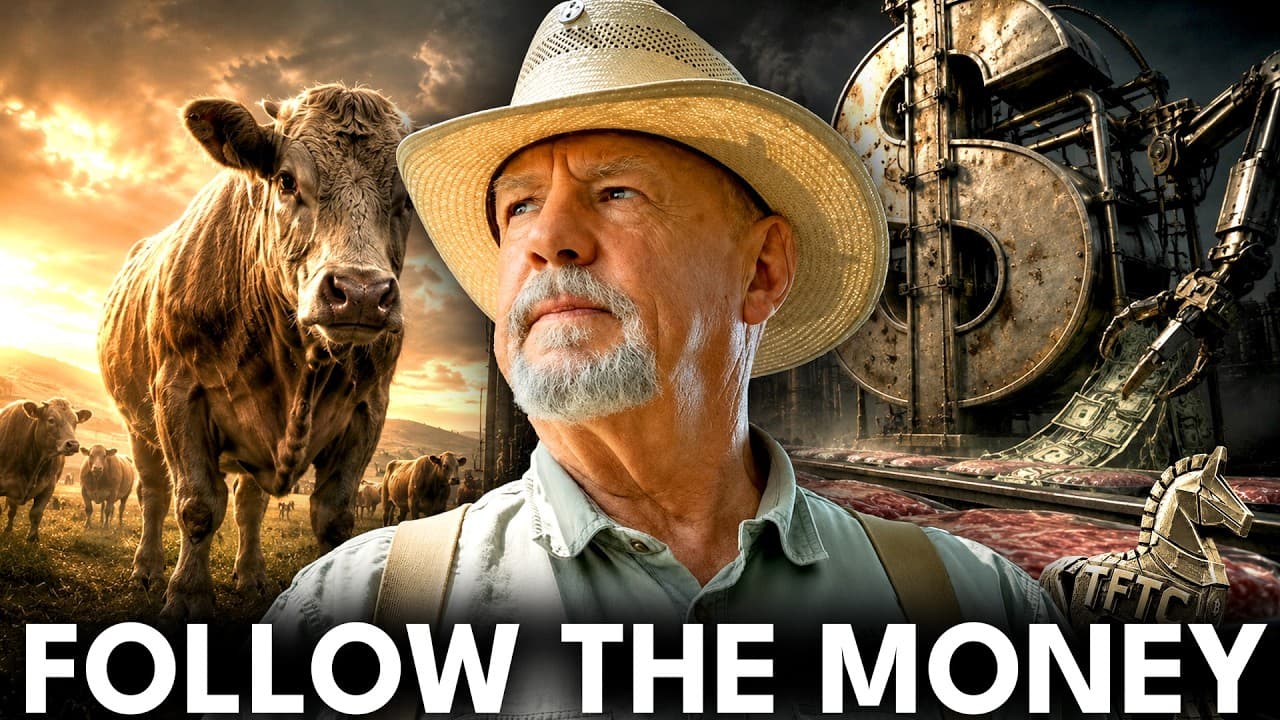
↓ Jump to the video and timestamps
I've been telling this audience to shake their rancher's hand for six or seven years. We buy a quarter-cow at a time. I spent four years in Austin and would go to a seven-day-a-week farmstand there as my primary grocery store. Now I'm back in the Northeast and I take my three boys down to a farm in Cape May County most summers to feed the pigs and chickens and bring home good food.
This is how my family eats.
So getting Will Harris on the show was a genuine treat for me, not a neutral interview. Will is the fourth generation of his family to run White Oak Pastures in Bluffton, Georgia. He spent twenty years as an industrial cattleman, then spent the next twenty-five-plus systematically dismantling everything he'd built and rebuilding it on entirely different logic.
What came out of our conversation confirmed something I've been arguing for a long time: the industrial food system operates on the exact same corrupted incentive structure as fiat money. Centralize, anonymize, race to the minimum standard, externalize the cost, and let someone else deal with the wreckage. The results in both cases are predictable and ugly.
Will doesn't use the word "fiat." That framing is mine. But everything he described about how industrial agriculture works maps onto it exactly. And what he's built at White Oak Pastures is as close to a sound-money analog in food as I've seen.
Key takeaways
- The industrial food system replaced "make the best product" with "meet the minimum standard", because total producer anonymity destroys every quality incentive at every link in the supply chain.
- A pound of industrial ground beef probably contains DNA from thousands of animals across multiple countries, it's two nearly inedible inputs blended into one edible product, which is why it's so cheap.
- Regenerative grazing sequesters carbon; feedlot farming emits it, the anti-beef greenhouse gas argument is accurate for confined feedlots and false when applied to properly managed grazing land.
- The fix is distributed, not scaled, the goal isn't one massive regenerative farm; it's more White Oak Pastures under independent regional ownership.
- No administration is going to legislate its way out of this, Will said it plainly and I believe him. Consumers hold the only real lever.
- Low time preference is the prerequisite, the same mental rewiring that makes someone a long-term Bitcoin holder is what makes someone willing to restore degraded land across generations. Harris has been 25 years into this transition and his best land still isn't done.
The Fiat Incentive Problem in American Food
Will's great-grandfather ran this farm with a mule-drawn wagon and no refrigeration. Every morning before dawn, he'd slaughter something, a cow, a few hogs, some sheep, load it up, and drive three miles down a dirt road to Bluffton to sell it. There was no USDA inspection and no cold chain; he sold it before it could spoil.
That constraint was a quality guarantee. The customer knew exactly where the meat came from. If it was bad, they didn't buy from him again. The producer was accountable at the point of sale, every single day.
Fast forward to now. The USDA publishes minimum acceptable standards for every product. The entire industry, Will told me, has evolved from trying to make the best possible product to meeting those minimums. His words: "We don't go for maximum, we go for the minimum."
That's the transition I'd call fiat thinking applied to food. When you centralize and anonymize the supply chain, producer sells to aggregator who sells to packer who sells to distributor who sells to retailer, you sever every accountability link. Nobody knows who raised the animal. Nobody can punish the producer for cutting corners.
The incentive to be excellent disappears, and the incentive to be cheap takes its place.
The beef packing market reflects that logic at scale. A small number of companies control the overwhelming majority of US beef processing, the kind of concentration that only happens when the priority is throughput, not quality. Will confirmed the picture when I raised it.
That's a centralized system optimizing for volume and margin, with the ecological and nutritional costs pushed off onto everyone else. Sound familiar?
What Industrial Farming Actually Does to the Land
Will gave me the number that stuck with me most. The soil on White Oak Pastures land that's been in his regenerative program for 25-plus years tests at 5.5% organic matter in the top four inches. The land he buys that's been farmed industrially comes in at 0.5%.
That ten-fold gap in soil health has a direct practical consequence: every 1% of organic matter absorbs roughly one inch of rainfall, which runs about 27,000 gallons per acre. His long-tenured land soaks up heavy rain.
The industrial land he acquires sheds it as muddy runoff. If you want to see what that looks like side by side, he's posted videos at whiteoakpastures.com, his farm's water versus his neighbor's farm's water after the same rainfall event. It looks like two different planets. I'd seen that footage when he was on Joe Rogan, and it's the kind of thing that's hard to un-see.
That runoff carries pesticides and synthetic fertilizer into the watershed. Will said he is about 80 to 90 miles from the Gulf of Mexico. The oyster beds in the Gulf near him, he said, have been decimated by chemical fertilizer and pesticide runoff washing off surrounding farmland. What gets called an "agricultural" problem on the label ends up being an estuary collapse downstream.
The pesticide logic follows directly from the monoculture mindset. When Will was an industrial cattleman, he wanted exactly one plant on his farm, Tifton 85 Bermuda grass. One animal, cattle. And ideally zero microbes. Every morning he went out looking for something to kill. An insect eating his grass. A nematode. A parasite. He was good at it, he told me, and he knew which product to reach for each time.
He woke up to the problem by being too extreme at it. He doubled every label recommendation. If a little helps, more helps more. The unintended consequences accumulated until he couldn't ignore them.
Now he goes to the same pasture every day and looks for ways to keep things alive, not kill them. He wants insects, nematodes, diverse plant species. He considers every creature in the ecosystem to have a role, whether we've studied it or not. Drive a species to extinction, he said, and the ecosystem operates differently, maybe subtly, but differently.
That's the complete opposite of what the land-grant universities and the industrial complex have been optimizing for seventy-five years.
The Anti-Beef Lie, Why Cows Done Right Are Carbon Sinks
The push to reduce cattle ranching over greenhouse gas emissions is, in my view, completely insane when applied to regenerative grazing. Will addressed this directly and I think he's right.
He was willing to concede the feedlot case. Animals standing on bare dirt, eating feed, urinating and defecating, he called it horrible for the environment, and he means it. The anti-beef movement seized that reality and painted all cattle production with the same brush. Cattlemen, Will said, let them get away with it for too long without fighting back.
Here's what actually happens on properly managed grazing land. Grass and forbs breathe in CO2 and grow. As the plant grows upward, it grows roots downward in proportion. Properly grazed land lets the plant mature, then runs animals through to graze it.
When the top gets bitten off, the underground root sloughs off carbon into the soil, where it gets sequestered. Dung beetles and other fauna pull the urine and feces underground. Then the land rests, sixty days on Will's rotation, and the cycle repeats.
That's where the organic matter comes from. The 5.5% organic matter in his best soil was atmospheric greenhouse gas, captured and sequestered by the grass-graze-rest cycle operating continuously for 25 years. The carbon moved from the atmosphere into the ground.
That's not a model, it's what's been happening since before humans showed up. The industrial feedlot legitimately earned the environmental criticism. Extending that criticism to regenerative grazing is either ignorance or dishonesty. Will put it simply: it's inarguable, and he'll show you if you want to come look.
The Ground Beef You're Buying Is Not What You Think
This section of our conversation is the one I think most consumers genuinely don't know, and it explains a lot about the price gap between industrial ground beef and what you get from a rancher you know.
When you fatten cattle in a feedlot, you produce a lot of what the industry calls 50% trim, 50% lean, 50% fat. It's the obese portion of an obese animal. By itself, it's barely marketable. Nobody wants to eat straight 50% trim.
The solution Big Beef landed on: import super-lean animals, usually old breeding cows, from overseas. Their meat grinds out at 90-plus percent lean. Blend the two. The 50% trim domestic fat and the 90%-lean imported lean combine to produce whatever ratio the label says, 70/30, 80/20, 93/7, depending on how you mix the inputs.
As Will put it: a pound of that product probably contains the DNA of thousands of animals from all over the world. That's his estimate and he qualifies it as such, but the underlying blending practice is documented. It's why the product can be made so cheaply. You're combining two nearly inedible inputs into something edible, sourced from an anonymous global commodity market, with no traceable connection to any individual producer.
The rollback of Country of Origin Labeling requirements for ground beef in 2015 made this more opaque for consumers, not less. You're not required to know where it came from.
The only real answer is to find a farmer and do business with them. Buy what they sell, ask questions, and if you don't like the answers, find another farmer. The onus is on the consumer, because it's not coming from the government and it's not coming from the packing companies.
Regenerative Is Replicatable, Not Scalable, The Distributed Model
The most common objection to regenerative farming is that it can't scale. Will addresses this better than anyone I've heard.
He agrees it's not as scalable as industrial farming. Then he reframes the whole question. The goal isn't to scale White Oak Pastures. The goal is more White Oak Pastures, different owners, different regions, different operators, same principles.
White Oak Pastures ships to 48 states today. Will told me he doesn't want to be doing that. He wants to produce what he produces and sell it in Georgia, Florida, and Alabama. He's where those three states meet. Atlanta is three hours up the road and he can't even feed Atlanta.
Shipping beef to California while Atlanta goes underserved is the wrong answer. The right answer is someone in California building what he built in Georgia, serving their region, accountable to their customers.
The family made a deliberate decision a few years ago to stop growing and start getting better. If they grew much more, they'd need to hire a CEO. A CEO is going to be focused on the month, the quarter, the year.
The Harris family is focused generationally. They make decisions on that farm they know won't pay off for decades, decisions they believe their great-grandchildren will benefit from.
That's a capital allocation framework completely incompatible with the quarterly-results mindset that runs industrial agriculture.
Will is also training the next generation of operators through CFAR, the Center for Agricultural Resilience, a nonprofit he started because too many people were coming to the farm wanting to learn and he wasn't set up to teach them. They take 6 interns per quarter, four quarters a year, and get around 20-plus applications for those 6 slots. They also run roughly 15 to 20 three-day workshops per year on specific topics, pig production, poultry, gardening, capped at 25 people each. Those fill up.
The people showing up aren't kids fresh out of school with no capital. They're young professionals who could financially start a farm if they wanted to. What they're missing is the three-legged stool Will describes: production (what you do on the land), processing (making it marketable, people eat beef and pork, not cows and hogs), and distribution (getting it to customers when you're in Bluffton, Georgia, population 150, trying to move $30 million in product).
Most prospective farmers come in fixated on production. Will told me it took him twenty-some years to figure out all three legs. He calls himself a slow learner. I believe him, and I also believe the knowledge is harder to acquire than the capital.
The financial pressure of industrial monoculture is squeezing out the people who know how to do this differently. Unless that knowledge gets passed down through generations, or through programs like CFAR, it has the potential to be lost within two or three generations. That's a real risk, not an abstraction.
How to Actually Opt Out
The consumer is the only lever that moves this. Will said it and I've been saying it for years. No administration is going to fix the industrial food system through policy.
Will was pretty direct that farmers waiting on the government to fix this are going to be waiting forever. He's not being cynical, he's being accurate.
What the consumer can do is find a farmer and buy from them. That's the whole playbook.
It doesn't have to be as complicated as it sounds. Will's online store at whiteoakpastures.com ships nationwide. They just opened their first retail location in Atlanta, an Austin company acquired an old industrial facility and converted it into a seven-day-a-week farmer's market format, and White Oak Pastures is one of the producers there. If you're near Atlanta, that's a direct option now.
Will also built a restaurant, general store, and lodging on-farm in Bluffton specifically so customers could come see the operation. He's in a remote area, so he created the infrastructure for visitors. You don't have to go every season, he told me most customers don't.
But you need to know you could go if you wanted to. That confidence, built through following along on social media and knowing the farm is real and open, is what makes the relationship work. Customers who've never visited still buy with confidence because they've watched the farm operate for years online.
His book, A Bold Return to Giving a Damn, goes deeper on everything we talked about. Pick it up wherever books are sold, we'll have a link in the show notes.
I've been using CrowdHealth (a TFTC sponsor, my family has been on it for five years) as our healthcare approach, the same way I've been buying food from farmers I know. Both are the same move: opt out of the anonymous centralized system, find a direct relationship, take accountability for your own choices. Sovereign money, sovereign health, sovereign food. The pattern is consistent.
Low Time Preference, The Missing Ingredient in Food and Money
This is where everything connects for me, and it's the frame I've been building toward for years.
We live in a high-velocity trash economy where everything's driven by, what have you done for me lately? What do the quarterly financial results look like? How much did we yield this month versus last month? That's the cultural pathology underneath both the fiat money system and the industrial food system.
Maximize throughput now. Externalize the long-term cost. Let someone else deal with the degradation later.
Bitcoin savings culture requires the opposite mindset. You buy, you hold, you wait. You're not trading for quarterly results. You're preserving purchasing power across years and decades, betting on a generational time horizon.
The mental rewiring required to do that, to sit through volatility and not flinch, is genuinely hard to develop in a culture that has optimized against patience.
Regenerative farming requires the exact same rewiring. Will has been 25 years into this transition. The land he acquired from industrial operators came in at 0.5% organic matter. His best long-tenured land is at 5.5%.
That gap closed over decades, not quarters. And it's still not done.
Will told me he doesn't know anything about Bitcoin. He wasn't making the connection I was making. But when I laid out the low time preference framing, he recognized it immediately from his own experience.
His family makes decisions they know won't pay off for a generation. They specifically declined to hire a CEO because a CEO operates on a monthly and quarterly time horizon and the farm doesn't.
That's what generational ownership does. It aligns incentives with outcomes on a timeline that actually matches the biology of soil restoration and the mathematics of compounding. A hired manager optimizes for their tenure. A family optimizes for their grandchildren.
The same mental rewiring of the brain that's necessary to hold Bitcoin through a 70% drawdown is what's necessary to restore degraded land across decades. Neither pays off in a quarter. Both pay off generationally. And our culture, high-velocity, trash-economy, what-have-you-done-for-me-lately culture, makes both harder than they should be.
That's what I think we're actually fighting against, in food and in money. And the exit looks the same in both cases: lower your time preference, find producers you can trust, do business with them directly, and let the anonymous centralized system atrophy for lack of your participation.
About Will Harris
Will Harris is the fourth-generation owner and operator of White Oak Pastures in Bluffton, Georgia, and the author of A Bold Return to Giving a Damn. He farmed industrially for twenty years after studying animal science at the University of Georgia before transitioning the entire operation to regenerative practices starting in the 1990s.
White Oak Pastures now runs a fully on-farm processing operation, ships beef and other products across the country, and operates a restaurant, general store, and lodging for visitors. Harris also founded the Center for Agricultural Resilience (CFAR), a nonprofit education program for aspiring regenerative farmers. His farm and its practices have been featured in national media.
Sources mentioned
- whiteoakpastures.com, White Oak Pastures online store, water runoff videos, farm visit information, and CFAR program details
- A Bold Return to Giving a Damn by Will Harris, available wherever books are sold; details on the transition from industrial to regenerative farming
Watch the conversation
Timestamps
- 0:07 - Intro: Bitcoin and fiat currency
- 0:34 - Will Harris introduction / White Oak Pastures background
- 3:05 - Industrial agriculture's corrupted incentives
- 7:41 - Regenerative vs. industrial: replicatable, not scalable
- 11:59 - The "shake your rancher's hand" shift, what Marty does
- 14:36 - White Oak Pastures Atlanta retail launch / why no CEO
- 15:51 - Local Pastures model, processing, and getting product to market
- 25:39 - What monoculture and pesticides do to the land
- 30:45 - The cow-methane argument and carbon sequestration
- 34:32 - The 60-day rest cycle and why regenerative grazing sequesters carbon
- 40:41 - Industrial ground beef: what's actually in it
- 43:30 - How consumers can opt out and visit the farm
- 46:44 - Progress since Joe Rogan / the disaster scenario if we don't change
- 51:40 - The three-legged stool: production, processing, distribution
- 54:25 - How long it takes to become a competent regenerative farmer
- 56:16 - A Bold Return to Giving a Damn / wrap
Sponsors
- Cash App: For a limited time, new customers can get $21 added to their balance. Just use code TFTC10 when you sign up, and send at least $5 to a friend in the first two weeks. cash.app/app/TFTC
- Square: For up to $200 off eligible Square hardware. square.com/go/tftc
- Bitkey: Use code TFTC10 for 10% off the new Bitkey. bitkey.world
- Aven: aven.com/bitcoin
- CrowdHealth: joincrowdhealth.com/tftc
- Unchained: unchained.com/tftc
- Salt of the Earth: drinksote.com/tftc
Frequently Asked Questions
What is regenerative farming and how is it different from organic farming?
Regenerative farming focuses on actively restoring ecological health, soil organic matter, biodiversity, water retention, and carbon sequestration, through practices like managed grazing, cover cropping, and eliminating synthetic inputs. Organic certification primarily restricts what you can't use (synthetic pesticides, GMOs) without requiring that you improve the land. A farm can be certified organic and still have degraded soil. Regenerative farming, as Will Harris practices it, is oriented around making the land healthier every year than it was the year before.
Why does grass-fed beef cost more than conventional beef at the grocery store?
Industrial ground beef is cheap because it combines two nearly inedible inputs, domestic 50% fat trim from feedlot cattle and imported lean trim from old breeding cows, into one edible product. The inputs are low-cost and the supply chain is optimized for volume. Grass-fed beef from regenerative operations costs more because the producer is doing more work per animal, on more land, with longer time horizons and no cheap imported blending inputs. You're paying for what the product actually is, not for a blend assembled from a global commodity market.
Does grass-fed cattle ranching actually help the environment, or is all beef bad for climate?
Properly managed grazing land sequesters carbon. Grass captures CO2 and grows roots; when grazed and given a rest period, those roots slough carbon into the soil where it stays. Will Harris's land has gone from 0.5% organic matter (when acquired from industrial operators) to 5.5% over 25 years, that organic matter came from the atmosphere. Feedlot cattle standing on bare dirt are legitimately a net emitter. The anti-beef argument is accurate for feedlots and wrong when applied to regenerative grazing. The two models have opposite effects on atmospheric carbon.
What does "DNA from thousands of animals" in ground beef actually mean?
Industrial ground beef is typically produced by blending domestic feedlot trim (high fat content) with imported lean trim from older animals to achieve a target lean-to-fat ratio. Each batch draws from many animals across multiple sources and countries. Harris estimates a single pound of industrial ground beef probably contains genetic material from thousands of animals. This is the documented result of commodity-scale blending, made more opaque by the rollback of Country of Origin Labeling requirements for ground beef in 2015.
What is White Oak Pastures and where can I buy Will Harris's beef?
White Oak Pastures is a multi-generational family farm in Bluffton, Georgia, operated by Will Harris and his family. They raise cattle, poultry, and other animals using regenerative practices, process on-farm, and sell directly.
You can order online at whiteoakpastures.com, which ships across the country. They recently opened their first retail presence in Atlanta through a seven-day farmer's market format. Will also runs a restaurant, general store, and lodging on-farm for visitors.
How do I find a local regenerative farmer near me?
Will's advice is simple: find a farmer and ask questions. If you don't like the answers, find another farmer. Farmers markets are the easiest starting point.
Buying a quarter-cow or half-cow from a local operation is a more direct route. If you can visit the farm once and see how it operates, you probably don't need to go back every season. The relationship and the confidence it builds is what matters, and you can follow along online in the meantime.
What is the Center for Agricultural Resilience (CFAR) and can I learn to farm there?
CFAR is a nonprofit Will Harris started at White Oak Pastures to train people who want to start their own regenerative operations. They accept 6 interns per quarter across four quarters a year and receive around 20-plus applications per cycle. They also run roughly 15 to 20 three-day workshops annually on specific topics like pig production, poultry, and gardening, capped at 25 participants each. Those sessions fill up. More information is available at whiteoakpastures.com.