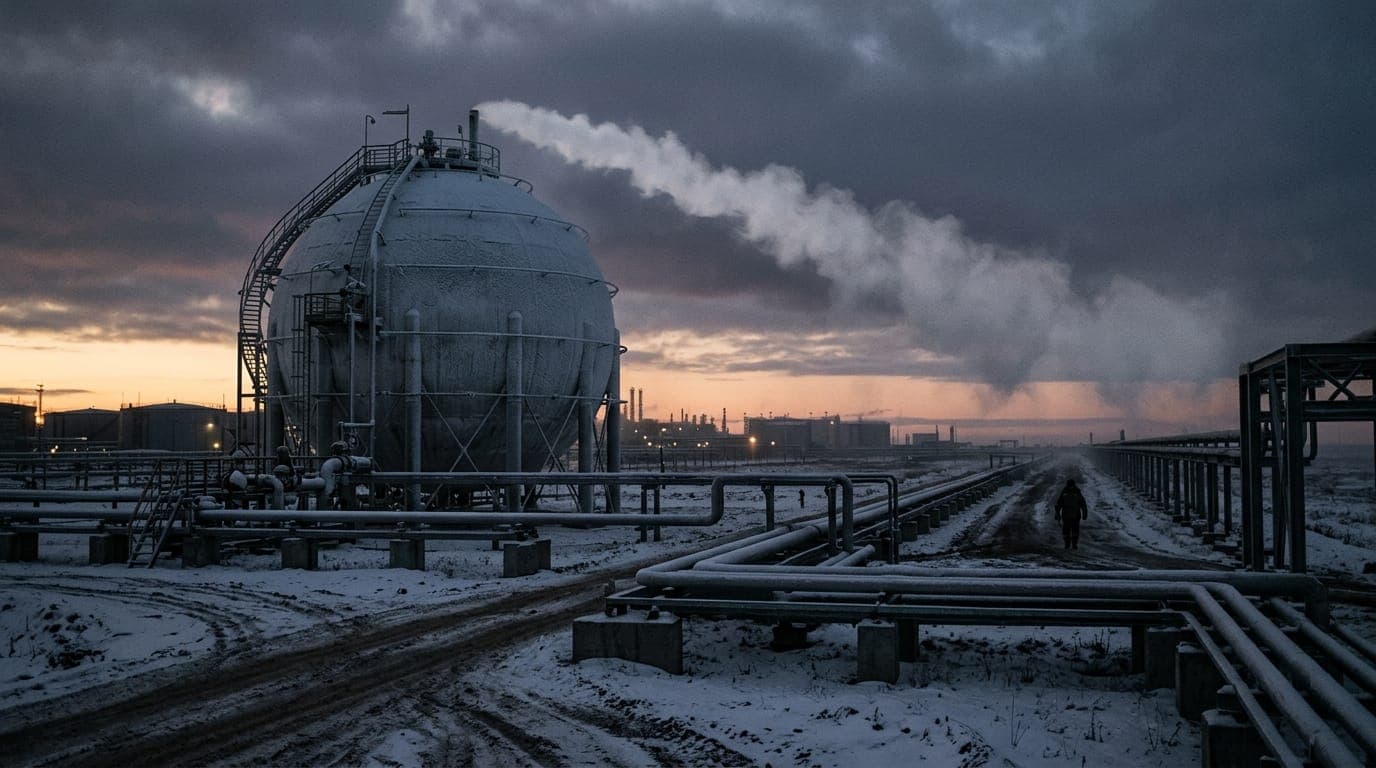
US Deploys Sea Drones in Combat for the First Time, Strikes Iran's Bandar Abbas Naval Base
Three Saronic Corsair unmanned surface vessels struck Iran's Bandar Abbas Naval Base on July 12 in the first-ever combat use of US sea drones. Brent crude surged 9.59%. Washington simultaneously restarted its naval blockade and revoked Iran's oil-sales license.
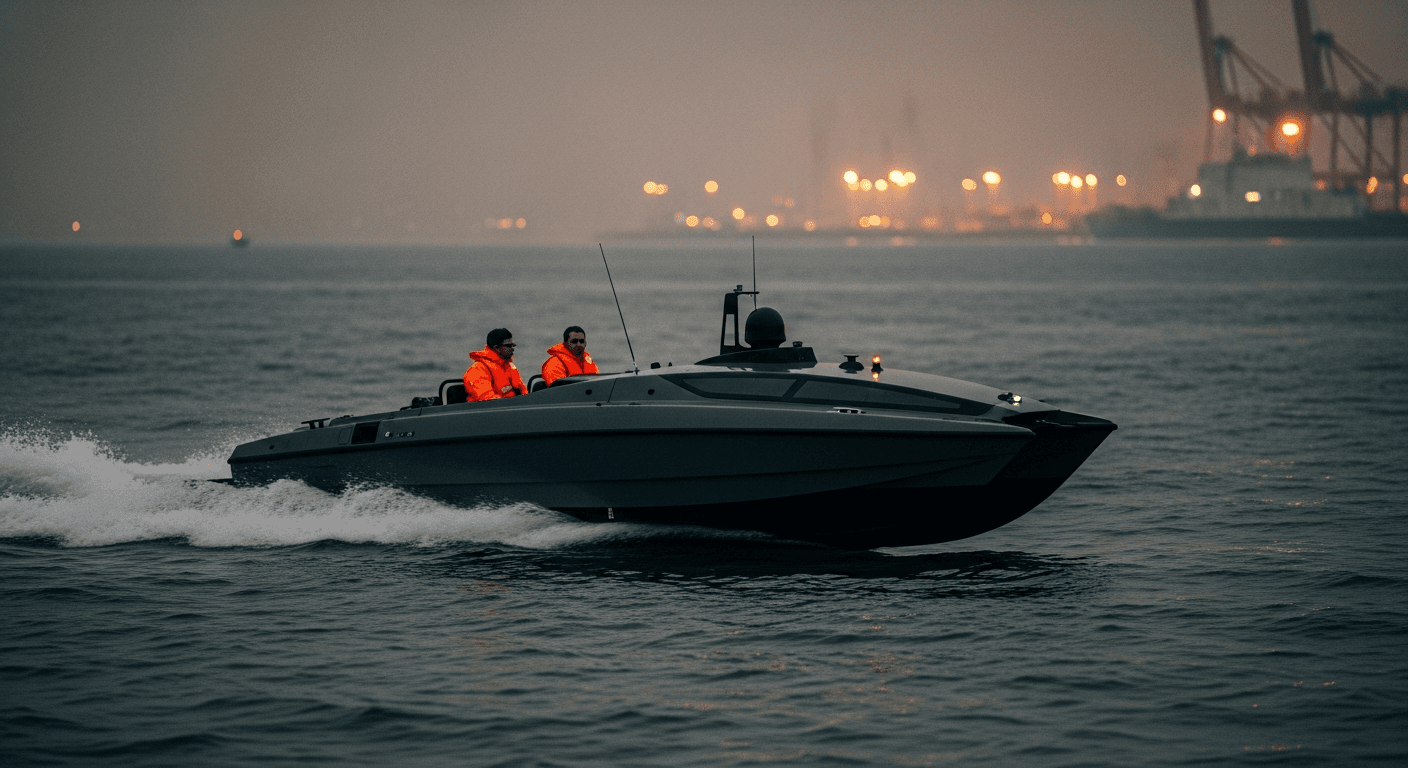
Three Saronic Corsair drone boats hit Iran's main Hormuz naval base on July 12. The chokepoint carrying 20% of global oil just became a live kinetic theater.
Key takeaways
- U.S. Central Command deployed three Saronic Corsair unmanned surface vessels against a submarine and ship maintenance facility at Bandar Abbas Naval Base on July 12, 2026, the first combat use of sea drones by U.S. forces.
- The strike is part of a broader campaign against Iranian military targets and is paired with a resumed naval blockade (effective July 14) and a revoked Iranian oil-sales license, signaling Washington is weaponizing energy access as a geopolitical tool.
- Brent crude surged 9.59% to $83.30 per barrel in a single session, its biggest single-day gain in over six years, with roughly 20% of global oil supply transiting the Strait of Hormuz.
U.S. Central Command announced on July 13 that three Corsair unmanned surface vessels struck a submarine and ship maintenance facility at Iran's Bandar Abbas Naval Base the previous day, marking the first time U.S. forces have employed sea drones in combat operations. The strike degraded what CENTCOM described as Iran's ability to continue attacking commercial shipping through the Strait of Hormuz.
CENTCOM's announcement, posted to @CENTCOM on X:
The Strike and the Platform Behind It
The Corsair is a 24-foot autonomous surface vessel built by Saronic Technologies, carrying a 1,000-pound payload with a range exceeding 1,000 nautical miles and a top speed above 35 knots. Per Saronic, the company had produced at least 300 Corsairs as of May 2026; that figure comes from a Saronic social-media post, not a DoD document. The Navy signed a $392 million production contract with Saronic in December 2025, and Corsairs have been in-theater since late March 2026. The June 8 rescue of two Army Apache crew members after their helicopter was shot down near Oman was the platform's first publicly noted operational use; the Bandar Abbas strike is its combat debut.
CENTCOM's statement was direct: "Three Corsair unmanned surface vessels hit the port at Bandar Abbas Naval Base, marking the first time American forces have employed sea drones in combat operations. Last night's strikes degraded Iran's ability to continue attacking commercial shipping."
Independent reporting by USNI News confirmed the operation was directed by CENTCOM rather than the forward-deployed Combined Task Force 59, per a U.S. defense official. Video released by CENTCOM shows what analysts at USNI identified as what appears to be a Ghadir-class midget submarine on a maintenance gantry at the facility. CENTCOM's own statement does not specify the submarine class.
The Bandar Abbas strike was one piece of a larger operation. CENTCOM's statement described Sunday's campaign as hitting dozens of Iranian military targets, including air-defense systems, coastal radar sites, and missile and drone capabilities.
The Hormuz Chokepoint and What's Actually at Stake
The Strait of Hormuz carries roughly 20% of global oil supply. An active kinetic campaign inside that chokepoint, layered on top of a resumed naval blockade, is a supply shock in progress. Brent crude moved 9.59% in a single session to $83.30 per barrel, its largest single-day gain in over six years, per CNN's live market data. Iranian missiles struck two UAE tankers in the Strait of Hormuz during the broader escalation, killing one crew member and injuring eight others, according to the UAE Defense Ministry.
Washington's moves are not only military. The U.S. revoked Iran's oil-sales license on July 7, then announced the resumption of a naval blockade against Iranian ports effective July 14. The sequencing matters: first cut Iran off from dollar-denominated energy markets, then resume the physical blockade, then strike the maintenance facility that keeps Iran's naval assets operational. That is energy access as a weapon, deployed in a deliberate sequence.
The war premium on Hormuz is no longer theoretical. Iran had already attempted to hedge some of that exposure, as seen in its Bitcoin-settled maritime insurance scheme for Hormuz shipping. Regional bypass routes are getting attention too, with France actively backing an alternative energy corridor through Syria precisely because Hormuz exposure is a live vulnerability.
For the monetary picture: a sustained oil bid re-accelerates energy inflation. The Fed's last-mile disinflation fight gets harder as Brent climbs. More fiscal pressure from an accelerating autonomous weapons procurement cycle (the Saronic contract is the floor, not the ceiling) means more deficit spending and more Treasury issuance.
Permissionless, bearer-instrument money without counterparty exposure to a U.S. Treasury OFAC action is not an abstract hedge at this point. The U.S. just demonstrated on video that it can simultaneously sanction a nation's energy revenues and physically blockade its ports. The off-ramp is self-custody of hard money.
CENTCOM spokesman Capt. Tim Hawkins told CBS News: "Quickly equipping our warfighters with cutting-edge capabilities enhances combat effectiveness, which is why operationalizing these new tools remains a U.S. Central Command priority." (CBS News)
What to Watch
The falsifiable read here is straightforward. If Iran agrees to a durable, verified ceasefire within days and Hormuz shipping volumes return to pre-conflict levels without a sustained oil-price spike, the energy-shock-to-debasement chain breaks and the near-term macro catalyst dissipates. Watch the EIA weekly petroleum report and the Brent forward curve. Watch whether CENTCOM issues a formal press release with additional target details at centcom.mil.
Watch Saronic procurement announcements for the next contract tranche, which will quantify how fast the autonomous surface vessel fleet scales. The Trump administration declared the previous ceasefire (which began April 8) over. Iran said it would continue negotiating. Neither position is stable.
Update, July 15, 2026
Wednesday's CENTCOM strikes on Iran marked the fifth straight day the U.S. launched attacks, and the campaign's stated scope is widening. Tuesday night's operation ran for seven hours, with CENTCOM hitting Iranian missile and drone sites, naval capabilities, and coastal defense systems.
A separate 90-minute wave on Wednesday targeted coastal defense systems and cruise missile storage and launch sites on Greater Tunb Island.
The more significant development is where Trump says this goes next. In a Fox News interview Tuesday, Trump said U.S. forces would target key Iranian infrastructure next week without a diplomatic breakthrough: "Next week it gets really bad for them because next week comes the power plants. Next week comes the bridges. We're going to knock out all their power plants. We're going to knock out all their bridges unless they get to the table and negotiate."
He also said, "I'll save the energy targets for last, but ultimately we'll hit energy targets."
Striking Iranian bridges and power plants would mark a significant escalation in military action for U.S. forces, which have so far focused on taking out Iran's ability to attack vessels in the strait.
Iran is widening its own counter-strike geography in parallel. The IRGC claimed overnight attacks on U.S. military assets in Bahrain, Kuwait, and Jordan, saying it inflicted damage on the U.S. Fifth Fleet headquarters in Bahrain and a logistics hub in Kuwait, and claimed destruction of shelters housing F-15, F-16, and F-35 aircraft along with several MQ-9 drones.
Brent crude was trading at $85 a barrel on Wednesday morning, extending the energy shock already underway.
Update, July 17, 2026
Trump followed through on his infrastructure threats. Iran acknowledged "attacks on power infrastructure" for the first time Friday, with its Energy Ministry issuing a call for people to use less electricity in southern provinces, saying those areas "are currently experiencing extreme heat and attacks on power infrastructure."
The ministry did not elaborate on whether it was power plants, transmission lines, or other equipment that had been attacked. Iran's grid operator confirmed the damage is material: the attacks have reduced electricity generation capacity by roughly 4,200 megawatts, with summer temperatures hitting 40 degrees Celsius across southern provinces, according to Mohammad Allahdad, head of Tavanir, the government-owned power grid operator. CENTCOM described the operation as targeting "military logistics infrastructure" and "maritime capabilities" during what was a sixth consecutive night of U.S. strikes.
The geographic footprint of the campaign widened significantly overnight. Officials in Hormozgan province say six bridges were hit in the latest attacks, along key transport routes linking Bandar Abbas with surrounding towns.
A railway junction station just west of Bandar Abbas was also hit.
CENTCOM said the Chabahar surveillance tower destroyed in the strikes was "part of a maritime surveillance network along Iran's Gulf of Oman coastline used for decades by the IRGC to track and target commercial vessels transiting the Strait of Hormuz," adding that "the destruction of the tower directly degrades IRGC's ability to coordinate attacks on innocent civilian crew members."
Iran is widening its counter-strike geography in parallel, and this is where the latest development is most significant. The IRGC said it launched an attack on a U.S. special operations command center at al-Tanf in Syria, with state media reporting the strike was in retaliation for the killing of Iranian soldiers in Iranshahr.
Reuters could not independently verify the claim, and there was no immediate comment from the U.S. military; notably, the U.S. military said in February it had completed a withdrawal from the al-Tanf base, positioned at the tri-border confluence of Syria, Jordan, and Iraq. The IRGC also claimed the broader Friday wave included strikes targeting American radar sites in Oman and weapons depots and launchers in Kuwait.
Iran also launched missile attacks against U.S.-allied nations including Qatar, a mediator in the war, and Kuwait, where a power and water desalination plant was damaged.
Iran is also threatening to widen the energy war beyond its own borders. Iran has reportedly instructed the Houthis to prepare to close the Bab el-Mandeb Strait if U.S. attacks on Iranian power infrastructure continue, with three sources telling Reuters that Iran's leadership discussed the move and recently conveyed the request to the group; a source close to the Houthis said missiles and drones had been deployed near the waterway awaiting an order to begin attacking shipping. A Hormuz blockade was already the central risk to global oil supply. A simultaneous Bab el-Mandeb closure would put two of the world's most critical energy chokepoints offline at the same time. The IRGC itself stated that Iranian forces "remain in full control of the Strait of Hormuz" and warned that "as long as the United States persists in its acts of mischief, not a single drop of oil or gas will be permitted to be exported from the region."
Update, July 18, 2026
CENTCOM completed its seventh consecutive night of strikes against Iran on July 17, hitting surveillance sites, military logistics infrastructure, underground weapons storage, and maritime capabilities. The target set has now expanded well beyond military hardware into the sinews of civilian life. Hormozgan's chief of communications and information technology confirmed that U.S. overnight attacks disrupted telecommunications in Bandar Abbas and Hajiabad, with authorities tallying at least 116 telecommunication towers taken out of service.
The damage resulted in outages and disruptions of fixed-line, mobile, and internet services, per Tasnim news agency.
Water is now a weapon in this corridor. Hamzeh Pour, chief executive of the Hormozgan Water and Wastewater Company, said a seawater pumping station and a power transformer at the Bunji desalination plant in Jask in southern Iran were "completely destroyed," depriving 20 villages of water.
The seventh consecutive night of strikes has left 10,000 people without water after the desalination plant was hit.
The Hormuz corridor is not moving freely in either direction. CENTCOM said U.S. forces have redirected 4 commercial vessels, disabled 1, and boarded 1 during the first three days of renewed blockade implementation. Iran is matching that move: Iran's Revolutionary Guard Corps said it blocked four vessels early Saturday as they attempted to move under U.S. protection through the Strait of Hormuz, with IRNA quoting the IRGC Navy Command as saying that "in a coordinated missile and drone operation, all four were halted and immobilized at sea." The Hormuz chokepoint is effectively contested from both sides, with telecom and water infrastructure now added to the target list -- the campaign's scope is no longer bounded by anything that could plausibly be called military-only targeting.
Update, July 20, 2026
The U.S. military carried out a ninth consecutive night of attacks on Iran overnight, with Tehran responding by targeting U.S. allies in the Gulf. That makes nine straight days of kinetic exchange since the campaign began on July 12. Separately, the New York Times reported that dozens of U.S. military personnel were wounded and helicopters damaged during three Iranian strikes on American forces in Jordan last week, with anonymous U.S. officials saying the Pentagon did not disclose those casualties and the damage inflicted during the attacks, which came before Iran's strike that killed two soldiers and left one missing on Friday in Jordan.
Qatar has floated the idea of a 10-day ceasefire paired with an end to restrictions on Hormuz shipping, according to mediators, though it was not clear whether either side was ready to accept a new halt to the fighting after the mid-June MOU collapsed.
Iran's Foreign Ministry confirmed Monday that mediation proposals to restart negotiations have been received, with spokesman Esmaeil Baghaei telling state media the country will continue to defend itself resolutely.
Iranian President Masoud Pezeshkian told citizens publicly that "the Islamic Republic of Iran is engaged in a full-scale war" and that Iranians "must be realistic and accept the natural consequences of this resistance." That framing from the head of state matters: it is the clearest official Iranian acknowledgment yet that this is no longer a contained exchange of retaliatory strikes. Markets, for their part, are still pricing in a diplomatic off-ramp, with Panmure Liberum's head of strategy noting that investors "still think the US and Iran will go back to the negotiation table," and warning that oil will only reprice higher for longer if the U.S. stops negotiating altogether.
Update, July 22, 2026
The Hormuz risk premium has now moved beyond oil futures into the labor market. Sinokor Group, the world's largest owner of supertankers, distributed an offer of six months' extra salary to crew willing to make a one-month return voyage through the strait to pick up oil from Saudi Arabia or Iraq, according to a document seen by Bloomberg.
The offers were made prior to fresh attacks on July 20 on merchant shipping , and came under renewed scrutiny after at least two seafarers died in attacks last week while another vessel was abandoned.
Shipowners can command millions of dollars for a single Hormuz transit, and insurers are now charging huge premiums as well. The crews, however, are the ones taking the greatest personal risk, and some are still refusing the extra rewards. Sinokor's six-month offer is the ceiling, not the floor: two people involved in securing crew for vessels transiting the waterway said they were generally seeing lower rates than Sinokor's, though significant bonuses remain on offer, with some firms adding as much as 60 days of salary to a 30-day contract.
Visible traffic through the strait has declined in recent days, though there is uncertainty about how much continues to cross the waterway dark, with satellite signals switched off. That last detail is the tell. When tanker operators start running dark and paying six months of wages for a single voyage, the market has already priced in the scenario that the corridor may not stay open.
Update, July 24, 2026
A Wall Street Journal investigation published Thursday, drawing on Planet Labs and Airbus satellite imagery and interviews with Western and Israeli officials, found that Iran has rapidly rebuilt a significant amount of infrastructure destroyed during months of US and Israeli strikes. The report suggests the speed at which Tehran is restoring its damaged capabilities is a key reason it continues to hold its own against the US after hostilities renewed this month.
The satellite record is concrete. A missile base access road and tunnel entrance near Kangavar, struck in March, showed freshly excavated entrances and a newly paved road just weeks later.
Israel and the US had often only succeeded in collapsing the surface-level entrances to Iran's missile bases rather than fully destroying them, leaving weapons stores inside untouched and waiting to be dug out.
Satellite imagery from early July also showed partial reconstruction at an IRGC-linked shipyard in the Caspian Sea port of Bandar Anzali.
Israeli military officials have pointed to these instances as proof that the bombing campaign launched on February 28 was ineffective.
The intelligence community is drawing the same conclusion on the diplomatic track. Both the CIA and the Defense Intelligence Agency have recently assessed that the current bombing campaign is unlikely to shift Iran's negotiating position, according to two US officials familiar with the assessments.
US intelligence agencies have also "concluded that Tehran and Washington are, for now, stuck in an indefinite limbo between peace and war." For oil markets, the read-through is straightforward: evidence that Iran retains missile production know-how and repair capacity argues against any near-term de-escalation, with strikes on US allies in Kuwait, Bahrain, and Jordan continuing and three US soldiers already killed. A conflict that was supposed to be shock-and-awe is looking more like a sustained war of attrition with two critical energy chokepoints in the balance.
Update, July 31, 2026
The U.S. footprint in Iraq is now actively shrinking under Iranian pressure. The U.S. military has started drawing down its last remaining forces from Iraq stationed near Erbil's airport in the Kurdish Region, according to well-placed sources with close knowledge of the process confirmed to Al-Monitor.
Patriot air-defense systems have already been removed from the compound, and "all" of the Patriot batteries have been redeployed to an undisclosed destination.
The pullout started last week and is ongoing, with the bulk of U.S. forces and heavy equipment already out.
Washington is framing the move as routine. Regional officials described the pullout as in line with the U.S. commitment to withdraw all forces from Iraq by a September 30 deadline agreed with Baghdad. But the timing tells a different story. The removal of Patriot systems ahead of the troop withdrawal has fueled questions about how the U.S. military is prioritizing interceptor deployment across the theater, with one source saying on condition of anonymity, "The Kurdistan Region is not a priority; the Gulf and Jordan clearly are."
The interceptor stockpile itself is the deeper problem. CSIS estimates fewer than 827 Patriot interceptors and fewer than 278 THAAD interceptors remain in stock, down from pre-war estimates of roughly 2,200 Patriots and 452 THAAD missiles.
Trump reportedly paused plans for further escalation in part due to depleted Pentagon stocks of regional air defense munitions, particularly Patriot antimissile interceptors, and a recommendation from CENTCOM commander Admiral Brad Cooper to halt the Hormuz campaign unless the U.S. was prepared to escalate further. The Army's response: a seven-year contract worth up to $58.6 billion awarded to Lockheed Martin to produce Patriot interceptors through 2032 -- but production timelines do nothing for the near-term supply crunch already shaping battlefield decisions in real time.
Update, August 7, 2026
Abu Dhabi National Oil Company issued a formal statement Friday putting hard numbers on the cumulative damage to its fleet. "Since the beginning of the conflict, 15 of our vessels have been attacked by missiles and drones while transiting the Strait of Hormuz, including three vessels this week alone," ADNOC said.
The attacks have resulted in one fatality and injuries to 20 crew members.
ADNOC did not identify the three vessels involved in this week's attacks or provide details on the extent of damage.
The attacks are hitting one of the few Gulf producers that has managed to restore exports close to pre-war levels. The UAE has relied on crude loading points outside Hormuz, including Fujairah, while continuing to move some barrels through the strait despite the security environment.
Shipping through the waterway has been repeatedly disrupted since the conflict widened, with attacks on commercial vessels raising freight rates and security concerns. Vessel-transponder data from late July showed around 10 vessels transiting the strait in a day, against a pre-crisis baseline of roughly 88 to 130 per day.
Insurance rates through Hormuz are currently four times the five-year average. The ADNOC tally is the most specific public accounting from any major Gulf energy operator of the compounding physical toll on export infrastructure since the campaign began, and it arrives as the U.S. naval blockade and ongoing CENTCOM strikes continue to constrict the corridor that once carried a fifth of the world's daily oil supply.
Update, August 30, 2026
The kinetic pause is over. The U.S. military on Sunday struck Iran's Larak Island, where forces were observed preparing to launch rockets with mines into the Strait of Hormuz, marking the first U.S. strikes in over a month.
U.S. forces struck two Iranian launchers on the island.
The pause had followed the President's cancellation of a threatened multi-day campaign late on August 1 , stretching nearly four weeks without confirmed kinetic action inside Iran.
The trigger was a live threat to the waterway. IRGC forces were observed preparing to launch rockets with sea mines into the strait, according to a U.S. official who spoke on condition of anonymity. Larak Island sits at the mouth of the Strait of Hormuz; mining operations launched from there would directly threaten the shipping lanes that carry roughly 20% of global oil supply, a chokepoint that has already been the central node of this entire campaign. Iran's Islamic Revolutionary Guard Corps vowed to respond after U.S. forces struck the two launchers on the island.
Residents reported hearing an explosion near Larak Island on Sunday, according to Iran's semi-official Fars News Agency. The resumption of strikes after a month-long lull resets the risk calculus for energy markets and monetary stability. A Hormuz mining attempt, if it had proceeded, would have been a direct escalation beyond anything seen in the campaign to date. The IRGC's vow to respond means the pause is over in both directions.
Update, September 5, 2026
The conflict crossed into new territory Saturday morning. U.S. forces struck three Iranian crude oil carriers after CENTCOM said the IRGC launched ballistic missiles toward two Navy warships in the region.
A U.S. aircraft carrier and guided-missile destroyer successfully evaded multiple attacks, and no American personnel were harmed.
CENTCOM named the vessels and their fates. Following Iran's failed attacks, CENTCOM permanently disabled the IRGC crude oil carriers M/T Downy off the coast of Kharg Island and M/T Stark 1 near Jask. American forces also completely destroyed the unladen crude oil carrier M/T Kylo in the Gulf of Oman, striking the vessel in multiple critical locations after the crew was directed to abandon ship.
CENTCOM described the three tankers as part of a multibillion-dollar shadow network that funds the IRGC and its regional proxies, adding that Iran "has no means by which to defend them." The CENTCOM statement on X was explicit on the exchange rate: "If you shoot at two of our ships, we will impose an even higher economic cost, taking out three of yours," said Admiral Brad Cooper, adding that U.S. forces "will not hesitate to defend American forces, and if necessary, destroy Iran's limited and exposed oil fleet."
The Kharg dimension matters beyond the tactical exchange. Iran is the third-largest producer in OPEC and exported 90% of its crude via Kharg Island before the war.
A senior Iranian source told Reuters that Iran has only about two months' worth of gasoline left in its supply as the U.S. war and economic sanctions impose a heavy toll, and Iran has to import gasoline because of limited refining capacity. Saturday's strikes push that pressure harder: the tankers hit were part of the shadow fleet keeping whatever residual export revenue alive. The fresh exchanges threaten to heighten a shipping war in and beyond the Persian Gulf, and the two sides trading strikes for the first time in over a month risks another retaliatory cycle.
Sources
Frequently Asked Questions
What is a Saronic Corsair and how does it compare to a conventional strike weapon?
The Corsair is a 24-foot autonomous unmanned surface vessel with a 1,000-pound payload, a range of more than 1,000 nautical miles, and a top speed above 35 knots. It is a one-way attack platform, meaning it is not recovered after the strike. The Navy's December 2025 contract with Saronic was valued at $392 million.
A single Tomahawk cruise missile costs upward of $2 million per unit. The cost asymmetry is the strategic point: a swarm of autonomous drone boats imposes disproportionate defensive costs on an adversary relative to the attacker's expenditure, which is exactly the lesson the U.S. drew from Ukraine's maritime drone campaign against the Russian Black Sea Fleet.
How much oil transits the Strait of Hormuz and what happens if it closes?
Roughly 20% of global oil supply passes through the strait, per EIA data. A sustained closure or significant disruption to tanker traffic through Hormuz would be a supply shock without a close modern precedent. Insurance costs for tanker operators spike immediately when military activity intensifies in the strait, rerouting ships around the Cape of Good Hope adds weeks and cost to delivery, and the global oil price responds before a single barrel fails to arrive.
The 2019 Abqaiq attack in Saudi Arabia moved Brent roughly 14% at the session close, with intraday peaks above 19%, per CNBC and a Congressional Research Service analysis. The current escalation involves active military strikes on the naval base that sits on the strait itself.