Paraguay's Ueno Bank Collapse Locks Out 60% of Adults, President Resigns
Paraguay's Central Bank seized Ueno Bank on November 3, locking more than 60% of the country's adults out of their accounts overnight. President Santiago Peña resigned two days later and was immediately impeached 78-0. Fitch had rated Ueno BB eight months before.
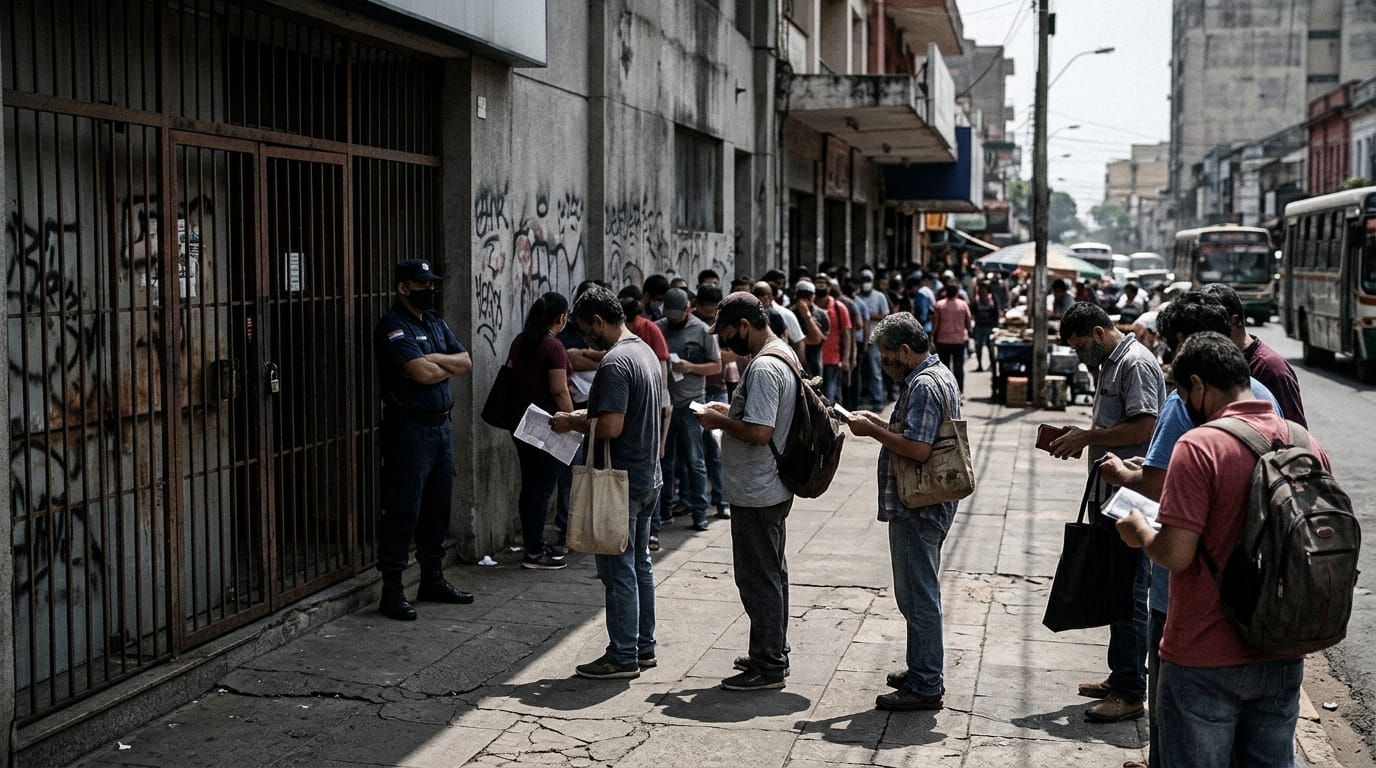
Paraguay's digital bank failure didn't just wipe out a balance sheet, it froze accounts for half the country and took down a presidency in 48 hours.
Key takeaways
- Paraguay's Central Bank (BCP) opened a resolution procedure against Ueno Bank on November 2, publicly announced it at dawn November 3, and immediately cut off app, card, and account access for roughly 3 million depositors, more than 60% of the country's adults.
- President Santiago Peña, a former investor in a company linked to Ueno's ownership group, announced his resignation on November 5; the lower house voted 78-0 to impeach him minutes later.
- Fitch rated Ueno "BB" as recently as March 2026, eight months before the BCP found its solvency ratio had fallen below 50% of the regulatory minimum, a ratings-lag failure that gave depositors zero actionable warning before access was cut.
Paraguay's Central Bank voted unanimously on November 2, 2026 to open a resolution procedure against Ueno Bank after finding its solvency ratio had collapsed to below half the legal minimum. The BCP announced the action publicly at dawn on November 3, simultaneously locking roughly 3 million depositors out of their accounts, cards, and apps. In a country of roughly 6.5 million people, that is more than 60% of adults losing access to their money before most of them woke up.
Eight Ueno executives were detained in the hours that followed, including bank president Juan Manuel Gustale and CEO Federico Miguel Vázquez, according to wire reports citing Paraguayan authorities. BCP Central Bank President Carlos Carvallo resigned the same day. President Santiago Peña, a former IMF economist who had previously sat on the BCP board and held a stake in Grupo Vázquez until March 2025, announced his own resignation on November 5 via a video posted to X, stating: "I have made the decision to submit my resignation as president of the republic" and "I do so thinking of the stability of our country, social peace and the need to preserve our democratic institutions." The lower house voted 78-0 to impeach him minutes after the announcement. Vice President Pedro Alliana is set to assume the presidency.
The Ratings-Lag Problem Nobody Wants to Name
CB Insights, citing Fitch, confirms Ueno held a "BB" rating as recently as March 2026. Eight months later, the BCP's review found a solvency fiction so advanced that the ratio had fallen below 50% of the legal floor. That is a slow rot that the conventional trust machinery, ratings agencies included, failed to surface before the resolution window slammed shut.
This is the same failure mode that appeared in Turkey's custody risk collapse: credentialed intermediaries signal safety right up until they don't, and by the time they update their signal, the depositor's exit window is gone. The sequence is always the same. Rating holds. Solvency cracks. Regulator acts at 3 a.m. Doors close.
Ueno held approximately 8.9% of Paraguay's deposit system as of December 2025, according to rating agency FIX. That concentration, inside a single government-supervised custodian, is what turned an institutional failure into a national crisis overnight.
What the BCP Guarantee Covers and What It Doesn't
The BCP has begun deposit guarantee payments, covering up to PYG 228.3 million (roughly $38,000) per depositor. The BCP's preliminary estimate holds that 97% of depositors fall entirely within that ceiling, which means the majority of account holders should eventually recover their full balances.
"Eventually" is doing a lot of work in that sentence. The BCP froze access on November 3. Payout notifications only began November 5. That is a minimum 48-hour window of total lockout for 3 million people on rent cycles, payroll, and grocery runs.
The government guarantee is real, but it requires trusting the state to administer correctly, to not devalue the currency in the interim, and to not impose capital controls to slow outflows during the resolution period. None of those risks appear in a Fitch rating.
What to Watch
The resolution timeline is the most important variable now. If Paraguay's BCP delivers full guaranteed payouts within 30 days with no capital controls and no preferential treatment for politically connected creditors, the deposit guarantee system will have performed roughly as designed at scale. That outcome is worth watching honestly because it has not happened yet and is rare at this size of failure.
If the payout drags, or if large depositors above the PYG 228.3 million ceiling face haircuts while the politically connected do not, the structural argument here hardens considerably. The criminal complaint BCP filed against Ueno executives is proceeding; the resolution process is in its early days. Alliana's new government will own whatever comes next.
Sources
Frequently Asked Questions
Are Ueno Bank depositors going to get their money back?
The BCP's deposit guarantee covers up to PYG 228.3 million (approximately $38,000) per depositor, and the BCP's preliminary estimate is that 97% of depositors fall entirely within that limit. The BCP has begun the payout process as of November 5. Depositors above the guarantee ceiling face an uncertain timeline tied to the broader resolution and asset-recovery process. Full recovery is possible for most account holders; the remaining question is how long it takes and whether the resolution is administered cleanly.
What does Fitch's "BB" rating eight months before collapse mean for depositors everywhere?
A BB rating in March 2026 implied speculative-grade but functional credit quality, yet eight months later the BCP found solvency below 50% of the legal minimum. The gap between the last published rating and the actual condition at resolution is where custodial risk lives. No rating, regulatory standing, or government adjacency provided depositors any actionable window to exit before access was cut.
The rating was not fraudulent on its face; it was simply backward-looking, as ratings always are, and the deterioration moved faster than the update cycle.
Why did President Peña resign over a bank failure?
Peña's prior stake in Grupo Vázquez, the ownership group linked to Ueno, which he exited in March 2025, made his position politically untenable once the scale of the crisis became public. Former President and Colorado Party boss Horacio Cartes withdrew support, triggering a revolt within Peña's own party. The 78-0 impeachment vote in the lower house, taken minutes after Peña's own resignation announcement, reflects how completely political cover had collapsed. Whether that prior stake created any legal exposure for Peña is a question for Paraguayan courts.