Iran Grants Hormuz Exemptions to China, India, Iraq, and Qatar
Iran has formally exempted vessels from India, China, Iraq, and Qatar from Strait of Hormuz transit restrictions, with Chinese and Indian ships paying transit fees directly to Tehran outside dollar-based settlement systems.
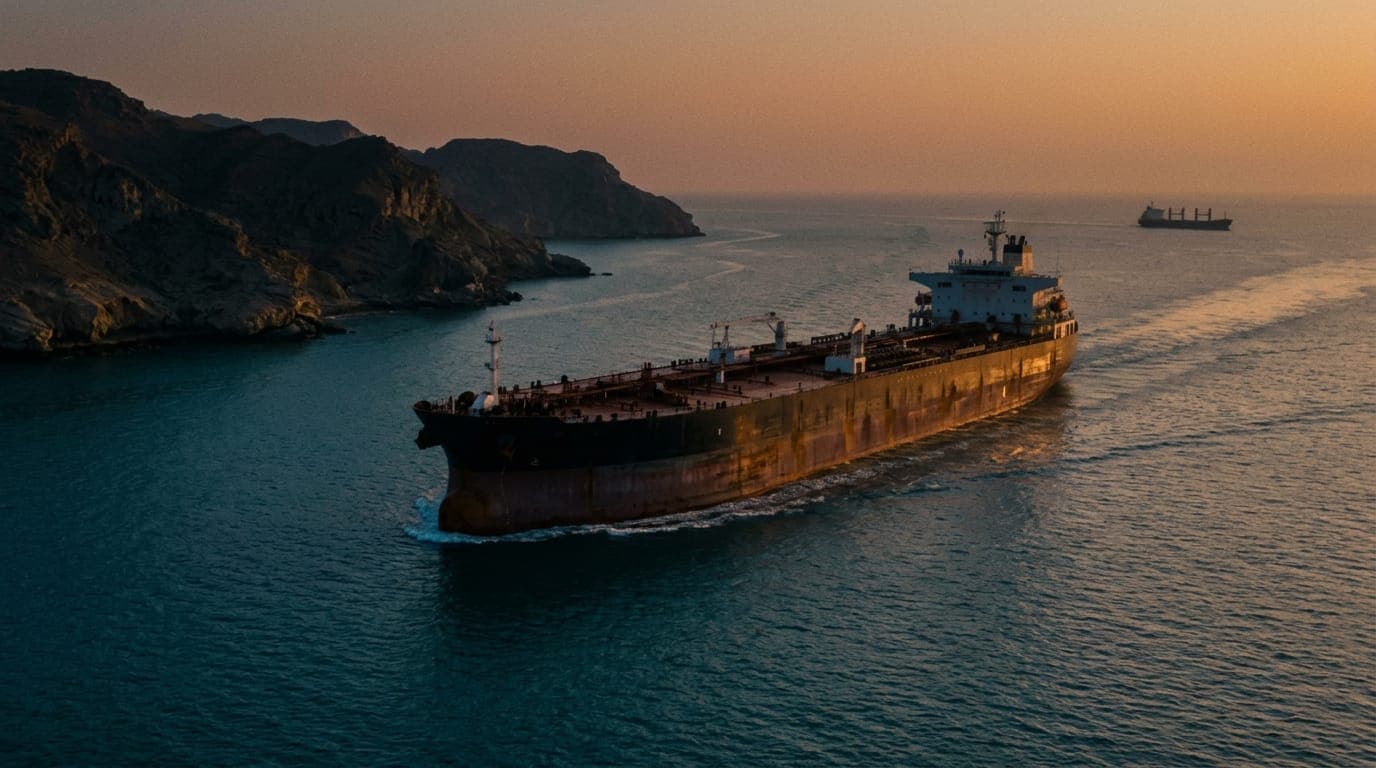
Tehran is selectively reopening the world's most critical oil chokepoint based on geopolitical loyalty, not maritime law.
Key takeaways
- Iran has formally exempted vessels from India, China, Iraq, and Qatar from Strait of Hormuz transit restrictions, with Chinese and Indian ships paying transit fees directly to Tehran; whether Iraqi vessels pay fees was not specified.
- Each exemption is explicitly tied to a bilateral arrangement: medicine imports for India, political backing for China, "mutual interests" for Qatar and Iraq. Dollar-based settlement is absent from every one.
- The Strait handles roughly 20% of global oil consumption and 25% of seaborne oil trade. Tehran's tiered access regime is the first codified example of a major energy chokepoint being used as a de-dollarization enforcement mechanism.
A senior Iranian lawmaker, identified across downstream sources as Amir Hayat-Moghaddam or Ahmad Hayat-Moghaddam, Deputy Chairman (also rendered Vice Chairman in some outlets) of the Iranian Parliament's National Security and Foreign Policy Committee, told the Iranian Students' News Agency (ISNA) on November 3, 2026 that Iran has granted transit exemptions through the Strait of Hormuz to vessels from India, China, Iraq, and Qatar. The announcement puts a formal structure around what had been a murky patchwork of bilateral workarounds, and it draws a clear line between nations inside and outside Tehran's preferred geopolitical orbit.
"We have currently exempted India, China, Iraq and Qatar from transit restrictions in the Strait of Hormuz. Ships from these countries pass freely," Hayat-Moghaddam stated in the ISNA interview, as reported by IranWire. "We are conducting business, and each of these exemptions has a distinct reason."
The Terms of the Deal
The rationale Hayat-Moghaddam laid out is explicit. India's exemption exists to facilitate medicine imports into Iran. China's exemption is designed to secure Beijing's political backing for Tehran. Qatari vessels pay no transit tolls at all. Iraq's terms were not specified beyond "mutual interests."
Crucially, Indian and Chinese ships pay transit fees directly to Tehran. Whether Iraqi vessels are subject to fees was not disclosed. That is bilateral settlement, outside SWIFT, outside the dollar. The IEA's Strait of Hormuz Factsheet puts the stakes in context: roughly 20 million barrels per day flowed through the Strait pre-crisis, representing approximately 20% of global oil consumption, 25% of seaborne crude trade, and 20% of global LNG trade. China and India alone received 44% of Hormuz crude exports in 2025.
Hayat-Moghaddam also claimed that US forces are not interdicting the exempted vessels. "The Americans do not intercept them either," he said in the ISNA interview, per IranWire. That claim is unconfirmed by the US Department of Defense or independent maritime tracking, and should be read as Tehran's stated position, not established fact. If it holds, however, the implication is significant: Washington may be tacitly tolerating a dollar-bypass energy corridor to avoid direct confrontation with two nuclear-armed trading partners.
Petrodollar Bypass, in Practice
This de-dollarization scenario is operating right now, at the chokepoint the IEA described as the site of "the largest supply disruption in the history of the global oil market" after Iran closed Hormuz to foreign shipping in response to the US-Iran war that began February 28, 2026.
Tehran is running a tiered access regime where passage rights are priced in diplomatic allegiance and direct bilateral fees, not dollars. Every barrel that moves under these terms is a barrel that did not require petrodollar infrastructure. The Hormuz standoff has already reshaped global energy flows.
The Dallas Fed's March 2026 analysis modeled a 2.9 percentage-point annualized hit to global real GDP for every 20% of supply removed. Prolonged disruption at that scale, combined with persistent energy-price pressure, creates the stagflationary trap central banks cannot cleanly exit: raise rates and kill growth, cut rates and fan inflation. Bitcoin, with a fixed supply and no sovereign jurisdiction, carries no counterparty exposure to that trap.
The falsifiable version of this thesis: if the US Navy confirms it is interdicting Chinese or Indian vessels despite Hayat-Moghaddam's claim, or if a formal diplomatic agreement re-normalizes Hormuz passage under US-led terms within weeks, the influence Tehran is signaling here is weaker than the announcement implies. Watch for confirmed maritime interdiction events or a sudden diplomatic thaw as the disproving triggers.
What to Watch
Whether through-tonnage for the four exempted nations actually increases is the ground truth that will confirm or hollow out Hayat-Moghaddam's announcement. Symbolic exemptions that produce no measurable cargo movement are just politics. Real flow data from maritime tracking services over the next 30 to 60 days will settle the question.
Separately, any US Navy statement on its rules of engagement for Indian or Chinese vessels in the Strait would either validate or directly contradict Tehran's "Americans don't interfere" claim and materially shift the calculus on how durable this corridor is. For background on how the Sinokor fleet ban and Saudi bypass positioning fit into the broader reshaping of Gulf energy flows, TFTC has been tracking both threads.
Sources
Frequently Asked Questions
Does this mean the Strait of Hormuz is fully reopening?
No. Iran's restrictions remain in force for all other nations. The exemptions carve out four specific trading partners based on bilateral political and economic arrangements. The broader blockade, which the IEA called the largest supply disruption in oil market history, is still in effect.
Why does it matter that Indian and Chinese ships pay transit fees directly to Tehran?
Those fees are settled bilaterally, outside the dollar-based SWIFT system. It is a live demonstration of non-dollar energy trade operating at scale inside the world's most critical oil chokepoint. De-dollarization theorists have described this mechanism for years. It is now running.
How does this connect to Bitcoin's macro thesis?
The selective Hormuz regime raises the probability of a prolonged stagflationary environment: persistent energy-price pressure alongside slowing global growth, with no clean central bank exit. Bitcoin's fixed supply and absence of sovereign jurisdiction make it the only monetary asset with no structural exposure to that policy trap.