Core Scientific Exits Bitcoin Mining by Year-End as AI Colocation Hits $215M
Core Scientific will complete its exit from Bitcoin self-mining by Q4 2026, entering 2027 as a pure-play AI colocation company. Q3 numbers show why: $215.4M in colocation revenue vs. $12.3M in self-mining from the same infrastructure.
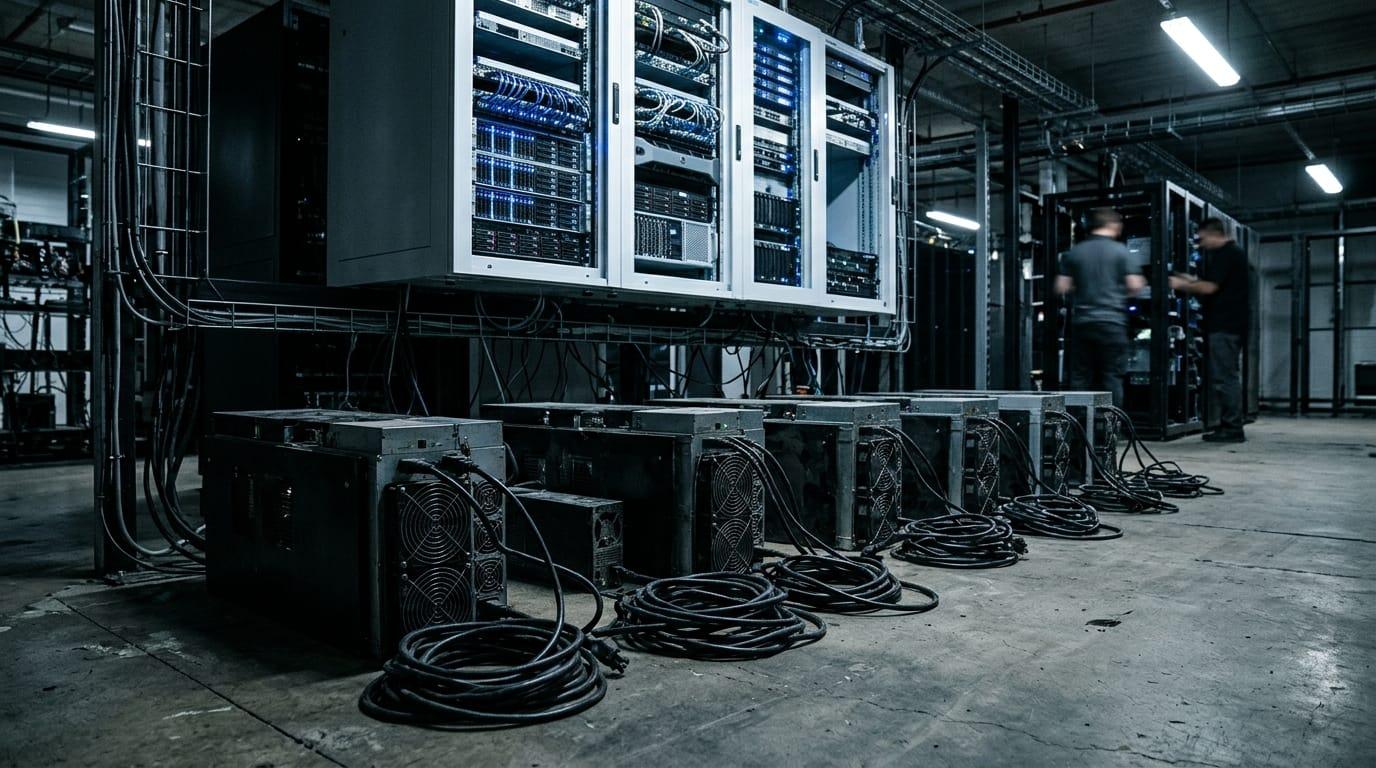
Once the largest publicly traded Bitcoin miner in the U.S., CORZ is turning off its last ASICs by December 31.
Key takeaways
- Core Scientific CEO Adam Sullivan confirmed on the Q3 2026 earnings call that the company will "complete our exit from Bitcoin mining by year end," entering 2027 as a pure-play AI colocation landlord.
- Q3 numbers show the economic logic: $215.4M in colocation revenue versus $12.3M in Bitcoin self-mining from the same power and floor space, a 17-to-1 ratio, with self-mining posting a $7.5M gross loss.
- As mid-tier public miners convert sites to AI tenants, hashrate ownership will consolidate among operators with the lowest all-in power costs. The structural pressure on the middle of the mining industry is accelerating.
Core Scientific (NASDAQ: CORZ) told investors on its Q3 2026 earnings call, November 5, that it will shut down its remaining Bitcoin mining fleet before December 31, completing a pivot that has already cut its online miner count by nearly 50% since year-end 2025. CFO Jim Nygaard said the company expects to "complete the wind-down during the fourth quarter." The Q3 financials explain the decision in one line: colocation now accounts for roughly 92% of total revenue.
The Q3 2026 earnings press release filed with the SEC shows colocation revenue climbing nearly 60% sequentially to $215.4M, while digital asset self-mining revenue fell to $12.3M. Hosted mining for third parties added $5.2M. Total revenue: $232.9M. Adjusted EBITDA more than tripled sequentially to $133.6M, with margin expanding to 57% from 25%.
The Revenue Gap Is the Whole Story
Colocation ran at a 60% gross margin, generating $128.4M in gross profit. Self-mining posted a $7.5M gross loss. Same campuses. Same megawatts.
The 17-to-1 revenue ratio between AI colocation and Bitcoin self-mining is not a fluke of one bad quarter, it reflects what large-scale LLM inference and training workloads can pay per megawatt-hour versus what an ASIC can generate at current difficulty and price. That spread is why a company once described by its own CEO as the largest publicly traded Bitcoin miner is walking away entirely.
Core Scientific is billing for 485 MW of colocation capacity as of September 30, up 90 MW in the quarter, representing more than $700M in average annualized GAAP colocation revenue. The remaining roughly 100 MW under its CoreWeave buildout is in commissioning. Beyond CoreWeave's 590 MW under contract, an AMD-backed agreement covers 530 MW across five campuses, with initial delivery targeted for the first half of 2027 and full delivery by end of 2028.
Combined, those two relationships represent approximately 1.1 GW. Management expects that portfolio to generate $1.8B in average annual run-rate revenue and $1.6B in net operating income once fully delivered. Nygaard framed 2027 as a "very clean P&L", no mining in the numbers, just colocation run-rate.
The AI revenue convergence trend across the mining sector has been building for several quarters. CORZ is the most complete example yet: going from the largest publicly traded Bitcoin miner to zero self-mining in roughly two years. CORZ is making a full exit, not hedging at the margin.
What It Means for Bitcoin's Hashrate
When a formerly top-tier miner exits, the hashrate does not disappear. Difficulty adjusts. The question is what happens to the ownership structure of that hashrate, and the answer is consolidation.
Operators without stranded or sub-$0.03/kWh power cannot compete with AI colocation economics at current Bitcoin prices and difficulty levels. The hashrate picture already reflects this: global hashrate keeps climbing even as mid-tier public miners convert sites, because the remaining operators are running leaner and harder.
Bitcoin's security budget is not shrinking. But fewer, larger entities are controlling an increasing share of it. That centralization pressure is worth watching.
The Bitcoin treasury liquidation at CORZ tells its own secondary story. Digital assets on the balance sheet fell from $222M at year-end 2025 to $49.7M at the end of Q2, then to $2.7M at September 30. That is roughly $219M in BTC liquidated across three quarters, absorbed without breaking the price, which is itself a signal about Bitcoin's bid depth at this stage of the cycle.
The falsifiable thesis here: AI capex is structurally repricing computational power away from Bitcoin mining at the infrastructure layer, and only the lowest all-in cost operators survive long-term. The trigger that disproves it is a fast enough Bitcoin price appreciation, combined with a hyperscaler capex pullback, that makes self-mining economical again before conversion is complete. Watch AI hyperscaler capex guidance in Q1 2027 earnings and whether any currently converting miner re-enters self-mining within 18 months.
What to Watch in Q4
The immediate test is whether Core Scientific turns off its last machines on schedule before December 31. The AMD financing package and commissioning timeline for the remaining CoreWeave capacity are the two operational variables that determine whether Nygaard's "very clean P&L" actually lands clean. Any delay in the AMD initial delivery (targeted 1H 2027) or a slip in the CoreWeave commissioning would put the 2027 revenue ramp at risk. Investors will also be watching whether the 32 GW power shortfall facing U.S. data centers creates any constraint on CORZ's ability to energize those five AMD campuses on schedule.
Sources
Frequently Asked Questions
Does Core Scientific's exit from Bitcoin mining hurt the network's security?
No, not directly. When one operator exits, its hashrate redistributes to remaining miners and difficulty adjusts downward at the next epoch. The network's security budget is a function of total hashrate and fee revenue, not which company is producing the blocks.
The more relevant concern is concentration: as mid-tier public miners exit, a smaller number of operators with structural power cost advantages control an increasing share of hashrate. That is a centralization pressure to monitor, not an immediate security threat.
What is the difference between Core Scientific's $1.2 billion net income and its $133.6 million adjusted EBITDA?
The $1.2B GAAP net income figure is dominated by a non-cash warrant fair-value gain. It does not reflect operating performance. Adjusted EBITDA of $133.6M is the operational number, representing what the business actually generated from colocation and mining activity in the quarter. For evaluating the AI colocation pivot, the EBITDA figure and the 57% margin are the relevant metrics.
What happens to Bitcoin miners that cannot pivot to AI colocation?
Operators without the balance sheet to build out high-density power infrastructure, or without a structural power cost advantage (stranded gas, sub-$0.03/kWh hydro, vertically integrated generation), face a narrowing set of options: merge with a better-capitalized peer, sell their sites to an AI tenant, or absorb losses until the next halving cycle shifts the economics. The conversion of former mining sites to AI data center use is already underway across the sector. The bifurcation between operators that can make that transition and those that cannot is the defining dynamic of the current mining cycle.