Russia Doubled Diesel Exports Under Trump's Waiver, Zero Barrels Reached the US
Five weeks after Trump announced Putin would immediately supply diesel to the American marketplace, Kpler data shows Russia doubled exports in October, to barely 37% of a normal month, and not one barrel has cleared a US port.
Five weeks after the deal was announced, the receipts are in: the global marketplace got the diesel, and America got nothing.
Key takeaways
- Russia shipped 271,000 barrels per day of diesel in October, per Kpler data first reported by the Financial Times, double September's volume but only ~37% of the five-year October average of roughly 700,000 b/d.
- At least three named US-bound tankers were turned away or rerouted after a bipartisan Congressional pushback and state-level port blockades; the Agioi Fanendes, carrying roughly 300,000 barrels, remains stranded off the East Coast with no buyer.
- OFAC's General License 135 waiving sanctions cannot override a law passed by Congress, and no US terminal operator will accept the legal and reputational risk, making the deal structurally unenforceable at every link in the chain.
On October 9, 2026, President Trump posted on Truth Social that he had "just concluded a highly successful discussion with President Vladimir Putin" in which Russia agreed to "immediately supply over 300,000 Tons of Diesel Fuel to the American and Global Marketplace, another 500,000 Tons during the month of November, and 1,000,000 Tons immediately thereafter." The Treasury Department's Office of Foreign Assets Control simultaneously issued General License 135 waiving sanctions on Russian diesel imports. Five weeks later, per Kpler data first reported by the Financial Times, Russia shipped 271,000 barrels per day in October, double September's 135,000 b/d, and every barrel went to Brazil, Turkey, or elsewhere.
The Numbers Don't Lie
Doubling exports sounds like progress until you see the baseline. Energy Aspects head of geopolitics Richard Bronze told the Financial Times that October's 260,000 b/d figure compares to a five-year October average of roughly 700,000 b/d. Russia doubled its exports to barely a third of a normal month. The IEA's November Oil Market Report confirmed 1.13 million metric tons of Russian diesel and gasoil loadings in October, with Turkey receiving roughly 240,000 mt and Brazil roughly 160,000 mt, as reported by the IEA.
Ukrainian drone strikes resumed on Russian refineries on October 30 after a brief pause, disrupting an estimated 30% of Russian refining capacity, per Reuters. Kpler analyst Sumit Ritolia told the Financial Times that Russia, already rationing gasoline domestically, will prioritize domestic supply. Energy Aspects expects Russian exports to remain weak in coming months. The Trump-Russia Ukraine energy ceasefire that was supposed to hold the truce together had no terms and no Kremlin confirmation from the start.
The Legal Blockade
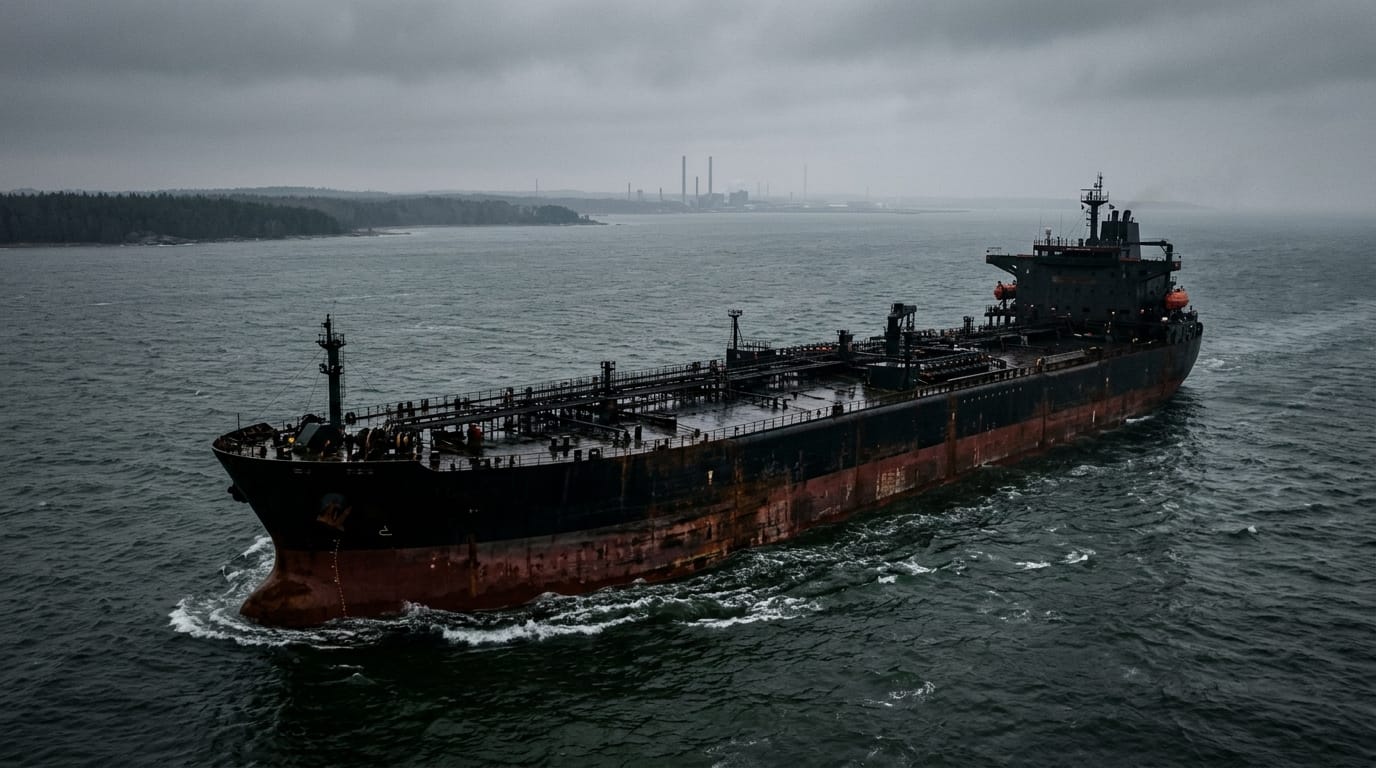
At least three tankers set course for the United States under the agreement, with Russia announcing four had been loaded. The Malta-flagged Agioi Fanendes loaded roughly 40,000 metric tons (~300,000 barrels) of ultra-low sulfur diesel at Primorsk on October 22, signaling New York. The Leruo and the Talisman followed.
Then Congress showed up. A bipartisan group of lawmakers warned banks and port authorities in New York/New Jersey, Houston, Beaumont, and Corpus Christi that accepting the cargoes could violate the 2022 congressional ban on Russian energy imports. Senator Richard Blumenthal wrote directly to the Agioi Fanendes' Greek owner warning that discharge would constitute an illegal transaction, per Maritime Executive. New Jersey Governor Mikie Sherrill told port and terminal operators to reject the tankers outright, arguing that Treasury's OFAC license cannot override a statute passed by Congress.
The result: the Leruo switched destination to Brazil. The Talisman diverted into the Mediterranean. The Agioi Fanendes, per Bloomberg, turned around roughly 400 nautical miles from New York and is now idling off the East Coast, with Reuters separately reporting it halted there. The White House says "negotiations with the owner are ongoing", which is a candid way of confirming nobody has bought the cargo yet.
The sanctions waiver architecture has the same structural problem here as elsewhere: an executive OFAC license can suspend enforcement, but it cannot repeal a law. Terminal operators, staring at bipartisan legal threats and potential federal contracting consequences, are treating the congressional statute as supreme.
What the Deal Actually Reveals
The White House's response to empty US ports is that more Russian diesel on the global market lowers prices for Americans indirectly. A barrel landing in Santos is a barrel the Gulf Coast doesn't have to ship to Brazil. That is a valid commodity-market argument, though a substantially smaller claim than "Russia will immediately supply diesel to the American marketplace."
Here's the math worth sitting with: the Agioi Fanendes carries roughly 300,000 barrels. EIA weekly distillate supplied data puts US distillate demand in a range of roughly 3.5 to 4 million barrels per day depending on the week, per the EIA Weekly Petroleum Status Report (eia.gov/petroleum/supply/weekly/). Even if the Agioi Fanendes had docked and discharged without incident, that cargo covers a matter of hours of American demand. The entire deal, executed perfectly, was a rounding error.
The deeper problem is structural. Russia's refinery capacity is constrained by resumed drone strikes. The export ban remains in place through end of January, with limited exceptions per Deputy PM Alexander Novak.
US terminal operators won't touch the cargo, and Congress hasn't moved to authorize imports under the 2022 ban. Those three blockers are simultaneous, and any one of them would be sufficient on its own.
Meanwhile, Russian crude is moving through other channels, and the broader sanctions architecture is under sustained pressure from every direction.
What to Watch
Three conditions would need to be true simultaneously for Russian diesel to actually reach a US port: Congress explicitly authorizing imports under the 2022 ban, US terminal operators accepting cargoes despite bipartisan legal threats, and Russian refinery capacity recovering enough to consistently supply export volumes near the 700,000 b/d historical average. Watch for movement on any of those three. Right now, the probability of all three converging is effectively zero, and the Agioi Fanendes has been sitting off the East Coast for over a week with no resolution in sight.
Sources
- Trump Truth Social post text, confirmed by Al Jazeera, Axios, NBC News, and CNBC (October 9, 2026)
- Financial Times, Kpler and Energy Aspects data, Agioi Fanendes tracking, White House statement (first reported by the Financial Times, November 12, 2026)
- IEA Oil Market Report, November 2026
- EIA Weekly Petroleum Status Report, US distillate supplied
- Maritime Executive, Senator Blumenthal letter to Agioi Fanendes owner
- Reuters, Ukrainian drone strikes resume on Russian refineries, October 30, 2026
Frequently Asked Questions
Can Trump's OFAC waiver override the 2022 Congressional ban on Russian energy imports?
No, at least not in practice. Executive branch sanctions authority allows OFAC to issue general licenses suspending enforcement, but it cannot repeal a statute passed by Congress. State governors and terminal operators are treating the congressional prohibition as the controlling law, and the bipartisan nature of the pushback makes a legislative fix politically unlikely in the near term.
Why did Russian diesel go to Brazil and Turkey instead of the United States?
Market mechanics. Brazil and Turkey have willing buyers, existing offtake relationships, and no legal prohibition on Russian energy imports. The barrel goes where it clears. With US terminal operators facing bipartisan legal threats and potential federal contracting consequences, there is no willing counterparty on the American side regardless of the OFAC waiver.
What would it actually take for the deal to work as originally described?
Three things simultaneously: Congress authorizing imports under the 2022 ban, US terminal operators accepting cargoes despite existing legal risks, and Russian refinery capacity recovering enough to sustain exports near historical norms. Ukrainian drone strikes resumed October 30 and are suppressing Russian output. None of the three conditions are currently in motion.