Norway Freezes AI Data Center Grid Access After 26,000 MW Demand Surge
Norway's national grid operator Statnett froze all new data center capacity reservations on November 9, 2026, after a single year produced 26,000 MW in applications, more than Norway's entire national peak electricity demand.
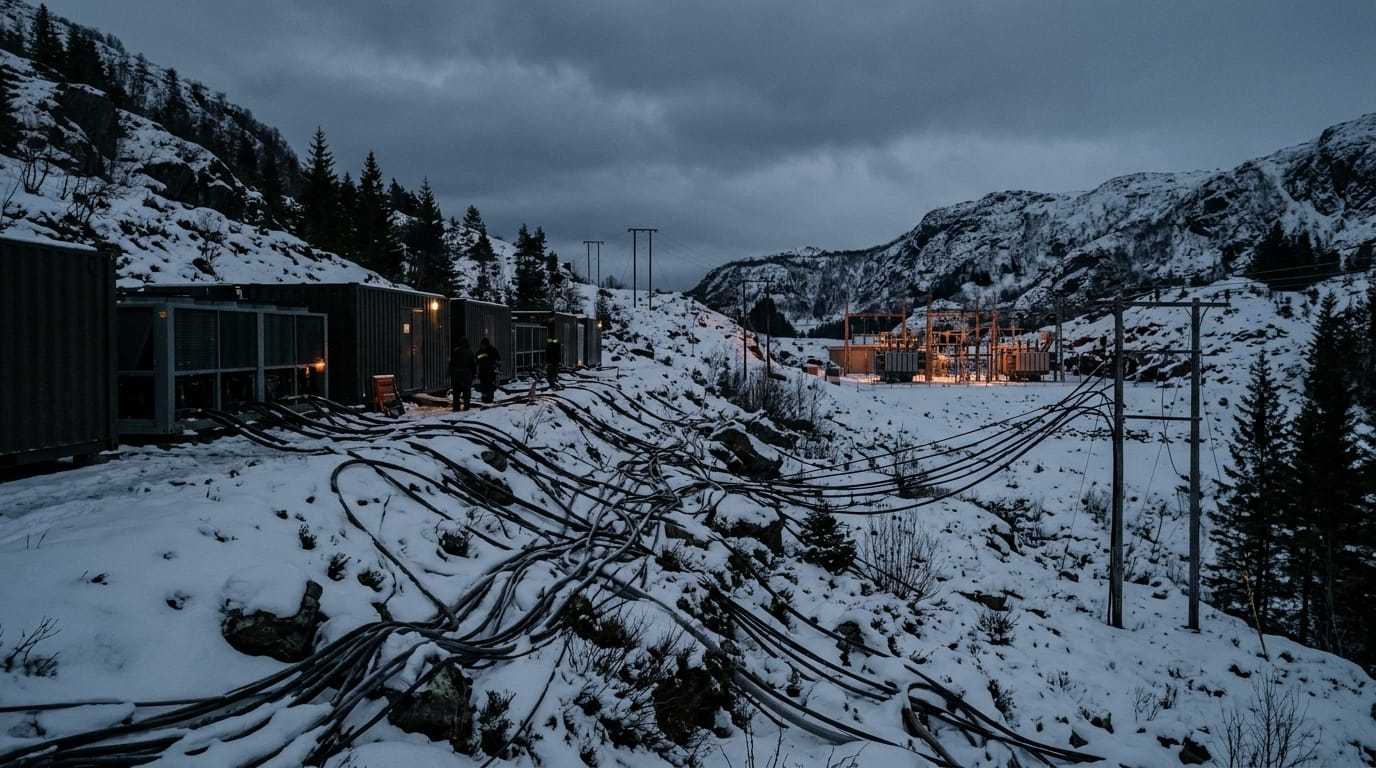
Norway's grid operator halted all new data center capacity reservations after a single year of AI-driven applications exceeded the country's entire national peak electricity demand.
Key takeaways
- Statnett, Norway's national grid operator, froze new large-scale data center capacity reservations effective November 9, 2026, with the halt expected to remain in place until at least August 1, 2027.
- Applications received in 2026 alone totaled 26,000 MW, surpassing Norway's national peak electricity demand of roughly 25,000 MW; data centers accounted for 75% of that volume.
- Even a net power exporter sitting on abundant hydroelectric capacity could not absorb the AI capex wave without rationing grid access, confirming that energy scarcity is now the central constraint on global AI infrastructure buildout.
Norway's national transmission system operator Statnett halted all new grid-capacity reservations for data centers on November 9, 2026, in a move the government called essential to maintaining responsible system operation. The Norwegian government simultaneously announced a coming licensing scheme to prioritize which large electricity consumers will be allowed to connect. The freeze applies specifically to new applicants seeking direct 420 kV high-voltage connections; existing grid connections and already-approved projects are unaffected.
The scale of the demand pressure explains the urgency. Per Statnett's press release, "Midlertidige tiltak for fortsatt forsvarlig systemdrift" (Temporary measures for continued responsible system operation), just 800 MW of data center capacity is currently connected to Norway's grid. Another 4,200 MW sits approved but unconnected. The queue holds 9,100 MW. Preliminary requests account for a further 18,000 MW.
Energy Minister Terje Aasland confirmed that total new capacity applications received in 2026 reached 26,000 MW, with data centers driving 75% of that figure, a volume that exceeds Norway's entire national peak demand, first reported by Reuters on November 9.
A Dam Wall Hits the AI Capex Flood
Norway is a net electricity exporter, powered overwhelmingly by hydroelectric generation, with one of the highest per-capita electricity outputs in Europe.
Digitalization Minister Torgeir Micaelsen was direct at the government's November 9 press conference: "We want data centers in Norway, but we can't have all types of data centers." He added: "We must therefore control the growth and ensure that Norway gets the data centers we actually need, those that provide the greatest societal benefit."
The numbers make the constraint tangible. The 32 GW power shortfall Morgan Stanley projected for U.S. data centers through 2028 now has a European mirror image. The EIA's record U.S. power demand projections through 2027 pointed the same direction. Norway just made it sovereign policy.
The government also floated requiring new data centers to construct dedicated gas-fired power plants with carbon capture as a condition of approval. This is a government telling the AI industry to internalize the cost of generation, not just consumption.
What Bitcoin Miners Already Know
Bitcoin miners have been absorbing this lesson for years, under considerably less favorable political conditions. Grid pressure, curtailment agreements, and regulatory hostility have been standard operating conditions for mining operations in Texas, the Nordics, and across North America. The industry's response has been to build dispatchable, behind-the-meter generation infrastructure: stranded gas, flared methane, co-located hydro. The model that looked like necessity is now looking like foresight.
AI hyperscalers are arriving at exactly the same wall at massive scale, with far less operational flexibility. A data center running inference or training cannot go offline for four hours without consequences. A Bitcoin miner can. That interruptibility is the grid-compatibility argument miners have been making to energy regulators for years, and Norway's freeze hands that argument another data point.
The "build your own plant" precedent matters beyond Norway's borders. Projects like Torus's modular AI compute strategy of deploying where power already exists, or The Nuclear Company's Kentucky campus anchoring new generation to large power consumers, reflect the same underlying logic: if you need guaranteed electrons at scale, you eventually need to own or co-develop the generation asset. Bitcoin miners figured this out first.
The falsifiable version of that thesis: if Norway lifts the freeze before August 2027 without meaningful new generation capacity coming online and AI data center build-out resumes at pace without materially higher electricity prices or grid stress, the structural energy constraint argument softens. If Norway fast-tracks modular nuclear or new hydro that absorbs demand within 18 months, same conclusion. Watch the generation side of the ledger, not just the policy announcements.
What Comes Next
The Norwegian government's licensing scheme will determine which data center categories get priority connection rights. The regime is expected to take shape before the August 1, 2027 freeze deadline. Norway in 2025 announced plans for a separate temporary ban on new proof-of-work crypto mining data centers, with legislation expected that autumn; the relationship between that prior measure and the new licensing framework remains to be clarified in formal licensing documents. The structure of priority tiers, and whether any compute workloads are explicitly excluded, will be the signal worth watching when the scheme is formally published.
Sources
- Statnett AS, "Midlertidige tiltak for fortsatt forsvarlig systemdrift," November 9, 2026, statnett.no
- Norwegian Government press conference, Ministers Torgeir Micaelsen and Terje Aasland, November 9, 2026
- First reported by Reuters, November 9, 2026
Frequently Asked Questions
Does the freeze affect Bitcoin mining operations already running in Norway?
No. Statnett confirmed that existing grid connections are unaffected. The halt applies only to new large-scale grid-capacity reservations. Norway's separately announced 2025 plans for a temporary ban on new proof-of-work crypto mining data centers is a distinct action from this freeze.
Could this freeze benefit Bitcoin miners already in Norway's grid queue?
Potentially. Removing a large wave of new, power-intensive competitors from the reservation queue reduces pressure on the pipeline for projects already approved or connected. The coming licensing scheme's priority structure will clarify how different compute workloads are treated going forward.
What does the "build your own power plant" proposal mean practically?
It signals that governments are moving toward requiring large electricity consumers to internalize generation costs rather than draw purely from the shared grid. Bitcoin miners operating behind-the-meter or co-developing stranded energy sources are structurally ahead of this curve. AI hyperscalers are now being pushed onto the same path.