Whitney Webb

Guest

Whitney Webb

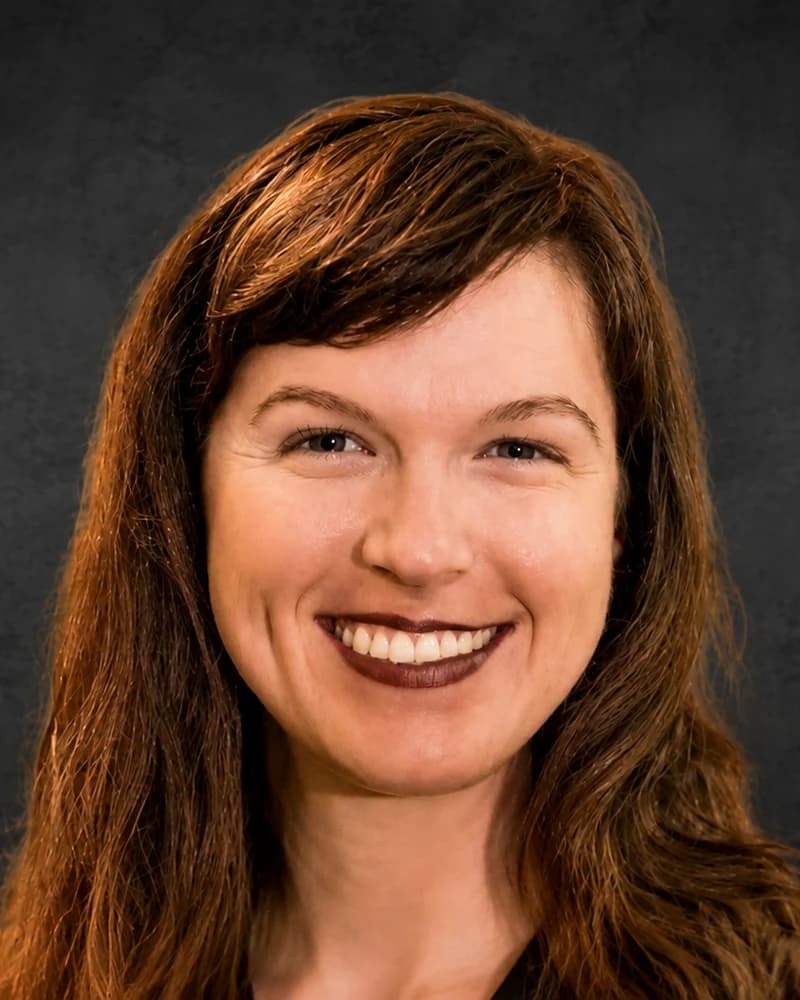
Investigative journalist · Founder of Unlimited Hangout

Whitney Webb is an investigative journalist, the founder of Unlimited Hangout, and the author of One Nation Under Blackmail, a two-volume investigation into how organized crime, US intelligence agencies and the Jeffrey Epstein network overlap. She has been interviewed on TFTC eight times since 2023, usually alongside her collaborator Mark Goodwin, and has written for the site.

Role
Investigative journalist
Founded
Unlimited Hangout
Book
One Nation Under Blackmail, 2 vols. (2022)
Beat
Intelligence, organized crime, financial surveillance
Usually with
Mark Goodwin
On TFTC
8 interviews · May 2023 – Sep 2025
Updated

Webb's reporting traces a single argument across decades: that the boundary between organized crime, the intelligence services and the private financial sector is not a boundary at all, and that reading them as separate institutions is what makes their behaviour look inexplicable. One Nation Under Blackmail applies it to the Epstein network; her work at Unlimited Hangout applies it to surveillance contracting, stablecoin legislation, carbon markets and the tokenization of physical assets.

The TFTC interviews work as a series. In May 2023 she described the shape a US central bank digital currency would actually take — Fed tokens for settlement between banks, bank-issued “deposit tokens” for the public, never called a CBDC — and the conversations since have followed that prediction through the stablecoin bills, the Epstein disclosures and Palantir's expanding federal footprint. Read in order they are one argument being extended into new territory, not eight unrelated interviews.

On TFTC · 8 interviews

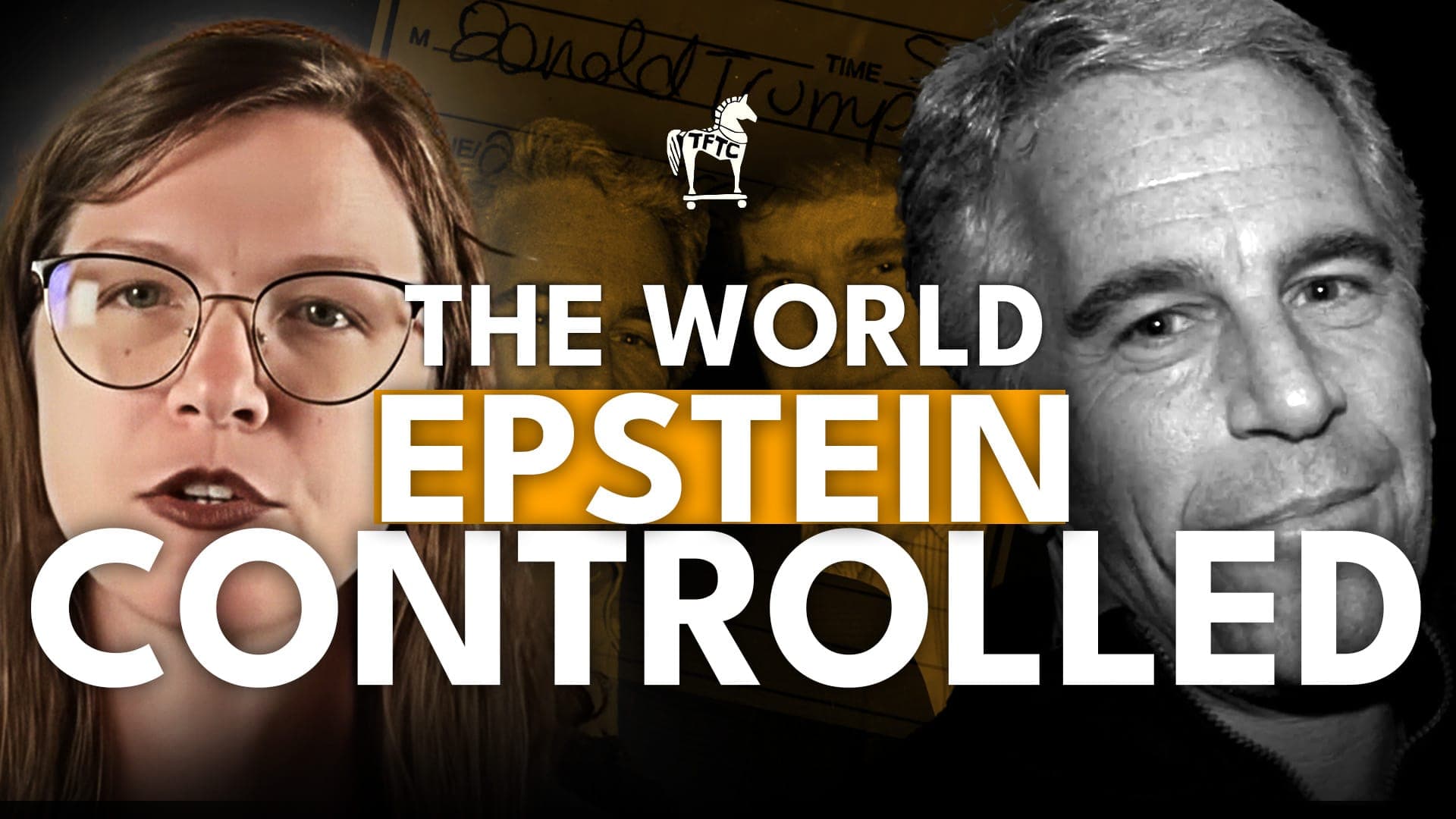
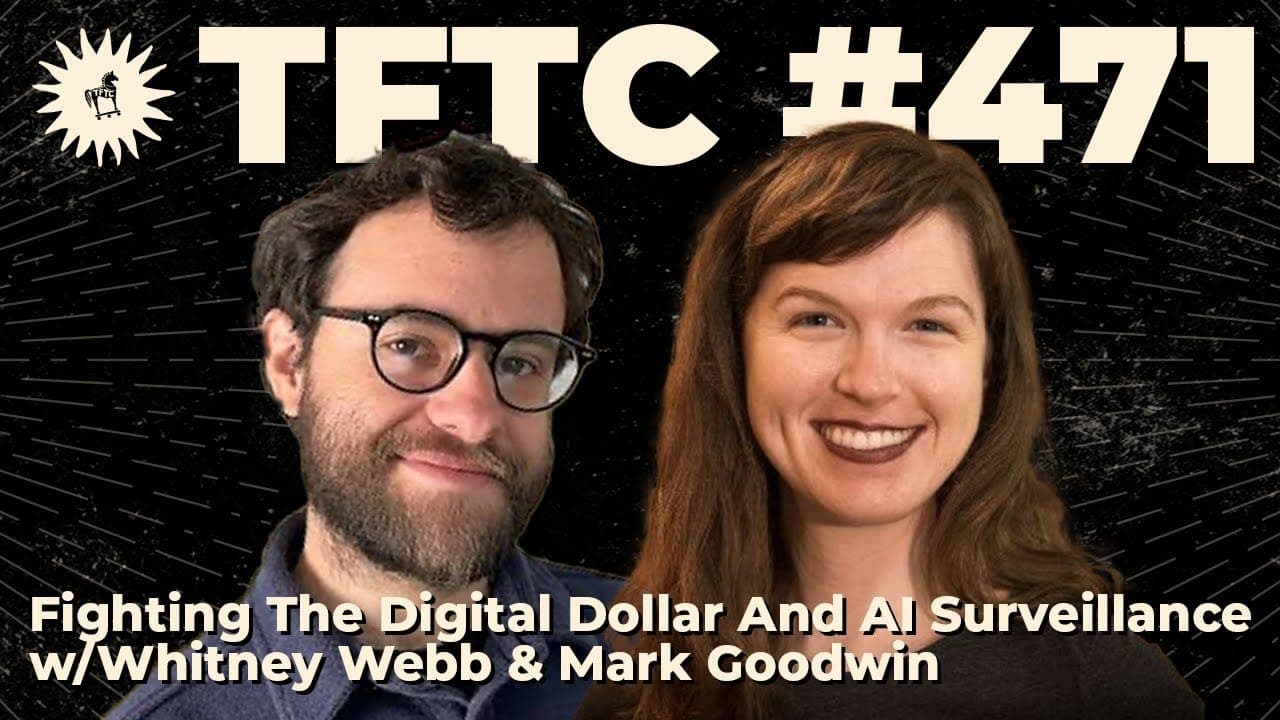
Whitney Webb and Mark Goodwin on the TFTC podcast discussing stablecoins, the election, and dollar hegemony

Whitney Webb and Mark Goodwin on Stablecoins and Dollar Hegemony

Recorded the week after the 2024 election, Whitney Webb and Mark Goodwin warn that the result didn't change the plan: stablecoins are being built into a programmable, surveillable dollar designed to extend US reach over anyone who touches it, and to fund the debt rather than escape it.

Whitney Webb and Mark Goodwin on the TFTC podcast discussing Palantir, pre-crime, and the privatized surveillance state

Whitney Webb and Mark Goodwin on the Privatized Surveillance State

Investigative journalists Whitney Webb and Mark Goodwin on how the surveillance state was deliberately routed through the private sector, from Palantir as privatized Total Information Awareness to legalized pre-crime, and why the surveillance dollar runs on the exact same trick.

Whitney Webb and Mark Goodwin on the TFTC podcast discussing carbon markets, satellites, and the surveillance dollar

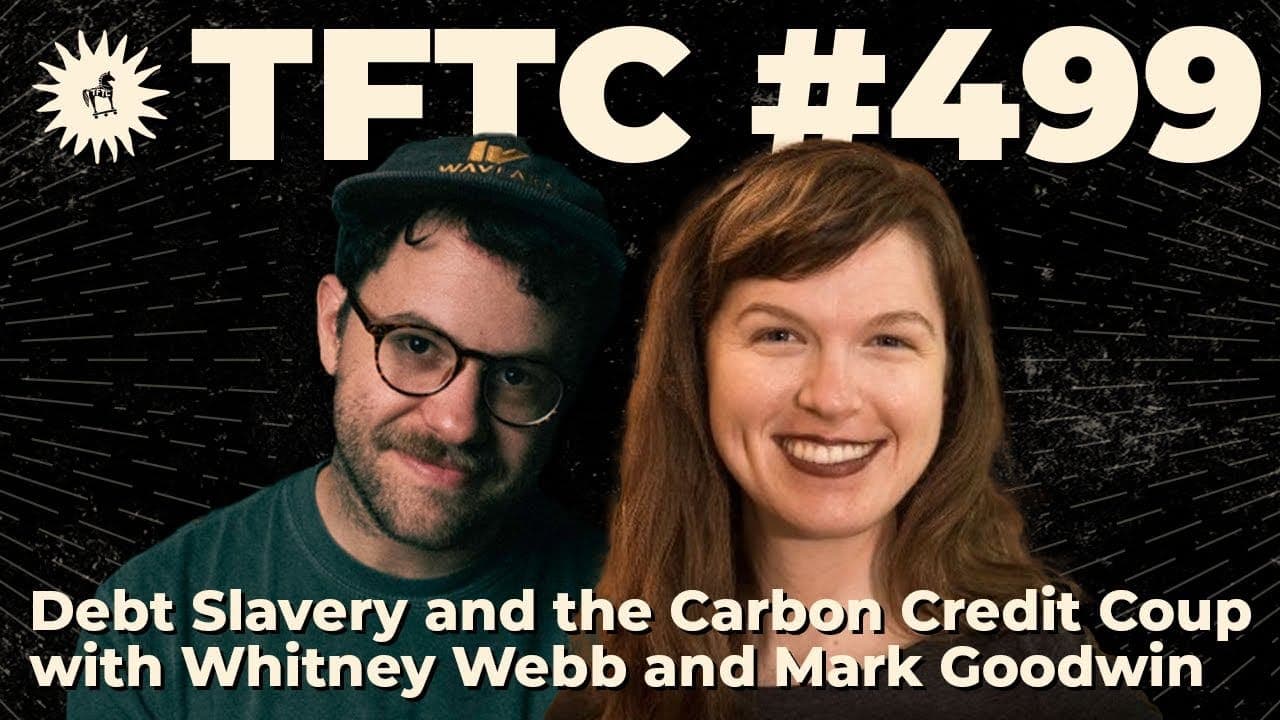
Whitney Webb and Mark Goodwin on the Carbon Credit Coup

Investigative journalists Whitney Webb and Mark Goodwin on how carbon markets, satellite surveillance, and a Bitcoin sidechain are being wired together to financialize nature, manufacture new demand for US debt, and extend the surveillance dollar into the physical world.

Whitney Webb and Mark Goodwin on the TFTC podcast discussing stablecoins as a synthetic CBDC

Whitney Webb and Mark Goodwin Called the Synthetic CBDC in 2023

In December 2023, investigative journalists Whitney Webb and Mark Goodwin argued the US digital dollar would not arrive as a Fed CBDC but as privately-issued, surveillable stablecoins. A year and a half later, the GENIUS Act codified exactly that. Here's the conversation that called it.

What Whitney argues

Positions drawn from Whitney’s TFTC appearances, grouped by theme. Quotes are from TFTC’s own recordings and are dated.

The two-tier CBDC she called in 2023

Her most specific prediction on TFTC, and the one events have followed most closely. Asked in May 2023 what an American central bank digital currency would look like, she said it would not look like one: the Fed would issue tokens for settlement between banks, and the public would hold programmable “deposit tokens” issued by the commercial banks — surveillable, programmable, and never called a CBDC. She repeated it in October and December 2023 and again in February 2024. By the September 2025 conversation the subject was the GENIUS Act and the digital-ID requirements the Treasury had begun attaching to it.

The Fed will issue the CBDC tokens, but the wallets will be managed by the commercial banks.

They're going to try and keep the two-tier system. The public will interact instead with deposit tokens issued by the commercial banks. They're not called CBDCs, but they're programmable money, and they're going to run on the rails of FedNow.

A bank-issued stablecoin is still just as surveillable and programmable as a hypothetical CBDC would be.

Some of these forms of digital control, like the CBDC and their private-sector equivalents: programmable, surveillable money.

Pre-crime: surveillance built to predict, not to record

Webb uses “pre-crime” literally. Her claim is that the data collection everyone worries about is the less important half; the point is to feed it into models that flag people before they act, and that the legal scaffolding for this was laid in the United States in 2019. On TFTC in 2025 she connected it to Palantir's expanding federal contracts, to companies selling schools and 911 systems software that promises to prevent shootings before they happen, and to how loosely the government's definition of domestic terrorism is written.

This isn't just about surveilling what you do in the present moment or what you've done in the past. This is using all of that data from past and present, feeding it into AI, and using it to predict if you'll engage in naughty behavior in the future.

Palantir was specifically created to be a pre-crime entity. It is a successor to the post-9/11 program housed in DARPA called Total Information Awareness.

A lot of the war on terror infrastructure was always meant to be used domestically at some point.

Governments tend to use these vague definitions to their advantage. They give themselves a lot of wiggle room so they can label whoever they want a domestic terrorist.

In order to get people to relinquish civil liberties enough to have this kind of predictive policing infrastructure be the norm, something really big has to happen. People have to get really angry and, more importantly, people have to get really insecure and fearful.

Privatizing the panopticon

Her account of how the surveillance state was built is that it was built twice: first inside the military, where the public rejected it, and then again as venture-backed companies, where the same programs were celebrated as innovation. She argues the second version is not the free market but the first program with a different owner — and that its power does not depend on the technology working.

There's a historical precedent in the US: when they pitch a particular policy or create a particular entity and it gets pushback for being openly part of the government, they privatize it, and then no one complains.

Facebook was a resurrected DARPA program called LifeLog. Facebook was launched on the same day that DARPA had to shutter LifeLog.

It's not really the free market. It's cronyism. It's crony capitalism. It's cartelism.

It's all about the illusion of those systems being in place — the idea that being under constant observation will make you behave, even if they don't do anything, because you know they're watching you.

Intelligence and organized crime as one system

The organising claim behind her books, and the one she returns to most often on TFTC: that the intelligence services and organized crime did not merely cooperate but merged, early, and that the Epstein network is a symptom of that merger rather than an aberration within it. She is consistently impatient with treating it as a partisan story.

Organized crime merged with intelligence in the '40s, even before the CIA existed.

You can't really tell where organized crime and intelligence agencies end and begin — for all intents and purposes, they're the same.

I don't really like that it's being treated as partisan when the historical record very clearly shows it's a bipartisan disease.

Turning the physical world into collateral

Her carbon-market and tokenization reporting is a single thesis: the financial system needs a new asset class to keep expanding, and the natural world is being surveyed, priced and securitised to supply one. She traces the idea's institutional lineage — the same names, over decades — rather than treating it as a recent invention.

What GFANZ proposes is creating a new financial governance system — seizing what they call the new Bretton Woods moment — basically recreating the global financial system and reimagining the multilateral development banks.

He had Richard Sandor come and basically launch the whole idea of creating this private carbon market as a solution to the climate change situation.

The left–right divide as a delivery mechanism

Webb reads partisan politics as a distribution system rather than a contest: one side creates the problem, the other arrives with the solution, and the solution is the one both agreed on beforehand. The practical consequence she draws is that the most dangerous moment for civil liberties is when one's own side is winning, because that is when people stop paying attention.

One hand creates the problem and the other hand comes in offering the solution to the problem the other hand created. But it's the same solution both sides agreed on the whole time, more often than not.

There are a lot of things that have an extreme bipartisan consensus that are very bad for individual freedom.

They want people complacent. They want people to feel like the opposition has won, but really they agree about the plan at the end of the day.

Complacency and the efforts to manufacture it are dangerous.

Where Bitcoin fits

Webb is not a Bitcoin evangelist and does not talk about price. Her interest is in what the institutional embrace of Bitcoin is for — she reads BlackRock's ETF and Larry Fink's reversal as co-option, not conversion — and in the tools around it. What she asks of the Bitcoin audience is less enthusiasm and more work on the software that keeps people out of the systems she reports on.

My policy tends to be: don't trust Wall Street giants. They become that powerful on Wall Street because they're pretty cutthroat and criminal. That's how you rise to the top of that particular sphere.

He openly abandoned the ESG terminology and straight up said that climate finance is about profits, not about wokeness or saving the planet. And since then he has also 180'd his stance on Bitcoin and changed a lot of his talking points, which I think is very notable.

If you're serious about fighting this stuff, you have no excuse not to invest in some sort of freedom tech. People, particularly in the Bitcoin space, need to put a lot more attention on freedom tech and on supporting the developers building it.

What she actually recommends

Webb is regularly accused of diagnosing without prescribing, and has a standing answer. It is deliberately unglamorous, and it has not changed across the series: nothing arrives from above, the convenient option is the trap, and the work is local.

We've been trained as a society to outsource everything to other people — to corporations, to the government. That's why we have this sovereignty crisis.

You should not be validating the current system at all. Instead, you should be divesting from it and putting your money and time into building a new system.

The whole selling point of that system is that it's convenient and easy. So obviously it's going to take some work to go the other route. But the future of human freedom depends on it, so I think it's a pretty easy choice.

I have long believed that change is going to come from the bottom up, not the top down — that people need to really focus on their local communities, on local resilience, and on building out alternatives.

Whitney’s writing on TFTC

  • Crowning the King of Wall Street

    Crowning the King of Wall Street

    After the search committee involving the aforementioned directors was formed, they hired the search firm Russell Reynolds to manage the search process and narrow the pool of potential CEO candidates down to 25 finalists.

Elsewhere

Notable appearances on other shows, newest first.

Common questions

Who is Whitney Webb?
Whitney Webb is an independent investigative journalist. She founded Unlimited Hangout, an outlet for long-form investigations, and wrote One Nation Under Blackmail, a two-volume study of the connections between organized crime, US intelligence agencies and the Jeffrey Epstein network. Her reporting concentrates on financial surveillance, intelligence contracting and the institutions behind digital-ID and carbon-market policy.
What is One Nation Under Blackmail about?
Published in 2022 in two volumes, it argues that the Epstein scandal was not an isolated case but the product of a decades-old merger between organized crime and intelligence agencies, and traces the financial and political networks that made it possible. Webb has said on TFTC that the merger predates the CIA itself.
What does Whitney Webb say about stablecoins and CBDCs?
That the United States will not issue a retail central bank digital currency, because it does not need to. Since May 2023 she has argued the design would be two-tier: the Fed handles settlement between banks, and the public holds programmable, surveillable tokens issued by commercial banks — a CBDC in everything but name. She reads the dollar-stablecoin legislation of 2025 as that design arriving.
What does she mean by “pre-crime”?
Using surveillance data not to record what people have done but to predict what they might do, and acting on the prediction. Webb dates the legal groundwork in the US to 2019 and points to Palantir, which she describes as the privatized successor to DARPA's Total Information Awareness program, as the central contractor.
What does Whitney Webb think about Bitcoin?
She is neither a promoter nor a critic of the asset itself. Her concern is institutional capture: she reads BlackRock's ETF and Larry Fink's reversal on Bitcoin as co-option rather than conversion, and is skeptical of dollar stablecoins as a scaling path. What she asks of the Bitcoin community is investment in freedom tech — software that keeps people out of the surveillance systems she reports on.
How many times has Whitney Webb been on TFTC?
Eight interviews between May 2023 and September 2025, most of them alongside her collaborator Mark Goodwin, plus one article she wrote for the site, “Crowning the King of Wall Street,” in November 2023. Every episode is listed on this page.
Where can I follow her work?
Her investigations are published at unlimitedhangout.com, and she posts as @_whitneywebb on X.
Whitney’s own work

  • One Nation Under BlackmailBook · 2022

    Two volumes on the ties between organized crime, US intelligence and the Epstein network.

  • The independent outlet she founded and publishes her investigations through.