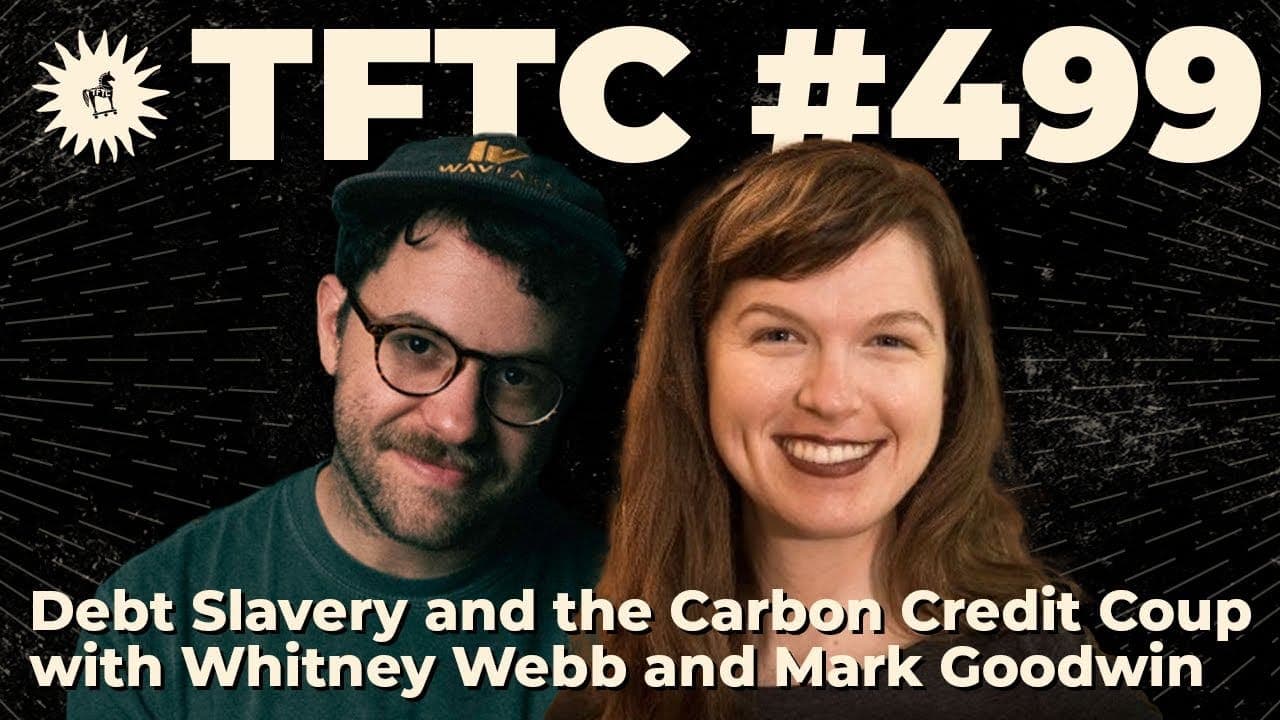
Whitney Webb and Mark Goodwin on the Carbon Credit Coup
Investigative journalists Whitney Webb and Mark Goodwin on how carbon markets, satellite surveillance, and a Bitcoin sidechain are being wired together to financialize nature, manufacture new demand for US debt, and extend the surveillance dollar into the physical world.

Guest: Whitney Webb
↓ Jump to the video and timestamps
Whitney Webb and Mark Goodwin came on to walk through a piece they had just published, "Debt from Above: The Carbon Credit Coup," and the thesis is stranger and more concrete than the usual climate-finance critique. The argument is that a specific network of people is wiring together three things, satellites, carbon markets, and a Bitcoin sidechain, to turn the natural world into a surveilled, tokenized, dollar-denominated asset class. The forests become collateral. The satellites become the meter. And the whole thing becomes a new place to manufacture demand for US debt.
The organizing idea underneath it is the one Webb returns to in every episode, and it's worth stating plainly because the rest follows from it.
"They're trying to make it different hands of the same person. And they're demonizing one hand to send people into the other hand. You have to realize that both hands are bad. Don't go in either hand."
That is the frame for everything here: the public sector and the private sector are presented as opponents so you'll run from one into the other, when they're the same network running the same play. This conversation is the natural-world chapter of the piece on how the digital dollar arrived without a CBDC. That piece covers stablecoins. This covers what happens when the same machinery is pointed at carbon, grain, and the air itself.
Key takeaways
- Carbon markets are being made involuntary. Webb's framing is that "voluntary" carbon markets are being restructured so that participation becomes mandatory in practice, routed through subnational deals with mayors and municipalities that skip national legislatures.
- Satellogic is "Palantir in space." The satellite firm underpinning the carbon-measurement scheme is deeply enmeshed with US intelligence and its contractors, and its board reads like a who's-who of the surveillance-finance world.
- It's junk bonds with a blockchain twist. The people financing this trace directly back to the 1980s junk-bond era. The man credited with inventing carbon trading came out of Drexel Burnham Lambert.
- A Bitcoin sidechain is the settlement layer. Rootstock (RSK) is being positioned to host the carbon credits, identity systems, and "cleverly authored" bonds, with a satellite feeding the data, which is exactly the orange-washing risk for Bitcoin.
- The endgame is commodity-backed surveillance money. Webb traces the play in Argentina, where grain reserves are already being tokenized, toward a world where whoever owns the commodities controls the money.
- The defense is the same as always. Don't onboard. Build Bitcoin-native, Treasury-free alternatives, ecash and stable channels, and refuse to let Bitcoin's ledger become the storage layer for tokenized debt and carbon.
The carbon credit coup
The specific program at the center of the piece is a secretive carbon initiative (Green+ / CC35) that Webb describes as a public-private partnership operating at the subnational level, signing up municipalities across Latin America to convert their protected areas into "natural equity" through carbon credits, with a cut of the proceeds dangled as the incentive. Going municipal, she notes, lets them skip national legislatures entirely, no congressional or senate approval, straight to city halls.
The part that's been overlooked in carbon-market coverage is the surveillance layer. Measuring where carbon is sequestered, and whether anyone is emitting too much, requires watching the ground from above. Goodwin's deadpan summary of the industry's own euphemism captures it: the satellite company's slogan is "observation is preservation," so it isn't surveillance, it's just Earth observation. The logical endpoint Webb lays out is a system that can decide you have too much livestock, or the wrong kind of stove, or are emitting too much heat, and charge you accordingly. Energy becomes money, and only the people the system likes get to use it freely.
Satellogic, the satellite oracle
The company doing the watching is Satellogic, and its corporate structure is the load-bearing fact, because it's verifiable. Satellogic is a public company whose board and backers include Steven Mnuchin's Liberty Strategic Capital, former Joint Chiefs chairman General Joseph Dunford, and Cantor Fitzgerald's Howard Lutnick, whose firm took Satellogic public and also custodies the bulk of Tether's Treasury holdings. Webb's reporting ties the company to DARPA, DHS, and NSA-linked contractors, and Goodwin's framing is that it privatizes nation-state-grade Earth-observation data and resells it, the same privatization pattern as Palantir and In-Q-Tel, now pointed at the planet's surface. The same names that show up in the surveillance story show up holding the satellite company. That overlap, not any single satellite, is the point.
Junk bonds with a blockchain twist
The historical thread is what makes the whole thing legible, and it's the most checkable part. Carbon trading wasn't invented by environmentalists. It was invented by Richard Sandor, a former Drexel Burnham Lambert executive from the 1980s junk-bond era who is also credited as a father of financial futures. Webb's read is blunt: the voluntary carbon market is "junk bonds on steroids," the same synthetic-market machine Wall Street has always spun up to extract yield, now wrapped in a planetary imperative so that opting out reads as endangering the species. She points out that even left-leaning environmental groups have concluded carbon credits are mostly meaningless, which is the tell. The fraud isn't a bug being fixed. It's being insured around, with a new market in carbon-credit insurance layered on top.
Goodwin adds the regulatory mechanics, and they rhyme with the stablecoin story exactly. The repeal of Glass-Steagall dissolved the wall between commercial and investment banking and produced the too-big-to-fail giants, and the same revolving-door figures who profited then are building this now, moving between Treasury and private capital depending on which seat is more useful at the moment. Trump's pardon of junk-bond financier Michael Milken sits in this lineage. The throughline is that the public sector keeps getting used as the "enabling environment" for whatever the private sector wants to sell next.
How the blockchain fits: Rootstock and the oracle problem
This is where it becomes a Bitcoin story. To write a "green bond" whose coupon depends on hitting an emissions target, you need an accredited source of data and a layer to settle and arbitrate the contract. Goodwin explains that a Bitcoin sidechain called Rootstock (RSK), which clones the Ethereum Virtual Machine and merge-mines with Bitcoin, can be the settlement and arbitration layer, with a satellite like Satellogic serving as the oracle feeding the emissions data in. That, in their telling, is how you get a commodity-backed, dollar-denominated instrument settled on top of Bitcoin, the "asset storage" use that BlackRock's Larry Fink reportedly covets for the network.
Marty's skepticism is the useful counterweight, and it's technical. The oracle is the weak point: the moment a satellite mismeasures and money moves the wrong way, the whole edifice invites a challenge, and verifying that the data is pure and accurate may never be possible. He also notes the sidechains simply haven't been adopted, pointing out that Blockstream's Liquid has been live for years and mostly runs one transaction per block. The machinery is being built. Whether anyone uses it is a different question, and the honest answer in the episode is "not yet."
Commodity-backed surveillance money
The reason to care even if Rootstock never ships is where the money thread lands. Webb's argument is that the same properties people fear in a central bank digital currency, programmable, surveillable, freezable, don't require a central bank. A commodity-backed stablecoin issued by private players delivers them, and whoever owns the commodity owns the money. Her concrete example is Argentina, where a Visa-backed firm is already tokenizing the country's grain reserves, which would hand monetary control to whoever holds the grain, a small set of oligarchs. Pair that with the "Climate Wallet" being developed by the World Bank and partners, and the interoperable digital-ID systems Webb stresses are designed as a mosaic rather than one global ID, and you get the surveillance dollar extended from your bank account to the air in your backyard.
Orange-washing, and the inversion
The constructive half is aimed squarely at bitcoiners, and Goodwin is sharp about the trap.
"Don't let BlackRock dollarize Bitcoin. That's my final word."
His warning is orange-washing: the assumption that anything built on Bitcoin inherits Bitcoin's freedom. It doesn't, and he's blunt that stablecoins are not a real scaling solution, calling it embarrassing that tokenized Treasuries have become the industry's default answer. He quotes a Rootstock co-founder arguing that Bitcoin must "shed its ethos" and stop being a threat to the banks to succeed, and treats that as the exact inversion to resist. Webb's jiu-jitsu is the clever part: if these players need the Bitcoin blockchain as their asset-storage layer, then they can't kill it, which means the move is to use that same blockchain as the freedom money it was meant to be. The practical exit is Bitcoin-native and Treasury-free: Chaumian ecash through Cashu and Fedimint, and "stable channels" that synthesize a stable unit of account over Lightning with a price feed and no Treasuries underneath. That cash layer is the subject of our later conversation with Calle.
Why a Bitcoin show is covering carbon markets
The reason a two-hour carbon-credit conversation belongs on a Bitcoin podcast is that it's the same network, the same mechanism, and the same goal as the surveillance dollar, just pointed at a different asset. The forests get tokenized, the satellites do the watching, the dollar denominates everything, and a new market gets manufactured where one didn't exist, all of it generating fresh demand for the Treasuries that prop up the system. Webb and Goodwin's case is that bitcoiners are the people best positioned to see it, and the most at risk of cheering it on because it makes the number go up.
More on the surveillance dollar
The carbon machinery this conversation maps is one front of a larger build-out. The full account traces how the same private-issuer logic shows up in stablecoins, how the GENIUS Act folds them into the Bank Secrecy Act, and why the most surveillable money in history is arriving wearing corporate logos instead of a central-bank seal.
Frequently Asked Questions
Why does going through subnational municipalities matter for carbon market adoption?
What makes Rootstock different from just building this on Ethereum or another chain?
How does the satellite oracle create a point of failure in the carbon bond scheme?
What is the connection between 1980s junk bonds and modern carbon markets?
If carbon credits are widely acknowledged as meaningless, why are they being expanded rather than reformed?
How does the grain tokenization in Argentina preview what the carbon scheme eventually looks like everywhere?
What is the practical alternative for bitcoiners who want to avoid becoming the settlement layer for this system?
About Whitney Webb and Mark Goodwin
Whitney Webb is an investigative journalist and the author of One Nation Under Blackmail. Mark Goodwin is her co-author at Unlimited Hangout and the author of The Bitcoin Dollar. Together they report on the public-private surveillance state, carbon and commodity markets, and the synthetic-CBDC thesis.
Sources mentioned
- "Debt from Above: The Carbon Credit Coup": the Webb/Goodwin investigation this episode is built on
- Richard Sandor: the Drexel veteran credited with inventing carbon trading
- Glass-Steagall: the repeal that dissolved the bank wall
- Rootstock (RSK): the Bitcoin sidechain positioned as the settlement layer
- The digital dollar, explained: how the same machinery runs through stablecoins
- Calle on the ecash defense: the privacy-preserving alternative
Watch the conversation
Timestamps
- 0:00 - Intro
- 1:27 - Explaining the article
- 9:56 - Satellogic
- 14:03 - Private/public cabal
- 23:14 - Steve Mnuchin
- 35:03 - The public/private smokescreen
- 44:29 - Gradually, Then Suddenly
- 45:08 - RSK
- 53:56 - Carbon dictatorship
- 1:17:04 - Stablecoin mafia
- 1:32:31 - Preventing Bitcoin's corruption
- 1:47:03 - Bitcoin ethos whitepill
- 1:58:14 - Fear tactics and censorship
- 2:10:35 - Final thoughts
Sponsors
- River: buy Bitcoin and take self-custody, zero-fee recurring buys, best-in-industry fees. river.com/tftc, get $5 in Bitcoin after you buy $100.
- Bitkey: multisig hardware wallet, easy to use and hard to lose. bitkey.world, code TFTC20 for 20% off.
- Gradually, Then Suddenly by Parker Lewis: the zero-to-one primer on Bitcoin as money. saifhouse.com, code TFTC for $5 off.