
Latest
Dave Collum: The Private Credit Bomb Is Coming
Dave Collum and Rudy Havenstein join me to lay out the private credit bomb, the AI bubble stacked on top of it, and why there are no adults left in any room, in finance, medicine, or government.

Guest
Professor of chemistry at Cornell · Author of the annual Year in Review
Dave Collum is the Betty R. Miller Professor of Chemistry at Cornell University and the author of an annual Year in Review that has covered markets, money and politics every December since 2009. A self-described gold bug who came to macro through the dot-com bubble, he has been a guest on TFTC seven times since 2023, often alongside Rudy Havenstein.
Collum came to markets sideways. A physical organic chemist who has run a research group at Cornell for more than four decades, he started posting on Doug Nolan's message board in the late 1990s, told a sophomore chemistry class in March 2007 that the banking system was about to collapse, and in 2009 began the Year in Review — a December essay that grew into a book-length survey of everything he read that year, now seventeen volumes. He says the chemistry is what taught him to look ten credentialed experts in the eye and conclude that they are all wrong.
On TFTC the finance is the constant and the range is the variable. Across seven conversations since January 2023, three of them three-way with Rudy Havenstein, he has held one market view — roughly 200% overvalued, a bear market measured in decades — while the surrounding material moved from Covid to the border to the wars to the AI build-out. The Year in Review ranges far beyond markets into politics, medicine and what he calls the rabbit holes, and so do the conversations; the distillation below follows them there, in his own words and dated.
Latest
Dave Collum and Rudy Havenstein join me to lay out the private credit bomb, the AI bubble stacked on top of it, and why there are no adults left in any room, in finance, medicine, or government.
Dave Collum explains why overvaluation, Big Tech excess, and blind faith in the Fed are setting the stage for an unavoidable market repricing.
Dave Collum and Rudy Havenstein warn that a merged Fed-Treasury is eroding the middle class and driving markets toward an inevitable collapse.

Dave Collum explores the harsh realities of inflation, geopolitical dynamics, and political corruption, suggesting that hidden forces, including complicity in child trafficking, shape global power structures.
Dave Collum returns for his annual year-in-review: the Weiner laptop claim he's careful to call a claim, his thesis on institutional corruption, the messy spot-ETF launch, and why self-custody, not the ETF, is the fight that matters.
History doesn't rhyme, it repeats. And what we're living through right now seems to be a repeat of the banking crises that led to the Great Depression and Weimar Republic hyperinflationary event.
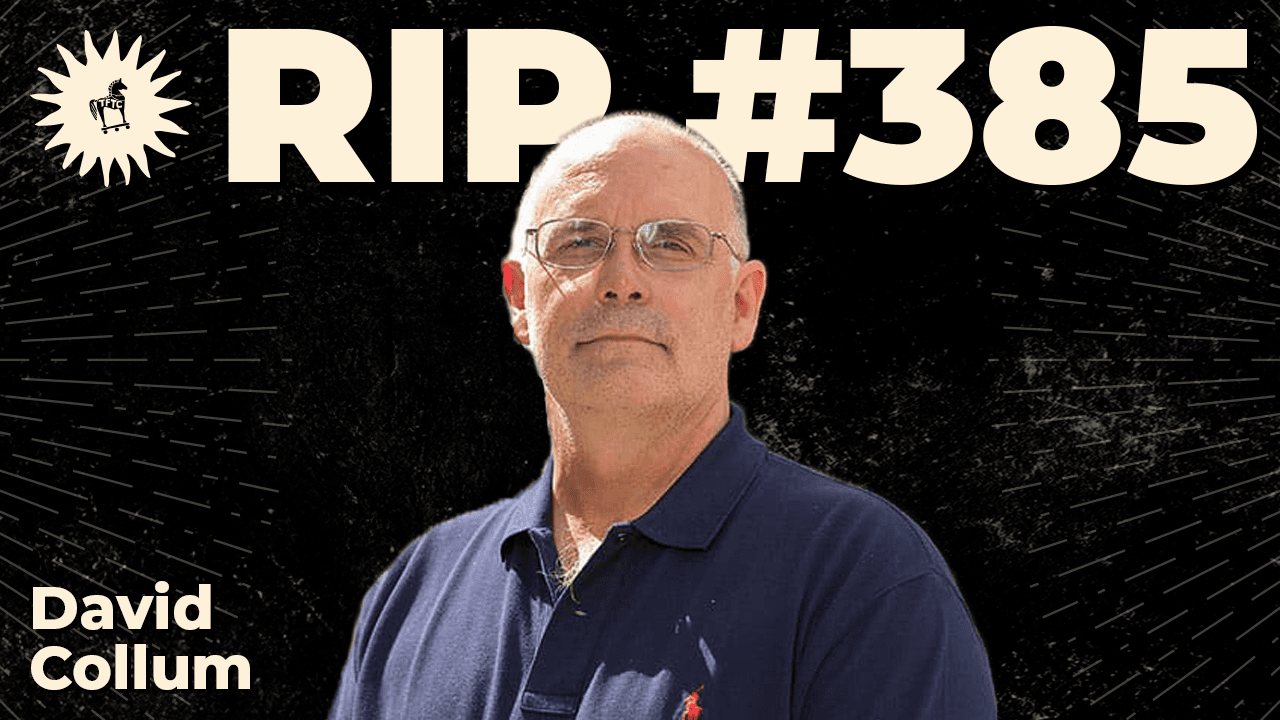
This is Dave's fifth appearance on TFTC and this rip is no different than the four that came before it.
Positions drawn from Dave’s TFTC appearances, grouped by theme. Quotes are from TFTC’s own recordings and are dated.
The argument that runs through every Year in Review and every TFTC appearance: the forty years from 1981 were an anomaly built on tailwinds that will not repeat — falling rates, cheap Chinese labor, cheap Russian resources, the boomers entering the workforce — and the valuation expansion they produced is a debt to be repaid, not a gain to be kept. He puts the market at roughly 200% above historical fair value and expects a bear market measured in decades, because those, he notes, are the normal kind.
“I think we're looking at an epic secular bear market that could last decades. Multi-decade bear markets are normal. They are not outliers, they're not rare.”
“If you owned the market in 1906, the price of that market in inflation-adjusted dollars was identical in 1981.”
“Recency bias in the investor world is not back to 2020, it's not back to 2009, it's not back to 2000. It's back to 1981.”
“During that 40-year period the valuations of the market — valuations, not price — compounded at 3% a year. What happens in the next 40 years when the valuations drop 3% a year for 40 years?”
“Valuations are not supposed to compound. They've been compounding at 3% a year for 40 years.”
“Give me a number. Insane could be 30%. The number I give is 200%, and it's real easy to document.”
“There's never been an asset class in history that got overvalued that didn't find its way back to cheap. Never.”
Collum has a two-part test that nothing since 1981 has passed: prices have to fall seriously, and investors have to be demoralized enough to swear off the asset. Forty years of V-bounces taught a generation never to sell, indexing taught it to buy without a reason, and he expects both lessons to be unlearned the hard way.
“What really sets a real bottom in an asset market is when you demoralize everyone. The quick ones don't do it. They become flesh wounds.”
“When some nitwit on CNBC says money's flowing into equities, there is no flow. If I buy equities because I want more equities, someone's got to sell them to me.”
“My definition of a correction is two things. One is it sends prices earthward in a serious way. The second is that you have to correct investors' attitudes. We haven't had a serious correction since the '67 to '81 bear market.”
“If you own 500 gas stations and 490 of them weren't producing any profit, what would you do? You'd sell them. But somehow with indexing you just keep buying more gas stations.”
“Every good idea becomes a business and ends up a racket. Indexing has reached racket phase.”
“We are due for a soul-ripping bear market, because all the guys who know what they look like aren't working anymore.”
“The risk is not some event. Those are triggers. The risk is the overvaluation. Overvaluation is always the problem.”
His quarrel is with the method — owner-equivalent rent, hedonic adjustment, the substitution rules — rather than with any single print. Correct the S&P for money supply instead of the CPI, he argues, and a century of capital gains disappears, leaving only dividends; correct GDP for the inflation people actually experience and the economy has been shrinking for years. He would rather have deflation, and says so.
“Inflation is never good. How is this whole ‘inflate away my debt’ model working? It was a stupid, stupid idea.”
“Over the last century the S&P hasn't budged, corrected for M2. Is it possible that the entire capital gain of the market over the last hundred years is zero real capital gain? And what did you get for investing? Dividends.”
“I love deflation. I'm hoping for deflation. Deflation is the boogeyman for several reasons, one of which is it's not taxable.”
“The CPI's got so many holes in it that's outlandish. It's not the answer that's a pack of lies. It's the protocol.”
“If we assume that inflation is running much hotter, one could argue we've been in a recession for years.”
“As a 13-year-old caddie I was paid one and a quarter pizzas per hour. That is a purchasing power that is not imaginable today.”
“The wealth is not going to transfer. It's going to reprice.”
By 2026 his framing was that the AI boom is not a bubble but a bubble on top of others — private credit, private equity, real estate, the index itself — and that the trigger will be a liquidity event rather than a valuation one. He has named the multi-trillion-dollar IPO as the moment that drains the pool, and Nvidia as the name that ends up in the textbook.
“They're selling chips to these guys, lending them money to buy the chips. We're just whizzing around in circles here.”
“Nvidia is going to become Global Crossing. It's going to become Sun Microsystems. It's going to be a chapter in a textbook.”
“These megatechs were high-profit-margin, low-capex businesses. Now they're in a high-capex, lower-profit market. This AI battle — those tech giants are going to kill each other, and they're not all going to be left standing.”
“You've got the AI bubble perched on top of private equity and private credit and real estate and standard equities. This is turtles all the way down.”
“I never call market tops and crashes. But if I were to call a market top and a crash, it would be the IPO of SpaceX.”
“The big winners of the Internet were not the front end. It was Google. It was Amazon. It was the guys who came along and used it.”
Collum reads Fed history as a sequence of postponements: the 2008 rescue cost $30 trillion and cannot be repeated, rate cuts arrive in the middle of the avalanche rather than before it, and every chair, Volcker included, acted for the banking system rather than the public. His chemist's analogy is a reaction that gives off heat and therefore accelerates — a bomb no bomb squad can disarm.
“The bailout cost $30 trillion. Was there anyone in the world who saw that coming? Nobody. Thirty trillion dollars means the system's on life support. They can't do that again, in my opinion.”
“Reactions give off heat when they go, and the heat makes them go faster. That's what a bomb is. By the world letting us flood the market with US money, Triffin's dilemma has been pushed back, but it's left us with a bomb that no bomb squad can disarm.”
“I was sophisticated enough to not short. When this goes, there's going to be no one to pay me. Counterparty risk was the operative word.”
“The attempt to do a controlled burn turns into an inferno.”
“When they're cutting rates, it means that you're in the middle of an avalanche.”
“Volcker didn't do it for us. They never do it for us. They did it because the banking system needed it.”
He bought gold under $300 in the early 2000s, still owns it, and has been Marty's most persistent unconverted guest. He calls gold bugs and bitcoiners kissing cousins, worries that the ETF will institutionalize Bitcoin to death the way he believes GLD saturated demand for physical gold, and has said his entry point will be a moment in history rather than a price.
“You would say buy Bitcoin, I'd say buy gold. That's fine.”
“The gold bugs and the hodlers are really kissing cousins. What you guys get out of the convenience of a key, we get out of 5,000 years of history. So you could call it a wash.”
“It's not price. It's some historical moment where I go, it's time.”
“The hodler community is the youngest investment community probably in the history of investing. But revolutions are not fueled by old men.”
“The two ways you undermine Bitcoin are to either institutionalize it to death or to just squash it. And the institutionalization is the path of lesser resistance.”
“I view the ETF as potentially not good for Bitcoin. Not necessarily bad, but not good.”
“I always thought the bad news was that when it goes mainstream, mainstream's going to totally swallow it like the Borg.”
The Year in Review has widened from markets to institutions, and the through-line is accountability: the last wealthy or powerful person to go to prison for anything, a media that stopped calling out the bad guys, the growing sense that facts no longer stay put. His metaphor for what comes next is the Fourth Turning's valley of death — a place you go through, not around, and not on a day trip.
“When the free market breaks, black markets appear. And that's true with the free market of ideas.”
“Our very biggest problem is the collapse of the media and the role it used to play in calling out the bad guys.”
“I think we've got to go through the Valley of Death to come out the other side. And generally the trip through the Valley of Death is not a day trip.”
“When was the last time someone who was either wealthy or powerful went to prison for anything?”
“Ten years ago, when I got a fact, it stayed. I could throw it in the fact pile. It doesn't feel that way now.”
“I'm a conspiracy theorist. I believe men and women of wealth and power conspire. If you don't, you're always called an idiot. And if you do but won't say anything, you're always called a coward.”
“It's like a fireworks display. If you're half done, what percentage of the fireworks have been blown off? Probably 15%. Because they all blow them off at the end.”
The thesis that pulled Collum out of markets and into what he calls the rabbit holes. He was trying to explain why leaders across the West kept making decisions with no upside for their own countries, and settled on blackmail as the unseen mass bending their orbits: not powerful people being compromised, but compromised people being handed power. He treats Epstein as the sanitized, public version of a much older arrangement between intelligence agencies and organized crime, and child trafficking as the currency in which the leverage is paid.
“The cornerstones of the CIA were organized crime.”
“You don't need to have everyone compromised. You just need enough people compromised, where the uncompromised people say, look, I can't do it.”
“I was looking for the black hole. I was looking for the thing that was causing perturbations that were not explainable.”
“I don't think they blackmail powerful people. I think they actually blackmail people and then give them power. I think if you're not corrupted, then you don't get the job.”
“I think Epstein's a highly sanitized version, because Epstein's basically getting a bunch of leaders and blackmailing them.”
“I believe that to explain what we're seeing, you have to believe that someone is attempting to destroy the United States.”
“One of them said that pedophilia is the currency of geopolitics. That's exactly what my angle has been.”
“I don't care that there's pervs out there. I care, but it doesn't get me anywhere. It is the networking of the pervs and their influence outside this network.”
“I said, let me ask you a simple question. Is the Clinton Foundation trafficking children? And he said, absolutely.”
“His first week inside the Beltway, he gets hauled off to the side by a grizzled veteran who says: whatever you do, don't go to a private party — even if it's at the vice president's house — because you'll wake up with a Polaroid clipped to your lapel, in a total fog, with you and a five-year-old.”
“They don't have to corrupt you. They just have to slip you a mickey.”
Collum spent twenty years consulting for Pfizer and holds a genetics degree, and his Covid position is the harshest thing on this page: the lockdowns were an intentional demolition, the vaccine was sold on claims its makers knew they had not tested, and the people responsible should be tried. He took the shot himself, under threat of losing his job, and says he will never take another. By 2026 the position had widened into a general distrust of prescription medicine — statins, SSRIs — and a preference for patient testimony over the authorities.
“If we had just ignored it and treated it like the flu, there would be less dead people. There would be less seven-year-olds who still don't know how to read.”
“The fact that they didn't have that data, I think, is forgivable. The fact that they pretended like they knew the answer is unforgivable.”
“Here's the question. Is this just arrogance and narcissism gone wild, or are these guys really trying to kill us?”
“Everything points to Fauci being a mass murderer. Do you think anyone could read The Real Anthony Fauci and not come to that conclusion?”
“That's what the lockdown did. And that looked like a controlled demolition to me. It looked like it was absolutely intentional.”
“I consulted for Pfizer for 20 years. I'm not totally uneducated in this topic. You need a CAT scan if you trust modern medicine.”
“The world still thinks polio was the greatest moment in modern medicine. I think it was a hoax.”
“I took the vaccine because I was told you had to quit your job. We will fire you if you don't take the vaccine. I did the risk-reward ratio measurement and I said, okay, it's a risk I've got to take.”
“I will never get another vaccine. Never, ever, ever get another vaccine. I don't trust them.”
“When you go on a new drug, go on Twitter, search the drug name, and just start reading posts.”
Collum's account of politics is that the media stopped being a watchdog and became the mechanism, that the internet shapes belief through wording too subtle to defend against, and that he can no longer name a single official narrative he believes as told — Butler, the 2020 count, the Kirk shooting. His view of Trump moved with events: Trump-adjacent in 2024, expecting a second term that would settle scores, and by mid-2026 concluding that the last hope had gone. He has said he believes Kamala Harris shows the traits of MK-Ultra conditioning, and that the evidence in the Charlie Kirk case does not support the lone-shooter account or a conviction of Tyler Robinson.
“I'm Trump adjacent. I have gotten past his idiosyncratic personality and I just listen to his message, and he seems okay to me.”
“I'm watching the media build this superstructure of belief that looks completely fraudulent to me.”
“That's what the Internet's doing to us. It is feeding us. And you think you can defend against it. It's just slight changes in wording in headlines. It's all being shaped.”
“If you had to bet your net worth on whether that was a lone gunman or a complex hit, you'd have to go with the hit.”
“What people don't understand is that Dominion is owned by a company in Beijing.”
“I don't think you can name a single narrative that you actually believe as told.”
“I actually believe the Kamala Harris being a Manchurian Candidate theory. I think that holds together pretty well. I've dug a lot into that. I think Harris was brainwashed.”
“I think they whacked Charlie Kirk. I believe the evidence is very good that it wasn't that lone-shooter story.”
“It's not that I had great hope. He seemed like our last hope, and now our last hope is gone.”
“I don't think you can convict Tyler Robinson based on what I've seen. There's literally no fact in this case that holds up to scrutiny. None.”
A hawk on capability and a dove on use, Collum wrote in his 2022 review that the Ukraine war was NATO's doing and has not moved from it. Israel is the position that changed: neutral until the Zionist right attacked him over a Tucker Carlson interview, he now argues that October 7 involved a stand-down, that Washington runs Israel-first, and that the Iran war is one the United States cannot win against a country with home-field advantage and, in his reading, a moral compass.
“My conclusion was that, unambiguously, the war was NATO's fault. We cornered Putin to the point where he had no options left.”
“Putin seems like one of the greatest leaders in the world to me. He's running a country that you have to be a complete beast to run.”
“I'm a hawk in the sense I believe we need a strong military. I'm a dove to the extent I don't think we need to bomb the shit out of every country in the world.”
“We killed five million people since 9/11.”
“I'm not anti-Semitic. I'm not even anti-Israel, although I'm getting closer to the latter. They've lost me.”
“They're owned. They're all owned. They're doing Israel first, America second. Sorry, guys, that's what it looks like.”
“You can make a compelling case that there was a stand-down order in Israel using exclusively Israeli sources.”
“The game theory is that Iran just has to outlast us. Home field advantage is everything.”
“I think it's quite possible that the Iranians actually do have a moral compass.”
“Israel wants us to shed our blood to take out their enemies. It's that simple.”
“You want to stop anti-Semitism? Stop the bombing. Stop kicking people out of their homes.”
Forty-five years inside one university give him a vantage the finance guests lack. He was cancelled on campus in 2020 for having fought two union drives, took the vaccine to keep his job, and in 2025 was attacked by Ted Cruz, Mark Levin and Victor Davis Hanson for a Patton quote on Tucker Carlson. What he sees in the classroom worries him more: a generation that cannot read an exam question, a work ethic gone, phones that have physically narrowed their vision — and a college model he expects to shrink hard. He is pro-choice and defends Dobbs on federalist grounds, and says he would go to war over men in women's sports.
“If someone wants to come at me for saying that you shouldn't let men in women's sports, I'm going to go to war.”
“I'm still pro-choice, but I'm not going to tell people in Mississippi that they have to do exactly what the people in California want them to do.”
“If you Google me, I'm Google toxic. Completely Google toxic.”
“There is an entire industrial complex out there designed to get you to be glued to that phone. We raised you. It's not your fault. But you've got to find a way to get rid of that phone.”
“The entire class was shy. Every last one of them was shy. I don't think the kids today really know how to work at all.”
“Six plus three equals seven plus X. What is X? They missed that, 25%.”
“You give me an athlete, I can turn him into a chemist. Athletes do great in academia. You just have to turn on the competitive gene.”
“I think college has got to go through a massive change. I think we're going to see a big attrition of colleges. Learn how to fix elevators.”
“When you've got thousands of signatures trying to get you fired and graffiti all over the campus and articles written daily about how you should be fired, that's unpleasant.”
“I asked the question: do you really want to play in the big leagues like this? Are you Candace Owens? Because if you're not, be careful.”
Notable appearances on other shows, newest first.
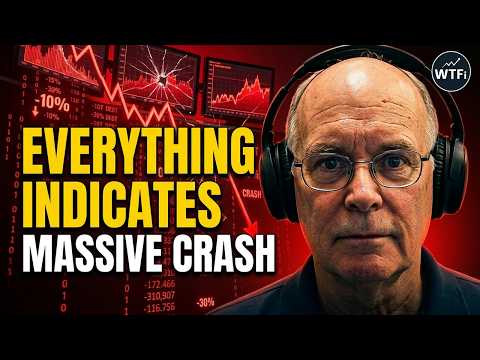 WTFinance · Mar 2026All Data Points to Massive Market Crash with Dave CollumThe 200%-overvalued case, two months after his January TFTC conversation.
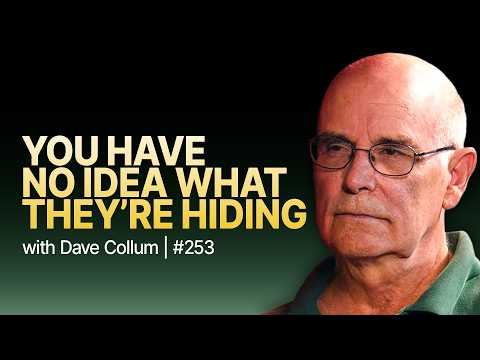 The Bitcoin Matrix Podcast · Nov 2025Bitcoin, AI, Gold… Everything You Believe Is WrongA Bitcoin-native show gets the gold bug's version of the argument.
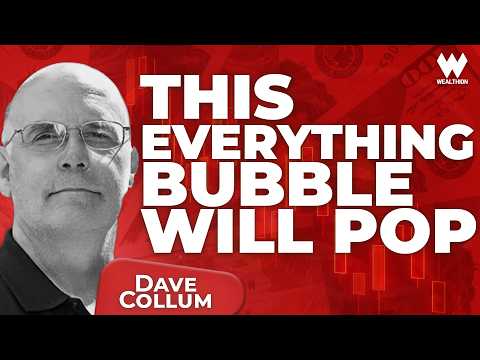 Wealthion · Aug 2025The Fed Can't Save Us from a 70% Market Crash!The bear case in full, recorded the same month as his Fed-Treasury conversation on TFTC.
 Resource Talks · Oct 202375% Market Crash, Oil Wars, Platinum Miners, and Physical GoldAn earlier statement of the same thesis, with the resource positioning behind it.
An annual December survey of markets, money and politics, published every year since 2009 and collected in seventeen bound volumes.
His research group in physical organic chemistry.