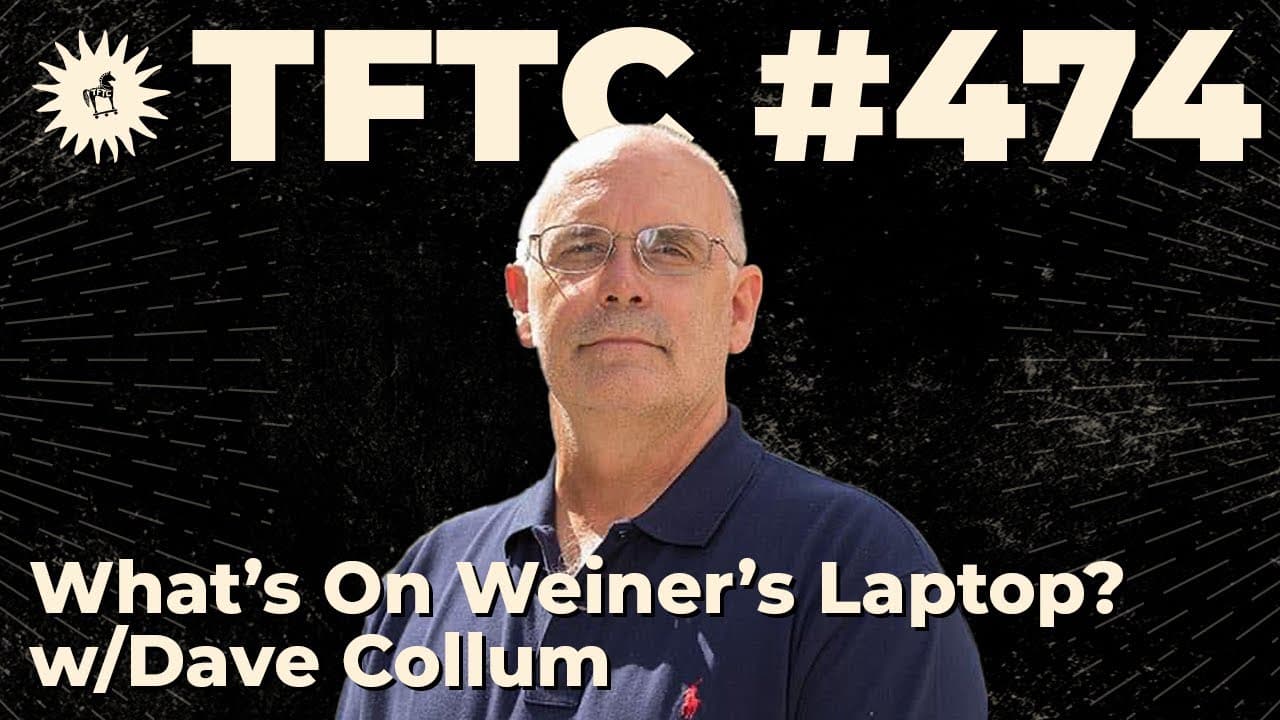
What's On Anthony Weiner's Laptop? | Dave Collum
Dave Collum returns for his annual year-in-review: the Weiner laptop claim he's careful to call a claim, his thesis on institutional corruption, the messy spot-ETF launch, and why self-custody, not the ETF, is the fight that matters.

Guest: Dave Collum
↓ Jump to the video and timestamps
Dave Collum came back on the show for his annual year-in-review, the sprawling end-of-year conversation he's become known for well outside his day job as a Cornell chemistry professor. It runs wide by design: markets, the Fed, the dollar, and a deep, openly stated distrust of the institutions most people assume are working in their interest.
It gets dark early. Dave has been circling some of this material in his own writing for a while, and he doesn't soften it when it comes up.
Key takeaways
- Most of the conversation is macro. Markets, the Fed, the dollar's debasement, and where Collum thinks the system is headed take up the bulk of three hours.
- Collum's darkest claim is about Anthony Weiner's laptop: footage so disturbing the officers who saw it couldn't finish, and the nine who reportedly viewed it supposedly no longer alive. He's clear it's a claim, not proven fact.
- Collum's organizing idea is that corruption precedes power, not follows it. His framework is that otherwise inexplicable decisions make sense if you assume the people making them were compromised before they ever held office.
- He treats QAnon as a psyop on the discourse itself, a label that makes anyone near a topic dismissible, rather than evidence of anything.
- The 2024 spot-ETF launch was a mess. The SEC's own account got hacked with a fake approval, and brokerages blocked clients from buying. Collum and I read that as institutional weakness, not strength.
- The ETF is not the win. Self-custody is the fight. A regulated wrapper you can't withdraw from is the least useful expression of Bitcoin, and the policy signals around it are worth watching.
What Collum says is on Weiner's laptop
Dave's account, which he traces to a veteran officer's description he's been tracking, is that Anthony Weiner's laptop held video footage so disturbing the officers who saw it couldn't finish watching. He says nine of them got to see the contents, and that, supposedly, none of the nine are still alive.
He frames it as a claim he's still chasing down, not a proven fact. The point he kept pressing was bigger than any single piece of footage: if even a fraction of what circulates here is real, you're looking at something run by people with serious power, not the stranger-in-a-van most people picture.
Dave's been working through this in a long written series. He told me he keeps stalling on it, not because the material runs out, but because so much of it is hard to stand behind and he doesn't want to get it wrong.
Collum's bigger thesis: corruption comes before power
Strip away the specific allegations and there's a framework underneath.
Collum's organizing idea is that the people running large institutions don't get corrupted after they reach the top. They get compromised on the way up, and the compromise is the reason they're allowed to reach the top at all. If you accept that frame, a lot of otherwise inexplicable behavior stops looking like incompetence and starts looking like obligation.
It's also how he reads the QAnon phenomenon. His take is that the label became a tool for discrediting, not understanding. Attach it to anyone looking into a difficult topic and you've sorted them into the most dismissible category available. He treats it as a psyop on the conversation itself rather than as evidence of anything in particular.
The same skepticism runs through how he talks about Jeffrey Epstein. Collum has argued publicly for years that the official 2019 account doesn't sit right with him, and he walked through his reasons again on tape. Do what he does: look at the primary material yourself and draw your own conclusion rather than taking his word or anyone else's.
I don't agree with every thread he pulls. What stays with me is the broader claim underneath all of it: institutional trust has been earned away, and the burden now sits with the institutions to win it back.
The CIA, Operation Gladio, and the drug trade
The most clarifying piece of Collum's institutional read is his framing of the CIA.
His analogy: the CIA is "American" the way a multinational bank is American. It's domiciled here, it has a campus here, it has a line in the federal budget. None of that, in his view, means its loyalty runs to the public it's nominally accountable to.
He grounds this in Operation Gladio, the documented NATO stay-behind program from the Cold War, and a book he read on it. His read on the drug trade is blunt: he doesn't think the agency has incidental ties to international trafficking so much as a structural role in it. The historical record of intelligence entanglement with drug networks is real and well-documented; how far you extend Collum's specific framing from there is a judgment call.
The practical takeaway he keeps returning to is that you can't reform a structure like that by electing a better senator, which is why the conversation kept bending back toward exit.
The border and January 6th
Two of the harder-edged stretches were the border and the January 6th prosecutions.
On the border, his framing was rhetorical and memorable: when people run from a war, they bring their families. When people run toward something, they don't. His read of the crossing demographics, heavy on military-age men, is that it doesn't fit a simple refugee story, and that the policy looks less like failure than like a choice. I live in Texas with two young kids, so this one isn't abstract for me, and I've made no secret that I think states have to lead here.
On January 6th, Collum's argument was about proportionality and selective enforcement: long cumulative sentences for people who walked through doors, set against much lighter outcomes for figures who, on video, appeared to be encouraging the crowd. He and others have raised questions about specific footage from that day. The point he was making is that the justice system's credibility depends on applying the same standard to everyone, and that a lot of people no longer believe it does.
Bitcoin, the ETF, and the fight over self-custody
This is the part I care most about, and it's where the conversation gets concrete.
The spot Bitcoin ETFs had just launched the week we recorded, and the launch was a mess. The SEC's own social account got hacked and pushed a fake approval that moved the market a day early. Brokerages including Merrill and Vanguard blocked their own clients from buying the products at all. Collum's read, and mine, is that this is what institutional decay looks like up close. Not a coordinated takeover by competent operators. A bureaucracy tripping over itself.
My own position on the ETF hasn't changed. It's the least useful expression of Bitcoin. You can't take self-custody of a share. You can't stream sats or touch the Lightning Network through a brokerage account. You get price exposure and you give up everything that makes the asset actually useful.
What I watch more closely than the ETF is the policy posture around self-custody. The normalization argument runs in one direction: you can have bitcoin, you just access it through a regulated institution. The thing that would make Bitcoin matter less is a world where holding your own keys gets treated as suspect. That's the line I care about, and it's worth watching regardless of what the price does.
The reason I keep coming back to Bitcoin through all of this is simple, and it's the through-line of the whole conversation. The system Collum spends three hours describing runs on the money printer. Bitcoin is the one tool that doesn't ask permission and can't be turned off with a letter to a custodian.
The long game
Collum pushed back on my optimism at one point, and it was a fair challenge. He pointed out that the Soviet people knew the system was broken, and knowing it didn't stop the gulags. Awareness isn't the same as a way out.
I take that seriously. My read is still that states leading, individuals self-custodying, and people keeping their attention on what they're actually protecting is the structural path through. It's not a quick fix and I didn't pretend it was.
Dave and I spent the last stretch of the conversation talking about our kids and lacrosse, which felt like the right place to end. The geopolitics and the dark threads aren't the point. The point is being able to sit down with your four-year-old and not worry about what the money in your account is going to be worth in ten years. That's what the work is for.
About Dave Collum
Dave Collum is the Betty R. Miller Professor of Chemistry and Chemical Biology at Cornell University, where he has been on the faculty for decades. He is best known to a wider audience for his annual "Year in Review," a long-form survey of markets, macroeconomics, geopolitics, and institutional decay that has built a substantial following far outside academic chemistry. He is one of TFTC's longest-tenured recurring guests.
Sources mentioned
- Operation Gladio: the documented Cold War NATO stay-behind program Collum references
- SEC statement on the approval of spot Bitcoin ETPs (January 10, 2024): the approval that launched the products discussed
- SEC's X account compromised with a false ETF approval (January 9, 2024): the fake announcement that moved markets a day early
Watch the conversation
Timestamps
- 0:00 - Intro
- 5:51 - The Bitcoin and fiat-debasement case
- 6:17 - Iowa caucuses and media narrative control
- 11:05 - The Weiner laptop claim and how dark the material gets
- 24:00 - QAnon as a psyop on the discourse
- 32:00 - Epstein and the official account
- 42:00 - The CIA and Operation Gladio
- 55:00 - The border
- 1:08:00 - January 6th and selective prosecution
- 1:22:00 - The Bitcoin ETF launch and self-custody
- 1:38:00 - Inflation, markets, and the long correction ahead
Sponsors
- River: fee-free DCA, limit orders, auto-withdrawals to self-custody, fully reserved, everything built in-house. river.com/tftc
- Unchained: 2-of-3 multisig vault with you holding two keys, IRA product, and an inheritance protocol. Code TFTC10. unchained.com/tftc
- CrowdHealth: crowdfunded healthcare, not insurance. You pay the first $500, the community covers the rest. $99 for your first six months. joincrowdhealth.com/tftc
- Bitcoin Talent Co: recruiting built by Bitcoiners for Bitcoiners, full-time hires or Flex contractors for development, design, and growth. bitcointalent.co
Frequently Asked Questions
Collum relays a claim, which he is careful to label a claim and not a proven fact, that the laptop contained video footage so disturbing that the law enforcement officers who viewed it could not finish watching. He says nine officers reportedly saw the contents and that, supposedly, none of the nine are still alive. He presents it as an allegation he finds worth investigating, not as something established.
Operation Gladio was a real, documented NATO "stay-behind" program during the Cold War, intended to organize resistance in the event of a Soviet invasion of Western Europe. Collum uses it as a historical anchor for his broader argument that intelligence agencies operate well outside their stated mandates.
The SEC's own social media account was hacked and posted a fake approval announcement that moved the market before the real decision. When the ETFs did launch, several large brokerages, including Merrill and Vanguard, restricted their clients from buying them. Collum and Marty read the episode as a sign of institutional dysfunction rather than competence.
The concern Marty raises is that normalizing Bitcoin through regulated ETFs builds a narrative where holding your own keys becomes the exception rather than the default. A restriction on self-custody would leave price exposure intact while removing the censorship-resistance and sovereignty that make Bitcoin useful. It's a policy posture worth monitoring, not a prediction.
His framework is that compromise comes before power, not after. If you assume decision-makers were leveraged before they reached the top, behavior that looks inexplicable from the outside becomes internally consistent. It's a thesis, and Collum presents it as his interpretive lens rather than as proof of any specific case.