Paraguay Kills Bitcoin Miner Power Deals, Signs 15-Year AI Contract
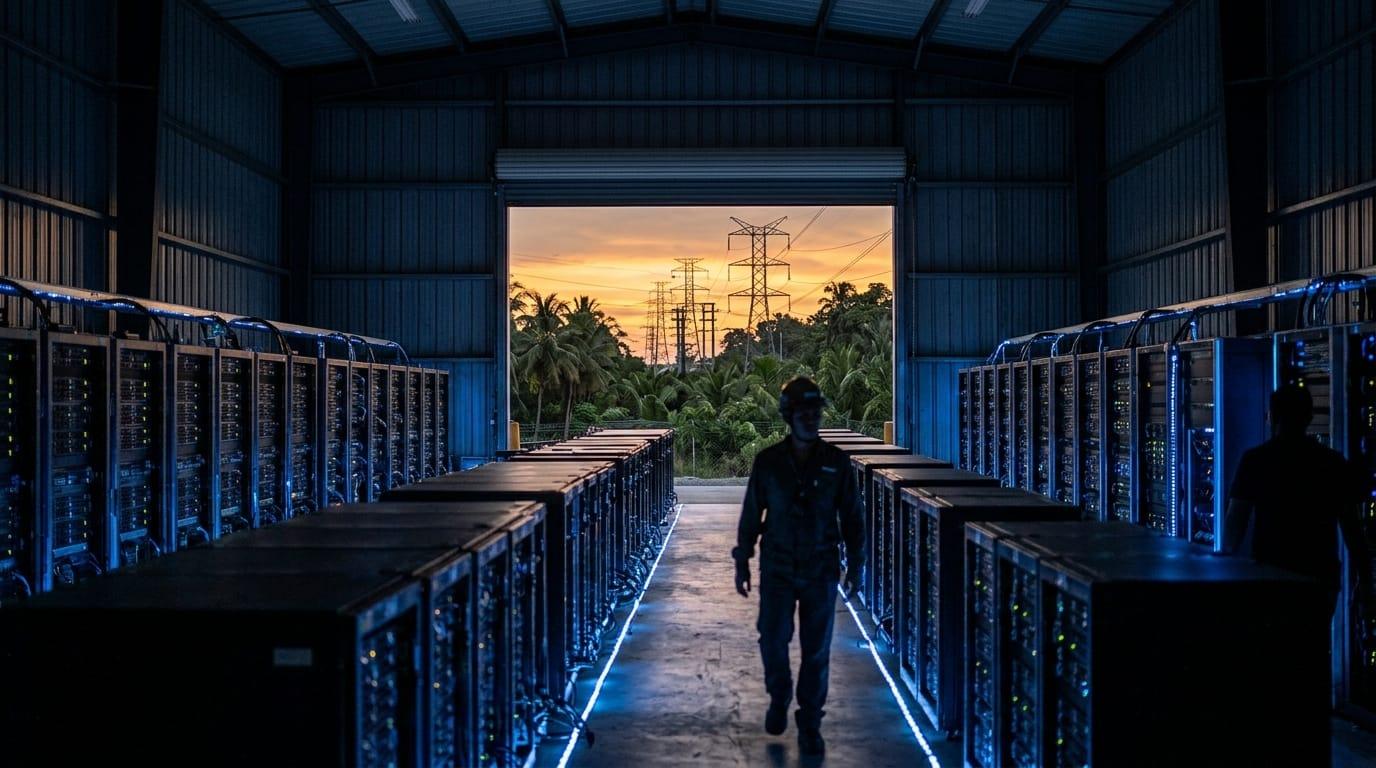
Paraguay's state utility ANDE has declared its special Bitcoin miner power contracts non-extendable past Dec. 31, 2027, covering roughly 944 MW and an estimated 4% of global hashrate, while simultaneously signing a 15-year supply deal with a Founders Fund-backed AI campus.
Paraguay's state utility hands AI a 15-year lease while telling Bitcoin miners their tariffs expire, hard, on December 31, 2027.
Key takeaways
- Paraguay's ANDE has declared the Dec. 31, 2027 expiration of all special Bitcoin miner power contracts (roughly 944 MW, approximately 4% of global hashrate per Hashrate Index) "improrrogable," meaning no extension is possible under current regulations.
- ANDE signed a 15-year deal to supply up to 286 MW to Kuntur, a Paraguayan company tied to Founders Fund-backed Araico, with Crusoe announced as the campus operator; supply begins Dec. 1, 2026.
- Any miner whose cost basis relies on a state-utility tariff discount rather than genuinely stranded or wasted energy faces the same AI-outbid dynamic now playing out in Paraguay.
Paraguay's national utility ANDE has formally declared the end of its special power contracts with Bitcoin miners, calling the December 31, 2027 deadline "improrrogable" (non-extendable), per reporting from Paraguayan outlets ABC Color and RDN.com.py. The contracts cover roughly 944 MW of capacity, pricing power at $44/MWh under a preferential tariff regime that generated an estimated $295 million for ANDE in 2025 and is projected to reach $350 million in 2026. At the same time, ANDE signed a 15-year agreement supplying up to 286 MW to Kuntur, a local company linked to Araico, which is backed by Founders Fund. Crusoe, the U.S. AI cloud company, announced in October 2026 it will operate the campus. First reported by CoinDesk.
The AI tenant is locking in a decade and a half of capacity before the miners' leases have even expired.
The Numbers That Matter
The $44/MWh current miner tariff is not the floor going forward. An ANDE engineer framework under internal discussion would cap combined mining and AI data center load at 700 MW starting in 2028, allocated through open auction at a floor price of $56/MWh on 3-to-5-year contracts. That proposal is not adopted policy, but it signals where ANDE's pricing logic is headed. The jump from $44 to $56/MWh is a 27% increase in the power cost floor, overnight, the day the auction clears.
HIVE Digital Technologies holds the majority of its mining capacity in Paraguay. A HIVE executive stated publicly in September that the company wants its contracts extended at least 10 years, could scale from 300 to 1,000 MW within 18 months, and expects to pay ANDE $140 million this year. Whether HIVE has disclosed a formal contingency plan in its investor filings is worth watching ahead of their next reporting period.
The demand backlog at ANDE is not a rounding error. The utility has received pending requests totaling approximately 6,300 MW of additional supply, per ANDE president Miguel Báez. Paraguay's entire share of Itaipu's output is roughly equivalent. The queue confirms this is not a local rebalancing. AI capex is repricing Paraguayan hydro the same way it is repricing stranded power in Bhutan, Quebec, and Iceland.
Renters, Not Owners
The TFTC read on this is straightforward: miners who built their cost basis on a state-granted tariff discount were always renters. The preferential contracts were an energy accident, not a durable competitive advantage. When AI data center capital shows up offering sovereign governments 15-year revenue certainty at higher floor rates, the utility's incentive to renew short-cycle commodity buyers at discount rates disappears.
That dynamic is not specific to Paraguay. The AI revenue pivot that miners have been chasing is partly a response to exactly this pressure: if you can't own the energy, you're exposed every time a bigger off-taker appears. The miners who are structurally insulated are those operating on genuinely wasted or stranded energy, flared gas, behind-the-meter wind curtailment, industrial byproduct heat, sources a state utility does not control and an AI campus cannot repurpose. Paraguay exposed what happens when "cheap power" actually means "a government discount that lasts until a better offer arrives."
EIA projections of record U.S. power demand through 2027 driven by AI data centers signal that this is a structural repricing, not a one-country story. Paraguayan national telecoms chief Gustavo Villate said it plainly in May 2026: "Unplug crypto and plug in AI." The Kuntur deal is that sentence made contractual.
The falsifiable thesis: this "renters not owners" frame holds as long as AI data center capital continues to offer sovereign governments longer contract terms and higher floor prices than miners can match. It breaks if ANDE reopens the GCIE tariff regime before year-end, or if Bitcoin's price-to-difficulty ratio rises enough that miners can outbid AI at $56/MWh and still run profitably. Watch for any ANDE resolution or decree before December 31, 2026 as the first signal the deadline has softened.
What to Watch
ANDE's proposed 700 MW auction framework has not been adopted. If it clears as written, it sets the competitive terms for 2028 capacity in Paraguay and provides a template other state utilities may follow. HIVE investor disclosures are the next near-term signal on how much of the exposed 944 MW has a contingency. The Araico campus ramp, starting at 6 MW on December 1 and scaling to 146 MW by April 2028, will serve as the live test of whether AI demand at Paraguayan hydro rates performs as promised or runs into grid constraints from the 6,300 MW backlog piling up behind it.
Sources
- ABC Color (ANDE "improrrogable" declaration, September 2026)
- RDN.com.py (ANDE contract expiration corroboration)
- Hashrate Index (Paraguay ~4% of global Bitcoin mining hashrate, Q2 2026)
- First reported by CoinDesk (November 13, 2026)
Frequently Asked Questions
What happens to Bitcoin mining in Paraguay after December 31, 2027?
All special GCIE tariff contracts expire. ANDE has proposed an open auction with a floor price of $56/MWh and 3-to-5-year contract terms, open to both miners and AI operators. Some miners may win capacity at higher cost. Others will relocate. No automatic renewal path exists under current regulations.
Why is an AI campus getting a 15-year deal while miners are getting cut off?
AI data center operators offer state utilities longer revenue certainty, higher floor rates, and a larger economic development pitch. Miners, by their nature, chase cheap power globally and move when it disappears. That mobility is a strength in a free market, but it makes them lower-priority tenants for a utility optimizing for stable, long-duration revenue. The Araico campus is linked to a reported multi-billion-dollar development pitch. A 15-year supply contract is the utility locking in that story.
Which publicly traded Bitcoin miners have the most exposure to the Paraguay contract expiration?
HIVE Digital Technologies has been named in coverage as holding the majority of its mining capacity in Paraguay, with a HIVE executive publicly seeking a 10-year extension. Investors in Paraguay-heavy operators should watch for formal contract contingency disclosures in upcoming filings, particularly HIVE's next MD&A or any SEDAR filing referencing their Paraguay operations.