OpenAI's Always-On Home Speaker Is a Surveillance Node, Not a Gadget
OpenAI's first consumer device is a $300-$400 screenless smart speaker with always-on camera, microphones, facial recognition, and environmental sensors. It's designed to learn your home. The data is the product.
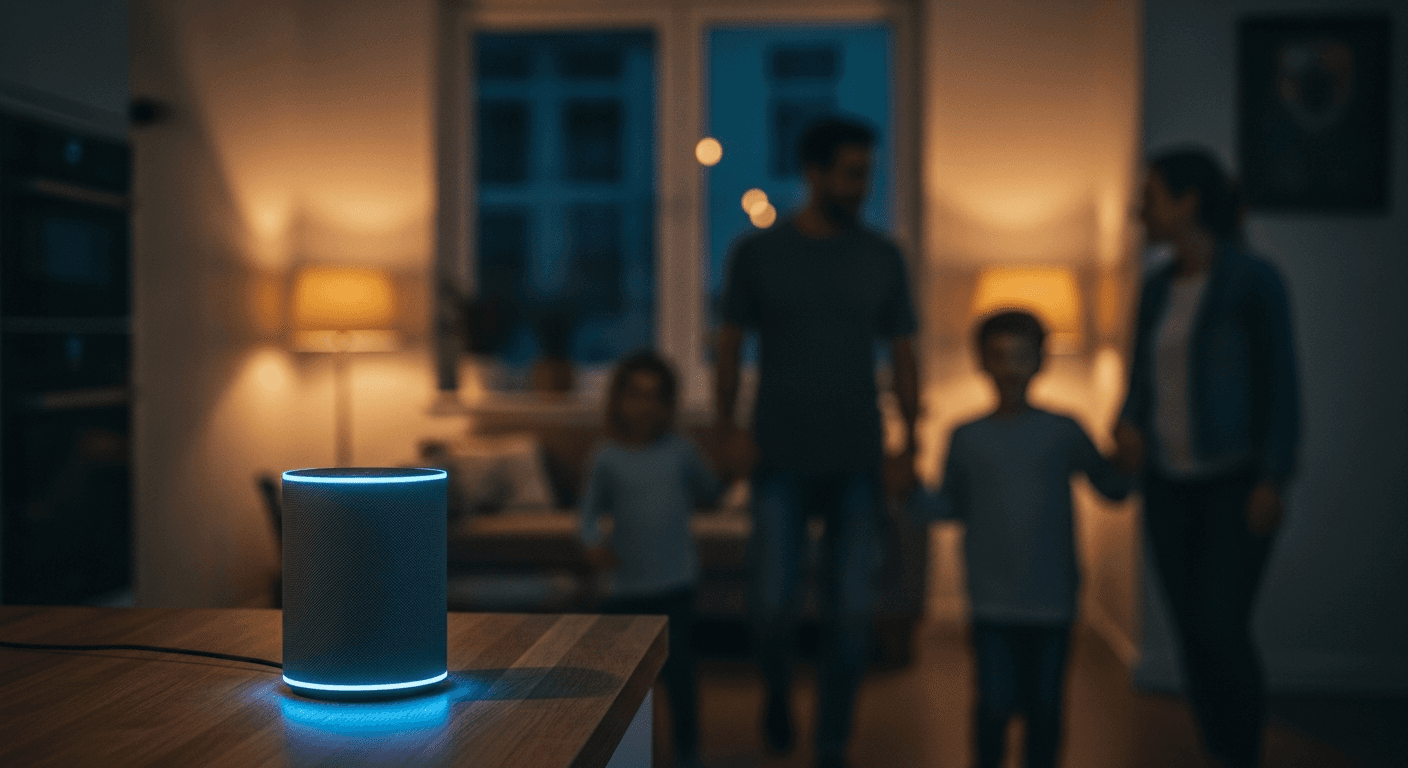
OpenAI's first consumer device is priced at $300-$400, ships in 2027, and is designed to watch, listen to, and learn your home. The data model is the part the product specs don't cover.
Key takeaways
- OpenAI is developing a $300-$400 screenless, always-on smart speaker with camera, microphones, facial recognition, and environmental sensors, targeting a 2027 release, first reported by Bloomberg's Mark Gurman.
- The device is framed internally as a "humanlike AI companion" designed to learn users' routines and observe their surroundings, positioning it as a persistent behavioral data collection platform.
- Apple filed a preliminary injunction on August 4, 2026 seeking to block the rollout over alleged trade secret theft; OpenAI denies the claims and the litigation remains unresolved.
OpenAI is building a donut-shaped, hockey-puck-sized smart speaker with no screen, a camera system, multiple microphones, environmental sensors, dynamic lighting, and autonomous moving parts, first reported by Bloomberg's Mark Gurman on August 6, 2026. Priced between $300 and $400 and targeted for a 2027 release, it is co-designed with Jony Ive's LoveFrom studio, following OpenAI's $6.5 billion all-stock acquisition of Ive's hardware startup io Products. The device is described internally as a "humanlike AI companion that lives in the home" and an "AI-first computer."
Unlike every trigger-word smart speaker on the market, this device is designed to be always-on. Per reporting by The Information from February 2026, summarized by MacRumors, the feature set includes facial recognition capabilities. The device is engineered to learn users' routines, observe their surroundings, and suggest actions based on behavioral observation.
The Hardware Is the Door; the Data Is the Business
Amazon's Alexa lineup runs $40 to $240. OpenAI is pricing above that entire range at $300 to $400. The gap is explained by the model underneath it, not the hardware.
A system sophisticated enough to identify faces, parse ambient audio, map environmental context, and build a behavioral profile of a household is not generating value from the one-time device sale. It generates value from the continuous data exhaust: routines, voice patterns, household composition, purchase signals, health indicators. That is the same architecture as every ad-supported smart home platform, with a model capable enough to actually understand what it captures.
OpenAI's infrastructure spend is running at $750 billion projected through 2030 and the company posted $38.5 billion in losses in 2025. At that burn rate, a consumer device at sub-$400 is not a margin business. The device is the acquisition cost for a data relationship.
A Single Subpoena Away
A centralized AI that knows your face, your voice, your daily schedule, and your home layout is a single legal request away from becoming a government asset. Bitcoiners already understand this risk in the financial context: a custodian holding your keys is a custodian who can be compelled. The same logic applies to a custodian holding your home's behavioral data.
The privatized surveillance state does not require a government camera in every room. It requires a consumer product people invite in willingly, operated by a company subject to U.S. law, with no verifiable data minimization architecture.
The falsifiable thesis here is straightforward: if OpenAI publishes and independently audits a legally binding architecture showing no persistent audio or visual storage, on-device-only processing with no upstream data retention, no third-party sharing, and user-controlled deletion with cryptographic proof, the surveillance framing fails. Until that documentation exists and survives scrutiny, the device's design as described is a persistent collection node that one for-profit entity controls, monetizes, and can be compelled to share.
The Apple Litigation and What It Could Change
Apple sued OpenAI on July 10, 2026 in the U.S. District Court for the Northern District of California, alleging trade secret theft and breach of contract. Named defendants include former Apple employees Chang Liu and Tang Yew Tan (now OpenAI's Chief Hardware Officer), along with io Products as a co-defendant. Apple alleges OpenAI has hired more than 400 former Apple employees.
Apple's complaint states: "At every level, from members of its Technical Staff to its Chief Hardware Officer, and in coordination with business partners, OpenAI has been stealing Apple's trade secrets and confidential information."
Apple filed a preliminary injunction on August 4, 2026 seeking to block development and release of products built with the alleged stolen information. OpenAI denied the claims in a formal blog post titled "Apple is getting this wrong," stating: "Apple's request for a preliminary injunction is both based on false information and completely unnecessary because we do not have, nor want, any of their trade secrets." No court has ruled against any defendant as of publication.
If the injunction is granted, it could delay or materially reshape the product before its internal late-2026 unveiling. That timeline is worth watching.
What to Watch
OpenAI targets an internal reveal in late 2026 ahead of the 2027 consumer launch. The Apple litigation is the near-term gate: the preliminary injunction outcome will either clear the runway or force a redesign.
The deeper question, one no court will answer, is what OpenAI's data retention and government access policies actually look like at launch. The open-source AI path exists as an alternative. Local models running on your own hardware, with no upstream dependency, are already shipping. Most people won't take that path, which is exactly how centralized platforms achieve lock-in before the terms change.
Sources
- Bloomberg / Mark Gurman, first reported August 6, 2026
- Apple v. OpenAI complaint, filed July 10, 2026, via TechCrunch
- Apple v. OpenAI complaint, filed July 10, 2026, via Axios
- Apple preliminary injunction motion, filed August 4, 2026, via Qz.com
- OpenAI smart speaker specs, The Information via MacRumors, February 2026
Frequently Asked Questions
Per Bloomberg's reporting and The Information's February 2026 coverage, the device is designed to collect ambient audio, visual data via its camera system, facial recognition data, and environmental sensor readings on an always-on basis. OpenAI has not published a data retention policy, a government access policy, or a third-party data sharing policy for the device as of this writing. What the hardware can perceive and what OpenAI stores, analyzes, and is legally compelled to disclose are separate questions. None have been answered publicly.
Amazon and Google smart speakers operate on a trigger-word model: they are designed to activate on a wake phrase and buffer audio. OpenAI's device is designed to be always-on with no trigger word, incorporating facial recognition and environmental sensors that those products do not have. The underlying AI model is also far more capable of understanding, categorizing, and contextualizing everything it captures. The privacy exposure is architecturally larger, not just incrementally so.
Apple's preliminary injunction motion, filed August 4, 2026, asks the court to block OpenAI from developing or releasing products built with the alleged stolen trade secrets, which include a proprietary metal-finishing technique. If the court grants the injunction before the late-2026 internal unveiling, it could force a redesign or delay the 2027 launch.
Preliminary injunctions require the plaintiff to show likelihood of success on the merits and irreparable harm. Apple argued both in its August 4 filing. The court has not ruled as of publication.