MARA Locks Up 2 GW Texas Site for Up to $600M in Power Land Grab
MARA Holdings signed a definitive agreement to acquire a 1,200-acre powered land site in Matagorda County, Texas, targeting up to 2 GW of grid capacity by April 2028 at a milestone-contingent price of up to $600 million.
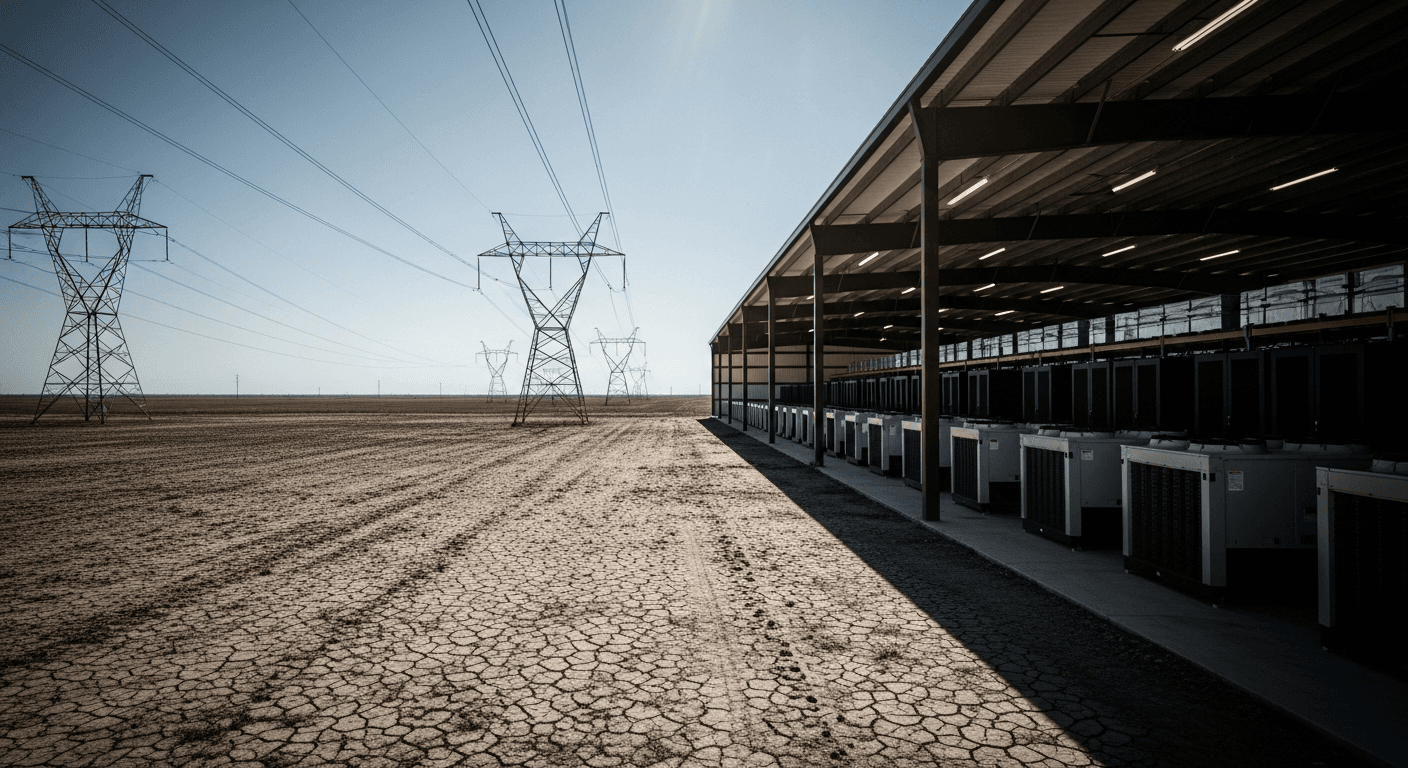
Grid-connected acreage is now a balance-sheet asset. MARA just made its biggest bet on that thesis.
Key takeaways
- MARA Holdings signed a definitive agreement to acquire a 1,200-acre powered site in Matagorda County, Texas, with up to 2 GW of grid capacity targeted by April 2028, at an aggregate purchase price of up to $600 million.
- The deal would lift MARA's total portfolio capacity to approximately 4.8 GW (including the pending Long Ridge acquisition), but no HPC anchor tenant is yet signed, the key outstanding execution variable.
- MARA shares rose more than 10% on the announcement; the bull/bear split is sharp, with Citizens at Outperform ($24 target) and Morgan Stanley at Underweight ($5.50), resolution hinging on whether MARA converts grid access into signed compute leases.
MARA Holdings signed a definitive agreement on July 9, 2026, to acquire a powered land site in Matagorda County, Texas, from HIF USA LLC, targeting up to 2 GW of grid capacity by April 2028, per the company's official press release. The milestone-contingent deal carries an aggregate purchase price of up to $600 million, implying roughly $300,000 per megawatt at full build, a number that crystallizes exactly how expensive defensible power infrastructure has become.
The site spans more than 1,200 acres approximately 90 miles southwest of Houston. An initial 1 GW of grid capacity is targeted by October 2027, with the full 2 GW available by April 2028. The deal closed on July 2, 2026, when MARA's subsidiary Volt Texas, LLC acquired the membership interests of MAT 1177 LLC from HIF USA LLC, with phased construction expected to begin in 2026 pending regulatory approvals. Development partner Starwood Digital Ventures is involved in the build-out. HIF has already issued a notice to proceed on switchyard construction to connect the site to the grid.
Power as the Scarce Asset
MARA Chairman and CEO Fred Thiel framed the acquisition plainly: "This transaction advances our strategy of securing strategically located infrastructure assets capable of supporting high-performance compute and bitcoin workloads. As demand for digital infrastructure continues to grow, we believe sites with access to reliable, scalable power will become increasingly valuable."
That framing is the thesis in plain language. The Matagorda site was not idle farmland. HIF USA is an advanced fuels company that developed the parcel for its own e-fuels ambitions, meaning the grid connections, land permits, and infrastructure work were already underway. MARA is acquiring a positioned asset, not raw acreage, and paying accordingly.
Once fully energized, Matagorda would lift MARA's total potential portfolio capacity to approximately 4.8 GW, including the anticipated close of the Long Ridge Energy & Power acquisition (that deal has not yet closed). The company has already invested more than $1.2 billion in Texas.
The $300,000-per-MW implied cost at full build is the number worth sitting with. It reflects what the market now prices for large-block, grid-connected power in a jurisdiction that can actually permit construction. The AI buildout is repricing power beneath every player in this space, and MARA is betting that owning grid access at scale is worth the premium before that repricing runs further.
The Execution Gap
The structure of the deal carries real risk. HIF retains a minority ownership interest in the project contingent on execution of a lease with an HPC tenant. That clause reveals the priority stack: HPC comes first, Bitcoin mining absorbs flexible capacity when compute tenants don't fill it. The site has received interest from potential HPC tenants, but no lease is signed.
That gap between "site secured" and "tenant signed" is where this thesis lives or dies. Compare MARA's position to peers who have already closed: TeraWulf's Anthropic lease at its Justified Data campus in Kentucky and Galaxy Digital's Helios conversion with CoreWeave as anchor tenant both have anchor tenants in place. MARA does not. The market is pricing in the possibility that MARA will land one; Morgan Stanley's $5.50 Underweight target reflects the possibility it won't, and that the capital deployed proves dilutive rather than generative.
The broader miners-to-infrastructure pivot also raises a question Bitcoiners should track carefully. If MARA's largest sites prioritize HPC tenants and treat Bitcoin mining as the fallback workload, the company's contribution to network hashrate growth depends on how much capacity remains uncontracted. More gigawatts on paper does not automatically mean more hashrate on the network.
What to Watch
The next material data points are straightforward: an HPC anchor tenant announcement for the Matagorda site, MARA's self-mined BTC production figures in upcoming quarterly reports, and the Long Ridge close. If MARA signs a hyperscaler for Matagorda before Q1 2028 and Long Ridge closes on schedule, the power-as-asset thesis holds. If neither materializes and MARA raises equity to fund continued build-out before generating lease revenue, the Morgan Stanley bear case gets validated. The switchyard notice to proceed is in motion. The rest is execution.
Update, November 19, 2026
The Long Ridge acquisition is now on the one-week clock. MARA filed an 8-K on November 17, 2026, confirming the pricing of the notes offering and setting the anticipated closing of the Long Ridge Energy & Power acquisition for November 27, 2026.
MARA priced $185 million of 8.750% senior secured notes due 2032 issued by Long Ridge Energy, with proceeds combined with cash on hand to fund the roughly $1.5 billion purchase and repay a portion of Long Ridge's existing debt.
The new notes stack on top of $600 million in existing Long Ridge notes carrying the same rate, bringing total combined principal to $785 million and annual interest obligations to around $68.7 million.
The Federal Energy Regulatory Commission approved the transaction on November 4-5, 2026, clearing the last major regulatory hurdle before closing.
The acquisition includes a 505-megawatt nameplate combined-cycle natural gas plant in Hannibal, Ohio, and more than 1,600 contiguous acres with access to power, water, fiber, and rail.
MARA has flagged the site as positioned to support multiple monetization pathways, including AI, HPC, critical IT workloads, flexible compute, and wholesale power generation into the PJM grid.
The financing path that got MARA here is worth noting. The debt raise follows MARA's November 9 disclosure that it sold 13,597 Bitcoin after quarter-end for approximately $1.1 billion.
The company used $750 million of those proceeds to repay loans it had taken out using its Bitcoin as collateral, loans that had initially helped finance the Long Ridge acquisition. In the new structure, the debt is secured not by Bitcoin reserves but by the energy business being acquired. The same execution gap flagged in this article remains open: the Long Ridge property includes land MARA says could support more than 1 gigawatt of data center capacity, but the company has yet to announce a major AI tenant for the proposed development.
Sources
Frequently Asked Questions
What is HIF USA, and why was it selling this Texas site?
HIF USA is an advanced fuels company that developed the Matagorda parcel for sustainable fuels production. By selling to MARA, HIF monetizes the infrastructure asset while retaining a minority interest if an HPC tenant signs a lease, and continues its e-fuels plans at other Texas and global sites.
How does the $600 million price break down?
The $600 million is a maximum aggregate, milestone-contingent figure. Payments are tied to regulatory approvals, the site contract closing, approval to receive grid power, and execution of a data-center lease with a third-party tenant. At the full 2 GW build-out, the implied cost works out to roughly $300,000 per MW.
Does this deal mean MARA will mine less Bitcoin?
Not necessarily, but the structure prioritizes HPC. The campus is designed for high-performance computing with Bitcoin mining as the flexible fallback workload. If a hyperscaler signs a lease, compute takes priority. Watch MARA's self-mined BTC production in future quarterly reports for the clearest read on how much capacity actually flows to the network.