France Bets on Syria as Hormuz Bypass, Petrodollar Moat Shrinks
France signed more than 16 strategic agreements with Syria on July 7, brought TotalEnergies to Damascus, and is explicitly building a Hormuz bypass. Iraq is already running 500-700 tanker trucks per day through the corridor. This is not emergency triage.
Paris signed 16+ strategic deals in Damascus and brought TotalEnergies along. Iraq is already running 500-700 tanker trucks a day through the corridor. This is structural, not temporary.
Key takeaways
- French Foreign Minister Jean-Noel Barrot said on July 10 that Paris is developing "alternative routes so that we are not dependent on blockages here or there," naming Syria as a potential new regional hub, three days after Macron landed in Damascus and France signed more than 16 strategic cooperation agreements with the Syrian government.
- Iraq has been trucking oil through Syria to Baniyas port since April 1, averaging roughly 130,000 bbl/day in seaborne exports by mid-June, per Vortexa shipping data. Iraqi officials say the route stays open even if Hormuz fully reopens.
- Every new corridor built outside US logistical control chips away at the structural dollar demand that petrodollar recycling depends on. The direction is clear even if the pace is slow.
France's sprint to plant its energy flag in Syria went public Thursday when Foreign Minister Jean-Noel Barrot told French network TF1 that Paris is developing "alternative routes so that we are not dependent on blockages here or there," explicitly naming Syria as a strategic corridor for Gulf oil. The statement followed President Emmanuel Macron's July 7 visit to Damascus, where France and Syria signed more than 16 strategic cooperation agreements covering energy, infrastructure, aviation, transportation, and investment, per Anadolu Agency.
TotalEnergies CEO Patrick Pouyanne accompanied Macron to the Syrian capital and described Syria as "at the crossroads of the Middle East" and "a positive initiative to come here." Two bombs detonated near the Four Seasons Hotel where the French delegation was staying during the visit, wounding 18 people including four police officers, according to Al Jazeera. Syria's Interior Ministry attributed the blasts to planted explosive devices. France did not leave early.
What France Actually Locked In
TotalEnergies holds a May 2026 MoU with Syria's state petroleum company, ConocoPhillips, and QatarEnergy for an offshore Mediterranean exploration block. No operational projects are running. Pouyanne was direct: "Today, it's clear that the security situation still doesn't allow us to operate." The visit was about positioning, not production.
The harder asset is CMA CGM's 30-year, €230 million concession to modernize the container terminal at the Port of Latakia, signed May 1, 2025. A French shipping giant holding the terminal concession at Syria's primary Mediterranean port is not a symbolic gesture.
The corridor already moving real barrels is the Iraq-Syria overland truck route, which began April 1. Iraq's SOMO contracted approximately 650,000 metric tons of fuel oil per month through Syria to Baniyas port, per Foundation for Defense of Democracies analysis citing Reuters and SOMO. That works out to 500-700 tanker trucks crossing daily. Vortexa shipping data put Baniyas seaborne exports at roughly 130,000 bbl/day for the four weeks ending June 14.
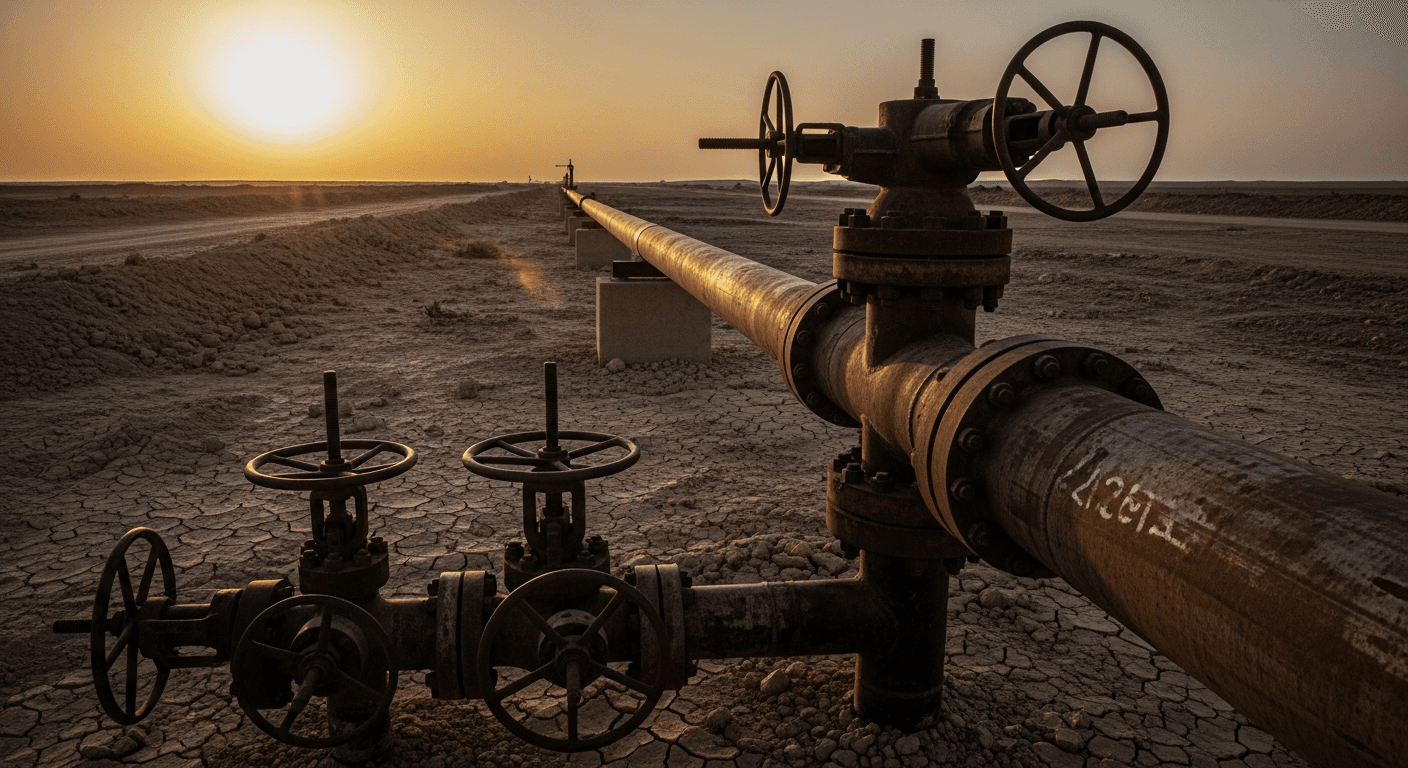
The dormant Kirkuk-Baniyas pipeline, offline since 2003 and capable of carrying up to 300,000 bbl/day, is under active discussion for rehabilitation. At current truck volumes, a restored pipeline would multiply corridor capacity by roughly six times. A North Oil Company official cited rehabilitation costs in the $300 million to $600 million range for partial rehabilitation, with other Iraqi officials citing figures in the billions for full reconstruction; costs vary widely depending on scope.
The Dollar's Energy Premium Is the Story
The standard geopolitics read stops at "France wants Syrian oil routes." The more important read is what these corridors do to the petrodollar architecture over time.
Petrodollar recycling depends on Gulf producers needing US security guarantees for their export routes, earning dollars, and cycling those dollars back into Treasuries. The moment European buyers and Gulf producers have credible parallel corridors through Syria, Turkey, and Jordan, the influence the US Navy's Hormuz presence provides gets smaller. Less dependency is less structural dollar demand. That is not a cliff event; it is directional erosion.
The energy shock that started with the Hormuz closure accelerated a transition that was already underway.
Syrian President Ahmad al-Sharaa framed it plainly at the Damascus economic forum: "After the Strait of Hormuz crisis, the world realizes the value of safe and stable corridors." Iraq's officials have gone further, stating the Syria route remains in place even after Hormuz fully reopens. That is permanent infrastructure policy, not emergency triage.
The OPEC defection dynamics that preceded this move already pointed the direction. What France's Damascus sprint confirms is that major powers are not waiting for the ceasefire to hold before building around the choke point. The speed is notable: operational truck convoys running at 500-700 per day within two months of the Hormuz closure going live.
The Bitcoin-adjacent frame here is direct. Energy infrastructure that routes around a single nation's geographic chokepoint is the physical analog to a payment network that routes around a single nation's financial chokepoint. Every major power that builds its own corridor is demonstrating, in practice, that no single point of control should be the linchpin of global commerce. The case for neutral, permissionless money gets incrementally stronger every time that logic gets applied to a new domain.
The falsifiable thesis: if the Hormuz ceasefire holds, Iran drops its toll ambitions, and Gulf states abandon Syria corridor investment entirely within 12 months, this is a wartime workaround and the petrodollar energy premium is not materially eroded. Watch whether Iraq scales back truck volumes and whether the Kirkuk-Baniyas pipeline rehabilitation talks quietly die.
What Comes Next
The next forcing functions are the pipeline rehabilitation decision and whether France's agreements translate into actual energy project financing. TotalEnergies' Pouyanne was patient but clear: security conditions have to stabilize before capital follows. Watch whether the joint economic committees Macron and al-Sharaa agreed to form produce a concrete timeline on the pipeline, and whether any Gulf state sovereign wealth funds co-invest alongside TotalEnergies in the offshore block. Capital commitment, not MoUs, is the signal worth tracking.
Update, July 18, 2026
The US strike campaign escalated sharply on the night of July 16-17, moving beyond military targets into logistics infrastructure. Iranian state media reported targets included six bridges in Hormozgan province, a railway junction station in Bandar Abbas, an airport in Iranshahr, and a maritime control tower at the port of Chabahar.
CENTCOM said the wave of strikes began with the objective of further degrading Iranian military capabilities while protecting freedom of navigation through the Strait of Hormuz.
The attacks marked the sixth consecutive night of American strikes.
The targeting logic is not subtle. The Kahurestan Bridge, struck directly, sits on the Bandar Abbas to Khamir to Lar highway and forms part of the main transportation corridor linking Bandar Abbas, Iran's largest commercial port, with Shiraz and central Iran. Taking out that corridor simultaneously degrades the overland workarounds Iran has been running since the maritime blockade tightened. Russia and its partners are pressing ahead on the longer-term fix: Russian Foreign Minister Lavrov said publicly this week that the Hormuz crisis is increasing the importance of the International North-South Transport Corridor, noting that Tehran has now completed land allocation on the Rasht-Astara rail section, and that railway chiefs from Russia, Azerbaijan, and Iran have discussed practical steps to begin work.
The race is real and the sides are running in opposite directions on the clock. Russia's Transport Ministry confirmed it plans to begin construction of the Rasht-Astara line once the security situation in Iran stabilises, with Minister Andrei Nikitin making the statement on the sidelines of the St. Petersburg International Economic Forum.
Analysts note that rail "operates entirely outside any waterway a Western navy can patrol, and entirely outside the dollar payments system" -- a point that carries obvious weight as every overland corridor that comes online is one fewer chokepoint where dollar-denominated maritime settlement applies.
Update, September 26, 2026
The Syria-Iraq corridor just went bidirectional. Gasoline shipped to Syria has begun moving by road to Iraq, establishing a two-way energy corridor through a route Baghdad has used to export fuel since disruption to shipping through the Strait of Hormuz. The prior coverage tracked fuel oil moving west from Iraq to Baniyas for seaborne export. The return leg is new. The first cargo inbound to Iraq, about 32,800 metric tons of gasoline aboard the Marshall Islands-flagged tanker Avanti, was unloaded into storage tanks at Syria's Baniyas refinery before being loaded onto trucks, according to SPC Refining Director Tareq Shallash speaking to Reuters. The operation is being carried out under a transit contract between SPC and Qatar's UCC Holding, which Shallash said was the supplier and was overseeing transportation.
Iraq's oil ministry confirmed the arrangement, with spokesperson Saleem al-Rikabi telling Reuters that "a contract was signed between SOMO and the Qatari company to supply Iraq with improved gasoline through the port of Baniyas by road tankers."
The corridor is thickening fast. Another Marshall Islands-flagged tanker, Gaita, loaded gasoline at the Port of Houston before sailing to Baniyas for discharge, LSEG shipping data showed. US Gulf Coast gasoline moving through a Syrian port to Iraq via overland truck is a logistical sentence that would have been unwritable two years ago. Shallash said the current transit contract is limited to gasoline, although the route could later be expanded to other petroleum products, crude oil, or other goods under future agreements.
The longer pipeline play is also advancing in parallel. UCC Holding, the same Qatari firm running the gasoline transit, is part of a consortium with Chevron and TI Capital studying the revival of the Kirkuk-Baniyas crude pipeline, after Iraq and Syria signed a memorandum of understanding in Washington in July.
Reuters reported in August that the project could take four years and cost at least $15 billion, because it would require entirely new infrastructure. The truck route is the working bypass today; a rebuilt pipeline would be the permanent one. Both legs are now moving product.
Sources
- Anadolu Agency: Barrot TF1 interview, July 10, 2026
- SANA: TotalEnergies/Pouyanne remarks, Damascus, July 7, 2026
- The New Arab/AFP: Pouyanne on Syria as alternative route
- Anadolu Agency / Türkiye Today: France-Syria 16+ agreements, CMA CGM concession
- Al Jazeera: Damascus bombings, 18 wounded
- Foundation for Defense of Democracies: Iraq-Syria SOMO trucking volumes
- Vortexa: Baniyas seaborne export data
- Foreign Policy: Hormuz transit volume baseline
Frequently Asked Questions
What is the Kirkuk-Baniyas pipeline and why does it matter?
The Kirkuk-Baniyas pipeline ran from northern Iraq to Syria's Mediterranean coast with capacity of up to 300,000 bbl/day. It has been offline since 2003. Rehabilitating it would transform the Syria bypass from a trucking workaround into a full pipeline corridor, multiplying throughput by roughly six times compared to current truck volumes. A North Oil Company official has cited partial rehabilitation costs in the $300 million to $600 million range; other Iraqi officials and analysts put full reconstruction costs significantly higher.
Does the Hormuz ceasefire make the Syria corridor irrelevant?
Iraq's own officials have said no. Gulf states and energy companies have stated publicly they intend to develop the Syria corridors regardless of Hormuz's status, specifically to reduce the influence any single chokepoint gives one power over global energy flows. The corridor went from concept to operational convoys in under two months. That infrastructure does not get dismantled because a ceasefire holds.
What does TotalEnergies actually have committed in Syria right now?
One MoU, signed May 2026 with Syria's state petroleum company, ConocoPhillips, and QatarEnergy, for an offshore Mediterranean exploration block. No operational projects. Pouyanne was explicit that security conditions do not yet permit operations. The Damascus visit was about establishing positioning ahead of the capital deployment that follows stabilization.