Makkah Joint Defense Agreement Fractures the Petrodollar Security Arch
Saudi Arabia, Turkey, and Pakistan formalized a NATO-style mutual-defense pact in Makkah on August 7, placing Saudi Arabia under Pakistan's nuclear umbrella and building a parallel security architecture that no longer runs through Washington.
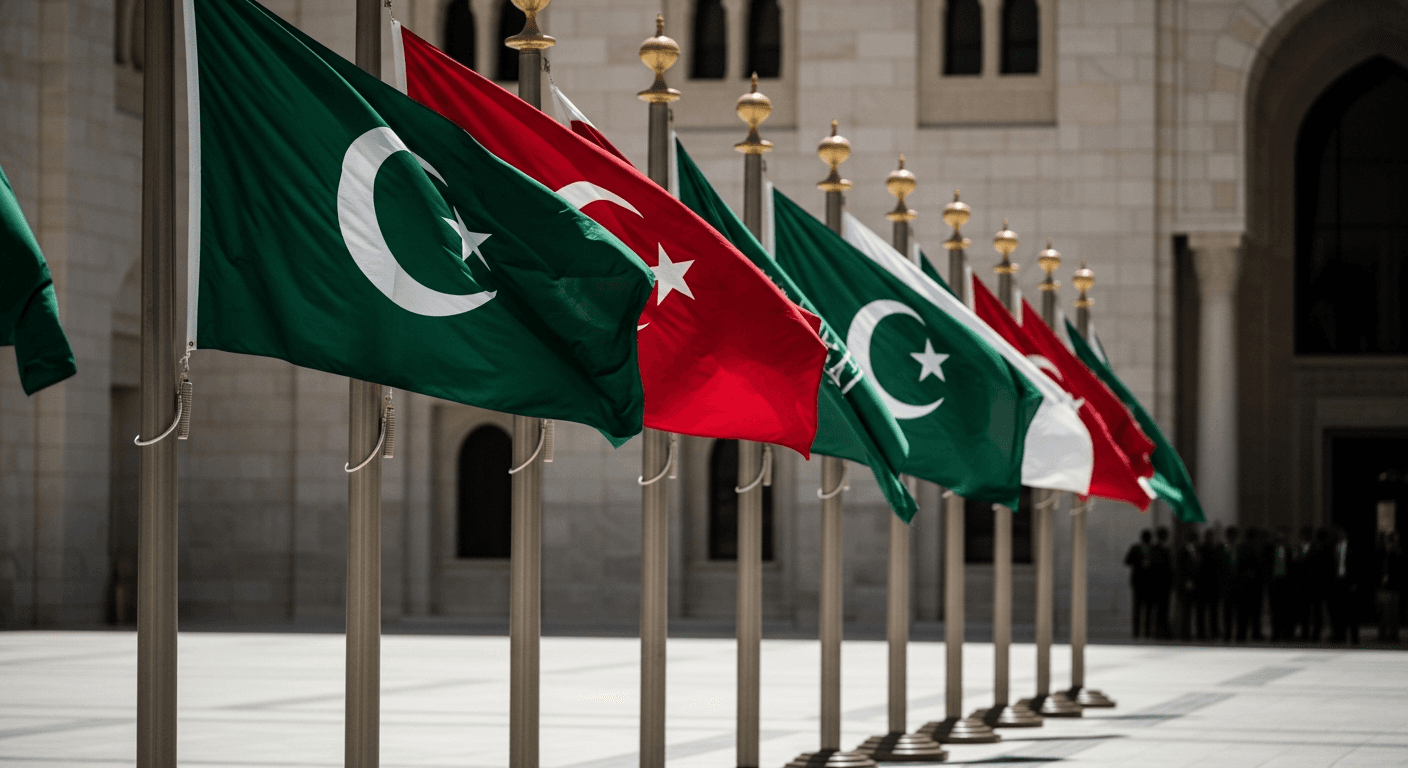
Saudi Arabia, Turkey, and Pakistan formalized a NATO-style mutual-defense clause on August 7, building a parallel security architecture that does not run through Washington.
Key takeaways
- Saudi Arabia, Turkey, and Pakistan signed the Makkah Joint Defense Agreement on August 7, declaring that an armed attack on any one of the three shall be treated as an attack on all, among nations totaling roughly 370 million people.
- The pact formalizes a nuclear umbrella over Saudi Arabia via Pakistan, with approximately 8,000 Pakistani troops, a squadron of JF-17 fighters, two drone squadrons, and a Chinese HQ-9 air defense system already deployed on Saudi soil under the bilateral Strategic Mutual Defence Agreement signed September 2025.
- The trilateral alliance chips directly at the first leg of the petrodollar arrangement: US security guarantees for Riyadh in exchange for dollar-denominated oil and Treasury recycling. As that guarantee becomes less exclusive, the logic sustaining dollar hegemony weakens.
Saudi Arabia's Crown Prince Mohammed bin Salman, Turkish President Recep Tayyip Erdogan, and Pakistani Prime Minister Shehbaz Sharif signed the Makkah Joint Defense Agreement in the Saudi holy city on Friday, August 7, 2026, per a joint statement published simultaneously by Saudi Arabia's official Saudi Press Agency and Pakistan's Ministry of Foreign Affairs. The core clause is unambiguous: "Any armed attack against any one of the three states shall be regarded as an attack against them all."
The agreement also provides for intelligence sharing and expanded defense cooperation across all domains. A Turkish government official told the Associated Press the pact is "purely defensive in nature" and "not against any specific actor." A Saudi official stated it "does not represent an effort to establish a military axis or a sectarian bloc." Both officials noted the agreement does not abrogate existing multilateral commitments, keeping Turkey's NATO membership intact, and that the pact is open to other regional countries joining.
A Nuclear Umbrella Outside the American Framework
The defense architecture here is not theoretical. Pakistan's Defence Minister Khawaja Asif implied publicly, in a Geo TV interview the day after the bilateral Strategic Mutual Defence Agreement was signed on September 17, 2025, that Pakistan's nuclear weapons would be available to Saudi Arabia under that pact. The Makkah agreement extends that logic to Turkey as well.
Pakistan already has skin in the game. Reuters first reported in May 2026 that Islamabad had deployed roughly 8,000 troops, approximately 16 JF-17 fighters built jointly with China, two drone squadrons, and a Chinese HQ-9 air defense system to Saudi Arabia. That deployment was formalized under the bilateral pact; the Makkah agreement upgrades it to a trilateral commitment. Saudi Arabia has been subject to Iranian missile and drone strikes since the 2026 Iran war began, and it has relied heavily on US air defenses. That reliance is now supplemented by a framework Riyadh controls through its own treaty relationships.
This is the first time a nuclear umbrella has been formalized outside the US, NATO, Russian, or Chinese frameworks. The nonproliferation architecture the dollar system has historically policed just acquired a new variable it does not govern.
What This Does to the Petrodollar
The petrodollar system rests on a two-sided deal. The US guarantees Saudi security; Saudi Arabia prices oil in dollars and recycles petrodollar surpluses through US Treasuries. The Makkah pact chips at the first side of that deal directly.
Riyadh is now paying for security through a different channel: financing Pakistani military equipment and locking in Turkey, a NATO member that has been pricing bilateral trade in non-dollar arrangements and has liquidated nearly 89% of its US Treasury holdings in a single month, as a strategic partner. Saudi Arabia has previously explored yuan-denominated oil contracts with China. The political economy for those contracts just got a stronger foundation.
The Strait of Hormuz dimension adds pressure. Roughly 20% of global oil trade transits the strait. A trilateral defense pact that puts Pakistani nuclear capacity and Turkish drone and munitions systems into the Saudi deterrence posture raises the cost of Iranian escalation against Saudi energy infrastructure. It also raises the risk of miscalculation producing the supply shock it is meant to prevent. TFTC has previously covered the petrodollar's structural pressures in depth; the Makkah agreement adds a hard geopolitical datapoint to what had been a slower-moving financial drift.
For Bitcoin, the geometry is straightforward. In a world fractured between a dollar bloc, a yuan-adjacent bloc, and now a third security architecture that straddles both and trusts neither, no single sovereign currency commands cross-bloc settlement confidence. Bitcoin is the only monetary asset none of these blocs issues, controls, or can freeze.
The falsifiable version of that thesis: if Saudi Arabia formally anchors a new US security guarantee, re-commits future oil contracts to dollar settlement, or advances normalization with Israel into a binding treaty framework, the dependency this pact is meant to reduce gets rebuilt. A strong American response that pulls Riyadh back firmly into the US orbit would break the argument. Neither outcome looks probable from Friday's signing.
What to Watch Next
Whether other Gulf states join the Makkah framework is the immediate tell. The pact is explicitly open to additional members. A UAE or Bahraini accession would signal the trilateral agreement is the seed of a durable regional bloc, not a bilateral upgrade with a third flag attached. Watch also for any movement on Saudi oil contract denomination. The military architecture and the financial architecture tend to move together, with a lag.
Sources
- Saudi Press Agency, joint statement, August 7, 2026
- Pakistan Ministry of Foreign Affairs, joint statement, August 7, 2026
- Dawn, joint statement text
- Xinhua, August 7, 2026 wire
- AP/CBS News, Turkish and Saudi official quotes
- Strategic Mutual Defence Agreement, Wikipedia reference
- Pakistan troop deployment first reported by Reuters (May 18, 2026); The Daily Star
Frequently Asked Questions
No. Per the agreement's own text and a Turkish government official speaking to the Associated Press, the pact explicitly does not abrogate existing bilateral or multilateral commitments. Turkey remains a NATO member. What the agreement does is add a separate mutual-defense obligation that layers on top of NATO, not underneath it.
The full text of the underlying bilateral Strategic Mutual Defence Agreement between Pakistan and Saudi Arabia, signed September 17, 2025, has not been made public. Pakistan's Defence Minister Khawaja Asif implied at the time of that signing that Pakistan's nuclear weapons would be available to Saudi Arabia. The Makkah agreement formalizes and extends the trilateral mutual-defense logic. The nuclear dimension is real and implied, though the exact terms of any nuclear-sharing arrangement remain outside what has been officially published.
Saudi Arabia is actively subject to Iranian missile and drone strikes as of this writing. A trilateral defense pact that places Pakistani nuclear capacity and Turkish military hardware inside Saudi Arabia's deterrence posture changes the escalation calculus for both sides. Iranian strikes on Saudi energy infrastructure now carry a higher potential cost. But a larger coalition also creates more nodes at which miscalculation can occur. The net effect on Hormuz transit risk is not lower uncertainty; it is higher stakes on both sides of the deterrence equation.