Recovered LUCAS Drone in Hormuz Threatens Pentagon's $54.6B Bet
A US LUCAS kamikaze drone reportedly recovered by Iranian fishermen in the Strait of Hormuz may hand adversaries an intact look at the platform behind the Pentagon's 243-fold drone budget surge.
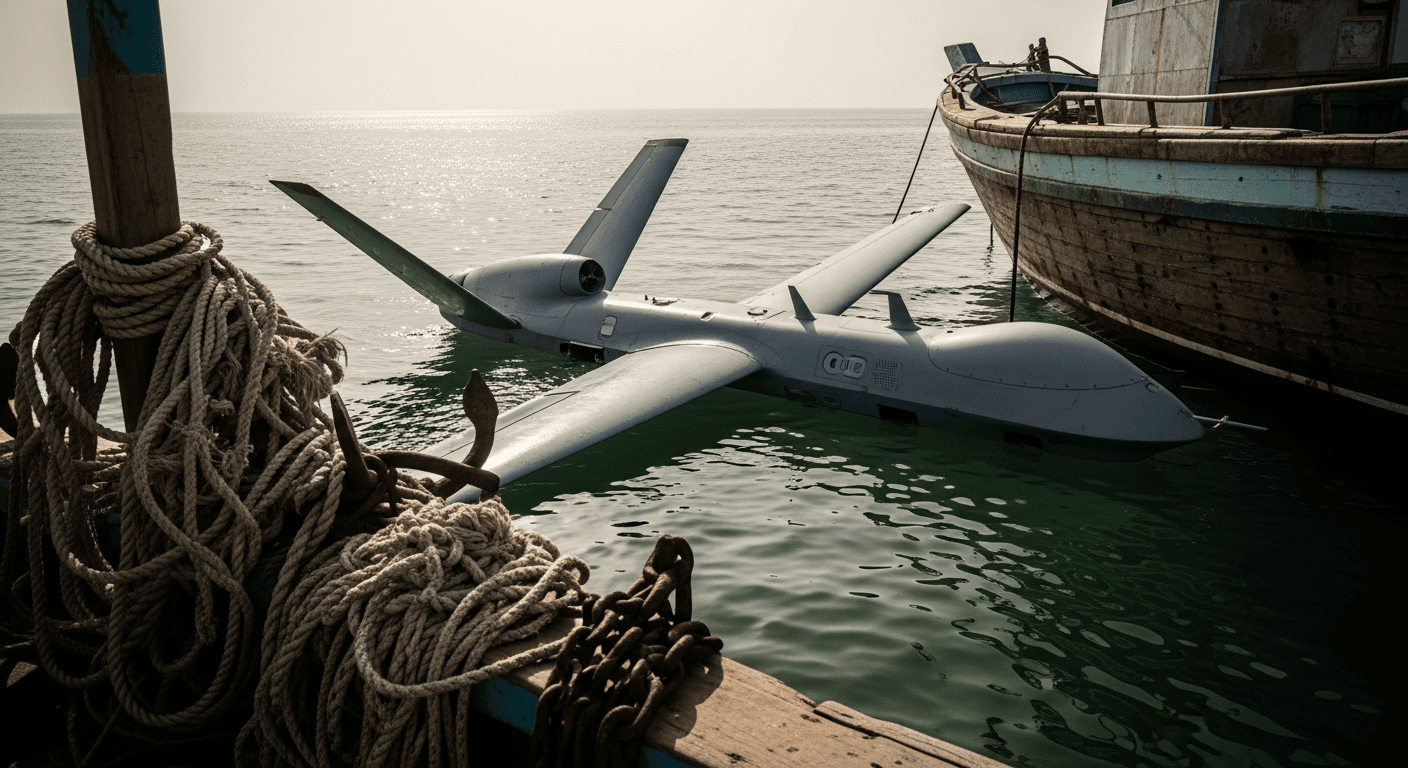
A reported recovery hands Iran a close look at America's mass-produced kamikaze platform right as the Pentagon proposes scaling it 243-fold.
Key takeaways
- Iranian fishermen reportedly recovered a US-made LUCAS one-way attack drone drifting in the Strait of Hormuz around July 17, 2026, and handed it to Iranian authorities, according to an Arabic-language post first reported by ZeroHedge.
- The Pentagon's FY2027 budget request proposes a 243-fold increase in Defense Autonomous Warfare Group (DAWG) funding, from $225.9 million to $54.6 billion, making autonomous drone warfare the single largest year-over-year budget jump in the DoD.
- If the drone was recovered in a condition yielding usable intelligence, Iran or its partners could attempt to reverse-engineer the platform the US military has only just begun deploying at scale, the same dynamic that gave LUCAS its origin story.
A suspected US-made LUCAS (Low-Cost Unmanned Combat Attack System) drone was reportedly found drifting in the Strait of Hormuz and recovered by Iranian fishermen, who turned it over to Iranian authorities, per an Arabic-language social media post dated July 17, 2026, first reported by ZeroHedge. No US government or Iranian official confirmation has been issued. The condition of the drone and the cause of its loss remain unknown.
The incident lands at an awkward moment. The Pentagon's FY2027 budget request, released in April 2026, proposes scaling DAWG funding from $225.9 million to $54.6 billion, a 243-fold increase that signals autonomous one-way attack drones as the centerpiece of future US force projection. A recovered airframe, functional or not, is not the headline the program needed.
What LUCAS Is and Why the Recovery Matters
LUCAS first saw combat on February 28, 2026, when US Central Command announced on X that Task Force Scorpion Strike had deployed one-way attack drones for the first time in history during Operation Epic Fury.
CENTCOM called them "low-cost drones, modeled after Iran's Shahed drones." That framing carries its own irony now. The Shahed-136 was itself reverse-engineered and mass-produced by Iran, then proliferated to Russia, which used it to reshape attritional warfare in Ukraine. The US studied that playbook, built LUCAS around it, and priced the platform at approximately $35,000 per unit, per Navy Capt. Tim Hawkins, CENTCOM's spokesperson, speaking to The War Zone.
The pitch: scalable, expendable, lethal at a fraction of the cost of a cruise missile. A drone bobbing in the Hormuz strait, handed to Iranian authorities, is precisely how that reverse-engineering cycle restarts.
Earlier this month, CENTCOM disclosed a separate first: three Saronic Corsair one-way attack surface drones struck a submarine and ship maintenance facility at Iran's Bandar Abbas Naval Base on July 12, 2026, with CENTCOM confirming the strike on X on July 13, 2026, marking the first US combat use of sea-going kamikaze drones.
The $54.6 Billion Doctrine and Its First Visible Crack
The Pentagon's FY2027 DAWG budget request is a doctrinal statement: cheap, mass-produced autonomous weapons are now the official answer to the cost curve of modern warfare. The math behind LUCAS is the whole argument: a $35,000 drone delivering effects previously requiring a platform two orders of magnitude more expensive.
That argument holds only as long as the adversary cannot replicate the system. The US-Iran dynamic has already run this loop once, in reverse. Now, with the doctrine scaled to $54.6 billion and production lines ramping, an intact or near-intact LUCAS in Iranian hands is the first data point that the "affordable mass" bet carries a serious counterintelligence exposure.
It is worth noting the falsifiable edge of that thesis. If the recovered drone is confirmed non-functional, stripped of meaningful components, or a decoy variant with no forward-looking tech aboard, the operational security damage is limited. The thesis weakens further if the US confirms a remote wipe or self-destruct occurred before recovery. None of that has been confirmed in either direction.
The Hormuz Chokepoint and the Second-Order Read
The Strait of Hormuz is not just a military theater. Roughly 20% of global oil and a third of global LNG transits it. Every escalation marker in that waterway reprices energy risk. War-risk insurance premiums in the strait have risen sharply.
A recovered drone handed to Iranian authorities is a meaningful escalation marker, whether or not it yields usable intelligence.
The deeper read sits at the intersection of fiscal and monetary risk. Wars fought with mass-produced $35,000 drones at a proposed $54.6 billion annual clip are not free. They come out of Treasury issuance on a sovereign balance sheet that is already stretched.
The war premium layering onto energy prices combines with deficit spending to tighten the squeeze on dollar-denominated assets. Every credible signal that US military hardware is being compromised in the world's most critical energy chokepoint accelerates the conversation about what a neutral, unseizable reserve asset looks like.
Analysts including Lyn Alden and Jeff Booth have mapped this trajectory for years. The petrodollar's durability rests on the perception of US military dominance and stability. A LUCAS drone drifting into Iranian hands does not end that perception. It chips at it.
What to Watch
The immediate question is whether Iranian or allied technical teams can extract useful information from the recovered airframe. A US government acknowledgment, a confirmed self-destruct or remote-wipe capability, or a credible report that the unit was non-functional would significantly change the operational calculus. Absent any of that, the recovery sits as an open intelligence variable for a program the Pentagon just proposed scaling to the largest single-year defense budget increase in the DoD's autonomous warfare history. Congressional scrutiny of the $54.6 billion DAWG request is the next proximate pressure point.
Update, September 12, 2026
The US military has reduced the daily window in which it offers air defense to commercial ships transiting the Strait of Hormuz, the Financial Times reported Saturday.
Washington had been offering air-based defense since May to ships sailing via a route hugging the Omani coast, but that coverage was cut down to two specific time slots daily around the start of September.
The move comes in response to stepped-up Iranian attacks on ships transiting Hormuz, particularly at night, and ships are reportedly advised but not required to sail during the protected windows, with shipowners required to apply through the Naval Cooperation and Guidance for Shipping (NCAGS).
The tighter schedule is a direct operational reversal. Since May, Washington had sought to break Iran's control of Hormuz by providing air defense for vessels sailing through the strategic strait along that southern Omani coast route. Collapsing that umbrella to two daily slots is not a logistical tweak; it is a de facto admission that the US cannot sustain continuous coverage of the world's most critical oil chokepoint.
An analyst at maritime intelligence firm Windward estimated that oil exports from Gulf countries other than Iran in August stood at about two-thirds of prewar levels, largely because of exports rerouted through pipelines to bypass Hormuz. That supply contraction already priced in full US protection. A narrowed air-defense window raises the probability of successful Iranian attacks during unguarded hours, adds an effective risk premium to every tanker transit, and tightens the screws on the roughly one-fifth of global seaborne energy supply that depends on this passage. Every tanker operator that now has to gamble on an undefended transit is a real-time stress test for energy markets built on dollar-settled oil flows. The macro feedback loop from here runs straight through inflation expectations and the long-term case for hard money.
Sources
- CENTCOM X post, Operation Epic Fury / first LUCAS combat use, February 28, 2026
- DefenseScoop, LUCAS first combat use coverage
- Breaking Defense, Pentagon DAWG FY2027 budget
- DroneXL, DAWG budget analysis
- GlobalSecurity.org, DAWG budget aggregation
- First reported by ZeroHedge, sourcing an Arabic-language X post by @mog_china dated July 17, 2026; no US or Iranian government confirmation has been issued.
Frequently Asked Questions
What is a LUCAS drone and how does it relate to Iran's Shahed?
LUCAS (Low-Cost Unmanned Combat Attack System) is a US-made one-way attack drone explicitly modeled on Iran's Shahed-136 kamikaze drone. The Shahed was mass-produced by Iran, proliferated to Russia, and used extensively in Ukraine. The US developed LUCAS to replicate that attritable, high-volume strike concept at roughly $35,000 per unit. The Hormuz recovery raises the possibility that Iran could now attempt to reverse-engineer LUCAS the same way the US studied the Shahed.
Has Iran successfully recovered US military hardware before?
Yes. In December 2011, Iran recovered a largely intact RQ-170 Sentinel stealth reconnaissance drone after it went down near Kashmar. Iran subsequently claimed to have reverse-engineered it and produced domestic variants. The RQ-170 precedent is the direct historical comparator for why a recovered LUCAS, even partially intact, is treated as a serious counterintelligence event rather than a routine equipment loss.
What does this incident mean for oil prices and the dollar?
The Strait of Hormuz handles roughly 20% of global oil supply and a third of global LNG. Any escalation there carries an energy price premium. IRGC activity in the strait has already driven war-risk insurance premiums sharply higher. A drone recovery that signals ongoing US-Iran kinetic friction keeps that premium elevated and adds pressure to oil-dependent dollar settlement flows, reinforcing the macro case for hard assets outside the fiat system.