Iran Seizes US Anduril Dive-LD Drone at Strait of Hormuz
Iran's IRGC Navy announced September 8 it seized a US Anduril Dive-LD autonomous underwater drone at the Strait of Hormuz entrance. The Pentagon hasn't confirmed it. The photographs make the denial difficult.
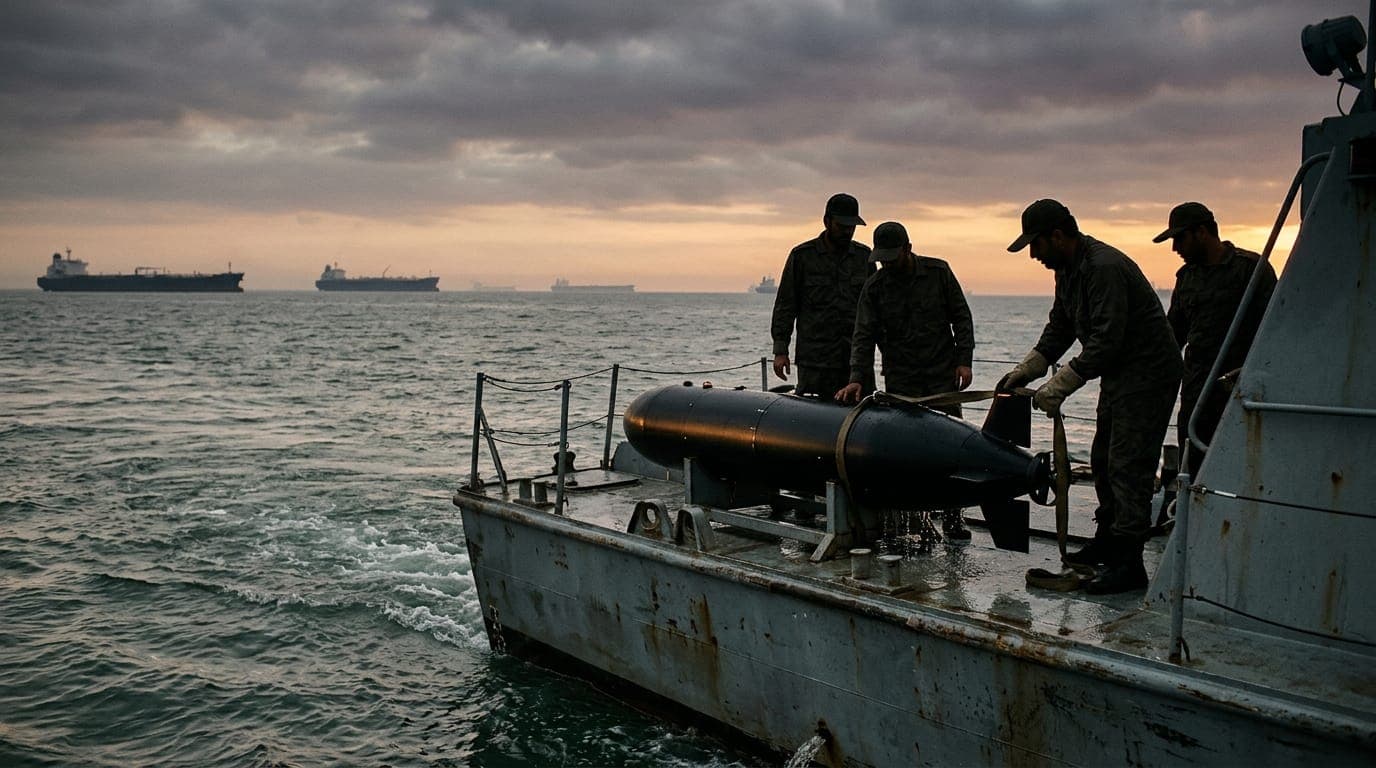
The Pentagon called it a malfunction. Iran called it a "complex intelligence and military operation." The photographs are hard to argue with.
Key takeaways
- Iran's IRGC Navy announced on September 8, 2026 that it seized a US Anduril Dive-LD autonomous underwater vehicle at the entrance of the Strait of Hormuz; released images closely match the drone's distinctive physical profile.
- The drone was reportedly operating as part of a covert US mission to de-mine the strait, which Iran has asserted control over since late February 2026; Iran now holds hardware from the operation designed to reopen the waterway.
- Roughly 20% of globally traded oil moves through Hormuz. An active, photographed, sub-surface military contest over the chokepoint is not a diplomatic standoff, it's confirmation the conflict is a live shooting war.
Iran's Islamic Revolutionary Guard Corps Navy announced Tuesday morning it had seized a US autonomous underwater vehicle at the entrance to the Strait of Hormuz in what it described as a "complex intelligence and military operation." Iranian state outlet Tasnim News Agency identified the captured system as an Anduril Industries Dive-LD, and photographs published by IRIB and IRNA on September 8 show a vehicle whose flood holes, fastenings, and transparent forward mast closely match Anduril's product specifications for the Dive-LD. The Pentagon has not confirmed the capture. CENTCOM spokesperson Navy Capt. Tim Hawkins told DefenseScoop that the drone was "essentially dead in the water for more than a day" and had been "surveying regional waters in support of ongoing operations."
The IRGC statement, published through Sepah News, the IRGC's official outlet, and amplified by IRIB and IRNA on September 8, framed the seizure as proof of US covert activity in Iranian-controlled waters: "This morning, through a complex intelligence and military operation, we seized a state-of-the-art smart unmanned submarine belonging to the US terrorist military at the entrance of the Strait of Hormuz."
What the Dive-LD Is and Why Iran Having One Matters
The Dive-LD is not an experimental prototype. Anduril delivered the first units to the US Navy's Unmanned Undersea Vehicle Squadron 1 in April 2025. Per Anduril's product page, the vehicle runs approximately 19 feet (5.8 meters) long, displaces roughly 3 metric tons, operates at depths down to 6,000 meters, and sustains autonomous missions for up to 10 days without returning to a base or ship. Its modular payload bays support mine countermeasures, seabed mapping, infrastructure inspection, and intelligence, surveillance, and reconnaissance missions.
That last capability is the point. The mine-clearance campaign in the Strait of Hormuz Traffic Separation Scheme involved UUVs mapping the seafloor and locating mines. A drone designed to do exactly that would carry sensor architecture, payload configurations, and operational data directly relevant to that mission.
Iran is a documented supplier of drone technology to proxy networks. A captured Dive-LD, if recovered intact, is not just a propaganda trophy, it's a potential technology transfer event.
On the same day as the drone announcement, the IRGC separately claimed its air defenses shot down a US drone over the strait. Iranian state media identified it as an MQ-9 Reaper, though the Pentagon has not confirmed that claim.
The Petrodollar Stress Test Nobody Wants to Price
Step back from the hardware and look at the system. Hormuz handles roughly 20% of globally traded oil. Iran has maintained assertions of control over the strait since late February 2026, and a US-Iran interim truce broke down in July after Iran struck commercial vessels.
The US response has been a covert sub-surface campaign: Navy divers and SEALs conducting mine-clearance operations, UUVs mapping the seafloor. Iran just photographed one of those UUVs in its custody.
The chokepoint is an active battlefield, underwater, below the threshold of the news cycle, and Iran is documenting it in real time. The petrodollar architecture depends on oil moving through shipping lanes secured by US naval power. When the security layer is being contested at the sub-surface level, the "tail risk" framing for an oil price shock stops being accurate.
The dollar's global reserve status runs through oil settlement. Oil settlement runs through tankers. Tankers run through chokepoints. Chokepoints are now active military theaters where US hardware gets seized and photographed.
The Hormuz closure has already rippled into Somali piracy and regional coalition fractures. The drone seizure is one more data point in a trend that has been building for months.
What to Watch
The thesis hinges on CENTCOM's next formal statement. If the Pentagon confirms the drone drifted passively into Iranian waters after a genuine malfunction, with no active seizure, and commercial transit through Hormuz normalizes within 30 days, this is an isolated hardware-loss incident. If CENTCOM stays silent or confirms the vehicle's presence without contesting Iran's account of how it was taken, the sub-surface conflict framing holds, and the energy-market and intelligence-leak implications both get worse. Watch also for any Anduril or DoD contract disclosure that establishes a production volume, which would clarify the scale of the operational exposure.
Update, September 10, 2026
The same strait where Iran's IRGC seized the Anduril UUV on September 8 also passed its first Qatari LNG cargo in weeks that same day. The carrier Al Marrouna, carrying around 81,936 metric tonnes of LNG from Qatar's Ras Laffan terminal, transited the Strait of Hormuz on September 7 under Pakistan's government-to-government arrangement with Qatar.
The vessel is confirmed to have docked in Pakistan by Thursday, with a second Qatari LNG carrier expected to cross in the coming days, also bound for the South Asian nation.
The relief matters because Pakistan has been absorbing the full downstream pain of the Hormuz blockade. Renewed hostilities around the strait disrupted the flow of Qatari LNG and resulted in the cancellation of a shipment scheduled for July 2026, after which Qatar declared force majeure, forcing Pakistan to seek emergency cargoes and expensive spot-market supplies.
The arrival is expected to provide temporary relief to Pakistan's power sector, where some areas have been experiencing load-shedding lasting between six and 12 hours. On the same day the Al Marrouna transited, Pakistan failed to secure a September LNG cargo after no supplier submitted an offer in its tender , a reminder that one successful crossing does not constitute a functioning market.
The structural fragility is the real story. After a month of calm in August, Iran and the US resumed exchanging fire in recent days, with Hormuz shipping traffic falling below the 10-day average; Iran's Revolutionary Guards attacked two US vessels and eight oil tankers in the Gulf in response to a US strike on five Iranian tankers.
The Al Marrouna transit has put bearish pressure on Asian benchmark Platts JKM and Northwest European LNG prices , but that pricing signal is contingent on the next vessel making it through intact. One drone captured, one tanker cleared, and the IRGC attacking shipping in the same 72-hour window is not normalization. It is a live auction for who controls the chokepoint.
Sources
- Anduril Industries, Dive-LD product page
- IRGC statement published via Sepah News, the IRGC's official outlet, September 8, 2026
- IRIB (@iribnews_irib) on X, September 8, 2026
- IRNA (@IrnaEnglish) on X, September 8, 2026 (images of captured vehicle)
- DefenseScoop, "U.S. military's Anduril Dive-LD drone was 'dead in the water' before Iran nabbed it," September 8, 2026
Frequently Asked Questions
What is the Anduril Dive-LD?
The Dive-LD is a large-displacement autonomous underwater vehicle built by US defense firm Anduril Industries. It measures approximately 19 feet long, weighs roughly 3 metric tons, operates at depths to 6,000 meters, and can run autonomous missions for up to 10 days. Its modular payload bays support mine countermeasures, seabed mapping, and ISR. The US Navy's UUVRON-1 received its first units in April 2025. Iranian state media identified the seized vehicle as a Dive-LD; this has not been officially confirmed by the US or Anduril.
Why does Hormuz matter so much to global oil prices?
Roughly 20% of globally traded oil transits the Strait of Hormuz. It is the single most critical energy chokepoint on the planet. Sustained disruption to commercial transit, through mining, seizure of tankers, or active military operations, feeds directly into global energy prices and, through energy, into broader inflation. There is no near-term alternative route that absorbs that volume.
What does this mean for Bitcoin?
Geopolitical shocks at major energy chokepoints have historically pushed oil prices higher, which flows through to broader inflation and erodes the real purchasing power of fiat-denominated savings. More structurally, the seizure illustrates the physical vulnerability of petrodollar infrastructure: the dollar's reserve status depends on oil settlement, which depends on open shipping lanes, which depend on military security that can be contested. Bitcoin settles without shipping lanes, without counterparty exposure, and without a chokepoint that can be mined or blockaded.