16 Days, 11,294 Munitions, and a Tungsten Gap the US Cannot Fill
Coalition forces expended an estimated 11,294 munitions in the first 16 days of the Iran conflict at a cost of roughly $26 billion. Replenishing those arsenals runs straight into a mineral supply chain the US spent decades offshoring to China.
The Iran conflict's opening fortnight exposed a mineral dependency decades in the making, and no procurement budget can fix it fast.
Key takeaways
- Coalition forces expended an estimated 11,294 munitions in the first 16 days of the Iran conflict at a cost of roughly $26 billion; replacing the gun-system ammunition alone requires almost 4,000 kg of tungsten, a model estimate per RUSI, a metal the US has not commercially mined since 2015.
- A July 2026 GAO report confirms the US is 100% import-dependent for 12 critical minerals and more than 50% dependent for 34 others, with no near-term fix for gallium, where China controls 99% of global primary production.
- Smelting capacity for antimony outside China is projected to remain roughly 27% below non-China demand through 2030 even if every announced project proceeds, per S&P Global's August 2026 assessment.
Coalition forces expended an estimated 11,294 munitions in the first 16 days of the Iran conflict at a cost of roughly $26 billion, according to a RUSI commentary by researchers at the Payne Institute for Public Policy. Replenishing those arsenals runs straight into a mineral supply chain the US spent decades surrendering to China.
"If the war in Ukraine was a wake-up call for the Western defence industrial base, the first 16 days of the Iran conflict are a fire alarm signalling a crisis of endurance," wrote Payne Institute researchers Macdonald Amoah, Morgan D. Bazilian, and Lt. Col. Jahara Matisek in their RUSI analysis.
The Mineral Math Behind the Munitions
The conflict opened with a salvo of over 5,000 munitions in the first 96 hours, per FPRI analysis. Iran's daily missile and drone attacks subsequently fell 80-90% from their initial peak, but sustained attrition continued draining coalition stockpiles throughout the period.
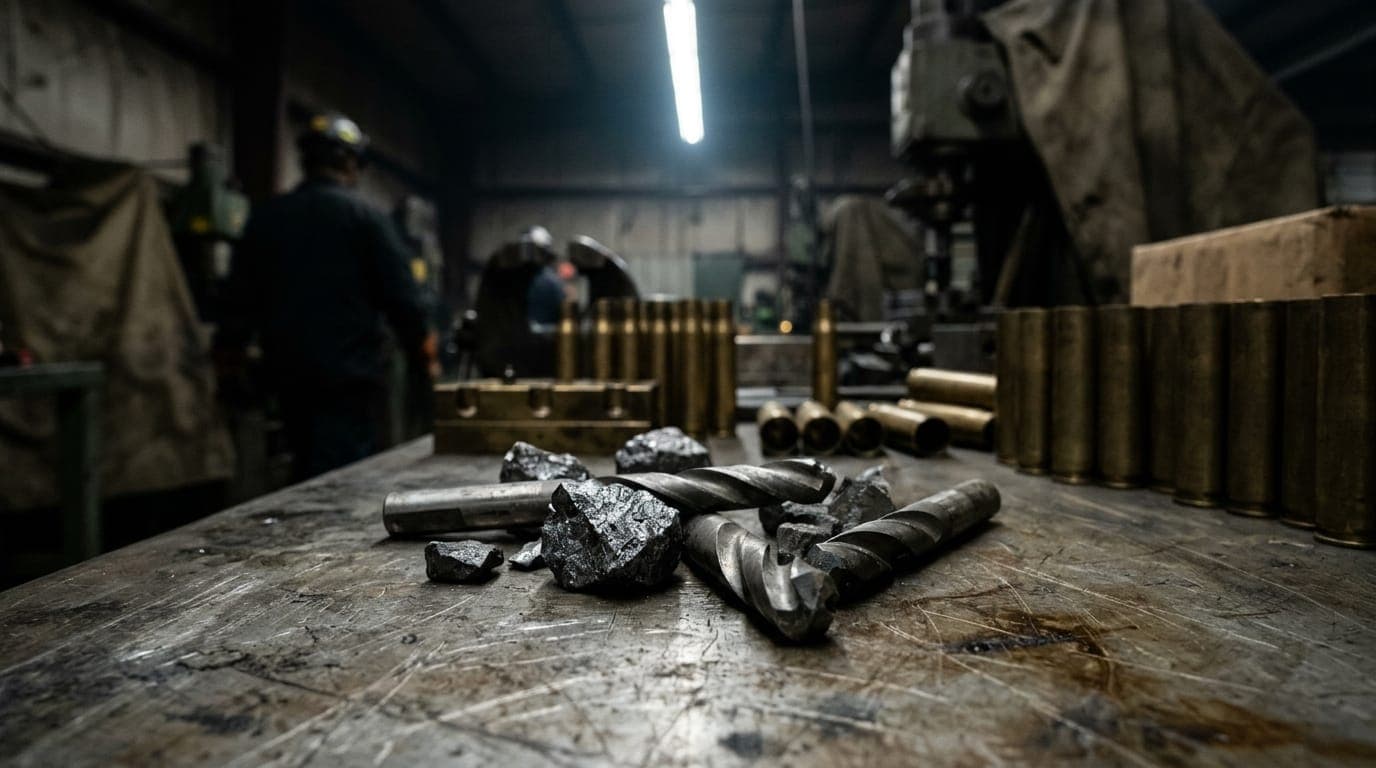
Replacing the gun-system ammunition expended in those 16 days requires almost 4,000 kg of tungsten, per RUSI's model estimate. The US produced none of the metal commercially in 2025. China produced approximately 67,000 metric tons out of a global total of roughly 85,000 metric tons, 79% of global mine production, according to USGS Mineral Commodity Summaries 2026. Beijing introduced tungsten export controls in 2025.
Gallium is equally exposed. The RUSI authors note that a single AN/FPS-132 radar contains approximately 75 kg of gallium, per FPRI. China accounts for 99% of global primary low-purity gallium production. The US carries 100% net import reliance for the metal.
RUSI estimates replenishing the 500-plus Tomahawk missiles already fired will take at least five years. Defense analysts have assessed that restoring key munitions to prewar levels could take several years.
A July 2026 GAO report (GAO-26-108687) quantifies the broader exposure: 100% import dependence for 12 critical minerals, and at least 50% reliance for 34 more. The GAO was explicit that alternatives for semiconductor minerals such as gallium are unlikely to reduce import dependence significantly in the near term.
The RUSI authors put the supply chain logic plainly: "A few kilograms of a constrained input, such as gallium, battery-chemicals or graphite, can stall the production of various weapons, while a warehouse full of steel is useless if a system is bottlenecked at the sub-tier."
The Bill for Decades of Financialization
The GAO confirms what the munitions ledger makes concrete. The US is short tungsten and gallium because the monetary and financial system spent decades making it rational to offshore the slow, physical, capital-intensive work of mining and refining while directing cheap credit toward software, financial services, and leveraged buyouts.
You cannot print tungsten. The supply-shock inflation problem the Fed openly admits it cannot solve with interest rates is the same structural rot showing up in a different uniform here. Fiat's reserve-currency privilege made imports cheaper than domestic production for so long that the industrial base atrophied. Now the bill arrives not as a CPI print but as a mineral gap in the middle of an active conflict.
The antimony situation illustrates the depth of the hole. S&P Global's August 2026 assessment estimates that even if every announced project proceeds, smelting capacity outside China remains approximately 27% below projected non-China demand by 2030, with new processing facilities potentially facing feedstock shortages on top of that capacity deficit. Antimony trisulfide goes into ammunition primers. This isn't an edge-case semiconductor input.
The Pentagon has moved. A $174 million investment in planned Australian gallium production was announced August 31, 2026, per the Department of War. The Defense Logistics Agency supports domestic recycling of optical-grade germanium.
IperionX and Perpetua Resources are receiving defense backing for domestic titanium and antimony supply chains, respectively. These are real commitments. They are also small relative to the scale of the gap and slow relative to the pace of the conflict.
A falsifiable thesis sits at the center of this: the fiat-enabled deindustrialization of the US mineral and manufacturing base has made sustained conventional war against a mid-tier adversary strategically untenable. The trigger that disproves it is operational output, not announced investment. If IperionX, Perpetua, and the Australian gallium deal produce at scale within three years, and Tomahawk stockpiles are meaningfully restored without a multi-year gap, the thesis is wrong. Watch those production milestones, not the press releases.
What Comes Next
The conflict's attrition dynamic has already repriced the defense production calculus in Washington. Every week the Iran conflict continues or expands, the mineral risk matrix tightens and the dollar's ability to paper over scarcity with purchasing power gets tested against real physical constraints. The GAO report, the RUSI ledger, and the S&P antimony projection are not abstract risk assessments. They are the terms of the problem the US now has to solve in production time, not planning time.
Sources
- RUSI: Over 11,000 Munitions in 16 Days of the Iran War
- Payne Institute mirror of RUSI analysis
- FPRI: Over 5,000 Munitions in the First 96 Hours of the Iran War
- GAO-26-108687: Critical Minerals, Reducing U.S. Import Reliance
- USGS Mineral Commodity Summaries 2026
- The Oregon Group / Anthony Milewski: The Missile Race Is Becoming a Race for Minerals
Frequently Asked Questions
How long will it take the US to replenish the Tomahawk missiles fired in the Iran conflict?
At least five years, per RUSI's Payne Institute analysis. Tomahawk production cannot be meaningfully surged because it depends on constrained sub-tier components, including gallium-based semiconductors and specialized propellants, that are themselves subject to the same import dependency the conflict has exposed.
Does the US have any domestic tungsten production?
No. The US has not mined tungsten commercially since 2015 and imports more than 11,700 tonnes annually, relying on recycling and allied-nation supply chains that themselves pass through China-dominated refining infrastructure. China controls approximately 79% of global mine production and introduced export controls on the metal in 2025.
Can recycling or substitution close the critical mineral gap?
For some minerals, partially. The GAO assessed that battery recycling could cut import reliance for lithium, cobalt, and nickel within two to three years.
For gallium and germanium, the GAO found that alternatives are unlikely to reduce import dependence significantly in the near term. Greenfield mines take ten to fifteen years from discovery to production. There is no fast path for the first-tier risks.