Nick Nemeth: Insurance Is the Next Contagion
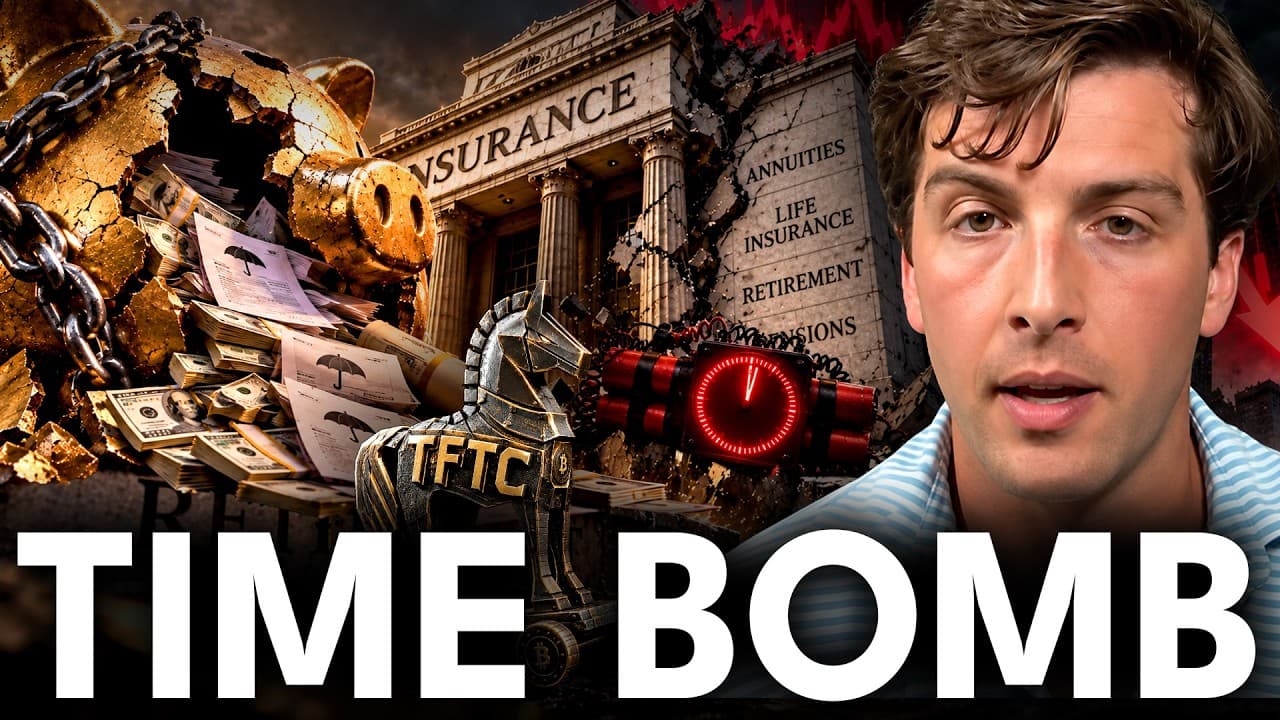
Nick Nemeth returns to walk through the Guggenheim insurance universe: $20B of affiliate paper, a contagion map bigger than SVB, and why policyholders have no idea what's backing their annuity check.

↓ Jump to the video and timestamps
Nick Nemeth has been on the show twice before, and both times we ended up somewhere that felt urgent. This time felt different. The Mark Walter situation had broken into the sports press. Jeff Passan and Pablo Torre were on it. Regulators who had been asleep for years were suddenly awake.
And Nick had just dropped his Guggenheim Universe piece, cross-referencing Delaware LLCs, statutory filings, and five interconnected insurer entities into what might be the most detailed map of a coming insurance blowup that anyone outside a regulator's office has produced.
We sat down in the new studio, our third different location in five months of doing this together, and went through the whole thing: what policyholders think they're buying, what they're actually holding, how per Nick's research Mark Walter used policyholder funds to build a sports empire on roughly $100 million of personal equity, and why the daisy chain that unwinds when Delaware Life and ClearSpring go down doesn't stop there.
The macro backdrop makes it worse. The 10-year is approaching 5%. Annuities written at 3 to 3.5% are mathematically indefensible against that. Surrenders are already climbing.
And the AI trade, which is the only thing holding the equity market's animal spirits together right now, is itself sitting on a mountain of debt that flows right back through the insurance sector's balance sheets. This is the episode to send to anyone still sitting in an annuity product they don't fully understand.
Key takeaways
- Insurance is functionally the next FTX. Per Nick's research, Mark Walter used policyholder funds to buy the Lakers with roughly $100 million of his own equity on a multi-billion dollar asset. I drew the SBF analog myself on tape and I'll stand by it: SBF took FTX depositor Bitcoin and invested it in Anthropic. Walter, by Nick's account, did the same thing with insurance money and a sports franchise. The legal structure differs. The mechanics don't.
- The affiliate paper hole at Guggenheim-linked insurers is bigger than SVB. Nick estimates the combined asset base of Delaware Life, ClearSpring, Equitrust, Heritage Trust/Amistad, and Sammons rivals the combined size of SVB, First Republic, and Signature from the 2023 regional banking crisis, without FDIC backing and with far less liquid collateral underneath.
- Policyholders have no idea what's backing their check. They got a 50-page document, a salesman taking 10 to 15% up front who has no fiduciary obligation to them, and an assumption that insurance companies are safe. What's actually backing the promise is, in some cases per Nick's research, Chicago-street-named Delaware LLCs created five to seven days before transactions closed.
- Regulators only woke up because sports fans got mad. Nick has been yelling about affiliate paper for years. So have researchers like Granado and Prenjal. What finally moved the needle was the Dodgers and Lakers connection generating enough political pressure that insurance commissioners couldn't ignore it anymore.
- The bond market crossed a secular threshold and the Iran War sealed it. My buddy sent me a global bonds priced in commodities chart this week. COVID stimulus broke the bond bubble. The Iran War sealed its fate. Four decades of secular bond bull market are done, and every annuity written at 3.5% is now a problem.
- Recessions are the cure, not the disease. The whole crisis traces back to a system that has structurally refused to let bad debt and zombie companies clear. That is going to be painful in the short and medium term. It is completely necessary. A collapsing system is worse than a recession, and the math on entitlements with no demographic support to service them is not going to fix itself.
What Policyholders Think They're Buying
Nick frames the buyer's psychology simply: security. Social Security isn't enough. They've got a home they want to pass to their kids. They want a guaranteed check in retirement.
They assume insurance companies are safe because, historically, not that many of them have failed.
So they sign a 50-page document they don't read, handed to them by a salesman taking 10 to 15% off the top who, per Nick, the industry has argued is not a fiduciary. They don't understand they have credit risk. They know the phrase exists. They don't understand the risk part of it.
The double betrayal, as I see it, is exactly this: they misunderstand the product, and the people they trust to manage the money are misallocating it. The design of the thing produces that outcome.
Sophisticated wealth managers put their clients into these products because they've been told they're good. They know credit risk exists. They don't understand the specific credit risk sitting underneath a given insurer's balance sheet. That's where this gets dangerous.
The Guggenheim Playbook
By Nick's account, Mark Walter used $1 to $2 billion of policyholder funds to buy the Lakers, with roughly $100 million of his own equity on the purchase. League rules cap team debt at 30% and private equity at 30%. Per Nick's research, Walter structured around those rules through a cluster of pass-through Delaware LLCs, many of them named after Chicago cross streets, created five to seven days before transactions closed.
The five insurer entities Nick maps in his Guggenheim Universe piece: Delaware Life and ClearSpring, the two directly under Walter; Equitrust and Heritage Trust/Amistad, which per Nick's cross-referencing received Walter-connected money and invested in the Dodgers TV deal; and Sammons, an original and ongoing major economic shareholder of Guggenheim. Guggenheim itself, by Nick's estimate, manages roughly half a trillion dollars, with 40% of its revenue tied to affiliate relationships.
Delaware Life and ClearSpring are under regulatory investigation for misrepresenting affiliate paper as non-affiliate. Per Nick's research, they've now had to reclassify $20 billion of assets. What's notable is that Equitrust, by Nick's reckoning, still reports zero affiliate paper despite holding functionally similar assets with functionally similar ownership structures.
The SBF comparison is worth sitting with. Nick made it, I agreed with it on tape, and I'll own it here. SBF took FTX depositor Bitcoin and put it into Anthropic and trading positions. Walter, per Nick's research, took policyholder money and put it into sports teams and side deals.
The legal wrapper is different. The mechanics are identical: other people's money, invested for personal gain, with no liquidity to pay it back when the claims come due.
The thing about a sports team as a backing asset is that it can make sense on paper for a long-duration liability. Teams hold value. But you can't clip off chunks of the Lakers to pay out an annuity claim. The liquidity profile is completely wrong, and that's before you get to the mismarking problem on the opaque SPVs nobody can see into.
The insurance-private credit machine is finally getting scrutiny, but it took a baseball fan base to get there.
The Contagion Map
Nick's chart of the failure cascade is straightforward and grim. Delaware Life and ClearSpring go down, that pulls on Equitrust and Heritage/Amistad, and then Sammons. By Nick's estimate, the total exposed asset base across those five entities rivals SVB plus First Republic plus Signature combined, without FDIC backing, and with illiquid private credit and commercial real estate underneath instead of long-duration Treasuries that at least have a functioning secondary market.
TWG, Walter's asset manager outside Guggenheim, is reportedly lined up to take $5 to $6 billion of the affiliate paper with regulator approval. That still leaves a massive gap. And Walter's problem is that the most unencumbered asset he had was the Lakers, which he's already sold. Everything else is either encumbered, tied up in litigation that makes it hard to transfer cleanly, or both.
Nick's shark metaphor is apt: it nibbles the calf, swims off, and comes back for the leg. The attention has ebbed and flowed in the press. But the underlying positions haven't moved. The surrenders are already running higher than insurers expected, even without reputational damage from the Walter story.
With 10-year yields approaching 5%, anyone in a 3 to 3.5% annuity can do the math. The fee math gets worse fast: 10% to a salesman up front, 40 to 50 basis points a year in operational fees, and then the spread between your guaranteed rate and what risk-free alternatives are paying. AI makes this more legible than it's ever been. People are putting their annuity agreements into ChatGPT and getting the answer back in seconds.
The Matt Ishbia / Phoenix Suns situation Nick raised is the same pattern in a different wrapper. Per Nick, Ishbia used United Wholesale Mortgage stock as collateral to finance the Suns purchase with JP Morgan holding the lien, the stock fell sharply from its highs, and the debt cap rules that leagues supposedly enforce weren't enforced.
Hunter Brook broke that story, per Nick on tape, and credit to them for it. The leagues and the regulators had the rules. They just didn't enforce them until the sports press made it impossible to look away.
The Macro Backdrop
A buddy of mine sent me a global bonds priced in commodities chart this week and his read on it was this: COVID stimulus broke the bond bubble, the Iran War sealed its fate.
Nick's frame for the regime shift is the duck, duck, goose analogy. Investors keep pointing to the last five times we got bailed out and assuming that's the playbook. They're focused on the duck. The whole name of the game is figuring out the goose.
Anyone investing today has only experienced a secular bond bull market. If you accept, as Nick does and as I do, that the regime shifted in 2020, you have to rethink what you're backing and why.
The Iran War is, in Nick's view and I agree, the worst fiscal decision any administration has made in a very long time. Not because of the geopolitics alone, but because it jacked commodities at the exact moment you need commodity prices lower to give the Fed any room. Mortgages, household budgets, the real economy, none of it operates in a vacuum from oil prices. You can't grow your way out while simultaneously closing the Hormuz-adjacent risk premium in.
The AI buildout is the thing holding the equity market's animal spirits together right now. A Ramp report Nick and I were looking at in the conversation showed the top 1% of enterprise AI spend had fallen for the first time in several quarters. Could be seasonal. Could be the beginning of something else.
But as Nick put it plainly: the debt associated with this buildout is massive, a lot of it flows through insurers, and the hurdle rate to justify it keeps getting harder to clear at 5% cost of capital. If you want a sense of the scale we're talking about on the capex side, PwC projects $31.6 trillion in AI data center spend through 2050. That's an enormous number to justify if rates stay here.
Scott Bessent raising the Treasury buyback program is a marginal move. Druckenmiller's point, and it's correct, is that the fiscal side is what matters and buying back on the margin doesn't fix it. The off-balance-sheet entitlement liability, the present-value number Druckenmiller has cited publicly, is a figure that makes the on-balance-sheet Treasury debt look manageable by comparison.
What we've promised is not happening. Every politician knows this and won't say it.
The Austrian Reckoning
These are cleansing mechanisms, recessions. They're necessary. That's free market. That's risk.
You take risks, some of them fail, you need to let them fail.
We've lived in an economy that has structurally not allowed a lot of waste and zombie companies to fail. And yeah, it's going to be painful, particularly in the short to medium term, but in the long term, it's completely necessary.
Nick made the point I've been making for years, and he made it well: Keynes believed in cycles. He believed you could use counter-cyclical fiscal policy to smooth them. What he would have been appalled by is the attempt to just never sleep. To run the economy like a special forces operator on modafinil doing 48-hour missions indefinitely.
What we're actually doing is pretending the cycle doesn't exist and calling the bill "unprecedented circumstances" every time it comes due. That is neither Keynesian nor Austrian policy.
The Austrians say even the counter-cyclical fiscal response is unnatural, that it exacerbates the cycle at both ends. I think that's right. But the debate between Keynes and Hayek is not the same debate as whether to just print forever and call it stability.
Keynes would not have called what we're doing stability. He would have called it insane.
Nick's framing on the entitlement math is the same place I keep landing. The demographics don't support it. You're not going to have enough young people paying into the system to service what was promised. That balloon, what I put at somewhere around $220 to $240 trillion in present-value off-balance-sheet federal obligations, is growing faster than the Treasury debt people actually argue about.
That is a number with no realistic path to repayment given the demographic drag. Aging populations move from the supply side of the economy to the demand side. They stop producing and start consuming the labor of young people. That is inflationary. That is a headwind on top of every other headwind.
And yes, I'll use the phrase Marty Bent used on tape: end boomer communism.
What You Should Actually Do
Nick is careful here and I will be too: this isn't financial advice. But Nick laid out his framework directly and I think it's worth repeating.
Asset classes he'd avoid: real estate, broadly, and high-risk credit. Treasuries are taking dollar risk and duration risk; make of that what you will.
If you're going to take risk, equity is still where he'd look, but he's selective on the S&P. He wants the companies that actually hold up if the AI trade softens. Bitcoin has its allocation, but be strategic. Gold maintains wealth over millennia but you need size for it to matter at the portfolio level.
Personal balance sheet: delever. Six months of expenses in something liquid, high-yield equivalent at minimum.
If you're in an annuity product, actually run the math. ChatGPT will do it for you. The answer may be uncomfortable.
Nick said on tape he's getting more constructive on Bitcoin. I'll take that.
My own investment thesis at Ten31, where I'm Managing Partner, is that pairing Bitcoin with traditional credit structures creates something genuinely uncorrelated, with different idiosyncratic risk profiles than anything currently in the private markets.
Longer duration, 5 to 10 to 15 years, makes particular sense in that framework. The private credit market is loaded with bad collateral. Bitcoin is the right collateral. That's what I'm building toward.
About Nick Nemeth
Nick Nemeth writes Guggenheim Universe and related insurance and credit research on Substack, where he has been tracking affiliate paper risk, asset manager-backed insurer structures, and systemic vulnerabilities in the US insurance industry. He has been a recurring guest on TFTC, with prior appearances focused on Athene, Apollo, and the broader private-credit-meets-insurance complex. He collaborates with researchers including Liam Dalton on market analysis and has been in contact with journalists at ESPN and elsewhere covering the sports ownership dimension of the Guggenheim story.
Sources mentioned
- The Insurance-Private Credit Machine Is Finally Getting Marked (TFTC): the prior TFTC coverage of how this private-credit-backed insurer dynamic is starting to get scrutinized
- PwC Projects $31.6 Trillion in AI Data Center Capex Through 2050 (TFTC): the scale of the AI debt buildout that flows back through insurance balance sheets
- Rabobank: The Post-WWII Order Is Gone and Central Banks Can't Fix It (TFTC): the macro regime shift framing that runs underneath this whole conversation
- Nick Nemeth's Guggenheim Universe research on Substack: the primary-source cross-referencing work on Delaware LLCs, statutory filings, and the five insurer entities discussed throughout this episode
Watch the conversation
Timestamps
- 0:07 - Intro: money freer than free
- 0:41 - What policyholders think they're buying
- 4:39 - The Guggenheim playbook: Lakers, Dodgers, affiliate paper
- 12:40 - What affiliate paper actually means
- 22:18 - Surrenders, liquidity mismatch, and the math getting worse
- 25:31 - LeBron, the salary cap, and Chicago-street LLCs
- 39:03 - AI trade holding the economy together
- 52:02 - The three outcomes: inflate, deleverage, or collapse
- 54:38 - Matt Ishbia, the Phoenix Suns, and league rules ignored
- 59:50 - What to actually do with your portfolio
- 1:02:23 - Entitlements, Druckenmiller, and the bond-vs-dollar choice
- 1:06:19 - Recessions as cleansing mechanisms; the Keynes debate
- 1:09:10 - Bitcoin-collateralized credit and rebuilding on sounder ground
Sponsors
- Cash App: For a limited time, new customers can get $21 added to their balance. Just use code TFTC10 when you sign up, and send at least $5 to a friend in the first two weeks. cash.app/app/TFTC
- Square: For up to $200 off eligible Square hardware. square.com/go/tftc
- Bitkey: Use code TFTC10 for 10% off the new Bitkey. bitkey.world
- Aven: aven.com/bitcoin
- CrowdHealth: joincrowdhealth.com/tftc
- Simple Mining: simplemining.io/tftc
- Salt of the Earth: drinksote.com/tftc
Frequently Asked Questions
Affiliate paper refers to assets on an insurer's balance sheet that were underwritten, originated, or controlled by a related party, typically the asset manager that also manages the insurer. It matters because the asset manager controls the marks, meaning the values assigned to those assets, creating an obvious incentive to overstate them. When regulators and ratings agencies trust those marks without independent verification, the insurer looks healthier than it is. Per Nick's research, Delaware Life and ClearSpring had to reclassify roughly $20 billion of paper as affiliate after regulators pushed back on their prior filings.
Per Nick Nemeth's research, Walter used $1 to $2 billion of policyholder funds across his Guggenheim-linked insurance entities to help finance the Lakers purchase, with roughly $100 million of personal equity on the deal. League rules for both the NBA and MLB cap team debt at 30% and restrict private equity ownership. Nick's cross-referencing of Delaware entity filings shows pass-through LLCs created five to seven days before transactions were executed, used to move assets between the insurance entities and the sports investments. These are Nick's findings from his Guggenheim Universe research, not independently verified regulatory conclusions.
Nick estimates the combined at-risk assets across the five Guggenheim-linked insurer entities, Delaware Life, ClearSpring, Equitrust, Heritage Trust/Amistad, and Sammons, rival the combined size of SVB, First Republic, and Signature Bank from the 2023 regional banking crisis. The key difference is that SVB held long-duration Treasuries, which are liquid and have a functioning secondary market. The Guggenheim-linked insurers hold private credit, commercial real estate, and opaque SPV paper that cannot be sold quickly or at par in a stress scenario, and there is no FDIC backstop for insurance policyholders.
An annuity is a promise to pay a guaranteed amount at a future date or on a schedule. The insurer funds that promise by investing the policyholder's premium.
If those investments are illiquid, mismarked, or tied up in assets that can't be sold quickly, like sports franchises or private credit funds in default proceedings, the insurer may not be able to meet claims when they come due. Unlike a bank deposit, annuity holders are not covered by FDIC insurance. State guaranty associations provide some protection, but coverage limits vary by state and are far below what many policyholders hold.
State guaranty associations step in when a licensed insurer fails, but coverage is limited. Most states cover annuity values up to $250,000 per policyholder, though limits vary. Claims above that threshold may face losses or extended delays.
The guaranty fund process is also slower than FDIC resolution; it can take years to fully settle. If you hold a large annuity, particularly with an insurer that has significant exposure to illiquid or affiliate paper assets, it's worth checking your state's guaranty association limits and understanding what's actually on the insurer's balance sheet. The statutory filings exist but require payment to access, and the opacity is itself part of the problem Nick is flagging.
When rates were low, locking into a 3 to 3.5% guaranteed annuity looked reasonable compared to alternatives. Now that the 10-year Treasury is approaching 5%, that same annuity is a bad deal. The surrender fee, often around 5% in year two of a contract, is less than the spread between what you're earning and what you could earn in risk-free alternatives.
Increasingly, people are running that math themselves with AI tools, and the answer points the same direction. Nick noted in our conversation that surrenders are running higher than insurers expected even without the reputational pressure from the Walter story. The math alone is doing the work.
Nick's argument is that asset manager-backed insurers have been using policyholder funds as cheap capital, investing in illiquid and affiliated assets, mismarking those assets to stay in compliance on paper, and operating with the blessing of regulators who were asleep to the problem. The incentive structure is worse than banking, in his view, because the capital is even cheaper and the disclosure requirements are even weaker. The Guggenheim cluster is the most egregious example he's found, but it reflects a broader industry pattern. The systemic risk, per Nick, is that a cascade starting with Delaware Life and ClearSpring could pull in the other affiliated entities and represent a failure cluster larger than the 2023 regional bank crisis, without any equivalent of the FDIC to absorb the shock.