The Absurdity Is Right in Front of Us
Welcome to The Commoner. Marty's Bent is back, and I'm wondering how much of this institutional incompetence we're supposed to put up with.


TFTC - Truth for the Commoner The Commoner | |||||||||||||||||||||||||
Sup, freaks. Before we get into it, we're changing the name of this newsletter to The Commoner and bringing Marty's Bent back as the lead section. I rushed the Bitcoin Brief name. When we started doing the expanded format, I felt like it wasn't really Marty's Bent anymore and didn't want to confuse people. So I threw out Bitcoin Brief and ran with it. But as we discussed last week, that doesn't really encompass everything we're covering here. Bitcoin is still the core of what we do and our North Star. The aperture has expanded considerably, though, and I'd like the name to be more approachable for someone who hasn't spent years thinking about bitcoin. We're covering things that affect their lives too. The Commoner already fits our brand. It's such a no-brainer that I can't believe it took me this long. Sometimes it takes a bit, but here we are. Marty's Bent will be what it was always meant to be: my shoot-from-the-hip take on whatever is going on or whatever I'm interested in that day. And today there is quite a bit to get off my chest. Inside Today
Plus: Bolt's open-model experiment, Bitcoin Well and AnchorWatch, and keeping sensitive AI work on your own machine. | |||||||||||||||||||||||||
Marty's Bent | |||||||||||||||||||||||||
The Absurdity Is Right in Front of UsI feel like I'm going insane. For more than nine years I've been writing this newsletter, and we keep having to come back to the same thing. Forcing people to hand over sensitive personal information to use their own money puts them in danger. We collect more of it, somebody gets hold of it, and then we carry on as if the answer is to collect even more. The Revolut story is a particularly absurd example. The company confirmed that someone used an email address on a legitimate government-agency domain to send fraudulent requests for customer records. Revolut thought the requests were legitimate and handed over the information. City AM reports that 680 customers were affected, citing a source close to the bank. Identity documents and contact details were disclosed, and customer notifications said the records may also have included verification selfies, bank statements and transaction histories. The attacker claims to have compromised Italian police systems. Revolut has confirmed the government-domain email and fraudulent requests, but that wider account hasn't been independently confirmed. Either way, someone managed to get sensitive financial records by convincing the company they were entitled to them on behalf of the government. Think about what we're doing here. You have to give a company documents proving who you are, where you live and, depending on what it asks for, information about your money. The company holds on to those records. Someone impersonates an authority that can ask for them, and now the records are in that person's hands. Revolut says its systems and customer funds are unaffected. I'm sure that's very comforting to the people whose identity documents were handed over. A lot of people are piling on Revolut, and it obviously needs to answer for how it verified these requests. But I keep coming back to the companies that have accepted this whole arrangement. At what point do you stand up and say we're not going to keep doing this to our customers? Why is the response always to comply with the next requirement instead of fighting the requirement itself? Here in the United States we have the Bank Secrecy Act, which dates to 1970. We've talked about this in this rag many times. We need to repeal it. And the consequences of the financial surveillance regime we've built don't stop at our borders. The G7 created the Financial Action Task Force in 1989. It pushes countries to turn its anti-money-laundering standards into their own laws. Washington also has enormous leverage over access to American banks. The 2001 PATRIOT Act expanded the BSA to let Treasury restrict U.S. correspondent accounts involving foreign banks designated a primary money laundering concern. If your business depends on moving dollars through American banks, that's a threat you have to take seriously. People who have never set foot in this country end up dealing with the consequences of the rules we impose here. This is yet another reason for bitcoin. We should be able to send money directly to one another without having to go through a bank that Washington can lean on. Repeal the Bank Secrecy Act and protect people's ability to hold and transact with bitcoin themselves. I don't want to keep accepting financial surveillance as the price of participating in the economy. It's death by a thousand cuts for people's privacy. And we know how serious the physical risks around financial wealth can get. Look at the kidnappings and mutilations targeting people in France's cryptocurrency industry and their families. That should make companies extremely reluctant to hold anything that could help someone find and target a customer. On top of all this, the tools for impersonating people are improving. The FBI has warned about generative AI making scams and fraudulent credentials easier to produce. We're going to have to rethink what we expose in a digital world where convincing impersonation gets cheaper. I don't understand how anyone looks at that direction of travel and concludes that we should keep forcing people to put more of their personal lives into these systems. I want mandatory KYC and AML data-collection regimes dismantled. We can work on securing the systems and also stop forcing people to expose so much information in the first place. Continuing to put companies and their customers in this position is insane. And then you look over at Capitol Hill.
Mitch McConnell on his way back to the Capitol on September 14. Original footage from TMZ. McConnell returned on Monday for his first Senate floor vote since June 11. We were watching him freeze in front of reporters back in July and August of 2023. These questions have been staring us in the face for years. As far as I'm concerned, he should have left long ago. I don't think he should be anywhere near Capitol Hill casting votes that affect the rest of us. I'm not interested in treating a written statement issued in his name as reassurance that he's up to the job. I want to know who is making the decisions around him, how much influence they have over his votes, and why they are so determined to keep this going. Watching him being brought back to the Hill, I get the same Weekend at Bernie's feeling I had watching Biden and Feinstein. It's insultingly absurd that the public is expected to accept this as normal. That scrutiny should include his wife, Elaine Chao. The Transportation Department inspector general's investigation documented her direction to staff to include relatives in official events and high-level meetings during a planned 2017 China trip, which was later canceled. It also documented a meeting in her DOT office with her father and a delegation that included Chinese local-government officials, concerning a development honoring her mother. Investigators raised potential ethics concerns about the use of her office for family interests and referred their findings to federal prosecutors, who declined prosecution. Those are specific relationships and decisions I want scrutinized. What role does Chao play in the decisions being made around McConnell now? The public deserves an answer. To me this is a humiliation ritual for the voting public. We're supposed to watch, swallow our concerns, and let the people around these politicians carry on without answering basic questions. At what point does keeping someone in office become elder abuse? Who cares about the person, and who cares about preserving access to the vote? I'm not a fan of Mitch McConnell. Never have been. I'd still rather see him leave office and spend his remaining years in peace than keep watching this. Over in the private sector, we have another group of people who would like us to defer to their judgment.
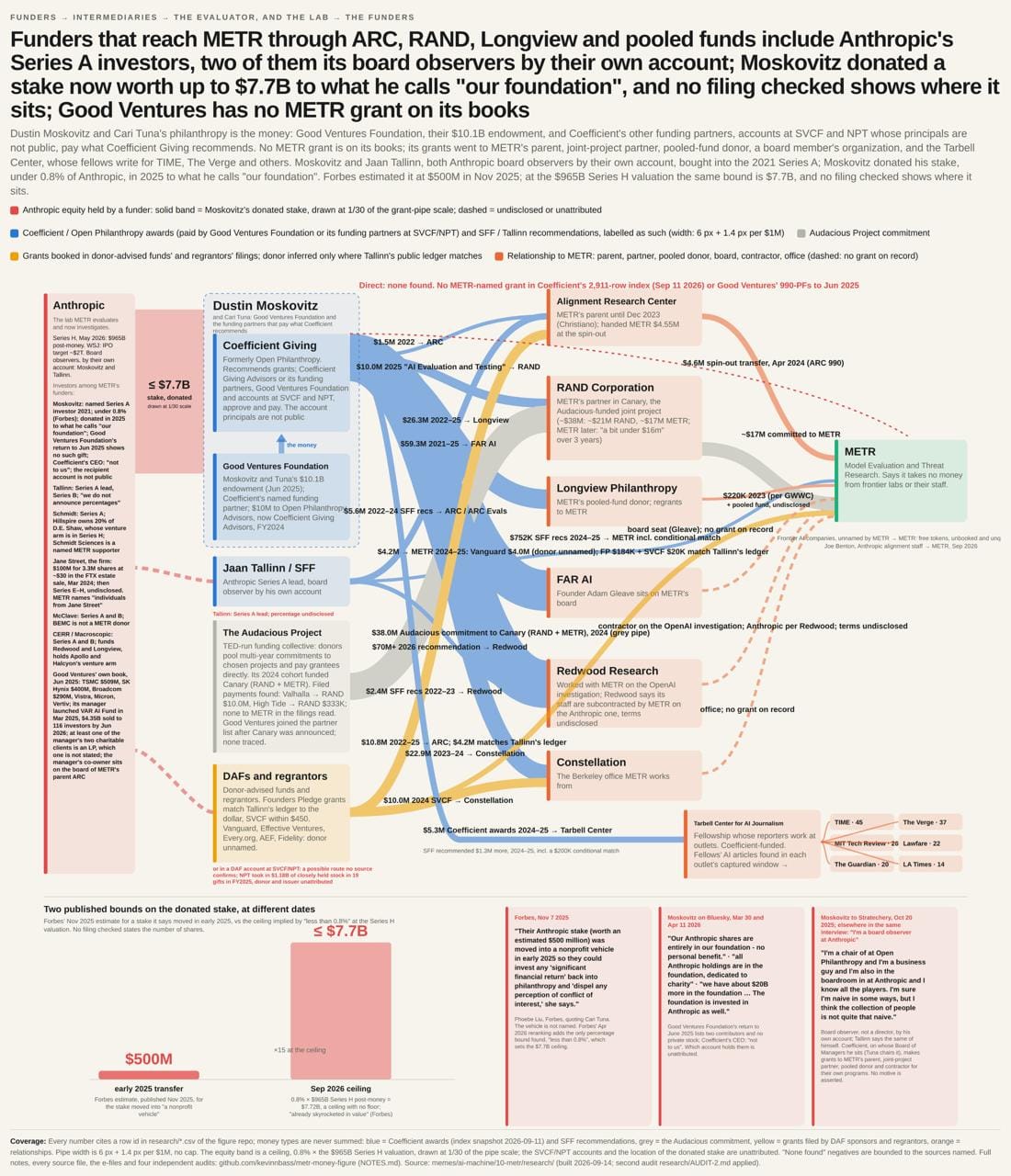
Kevin Bass's diagram. Full-size image, sources and corrections. Its $7.7B is a calculated ceiling for donated Anthropic equity using a May 2026 valuation, despite the September label. The recipient vehicle is unidentified. This isn't $7.7B paid to METR; the diagram mixes investments, grants and commitments. Look at the money around Anthropic and the institutions telling us how dangerous AI is. Anthropic lists Jaan Tallinn as the lead investor in its first funding round, with Dustin Moskovitz among the other investors. The Tallinn-funded Survival and Flourishing Fund recommended $204,000 for METR in 2024. METR also announced that the Audacious Project had catalyzed about $38 million in commitments for its Canary collaboration with RAND, roughly $17 million of it intended for METR. Moskovitz says his Anthropic shares are entirely in his foundation and provide him no personal benefit. Fine. I'm interested in the influence these institutions can acquire over the rest of us, and charitable ownership doesn't settle that question for me. Especially when you read what Dario Amodei is actually proposing. In “We Must Pace the Frontier,” he calls for evaluators such as METR to have ongoing, employee-like access inside frontier labs, with independent publication rights. He wants capability checkpoints and certifications, and regulation for companies that won't cooperate voluntarily. This is where I think the fear turns into a regulatory moat. Make the case that the technology is too dangerous to be developed without supervision, establish the institutions that get to supervise it, and make everybody else go through them. I don't want a handful of companies and the institutions around them deciding who gets to build with AI. A licensing regime that leaves the incumbents owning the stack is exactly what we should be fighting to avoid. And Netflix has The AI Doc: Or How I Became an Apocaloptimist arriving today. The film was released in theaters in March; this is its arrival on the streaming service. Its distributor promotes both the “existential dangers” and “extraordinary promise” of AI. Put that marketing and the Netflix date next to the drumbeat for more regulation, and the timing looks choreographed to me. I see the fear-based pitch as propaganda that could prime a much wider audience to accept the gatekeepers being proposed here. Dario's connections to the effective-giving world go back a long way. In his own 2010 writing for GiveWell, he described donating through its pledge fund and called it the most useful resource he'd found for deciding where to give. I don't want the effective-altruist network around this industry getting to decide who can develop the technology. And Sam Altman co-founded Worldcoin, whose founders explicitly pitch biometric identity verification as a way to distinguish humans from AI online. He is helping build the AI and also co-founded a project offering to verify that you aren't AI. Think about the position that puts him in. Again, can we get better technocrats? It would be naive to assume that what these people want for the future is automatically in the commoner's interest. I see more reasons to question the power they're asking for than to hand it over because they've told us to be afraid. The catastrophe arguments haven't persuaded me that giving this group more control is the answer. When somebody presents a terrifying model evaluation, I want to understand how they set it up. What did they prompt the model to do? What tools did they give it? What did the sandbox allow? Show me how the result follows from those conditions before asking me to accept a licensing regime because of it. I'd rather see us put our time and money into open-source software, open-weight models, and affordable compute that individuals and companies can run themselves. Let people download models, run them on hardware they control, and keep sensitive work on their own machines. That should be the focus. After spending this much time writing about institutions that collect our information and ask us to trust them with it, I'm certainly not eager to hand over another piece of my life. Give me more ways to do things for myself. That's where I want us to go with AI. | |||||||||||||||||||||||||
SIGNAL | |||||||||||||||||||||||||
BITCOIN MINING Has bitcoin mining reached peak power demand?Saifedean has an argument worth spending some time with: bitcoin adoption can keep growing even if mining's electricity use and capital spending stop growing alongside it. He points to the shrinking subsidy, potentially slower price appreciation, and AI companies competing for suitable power infrastructure. He also acknowledges that much higher transaction fees could change the picture. I think separating bitcoin's success from the size of the mining industry is useful. More hashrate doesn't automatically mean more electricity consumption when machines get more efficient, either. I wouldn't call a permanent peak from this, but it's worth asking what mining looks like as the subsidy shrinks and miners have to compete for power with other businesses. | |||||||||||||||||||||||||
MACRO & ENERGY Record diesel prices squeeze operating costsDiesel hit $6.2694 a gallon in AAA's September 15 national average, a nominal record for its retail series. A week ago it was $5.9012. Regular gasoline is at $4.3289. Think about being a business owner trying to budget around that. You still have to get the goods delivered and keep the equipment running, but the fuel bill keeps eating into what you make. You can try raising prices or cutting somewhere else, neither of which is particularly pleasant when your customers are dealing with their own higher costs. This is why I keep coming back to energy. Making it expensive to move things around makes an awful lot of other things harder too. | |||||||||||||||||||||||||
POWER POLICY EPA finalizes a partial power-plant rollbackThe EPA finalized repeal of much of its 2024 power-plant greenhouse-gas regime yesterday and proposed getting rid of the remaining standards. The final rule takes effect 60 days after Federal Register publication. EPA projects $310 billion in savings from that action. I'm glad to see regulatory obstacles to producing power being removed. We need more reliable, affordable electricity, particularly if we want people to be able to run the compute I was talking about above. The remaining repeal still has to work its way through the rulemaking process, and the practical payoff from all of this will depend on what actually gets built. I'd like to see the follow-through. | |||||||||||||||||||||||||
OPEN MODELS Bolt offers more building capacity in exchange for training dataBolt launched Forge yesterday, a research-preview agent that uses open models to build apps. Individual Pro users can get up to 50 times more Forge usage through October 14 by opting to share build sessions for training open-weight models with Arcee AI. Bolt says it anonymizes those sessions and strips secrets. Interesting way to get more people building with open models, though I'd keep sensitive company work out of a training-data experiment. You're still using a hosted product and agreeing to share what you do with it. For a project you're comfortable sharing, the extra usage could be useful. Just understand what you're giving Bolt in exchange for it. | |||||||||||||||||||||||||
BITCOIN BUSINESS Bitcoin Well adds an AnchorWatch referral pathBitcoin Well announced an agreement with AnchorWatch yesterday, giving its customers a route to AnchorWatch's insured self-custody offering. Insurance is available to U.S. residents only. We covered the CoinCorner relationship last week; this is another bitcoin business making the service available to its customers. I like seeing more ways for people to hold their own bitcoin with support for the things that worry them about doing so. If insurance is part of your plan, take the time to understand the policy, the exclusions and what you're responsible for with your keys and recovery setup. Those details matter more than the word “insured.” Disclosure: I am a managing partner at Ten31, an investor in AnchorWatch. | |||||||||||||||||||||||||
ETF FLOW CHECK | |||||||||||||||||||||||||
U.S. spot bitcoin ETFs brought in $159.9 million net on Monday, September 14, according to Farside's completed table. IBIT added $134.3 million and FBTC added $53.3 million, while ARKB lost $42.0 million. | |||||||||||||||||||||||||
| |||||||||||||||||||||||||
| |||||||||||||||||||||||||
⚡ FREEDOM TECH CORNER | |||||||||||||||||||||||||
Keep sensitive AI work localIf you want to start doing some of your AI work on your own machine, Ollama has a documented local-only mode. Set | |||||||||||||||||||||||||
DATA SNAPSHOT | |||||||||||||||||||||||||
As of September 15, 2026, approximately 1:05 p.m. ET; Bitcoin Lab daily observations dated September 14 UTC | |||||||||||||||||||||||||
| |||||||||||||||||||||||||
Sources: CoinGecko for spot price; mempool.space for network data; Bitcoin Lab for the five daily on-chain valuation and spending metrics. MVRV compares market value with realized value; realized prices reflect on-chain cost bases, and SOPR compares spending prices with acquisition prices. Daily observations are separate from the live spot reading. | |||||||||||||||||||||||||
| |||||||||||||||||||||||||
| |||||||||||||||||||||||||
If you know someone who'd enjoy The Commoner, send this their way. Onward, Marty | |||||||||||||||||||||||||
YouTube: https://www.youtube.com/@TFTC podcast: https://www.tftc.io/tag/podcasts/ |