Hyperscale Data Sells 100 BTC to Fund Michigan AI Data Center Build
Hyperscale Data (NYSE: GPUS) sold approximately 100 Bitcoin from its corporate treasury on July 30, 2026, directing proceeds to its Michigan AI data center campus while retaining 1,000+ BTC as collateral for a new Bitcoin-backed credit facility at 4.5-5.0%.

The corporate Bitcoin treasury just became infrastructure financing, not a passive hedge.
Key takeaways
- Hyperscale Data (NYSE: GPUS) sold approximately 100 BTC from its corporate treasury on July 30, 2026, directing proceeds to construction at its Michigan AI data center campus while retaining 1,000+ BTC as collateral for a new Bitcoin-backed credit facility at 4.5%, 5.0%.
- The Michigan campus is operating under a 10-year master services agreement with an unnamed California-based neo-cloud AI provider for 20 MW of compute capacity, with potential contract revenue exceeding $1.2 billion.
- The move is a concrete proof-of-concept that a Bitcoin treasury can function as active, dual-track infrastructure financing, avoiding equity dilution while funding a capital-intensive build.
Hyperscale Data, Inc. (NYSE American: GPUS) announced July 30, 2026 that it sold approximately 100 Bitcoin from its corporate treasury, with proceeds directed toward construction, critical infrastructure, and long-lead equipment purchases at its Michigan AI data center campus, per the company's press release. The company simultaneously established a Bitcoin-backed credit facility using its remaining holdings as collateral, carrying variable rates of 4.5%, 5.0%.
CEO William Horne framed the move precisely: "By selectively monetizing and financing against a portion of our Bitcoin holdings, we are shifting one balance sheet asset for another."
Two Tracks, One Treasury
Hyperscale Data held 1,106.0467 BTC valued at approximately $71.7 million as of July 27, 2026, per its weekly Bitcoin treasury disclosure. After selling roughly 100 BTC, the company retains more than 1,000 BTC as the collateral base for the new credit facility.
That two-track structure, direct sale for hard capex plus a collateralized facility for ongoing liquidity, is the mechanism worth understanding. Horne indicated the strategy is intended to reduce reliance on equity financing and limit stockholder dilution. For a company carrying a volatile stock, that is a real capital structure argument: the BTC treasury absorbs the financing function that would otherwise require a secondary offering and shareholder dilution.
The Michigan campus is bound by a 10-year master services agreement with an undisclosed California-based neo-cloud AI infrastructure provider, covering an initial 20 MW of compute capacity, with two five-year customer-exercisable extension options. Revenue potential under the full 10-year term exceeds $1.2 billion.
The revenue context matters. Hyperscale Data filed preliminary H1 2026 revenue of approximately $80 million, up roughly 57% year-over-year from $51 million in H1 2025, per the SEC 8-K filed July 29, 2026. Full-year 2026 guidance stands at $180 million to $200 million, with a preliminary 2027 outlook exceeding $300 million. A $1.2 billion contract sitting on top of that trajectory changes the company's scale entirely.
The Mining-to-AI Conversion and What It Signals
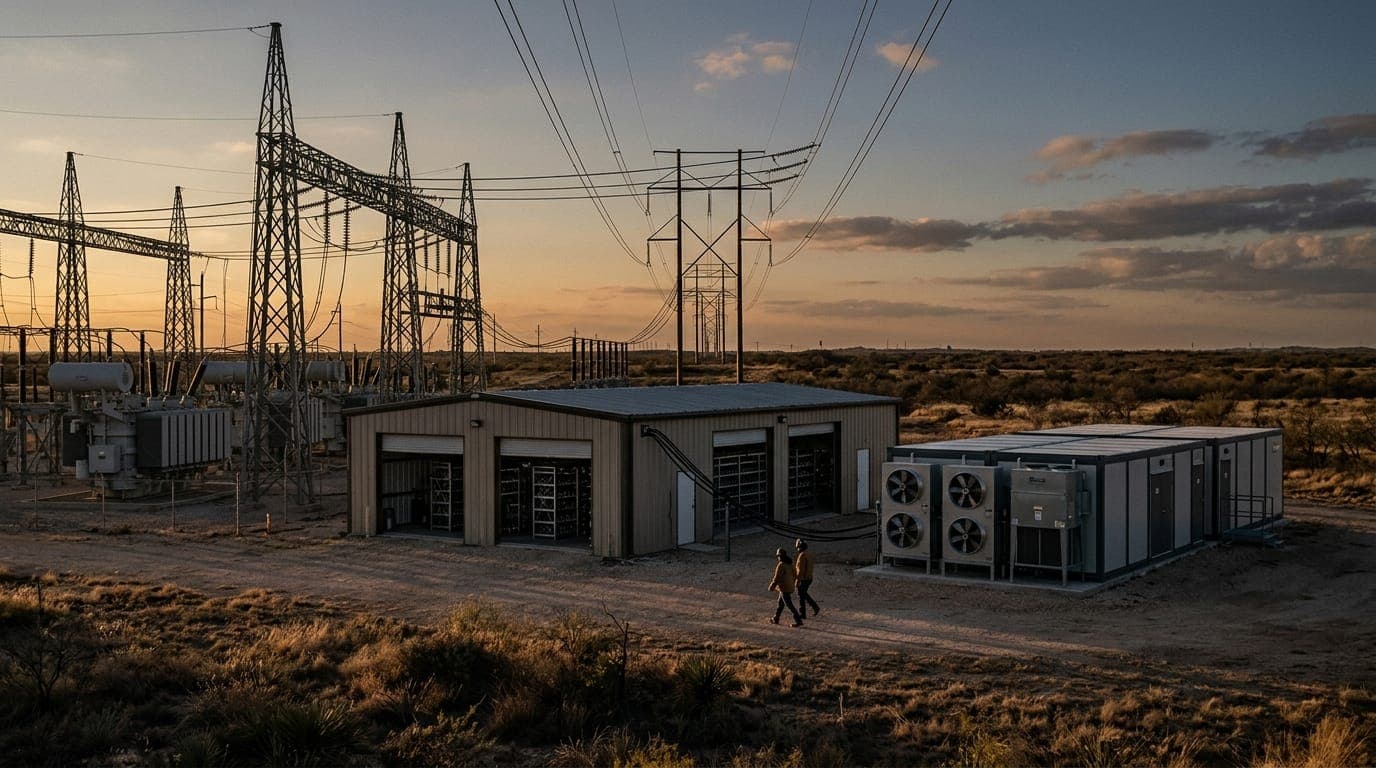
The Michigan campus previously operated approximately 28 MW of Bitcoin mining capacity. That infrastructure, the power contracts, the real estate, the cooling, is now being converted to AI compute under a contract worth multiples of what the mining operation could generate. The campus sits on roughly 83 acres after a June 2026 land acquisition.
This is the energy-compute convergence trade playing out at the asset level. Bitcoin mining built the physical foundation. Bitcoin treasury financing is now funding the conversion. The underlying asset both built the site and is capitalizing its next phase. For the AI data center buildout that is struggling with power access and capital constraints across the country, that is a meaningful data point about where existing Bitcoin mining infrastructure fits in the stack.
Hyperscale Data's BTC treasury itself reflects rapid accumulation: according to secondary reporting, the company held roughly 11 BTC in early 2025 and grew that position to 1,106 BTC by late July 2026. Executive Chairman Milton "Todd" Ault III has been consistent on the rationale: "Surpassing 1,000 Bitcoin reflects our conviction that a strong corporate treasury can provide financial flexibility while we continue building a leading AI infrastructure company."
The Bitcoin treasury arbitrage dynamic that drove some of the corporate accumulation wave is facing compression, which makes the functional deployment of that treasury more important, not less. Passively holding BTC and collecting an mNAV premium is one trade. Using BTC as collateral at sub-5% rates to fund a $1.2 billion revenue contract is a different animal.
The falsifiable part: if Hyperscale Data fails to deliver the 20 MW build on schedule, triggering contract renegotiation or default, or if a significant BTC price drawdown forces liquidation of the collateral position, the thesis becomes a cautionary tale about using a volatile asset to fund capital-intensive infrastructure. Watch Q3 2026 Michigan campus progress reports and the unnamed neo-cloud client's first capacity milestone.
What to Watch
The identity of the California-based neo-cloud customer remains undisclosed. A 10-year commitment from an unnamed counterparty to a sub-$200 million revenue company is the open question with real implications for how durable this revenue base actually is. Hyperscale Data also plans to divest subsidiary Ault Capital Group in Q2 2027, sharpening the company's focus solely on data center operations and digital asset holdings. That simplification, combined with the BTC-backed financing structure, is worth tracking as a template other energy and compute operators might replicate.
Sources
- Hyperscale Data July 30, 2026 press release (PRNewswire), primary announcement; direct URL not confirmed in search results; verify via SEC EDGAR filing index for Hyperscale Data (CIK 0000896493)
- Hyperscale Data SEC 8-K, July 29, 2026 (H1 2026 preliminary financials)
- PRNewswire, July 28, 2026: Hyperscale Data Bitcoin treasury reaches 1,106 Bitcoin worth approximately $71.7 million
- PRNewswire, July 9, 2026: Hyperscale Data surpasses 1,000 Bitcoin in corporate treasury
- PRNewswire, July 15, 2026: Hyperscale Data expects to sign AI data center MSA with California-based AI company
- SEC EDGAR filing index, Hyperscale Data (CIK 0000896493)
Frequently Asked Questions
A Bitcoin-backed credit facility works like a collateralized loan: the company pledges its Bitcoin holdings to a lender, borrows cash against that collateral, retains the price upside on the BTC, and faces forced liquidation risk if the BTC price falls below a defined threshold. Hyperscale Data's facility carries variable rates of 4.5%, 5.0%, which is cheaper than most equity-dilutive alternatives for a micro-cap. The risk is that a sharp BTC drawdown can trigger a margin call against the same asset base funding the build.
The economics have shifted. AI compute contracts under a multi-year MSA carry more predictable and higher-margin revenue than Bitcoin mining at current difficulty and price levels. The existing infrastructure, power access, cooling, and real estate built for mining is largely redeployable for AI compute with capital investment. The 20 MW conversion at the Michigan campus reflects an industry-wide trend: Bitcoin miners with physical infrastructure are positioned to pivot toward the AI data center buildout without starting from scratch on site development.
Undisclosed in all public filings as of July 30, 2026. The company is described as California-based and an AI infrastructure provider willing to commit to a 10-year MSA with two five-year extension options. Hyperscale Data announced the expected signing on July 15, 2026. The counterparty's identity will be the signal inside this story when it surfaces.