Evergrande Founder Gets Life as $300B Debt Hole Falls on Homebuyers
Shenzhen court sentences Evergrande founder Hui Ka Yan to life in prison for financial fraud. The $2.35B in corporate fines is roughly 0.8% of the group's $300B+ liability stack. The gap lands on ordinary creditors.
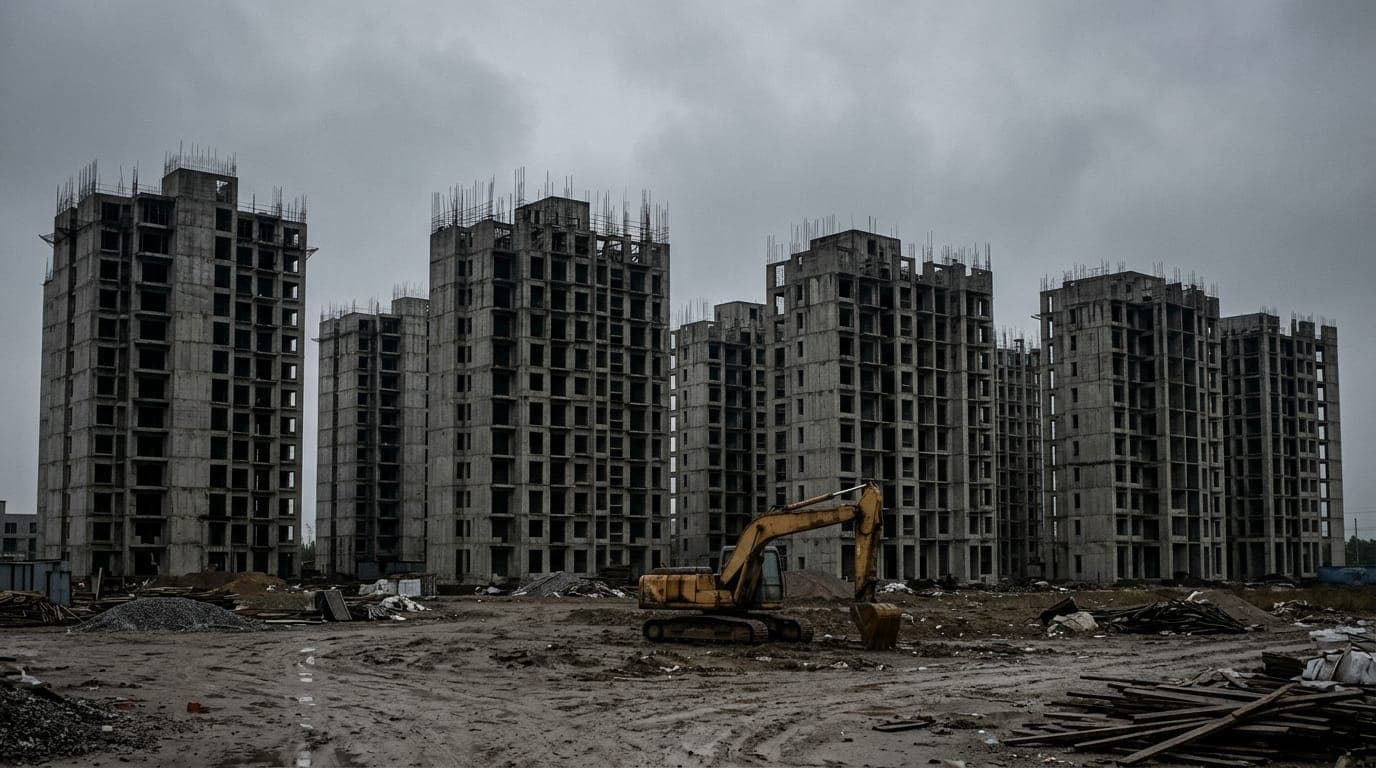
A life sentence for the man who built China's biggest property Ponzi does nothing to rebuild the apartments that were never finished.
Key takeaways
- The Shenzhen Intermediate People's Court sentenced Evergrande founder Hui Ka Yan to life in prison on August 20 for financial fraud, asset inflation, and bribery; all personal assets were confiscated.
- Combined corporate fines against Evergrande and its property subsidiary total 15.82 billion yuan (roughly $2.35 billion), covering less than 1% of the group's $300 billion-plus in liabilities, leaving homebuyers, suppliers, and creditors to absorb the real losses.
- The day after sentencing, a Guangzhou court accepted a bankruptcy liquidation application against Evergrande's main mainland property unit, opening formal creditor claims proceedings with no guarantee of meaningful recovery.
Hui Ka Yan, 67, the founder and former chairman of China Evergrande Group, was sentenced to life in prison by the Shenzhen Intermediate People's Court on August 20, 2026, per Xinhua, after pleading guilty in April to charges including fundraising fraud, illegally absorbing public deposits, asset inflation, and bribery. His political rights were revoked for life and all personal property confiscated. The verdict also hit the corporate level: Evergrande Group was fined 8.82 billion yuan and its property subsidiary fined 7 billion yuan, a combined 15.82 billion yuan (approximately $2.35 billion at current rates).
More than 50 co-defendants were sentenced alongside Hui, including his two sons Xu Tenghe and Xu Zhijian, with prison terms ranging from one year and ten months to eighteen years.
The Math on Recovery Is Brutal
Evergrande's total liabilities exceeded $300 billion at collapse, per AP and Reuters reporting. The combined fines represent less than 1% of that figure. The court verdict, reported by Xinhua, states the criminal conduct "seriously disrupted the order of the socialist market economy," but disrupted orders do not rebuild apartments or repay suppliers.
Davy Jun Huang, a U.S.-based economist and former columnist for Chinese state media outlet CNTV, told The Epoch Times the sentencing answers one question while leaving the consequential one wide open. "The harsher Hui Ka Yan is punished, visually it feels like the problem has been solved," Huang said, "but in reality, the houses will not automatically be completed because of this, and creditors' money will not be recovered because Hui Ka Yan has been sentenced."
The Shenzhen court noted that restitution for losses takes priority over enforcement of fines, and that illegal proceeds are to be recovered with shortfalls subject to restitution. In practice, against a $300 billion liability stack and a company already in liquidation, that hierarchy is aspirational.
The day after sentencing, the Guangzhou Intermediate People's Court accepted a bankruptcy liquidation application filed by Guangzhou Rural Commercial Bank's Huaxia branch against Hengda Real Estate Group, Evergrande's principal mainland property unit, per the court's official notice via China.org.cn. A liquidation administrator was appointed and creditors directed to file claims. The formal process is open. The recovery math is not encouraging.
Who Extracted the Gains, Who Absorbs the Losses
The state's role spans the full arc of the property boom, not just Hui's personal conduct. China's government was simultaneously the dominant supplier of land, the regulator of the developers who bought it, and the primary beneficiary of land-sale revenues and transfer taxes that funded municipal budgets for two decades.
"When real estate was rising, the government used land-sale revenues, land-transfer taxes, and layers of extraction to squeeze out the last penny," Huang said. "When the real estate bubble burst, under the Chinese Communist Party's political model, the government would not bear any of the losses."
Huang drew a comparison to the U.S. government's 2008 intervention in Fannie Mae and Freddie Mac, arguing that a government which profits from a housing finance system carries corresponding responsibility when that system fails. That intervention is the benchmark: if Beijing deployed sovereign revenues to fund a genuine restitution mechanism for retail victims, the framework breaks. It has not done so.
The revenue fraud involved in the collapse was not small. Evergrande overstated revenues by roughly $80 billion across 2019 and 2020, per the China Securities Regulatory Commission's March 2024 findings. That fraud inflated the entire system that retail buyers, suppliers, and downstream creditors were operating inside.
What Comes Next
Creditors now have formal liquidation proceedings to file claims against. The realistic outcome for ordinary homebuyers and suppliers sits somewhere between thin recovery and none, depending on what asset value remains after secured creditors are satisfied. The liquidation administrator's findings over the coming months will be the actual signal, not the life sentence.
The falsifiable thesis here: if Beijing deploys fiscal reserves or land-transfer revenues into a restitution fund that materially reaches retail victims, not just banks, the state-privatizes-gains-socializes-losses frame fails. That trigger has not fired. Watch the liquidation proceeding, not the sentencing coverage.
For anyone thinking about where capital goes when the state-managed savings vehicle breaks and sovereign debt spirals tighten globally, the Evergrande saga is the clearest real-world demonstration of what financial repression looks like at scale. The individual creditor has no self-custody, no permissionless exit, and no recourse, finishing last in line behind a government that collected its cut on the way up.
Sources
- Shenzhen Intermediate People's Court verdict via Xinhua English
- Guangzhou Intermediate People's Court bankruptcy liquidation notice via China.org.cn
- Guangzhou liquidation proceeding via Global Times
- Epoch Times: Evergrande Founder Gets Life but Homebuyers, Suppliers Bear the Costs of China's Property Collapse
Frequently Asked Questions
Will Evergrande homebuyers recover their money or get their apartments?
Formal creditor claims are now being filed through the Guangzhou bankruptcy liquidation proceeding. In practice, secured creditors (primarily banks) sit ahead of homebuyers in the claims hierarchy. With total liabilities exceeding $300 billion and fines covering less than 1% of that figure, meaningful recovery for retail claimants is not supported by the numbers available. The liquidation administrator's asset assessment will determine actual distributions.
Why hasn't China bailed out Evergrande's retail victims the way the U.S. backstopped Fannie and Freddie in 2008?
Davy Jun Huang's argument, offered to The Epoch Times, is that Beijing has chosen to prosecute the corporate figurehead rather than assume the losses the state's own land-revenue system helped create. Huang points to the U.S. government's 2008 conservatorship of Fannie Mae and Freddie Mac as an example of a government assuming responsibility when a major part of the housing finance system fails. No analogous mechanism has been deployed for Chinese homebuyers. Whether the political cost of that inaction eventually forces a policy shift is the open question.
How big is China's property sector debt problem beyond Evergrande?
Evergrande is the largest single collapse but not an isolated one. Sunac, Country Garden, and multiple other major developers have entered distress or default since 2021. At its peak, China's residential property sector was estimated to contribute approximately 25-30% of the country's GDP, per multiple analyses including Axios and researchers at the National Bureau of Economic Research.
Municipal government finances, which depended on land-sale revenues as a primary budget mechanism, are under acute stress as that revenue stream dries up. Evergrande is the headline, but the structural overhang is sector-wide.