EO 14421 Targets Chinese Grid Hardware, But Battery Storage Is the Real Exposure
Trump's EO 14421 invokes emergency powers over the bulk-power system, but Chinese import exposure in transformers and breakers has already collapsed. Battery storage, where China controls half of US import value, is the actual vulnerability, and the December 24 DOE rulemaking could detonate the
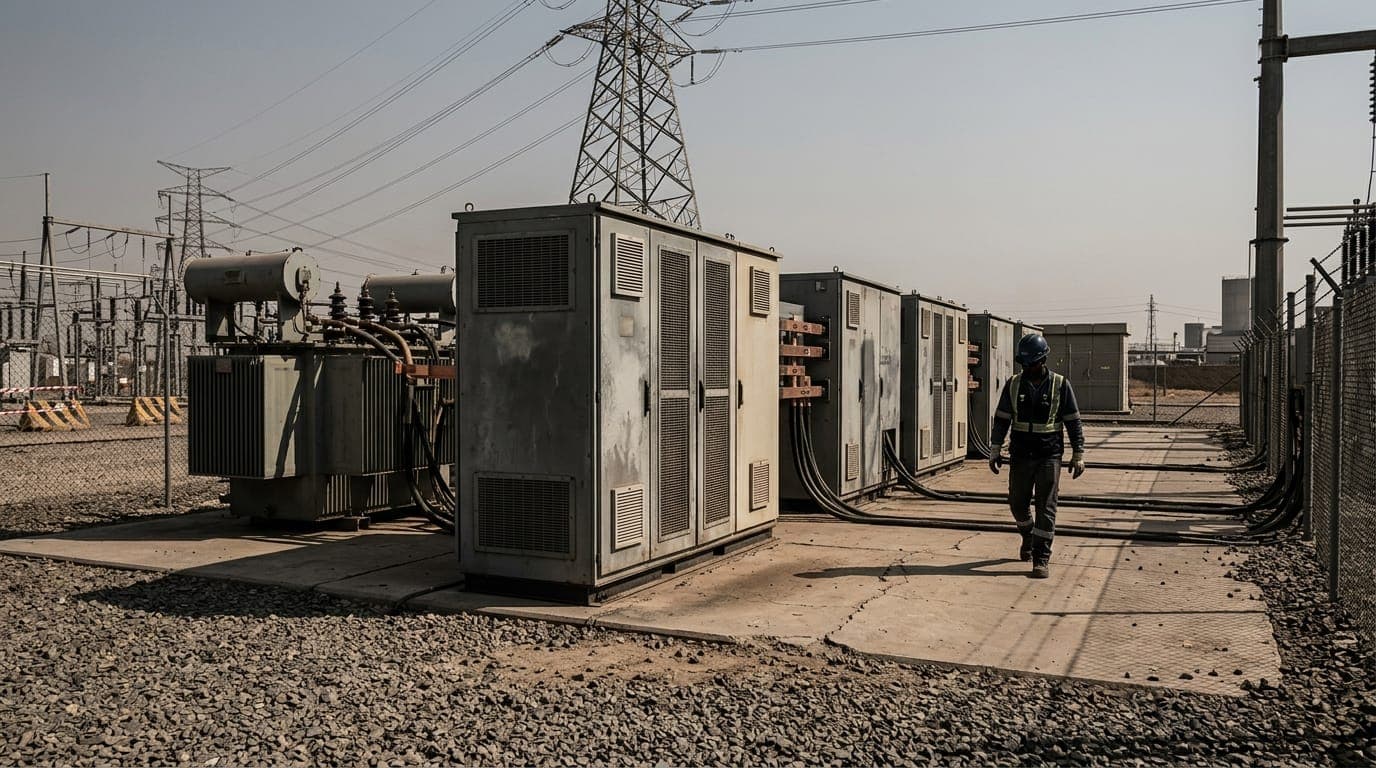
Trump's emergency order covers transformers and breakers where China's footprint has already shrunk to near zero, the 50% lithium-ion battery import share is the supply chain grenade, and DOE has until Christmas Eve to pull the pin.
Key takeaways
- Chinese import exposure in US transformer and circuit breaker markets has collapsed to 3% and under 1% respectively; battery storage, where China holds roughly 50% of import value, is the genuine vulnerability EO 14421 creates.
- The December 24, 2026 DOE rulemaking deadline is the order's most consequential moment: a broad definition of "Covered Foreign Entity" could sweep South Korean and Mexican assembly operations that rely on Chinese capital into the restricted category overnight.
- AI data center battery backup systems fall explicitly under the order's BESS language, putting hyperscaler infrastructure timelines directly in the crosshairs alongside the grid-scale storage market.
President Trump signed Executive Order 14421, "Declaring a National Emergency to Secure the United States Bulk-Power System," on August 26, 2026, invoking the International Emergency Economic Powers Act and the National Emergencies Act to restrict Chinese-origin equipment across the US power grid. The order covers substation transformers, grid-connected inverters, battery energy storage systems, high-voltage circuit breakers, generation turbines, and associated software and firmware. It also explicitly names "advanced manufacturing, data centers, artificial intelligence, and defense production" as the reason supply disruptions now carry national security consequences, per the Federal Register filing.
The full order is published on GovInfo. The DOE has opened a public request for information on implementation, available at Regulations.gov.
Where the Exposure Actually Lives
The transformer headline is largely already-solved problem. Rystad Energy's analysis of the 12 months through June 2026 puts China at just 3% of US transformer imports by value. Circuit breakers are under 1%, with South Korea, Mexico, and Canada together accounting for 74% of US breaker imports. The market repriced Chinese grid hardware risk before Washington formalized it.
Battery storage is a different story entirely. China supplied roughly 50% of US lithium-ion battery imports by value over the same period, per Rystad, with no alternative origin anywhere close to absorbing that share at scale. The AI capex cycle has made that exposure worse, not better: behind-the-meter UPS systems that data centers depend on for power resilience fall squarely under the order's BESS language. Hyperscalers are not bystanders to a grid security debate; they are inside the perimeter.
Geoffrey Hebertson, Lead Renewables Analyst at Rystad Energy, put it plainly:
"The order is written around the grid, but the supply chain problem it creates falls most squarely on battery storage. Transformers and breakers have low Chinese import exposure today because the market shifted before this order arrived. Battery storage has not made that transition yet, and there is no alternative origin that can absorb a 50% Chinese share at the volumes data centers and AI infrastructure now require."
The December Rulemaking Is the Real Decision
The Secretary of Energy has 120 days from August 26 to publish implementing rules, a deadline that lands on December 24, 2026. Until then, the precise scope of "Covered Foreign Entity" is unsettled, and that ambiguity is where the real risk sits.
The current industry workaround routes battery procurement through South Korean and Mexican assembly operations. If DOE draws "Covered Foreign Entity" broadly enough to follow Chinese capital into those third-country plants, the workaround evaporates. Hebertson again:
"The December rulemaking is the order's most consequential moment. If ownership is drawn broadly enough to follow Chinese capital into South Korean or Mexican assembly plants, the supply chain the tech industry is currently relying on to keep AI infrastructure buildout on schedule becomes part of the problem. That outcome is not a certainty, but it is a plausible reading of the text, and procurement teams at hyperscalers should be modelling it now."
The administration's tension here is real. The EO's own text uses AI data center growth as a national security justification for grid decoupling. But aggressively restricting the battery supply chain that 50% of import value depends on could slow that same buildout materially. Washington is simultaneously pushing the accelerator and the brake. Prior TFTC reporting on China's role in the data center supply chain and the scale of AI capex commitments makes the stakes concrete: this is not a regulatory footnote.
The falsifiable thesis is this: EO 14421 is a genuine supply-chain grenade for AI battery storage, not transformer theater. The trigger that disproves it is a narrow December ruling that excludes third-country assembly from the covered entity definition, allowing hyperscalers to route around the restriction through Korea and Mexico with no material delay in data center commissioning through Q1 2027.
Energy as a Geopolitical Battleground
There is a second-order dimension that runs beyond AI. The same battery storage supply chains and grid interconnection queues powering hyperscaler buildouts are in direct competition with Bitcoin mining infrastructure. A supply crunch in BESS does not selectively harm large-language-model operators; it tightens the energy envelope for everyone fighting for grid access and behind-the-meter resilience.
The broader signal is this: Washington is now treating compute-powering energy infrastructure as a strategic asset, not just an economic input. The EO invokes emergency powers to enforce that framing. The Chinese state's involvement in restricted technology supply chains has been a recurring theme; this order extends that battleground from chips to the physical grid layer beneath them. Operators running on-site, dispatchable generation are structurally ahead of any entity that assumed the grid supply chain would remain geopolitically neutral.
What to Watch
The December 24 DOE rulemaking is the only date that matters for the next four months. Watch the definition of "Covered Foreign Entity" with particular attention to whether it tracks ownership, capital origin, or manufacturing location. A narrow ruling gives the market a clean workaround. A broad ruling puts procurement teams at every major hyperscaler and grid-scale storage developer into emergency replanning mode at the worst possible point in the AI capex cycle.
Sources
Frequently Asked Questions
What equipment does Executive Order 14421 cover?
EO 14421, signed August 26, 2026, covers substation transformers, grid-connected inverters, battery energy storage systems, high-voltage circuit breakers, and generation turbines, along with associated software, firmware, and remote-access capabilities. Behind-the-meter UPS systems used by data centers fall under the BESS category.
Why does a grid security order affect AI data centers?
The order explicitly cites AI data center growth as a national security concern, and data centers rely on battery backup systems covered under the BESS language. Any restriction on Chinese-origin battery storage hardware directly affects the power resilience infrastructure hyperscalers depend on to keep facilities operational.
Could the December 2026 DOE rulemaking eliminate the South Korean and Mexican workaround?
Yes, if DOE defines "Covered Foreign Entity" to follow Chinese capital into third-country assembly operations, battery supply chains currently routed through South Korea and Mexico could become non-compliant overnight. Rystad Energy flags this as a plausible reading of the text, not a certainty, but one that procurement teams should be stress-testing now.