EIA Projects Record US Power Demand Through 2027 as AI Data Centers Drive Surge
The EIA's October 2026 Short-Term Energy Outlook projects US electricity demand hitting consecutive records through 2027, with AI data centers identified as the dominant driver. Wholesale prices are forecast up roughly 11% in 2026. Bitcoin mining's load-flexibility advantage widens as AI cements
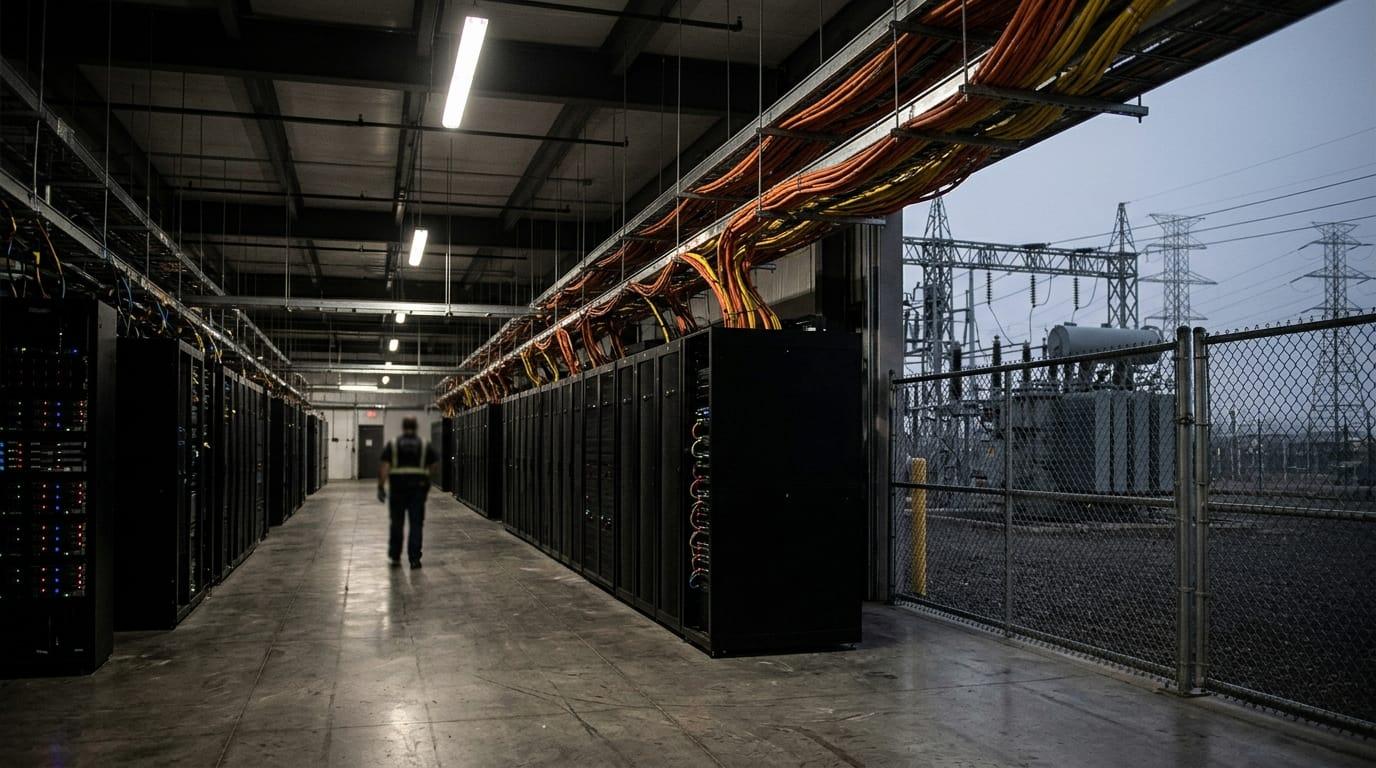
The US government's own energy forecaster now says AI is structurally repricing the American grid.
Key takeaways
- The EIA's October 2026 Short-Term Energy Outlook projects US electricity consumption rising from a record 4,195 billion kWh in 2025 to 4,288 billion kWh in 2026 and 4,356 billion kWh in 2027, driven primarily by AI data centers.
- Wholesale electricity prices are forecast to average approximately $52/MWh in 2026, up roughly 11% versus 2025, with AI-driven demand cementing what looks like a structural, not cyclical, energy cost floor.
- Bitcoin mining's load-flexibility advantage widens as AI locks in as a fixed, 24/7 grid load: miners can follow stranded and curtailed power across geographies; hyperscalers cannot.
The EIA's October 2026 Short-Term Energy Outlook, released October 6, 2026, projects US electricity demand will set consecutive annual records in 2026 and 2027, with AI and cryptocurrency data centers identified as the primary driver. First reported by Reuters, the forecast puts the structural energy-inflation thesis on the record in an official US government document.
What the EIA Is Actually Projecting
US power consumption hit 4,195 billion kWh in 2025, already the second consecutive annual record. The October STEO projects that figure rising to 4,288 billion kWh in 2026 and 4,356 billion kWh in 2027. That is 161 billion kWh of incremental demand added in two years, the equivalent of adding a mid-sized country's entire electricity consumption on top of the existing US grid.
The EIA specifically flags the West South Central region, which includes Texas, as accounting for the largest share of total electricity sales growth in the forecast. The notable detail: that growth comes despite a pause in connecting new Texas data center projects to the grid. According to the October STEO, the West South Central region accounts for the largest share of total electricity sales growth in the forecast even as new data center grid connections in Texas are being throttled. Demand pressure is so heavy that even throttled connection activity in the largest growth region still dominates the national numbers.
On the generation mix: natural gas holds at roughly 40% of power generation in both 2026 and 2027. Nuclear stays at 18%. Renewables grow from approximately 24% in 2025 toward 27% by 2027. Coal continues its structural retreat.
Wholesale electricity prices are forecast to average approximately $52/MWh in 2026, up roughly 11% versus 2025, with extreme weather cited as a proximate cause but AI data center demand as the sustained underlying force.
The Grid Stress Bitcoin Miners Can Arbitrage
The EIA framing matters because it is the US government's baseline forecast, used by utilities, grid operators, and policymakers to drive infrastructure planning, rate cases, and transmission investment decisions for years. When this document says AI data centers are the dominant marginal driver of power demand, that assessment cascades into all of those decisions.
The grid is being asked to absorb a new category of industrial load that is large, fixed-location, and non-interruptible. AI hyperscalers make 10-to-20-year commitments to specific sites with massive cooling buildout. They cannot relocate to chase cheap curtailed power. They cannot shut down during peak pricing events without material operational consequences.
Bitcoin miners can do all of those things. Every gigawatt of renewable generation built to serve AI demand produces off-peak and curtailed energy that AI cannot absorb. Bitcoin miners can.
Texas is the proof-of-concept: the EIA calls it the top demand-growth region while simultaneously noting that data center grid connections there are being throttled. That tension is precisely the environment where dispatchable, geographically portable mining operations create value both for the grid and for their own cost structures. The facilities being built now are increasingly dual-use, and the ones with the best power agreements are the ones that understood grid dynamics before the EIA made it front-page news.
The falsifiable version of this thesis: if AI hyperscalers demonstrate they can operate profitably as interruptible, demand-responsive loads at scale, absorbing curtailment the way Bitcoin miners do, the grid-flexibility premium collapses. Watch for large-scale demand response contracts between AI operators and regional grid operators, or verified proof of AI workload load-shifting at meaningful scale, as the trigger that changes the calculus.
What to Watch
The EIA has also launched a pilot survey on energy use at data centers, per its press releases page, which will produce better primary data on exactly how much of the new load is attributable to AI versus other commercial categories. That data, when it arrives, will either confirm or complicate the AI-as-dominant-driver thesis embedded in the October STEO. Meanwhile, the forecast is revised monthly. If AI capex continues to outpace prior EIA assumptions as it has for the past two years, the 2027 demand projection is more likely to move up than down.
Sources
- EIA October 2026 Short-Term Energy Outlook (landing page)
- EIA October 2026 STEO, Full Report PDF
- EIA Press Releases
- First reported by Reuters (byline: Scott DiSavino), October 6, 2026
Frequently Asked Questions
Why can't AI data centers absorb curtailed and off-peak power the way Bitcoin miners do?
AI inference and training workloads are time-sensitive and location-specific. Hyperscalers build to serve latency requirements for real users or continuous training runs, both of which require reliable uptime at fixed sites. The cooling infrastructure alone represents billions in fixed investment tied to a specific location. Bitcoin mining, by contrast, has no latency requirement and no fixed site dependency.
A miner can pause, relocate, or run only during low-price hours without losing anything except the revenue from those hours, which is the point.
Does an 11% rise in wholesale electricity prices hurt Bitcoin miners materially?
Miners with locked-in power purchase agreements at sub-$30/MWh are largely shielded in the near term. Those on spot or indexed contracts face direct margin compression. The more important structural point: rising energy prices make Bitcoin's fixed supply and energy-cost relationship more legible as a sound-money signal, and they make access to stranded or curtailed power a wider competitive moat for miners who built those relationships before the market priced them in.
How reliable is the EIA's Short-Term Energy Outlook?
The STEO is the US Energy Information Administration's monthly near-term forecast for US and global energy markets. It is the authoritative government baseline used by utilities, grid operators, policymakers, and energy investors. The electricity demand projections have been revised upward repeatedly over the past two years as AI capital expenditure has outpaced prior EIA assumptions. That revision track record is itself a signal: the structural demand story is not softening.