Cuba's Grid Collapses for the Sixth Time as Dollar-System Cuts Off Oil
Cuba's national power grid went dark for the sixth time in 2026 after U.S. sanctions cut Venezuelan and Iranian oil supply lines. The island's Energy Minister has already confirmed there is no fuel. This is the live stress-test of permissioned energy and money.
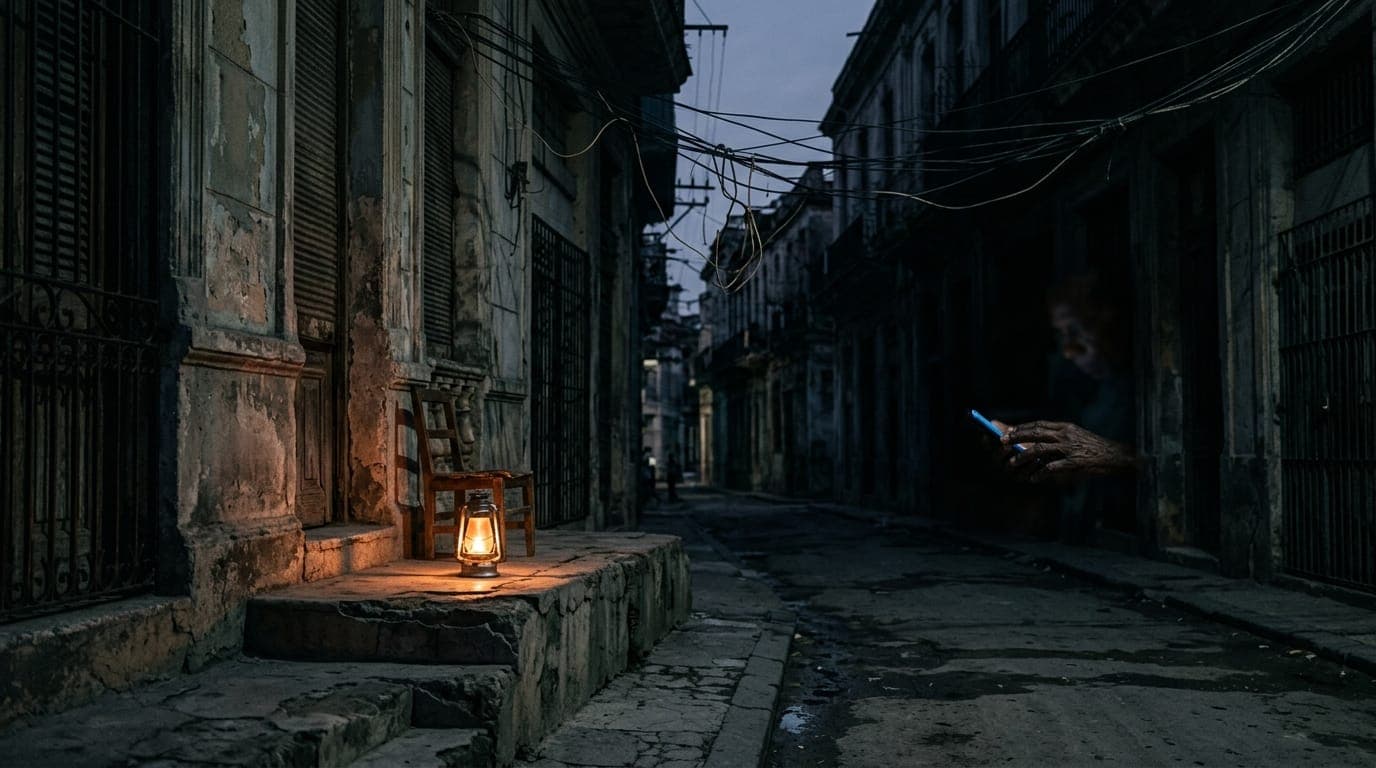
The island's power infrastructure has failed six times in 2026 alone. The cause is monetary, not technical.
Key takeaways
- Cuba's national power grid suffered its sixth total collapse of 2026 on Sunday night, August 2, per reporting from Al Jazeera and AP, leaving roughly 10 million people without electricity after attempts at partial restoration failed.
- Cuba's Energy Minister Vicente de la O Levy confirmed in May 2026 that the island has "absolutely no fuel, oil, and absolutely no diesel," and oil imports effectively fell to zero in January 2026 after U.S. sanctions severed Venezuelan supply lines and the Strait of Hormuz crisis neutralized Iran's clandestine export capacity.
- The collapse is a working demonstration of why permissionless money and self-sovereign energy are not abstract ideals: any state or individual dependent on dollar-denominated energy flows is one policy decision away from the same failure mode.
Cuba's Unión Eléctrica de Cuba (UNE) announced the "total disconnection" of the National Electric System on Sunday night, August 2, 2026. Partial restoration efforts in Havana collapsed again almost immediately, with UNE confirming via CNN that "prevailing weather conditions caused disruptions to the grid, directly affecting the generating units that were online." Lazaro Manuel Alonso, news director of Cuba's state-run television, was blunt: "Despite the progress made today, an electric oscillation triggered the collapse."
This is the sixth nationwide blackout in eight months, as confirmed by multiple wire sources as of that August 2 collapse. Cuba recorded two total collapses in all of 2024. Six in 2026 alone through early August is a terminal resource problem, not a technical one getting incrementally worse.
No Fuel, No Fix
Cuba's Vice Minister of Energy and Mines Argelio Abad Vigo stated in March 2026 that the country had gone three months without receiving a single delivery of diesel, fuel oil, gasoline, aviation fuel, or liquefied petroleum gas. By May, Energy Minister Vicente de la O Levy put it without qualification: "We have absolutely no fuel, oil, and absolutely no diesel."
The supply chain breakdown is structural, not temporary. Venezuelan oil, a major import source for Cuba, stopped flowing after the U.S. arrested Venezuelan President Nicolás Maduro in early January 2026, a move confirmed by Reuters. LSEG ship-tracking data, also cited by Reuters, showed only two small oil-carrying vessels arrived in Cuba in the entire period through mid-March. Russia's contributions cover only a matter of days of total consumption per quarter. Iran's shadow fleet, which had been routing clandestine crude to the island, was effectively neutralized when the Strait of Hormuz crisis began February 28, 2026, cutting off Iran's export capacity entirely.
Cuba's grid was already operating near collapse before the cutoff. Generation capacity sat at roughly 1,700 MW against peak demand of approximately 3,000 MW as of April 2026, per UNE data. Some rural communities faced outages exceeding 70 hours even before the sixth total collapse.
Carlos Montes de Oca, a Havana resident, told Reuters: "It affects every aspect of our lives. All we can do is sit, wait, read a book... otherwise the stress gets to you."
The Dollar Controlled Both Ends
The standard geopolitical read here frames this as sanctions working as intended. That is accurate but incomplete.
What Cuba illustrates is that the dollar-system controls two chokepoints simultaneously: the payment rails and the tanker routes. Cuba cannot buy oil on spot markets because the U.S. embargo blocks correspondent banking access, meaning no dollar-denominated transaction can clear. Cuba cannot receive oil from sanctioned counterparties because those counterparties are themselves being blocked or blockaded.
The same policy apparatus that froze Venezuela's ability to move dollars also froze Iran's ability to export crude through the Strait. One hand, both levers.
Any non-aligned state (or non-compliant individual) running on dollar-denominated energy access faces the same architecture. The Geyser situation made that visible even at the individual level: a non-custodial Bitcoin platform blocked Cuban users under OFAC pressure. Permissionless in name, permissioned in practice.
Bitcoin does not conjure barrels of oil. But it is the only monetary layer that cannot be switched off by the same hand controlling the tanker routes. A world where energy-exporting nations price in BTC is structurally harder to blockade through correspondent banking because the settlement layer sits outside dollar clearing entirely.
That is not a speculative thesis. El Salvador and other energy-adjacent jurisdictions are already piloting pieces of this architecture. The Operation Economic Outcast sanctions campaign against Iran's aviation network shows exactly how aggressively the U.S. deploys these tools. Cuba is the downstream consequence of the same playbook applied to energy supply.
The falsifiable test: if Cuba successfully pivots to domestically financed solar and storage capacity and stabilizes its grid without external oil or IMF credit, centralized state management survives the energy sanctions playbook. Alternatively, if a negotiated deal with Washington restores Venezuelan oil flows and the grid recovers without structural reform, the thesis weakens to "sanctions work temporarily, not systemically." Neither outcome has materialized. The lights are still off.
What Comes Next
The emigration pressure will accelerate. Hundreds of thousands of Cubans have already fled since 2022, and each departure shrinks the productive base that might otherwise support any recovery.
Without a viable path to hard currency for fuel imports, and with every clandestine supply route now cut, the frequency of total collapses is more likely to increase than stabilize. UNE has no announced timeline for restoration. The sixth collapse will not be the last.
Sources
- Al Jazeera, Sixth collapse, August 3, 2026
- Al Jazeera, Energy Minister "absolutely no fuel," May 14, 2026
- NPR, Vice Minister Abad Vigo, three months without fuel, March 22, 2026
- Reuters / Yahoo News, LSEG ship tracking, Venezuelan oil cutoff, March 17, 2026
- AP / Local10, Sixth collapse confirmation, August 3, 2026
- CNN, UNE weather disruption statement, August 3, 2026
Frequently Asked Questions
Russia has sent minimal supply, covering only days of total consumption per quarter. China has not filled the gap. Iran's shadow fleet, Cuba's last viable clandestine source, has been effectively neutralized by the Strait of Hormuz crisis that began in late February 2026. Cuba also has no hard currency to pay for spot cargo on international markets: the U.S. embargo blocks correspondent banking access, which means dollar-denominated transactions cannot clear, and no major oil exporter accepts Cuba's peso-denominated payment.
Iran had been one of Cuba's clandestine oil sources through overlapping shipping networks. The Strait of Hormuz crisis, which began February 28, 2026, followed by a U.S. naval blockade of Iran from April through late May (reinstated July 14), has effectively closed Iran's export capacity. With Venezuelan supply already gone and Iranian supply blocked, Cuba's last meaningful clandestine supply lines collapsed simultaneously.
Bitcoin does not produce oil. But it provides payment settlement outside dollar correspondent banking. In a future where energy-exporting nations accept BTC for trade, the correspondent banking chokepoint the U.S. currently uses to block Cuba from purchasing oil on international markets becomes less effective. The architecture is already being tested at the margins. The Cuba scenario is the live argument for why that matters, not a hypothetical one.