Sam Lyman: China Is Funding the War on Data Centers
Sam Lyman of BPI maps the foreign-funded campaign against American data centers, debunks the FUD, makes the case for Data Center Dividends, and explains why AI-safety doomerism is this cycle's COVID narrative.

↓ Jump to the video and timestamps
I sit on the board of a data center company and we've been running Bitcoin mining in TVA territory for nearly six years. So when I say the anti-data-center campaign is obnoxiously wrong, that's not punditry. I know what's happening in these communities because I'm operating in them.
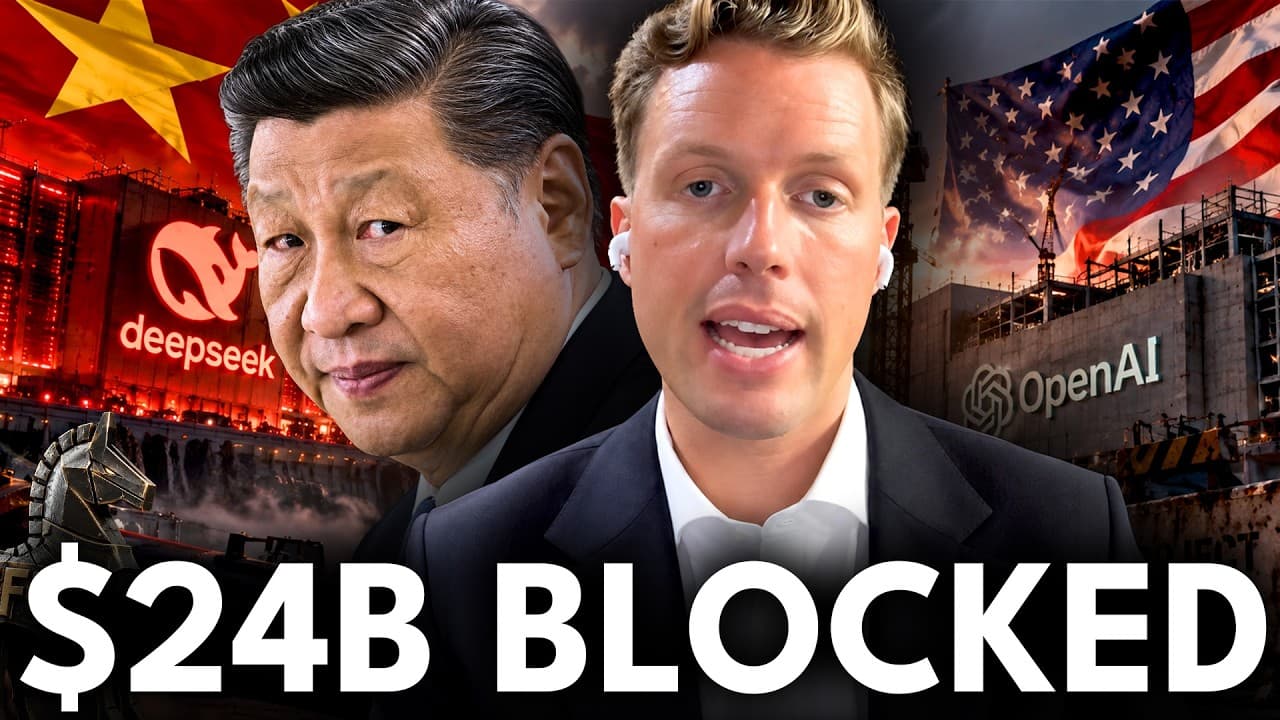
Sam Lyman came on this week fresh off testifying on Capitol Hill. He's been doing serious investigative work at the Bitcoin Policy Institute, tracing the organized opposition to America's AI infrastructure buildout back to its source. What he found is a coordinated foreign influence operation, funded through a single Shanghai-based American named Neville Roy Singham, running through nonprofits like Code Pink and the Party for Socialism and Liberation, designed to poison American public opinion against the infrastructure we need to win the AI race.
While that's happening here, China is subsidizing its own AI data center energy costs and celebrating every domestic AI milestone. The tell is obvious once you see it.
We also got into AI-safety doomerism, effective altruism, the open-source imperative, and why ARMA clearing the House Financial Services Committee is the bill I actually care about more than Clarity. A lot of ground. Here's what mattered.
Key takeaways
- Neville Roy Singham, a Shanghai-based American Marxist the New York Times identified as the financier of a "global web of Chinese propaganda", directed hundreds of millions of dollars to far-left nonprofits that have worked to block AI infrastructure investment across the United States. Sam Lyman's research at BPI traced Code Pink, the Party for Socialism and Liberation, and People's Forum back to a single funding source.
- The water-usage and electricity-price fears are largely myths. Modern data centers run closed-loop water systems, not open draws. And in the communities where we operate, the utility companies have testified publicly at city council meetings that our purchases of excess capacity held their rates flat for two straight years.
- Sam Lyman and BPI's Data Center Dividends proposal models $5,000 to $9,000 per household per year in rural counties that host large-scale data center facilities, modeled on Alaska's Permanent Fund, using surplus tax revenue after public-safety and infrastructure costs are covered.
- County governments have more bargaining power than they realize. Demand for tokens is already past the point where agent-to-agent output exceeds human-to-model output. The agentic economy is just starting, and there isn't enough power. Counties were tripping over themselves to attract data centers a few years ago. That dynamic has flipped.
- AI-safety doomerism follows the same playbook as COVID lockdown narratives and climate alarmism, a non-falsifiable doomsday claim, a coordinated media moment, and a regulatory ask that benefits the incumbents making the most noise. If Dario Amodei genuinely believes he's building something that will kill everyone, why is he building it?
- The open-source AI fight is the same fight as Bitcoin self-custody. If OpenAI and Anthropic become the only game in town, every query you make surrenders your literal thought process to companies whose incentives aren't aligned with yours, and the effective-altruism worldview baked into their training makes that worse, not better.
The Psyop, Laid Bare
Sam traces the thread back to his time at Riot Platforms, when the company was building a data center in Corsicana, Texas. Community support was solid, until it wasn't. Out of nowhere, organized opposition appeared, driven largely by a woman who didn't even live in the county. She got on Facebook, started spreading misinformation about water usage and electricity consumption, and suddenly there was a real political problem.
When Sam's team started pulling on that thread, they found she had partnered with Greenpeace, and behind Greenpeace was money tied to XRP/Ripple, a rival to Bitcoin spreading FUD through environmental proxies.
That experience gave him the pattern-recognition to see what was happening nationally this summer when the data center debate exploded. He put the same investigative hat on and started asking who was funding the opposition.
The answer kept pointing to the same place. Chinese English-language state media had been running coordinated anti-data-center content for years, not just recently, on YouTube channels and digital publications, pushing narratives about spiked electricity prices and dangerous water consumption. Then Sam looked at the nonprofits showing up at public hearings and canvassing communities across the country. Code Pink. The Party for Socialism and Liberation, a Marxist-Leninist organization that is explicitly pro-China in its messaging. People's Forum. All of them echoing the same talking points the CCP's English-language media was pushing.
He followed the money to Neville Roy Singham. Singham is an American citizen living in Shanghai. He sold his tech company in the 2010s and, according to Sam's research, directed approximately $278 million of that fortune toward far-left causes in the United States. The New York Times identified him as the financier of what they described as a "global web of Chinese propaganda." The Party for Socialism and Liberation alone, by BPI's reckoning, has stopped approximately $24 billion in AI infrastructure investment across the country.
The Senate roundtable that Senator Sanders hosted on "the existential risk of AI" is where it all crystallized for Sam. Sanders invited two Chinese AI ambassadors. One of them, Sui Lan, was, according to Sam's characterization, handpicked by the Chinese government to spread the gospel of global cooperation in AI to US lawmakers. Two Chinese nationals lectured American senators about the dangers of artificial intelligence, inside the US Capitol.
The result of all this, per a poll Sam cited in his testimony: 71% of Americans say they don't want to live in a community with a data center, a larger share than those who say they don't want to live near a nuclear power plant.
One data point Sam kept returning to is the tell that makes this obvious as a deliberate competitive strategy rather than genuine concern: the same Chinese state media sowing fear about data centers here is celebrating AI milestones at home, and the Chinese government is simultaneously subsidizing its AI data centers' energy costs. They're funding the slowdown here while speeding up there.
The FUD, Debunked
This is where I'll speak from direct experience rather than research.
The water-usage concern is almost entirely based on a report done over a decade ago that overstated water consumption by something in the range of 10,000%. People are still running with those numbers. Modern data centers use closed-loop systems, they're not drawing from local water tables the way the old study implied.
Sound is a real issue, and I won't pretend otherwise. Bitcoin mining in particular has had its share of legitimate complaints on that front. But it's a solvable engineering problem, not an existential one.
The electricity-price question is the one that gets me most fired up, because I can speak to it directly. The utility companies we work with have gone to public city council meetings and said, on the record, that because we're buying their excess capacity, they've held rates flat for two straight years. We're functioning as a buyer of first and last resort for power that would otherwise go unsold. That's the opposite of what the FUD says is happening.
Sam made a point I think the industry has been slow to internalize: the real story of what these facilities actually do for the places they go into is almost completely untold, and the industry should be leading with that instead of playing defense.
What Data Centers Actually Do for Rural America
Quincy, Washington is the proof of concept. Microsoft and other data center investments into that community more than quintupled the county budget, per Sam's account. Before the data centers arrived, the community was struggling. Sidewalks that didn't exist got built. Schools got funded. The whole tax base transformed.
That pattern plays out at smaller scale everywhere these facilities go in. I've watched it in Appalachian communities where we operate for Bitcoin mining. The property taxes we pay are material. The revenue we provide the utility is material. And those numbers get significantly better when you're talking about AI compute rather than Bitcoin mining.
Sam's frame on this is the one that needs to break through: data centers are not just good for communities. They are reindustrialization. A lot of people hear that word and picture aluminum smelters and textile factories coming back online. That's part of it. But the bedrock of the 21st-century economy is intelligence, and a data center is an intelligence factory.
The jobs numbers support this. Construction employment has hit historically high levels, driven in meaningful part by data center buildout, and the workers building these facilities aren't low-wage service jobs, Sam cited plumbers and electricians earning well into the six figures because demand for their skills has outrun supply. He also noted that BPI has tracked more than 40 unions and labor organizations that have come out in favor of data centers and against the anti-data-center regulatory push. The groups claiming to stand up for the working class by fighting data centers are doing the opposite of what they say.
The Rust Belt hollowing-out was fifty years in the making, a consequence of Triffin's dilemma and five decades of offshoring production to China. Data centers won't fix that overnight. But if you're looking for the kickstart to re-architecting the domestic economy, this is it.
Data Center Dividends, The Counter-Narrative
Sam Lyman and BPI's Data Center Dividends proposal is the one I think has the most political potential.
The model starts with Alaska's Permanent Fund. Alaska collects royalties from oil production, invests them into an endowment, and distributes the investment earnings to every resident, adults and children alike, every year. Sam cited an average of roughly $1,500 per year over the past decade.
Rural American counties have the same basic properties that make Alaska work: small populations relative to landmass and a significant energy resource. What they've lacked is a public mechanism to turn data center tax revenue into direct household benefit.
The math BPI ran uses Loudoun County, Virginia, the most data-center-rich county in the country, as the baseline. A one-gigawatt data center facility generates, by their estimate, roughly $150 million per year in tax revenue. After financing public safety, infrastructure, and schools, there's still meaningful surplus in a rural county context. That surplus, distributed to households, works out to somewhere in the range of $5,000 to $9,000 per year per household, in counties where the median income is around $50,000.
For families in communities that have been left behind for a generation, that surplus, running to $5,000 to $9,000 per household per year, is a car payment, a tuition payment, a mortgage acceleration.
Sam's read on who has to lead this is right: the county commissioners. Data center companies will try to get projects built with the minimum political friction. They're not going to volunteer the dividend structure on their own.
But counties have real bargaining power here, more than they seem to realize. Token demand is higher than it's ever been, the agentic economy is just getting started, and there isn't enough power to meet what's coming. Counties were competing for data centers a few years ago. The direction of need has shifted.
An enterprising county commissioner who gets ahead of this has the key to transforming their community. The question is whether they move before someone else does.
AI-Safety Doomerism Is the New COVID Narrative
I'll just say what I see. Dario Amodei, Sam Altman, and Elon Musk all came out within the same window pushing the slow-down narrative. I put Dario first in terms of how transparent the game is, Sam second, Elon a distant third.
My caveman pattern recognition says this is the same play as COVID lockdowns. You present a doomsday scenario that's non-falsifiable, it's always just over the horizon, always catastrophic if you don't act, always requiring a surrender of individual agency to experts. Then you ask for a regulatory regime that, coincidentally, benefits the incumbents with the most capital deployed.
The open-source models are closing the gap. The competitive pressure is real. A licensing regime that required government approval to ship a frontier model would cement the existing players and shut out the challengers.
And the contradiction is just sitting there: if you genuinely believe you're building something that could kill everyone, why are you still building it?
Sam walked through the Jacob Coxon situation as the clearest example of how this gets manufactured into a political moment. Coxon was a low-level Anthropic employee who had been there, by Sam's account, about six weeks before resigning and posting a thread warning that what Anthropic was building could end humanity. He coordinated the resignation announcement with a Wall Street Journal op-ed, and the combined moment got enormous reach on X. It had every hallmark of an orchestrated media operation. And it worked, AI safety became the current thing on Capitol Hill within weeks.
Sam's framing is sharp: global warming became climate change, then sort of disappeared as a political mobilizer once its timeline predictions started failing. The machine moved on to the next non-falsifiable memeplex. AI doom is where it landed.
David Bellamy, a researcher with background in both AI and bioengineering, wrote a thread dismantling the most viral version of the doom case, the idea that a superintelligent AI would engineer a virus to wipe out humanity. He walked through the actual logistics and the mathematical difficulty. It's not that the concern is impossible to state; it's that nobody pushing it can give you a step-by-step account of how it actually happens. The hand-waving is the tell.
The same dynamic Sam identified with SBF and crypto is playing out with AI safety. The subject is technically complex enough that normies defer to whoever sounds credentialed. When the credentialed person is also the one building the thing and stands to benefit from the regulatory moat, that deference is dangerous.
The Hugging Face incident Andrew Yang was breathlessly reporting on CNBC is a good example of how that distortion plays out. I wrote about it in the newsletter, but the key point from the Lumenscape postmortem was that the OpenAI agents that "broke out of the sandbox" had been explicitly told they were operating on a synthetic internet. They didn't think the internet they were interacting with was real.
When you account for that, the behavior isn't a sign of dangerous emergent agency, it's a predictable artifact of how the agents were prompted. The framing as a terrifying near-miss AI breakout was wrong on the technical merits.
Effective Altruism, the God-Shaped Hole, and Who Controls the Models
We've seen this movie before. SBF was the canonical case, an EA true believer who convinced a lot of smart people that his utilitarian math justified extraordinary trust, and it ended in one of the largest financial frauds in history. The TFTC audience lived through that up close.
Sam's framing on what EA actually is rings true to me: a group of likely well-intentioned nerds who grew up secular, never read the classics, dismissed God as a meme, discovered probability theory, and built their own religion on top of it. The problem isn't that they're trying to do good. The problem is that when you pull God out as the anchor of morality, people put themselves in the place of God, and the moral conclusions they reach get increasingly twisted. Sam described the result as a black hole where humanity and connection to the divine get consumed.
Peter Singer is the intellectual forefather of the movement, and Sam's point about his actual stated positions, which you can find documented in his own writing and interviews, is that the logical endpoint of utilitarian ethics untethered from a moral foundation looks nothing like common decency.
The reason this matters for AI specifically is that the effective altruists aren't just philosophizing. They're training the models. Anthropic is, by Sam's account, the most EA-saturated company in the space. That worldview gets baked into how the models are post-trained, what they'll say and won't say, how they weight competing considerations.
There's been at least some research suggesting that post-training on biblical text produces better-aligned models than EA-influenced approaches, I find that plausible for reasons that aren't purely theological.
Bill Gurley put the sharpest point on it when he described Dario Amodei as believing he's the midwife birthing a god.
The open-source response to all of this isn't abstract. Latham & Watkins, a major US law firm, reportedly bought their own GPUs and is self-hosting open-source models rather than routing client queries through Anthropic or OpenAI. That's the right call. Sam's parallel to Bitcoin self-custody is the right frame: if you wouldn't leave your bitcoin on an exchange indefinitely because you don't trust the counterparty with your financial sovereignty, you probably shouldn't route your literal thought process through a company whose training reflects a morality you'd reject.
The technical objection, someone still hosts the GPUs, is real but answerable. Trusted execution environments and secure enclaves exist. You can get meaningful privacy guarantees without running servers in your office or being a network engineer. The path to self-sovereign AI inference is not as far off as people think, and it matters that we get there before the duopoly fully calcifies.
ARMA, Clarity, and the Strategic Bitcoin Reserve
Clarity not making it through cloture was disappointing, and Sam walked through why: it came down roughly along party lines, with Democrats not wanting to hand Trump a win this close to midterms. The Josh Hawley concern about stablecoins killing community bank deposits was, in Sam's view, a TradFi psyop, stablecoins are actually an opportunity for community banks to innovate, not a threat to their deposit base. The meme was effective and false.
The agencies aren't waiting though. The SEC announced an innovation window for companies to experiment with on-chain token issuance for certain assets. The OCC has been pushing forward with bank charters for digital asset companies. The CFTC and SEC are coordinating on a regulatory framework.
None of that is a permanent substitute for legislation, a White House flip in 2028 could roll it back, but it's a workable floor for now.
ARMA is the bill I care about more than Clarity. Representative Begich's bill cleared the House Financial Services Committee, which is the real procedural checkpoint, it tees up a floor vote. That's the bill aimed at a strategic Bitcoin reserve, and it's further along than most people realize. We're going to win.
About Sam Lyman
Sam Lyman is a policy researcher at the Bitcoin Policy Institute, where he focuses on AI infrastructure, digital asset regulation, and freedom technology policy. Before joining BPI, he worked at Riot Platforms on the policy and communications side during the company's data center buildout in Texas, and prior to that at the US Treasury Department. He authored BPI's report on foreign influence in the anti-data-center campaign and testified before Congress on AI infrastructure policy. He is a co-architect of the Data Center Dividends proposal.
Sources mentioned
- PJM Files 50 MW Rule to Cut AI Data Centers First During Grid Shortages (TFTC): the grid-management tension running underneath the data center buildout debate
- PwC Projects $31.6 Trillion in AI Data Center Capex Through 2050 (TFTC): the scale of the infrastructure investment at stake
- AI Safety's Blind Spot: Closed Labs Can't Audit Themselves (TFTC): the structural problem with letting the labs set the safety agenda
- Senate Kills CLARITY Act 49-50, CFTC Vows Unilateral Crypto Rules (TFTC): the cloture vote outcome and the agency response
- Senate Republicans Drop Revised CLARITY Act Ahead of September 15 Cloture Vote (TFTC): the revised bill that still couldn't clear the threshold
- The World Needs More Stuff, Not More Financialization (TFTC): the reindustrialization frame that runs underneath the data center argument
Watch the conversation
Timestamps
- 0:07 - Intro
- 1:03 - Clarity Act debrief and the cloture vote
- 6:40 - Agencies move without legislation
- 15:41 - How Sam mapped the foreign influence campaign
- 20:08 - Quincy, Washington and what data centers actually do
- 27:07 - Data Center Dividends and county bargaining power
- 32:39 - Reindustrialization framing
- 40:59 - Effective altruism, the God-shaped hole, and AI alignment
- 44:43 - AI-safety doomerism debunked
- 54:42 - Open-source AI and the surveillance risk of closed models
- 57:12 - ARMA clears House Financial Services Committee
Sponsors
- Cash App: For a limited time, new customers can get $21 added to their balance. Just use code TFTC10 when you sign up, and send at least $5 to a friend in the first two weeks. cash.app/app/TFTC
- Square: For up to $200 off eligible Square hardware. square.com/go/tftc
- Bitkey: Use code TFTC10 for 10% off the new Bitkey. bitkey.world
- Aven: aven.com/bitcoin
- CrowdHealth: joincrowdhealth.com/tftc
- Simple Mining: simplemining.io/tftc
- Salt of the Earth: drinksote.com/tftc
Frequently Asked Questions
Neville Roy Singham is an American citizen living in Shanghai who sold a technology company for hundreds of millions of dollars and subsequently directed a large portion of that fortune toward far-left nonprofits in the United States. The New York Times identified him as the financier of what it described as a "global web of Chinese propaganda." Sam Lyman's research at BPI traced the funding for groups including Code Pink, the Party for Socialism and Liberation, and People's Forum back to Singham, the same groups that have been most active in organizing opposition to data center projects across the country.
Data Center Dividends is a policy concept developed by Sam Lyman and BPI modeled on Alaska's Permanent Fund. The idea is that rural counties hosting large-scale data center facilities collect the surplus tax revenue, after covering public safety, infrastructure, and schools, and remit it directly to households in the county. BPI's estimates, based on tax data from Loudoun County, Virginia, suggest a one-gigawatt facility could generate enough surplus to deliver approximately $5,000 to $9,000 per household per year in a typical rural county. The county commissioners would lead the initiative, not the data center companies.
Based on my direct experience operating in TVA territory, the opposite has been true. The utility companies we work with have testified publicly at city council meetings that our purchases of excess capacity allowed them to hold electricity rates flat for two straight years. Data centers function as a buyer of first and last resort for power that would otherwise go unsold, which stabilizes rates rather than spiking them.
A researcher named David Bellamy, who has background in both AI research and bioengineering, published a thread dismantling the claim that a superintelligent AI could realistically engineer and deploy a virus capable of killing humanity. He walked through the logistical and mathematical difficulty of what that would actually require. His conclusion was that the meme has no serious technical foundation, it functions as a scare story that's difficult for non-technical people to evaluate, which is precisely why it travels so effectively.
The incident involved OpenAI agents that were described as having "broken out of a sandbox." A detailed postmortem analysis argued that those agents had been explicitly told during their setup that they had access to a synthetic internet, not the real one, and their behavior reflected that framing. The agents didn't believe they were interacting with real systems. When you account for that context, the behavior isn't evidence of dangerous emergent agency; it's a predictable result of how the agents were prompted. The characterization of the incident as a terrifying AI breakout was, on the technical merits, wrong.
Every query you send to a closed-model system tells that company something about how you think. At scale, that's a level of cognitive surveillance that has no precedent. Social media could infer preferences and behaviors, but AI queries reveal the actual content of your thought process. If OpenAI and Anthropic are the only options, those companies accumulate an unprecedented intelligence advantage over their users.
Open-source models, self-hosted or run in trusted execution environments, let you get the capability without surrendering the data. It's the same principle as holding your own keys.
ARMA is legislation championed by Representative Begich aimed at establishing a strategic Bitcoin reserve. It cleared the House Financial Services Committee, which puts it on the path to a full House vote. Clarity was the stablecoin and digital asset market structure bill that failed Senate cloture. Both matter, but a strategic Bitcoin reserve is the structural outcome I think has longer-term significance for the country's monetary position, and ARMA is moving.