Time Is a Flat Circle
Bill Gates is talking about the next catastrophe, and I feel like we're doing COVID all over again. The good news is that people are calling it out.


TFTC - Truth for the Commoner The Commoner | |||||||||||||||||||||||||
Sup, freaks. Welcome back to The Commoner. Bill Gates is talking about the next catastrophe, and I feel like we're doing COVID all over again. The good news is that people are calling it out while it's happening. Inside Today
Plus: ETF flows, a fresh bitcoin snapshot, and taking control of your reading list with RSS. | |||||||||||||||||||||||||
Marty's Bent | |||||||||||||||||||||||||
Time Is a Flat CircleI watched Bill Gates talking about AI yesterday and felt like I was going insane. We're just replacing the COVID language in a Mad Libs fashion with AI doomerism slop. We went along with these people last time, gave up an incredible amount of control over our lives, and now they're back telling us how the next emergency needs to be managed. I wish we had better technocrats. I'm kidding. I'd like fewer people deciding what the rest of us are allowed to do. In the Times Tech Podcast clip I shared yesterday, Katie Prescott asks Gates about an international organization to manage and monitor AI, with the United States and China involved. Gates points back to America's role in creating international institutions like the UN after World War II. Earlier, he calls for government biosecurity and cyber expertise to be activated. Watching it, I kept wondering how much say any of us would have in the decisions these people want to make for us. And we have a pretty good idea of the restrictions Gates has in mind. In his August 26 interview with MIT Technology Review, he said models capable of making novel molecules should be monitored and that copies shouldn't be allowed to escape that monitoring. He wants the United States and China to agree on this. He also floated taxes on AI tokens and reserving jobs for humans. Imagine getting your hands on a tool that allows you to do things you couldn't do before and then having Bill Gates explain all the ways you need to be restricted from using it. This is the same man who wrote "Shutdown anywhere means shutdown everywhere." in 2020. I would like us to spend a bit more time thinking about how that worked out before we start entertaining his ideas about who should control AI.
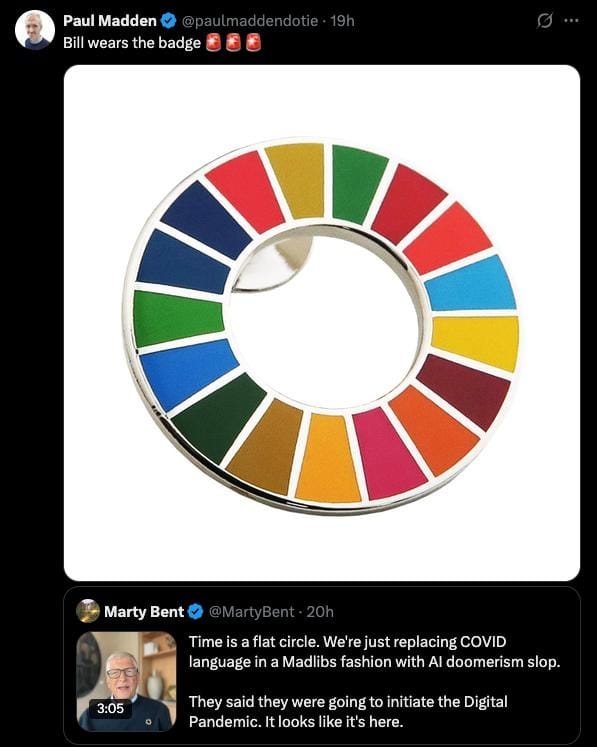
Paul Madden's post highlights the pin above my post sharing the Gates clip. The pictured design is the UN Sustainable Development Goals wheel. Take a look at the pin highlighted above. That's the UN's Sustainable Development Goals wheel, the 17 goals in its 2030 Agenda. The WEF formally partnered with the UN in 2019 to accelerate that agenda, including work on digital cooperation and standards for digital governance. These organizations are quite open about wanting to help decide how the rest of us live. I look at that pin and think about the worldview behind it. All these people getting together, deciding what humanity should be working toward, and assuming the rest of us want to go along with them. What if we don't? What if I want to build something they don't approve of, or use a tool in a way they hadn't considered? Why should that be up to them? I can't help thinking about the conversations we've had with Susan Kokinda and Tom Luongo about the City of London. Tom has been beating the drum for years about the Davos class and the fight for American sovereignty. Susan comes at it through the history of the British financial empire. The idea that Americans might actually take control of their own future, rather than have it negotiated for them by this class of people, is central to those conversations. I think it's a useful way to look at what's happening with AI right now. Look at METR, which we discussed yesterday. It operates from Berkeley, but there are Oxford connections: chief scientist Hjalmar Wijk earned his master's there and left an Oxford doctoral program to join METR. Operations director Stephanie Palla worked there, and Pip Arnott studied there. METR also has a technical-assistance contract with the European AI Office. Then you have The Times of London asking Bill Gates about an international organization to manage AI. I keep hearing Tom and Susan in the back of my head as I watch all of this. If you're looking at this through their lens, the fight over who gets to control AI fits right into the sovereignty fight. Are Americans going to be able to build and use these tools freely, or are we going to have a bunch of people meeting internationally to decide what's permissible? That's one lens through which to view the AI doomerism chatter. I think it's worth keeping in mind when you hear the proposed solutions. I also keep going back to the talk about a digital pandemic during COVID. In July 2020, Klaus Schwab warned that a comprehensive cyberattack could interrupt electricity, transportation, and hospital services and make COVID look like a small disturbance. Cyber Polygon was running an exercise about preventing a digital pandemic, with governments and businesses cooperating globally. Even as we were living through one catastrophe, we were being warned about the next one and told how important it was for these institutions to manage it. This is what I'm getting at with the Hegelian dialectic, the problem-reaction-solution routine. Scare the shit out of people, get them clamoring for someone to do something, and use that opening to push through things they would never accept otherwise. You don't need to invent every problem to do this. You can take a real one, convince people that questioning the response puts everyone in danger, and get an incredible amount of control over their lives. We've seen how well it works. After September 11, we got the Patriot Act in October 2001. Then came the invasion of Iraq in 2003 and the weapons of mass destruction we were told justified it. The Iraq Survey Group didn't find the claimed active chemical stockpile. We spent years fighting in Iraq and Afghanistan, and the broader post-9/11 wars have cost us trillions. Think about the lives lost and the damage to this country's reputation. What did ordinary Americans get out of that? In 2008, we were told the banks needed to be bailed out. We got TARP and the Fed's large-scale asset purchases. Most of the TARP money was recovered, but I look at the broader response and see a system that protected asset owners while people living paycheck to paycheck fell further behind. If you already own assets, policies that support their prices work out pretty well for you. If you're trying to save enough to buy them, you're on the other side of that trade. Then COVID. Shut down your business, stay home, accept the mandates. People went along with an incredible amount of this because they were scared. And now I worry we're being scared into accepting a licensing regime for AI that leaves Anthropic and OpenAI in control of how the technology progresses and how the rest of us get to use it. Think about how convenient that would be for them. Help design the rules, make compliance expensive enough that a smaller competitor can't afford it, and call it safety. We wind up with a completely cucked AI landscape because we let the companies that stand to benefit tell us which restrictions are necessary. After what we covered yesterday about the interests around AI safety, I have very little desire to give them the benefit of the doubt. But I am encouraged by what I'm seeing on X. People are recognizing this and calling it out in real time. They remember what happened during COVID. They remember what they were told and what it cost them to go along with it. I think there's a diminishing marginal return on this type of fearmongering, and that's a very good thing.
The frog video shared by Ben Wehrman, with a visible @JESSAREED credit. This was the clip that stuck with me yesterday. The frog video above got a laugh out of me yesterday because it gets at exactly this. Being able to see the propaganda should make you more optimistic. It means you're recognizing what's being done to you. And why are we calling these people the elites? Why are we accepting the flattering description they've given themselves? I watched it yesterday and thought it did a pretty good job of explaining all of this in a way that might actually get through to people. However, I don't want to confuse what I'm seeing on my timeline with what everybody else is seeing. Jacob Coxon, the researcher who recently left Anthropic, has been on CNN, in WIRED, and back on CNN after its Dario Amodei interview. His warning is about the models he expects to come next; he told CNN that today's models pose no extinction risk. He's calling for international coordination in response. That's what people watching those interviews are hearing. There are plenty of boomers, Gen Xers, and older millennials who still get their news from these outlets. They aren't necessarily seeing the pushback we're seeing. It's easy to forget that when you're on X all day and everyone around you seems to have figured out the same thing. So if you're reading this and recognize what I'm talking about, bring it up with people you know who aren't on social media. Your parents, someone at work, a friend who uses AI but hasn't paid much attention to this debate. Show them what Gates is proposing and ask them whether they want him, or some international organization, deciding how they're allowed to use these tools. You don't have to dump all of this on them at once. Have a conversation. Ask what they remember about the last time we were told to hand over more control because the situation was too dangerous to do anything else. I think a lot of people are ready to have that conversation, even if they haven't seen a frog explaining it on the internet yet. | |||||||||||||||||||||||||
SIGNAL | |||||||||||||||||||||||||
BITCOIN POLICY My view on bitcoin after the CLARITY voteThe Senate rejected cloture on the motion to proceed with CLARITY, 49 to 50, yesterday. A procedural setback, and I don't think it changes anything about why you'd want to own bitcoin. If anything, rising costs and distrust of institutions make the case stronger. As we covered Monday, BRCA's civil safe harbor would have been a net positive for developers, but it still left criminal exposure unresolved. I would have liked to see that protection pass. We shouldn't pretend it solved the whole problem, though, or that bitcoin needs this bill to keep working. For businesses waiting on clearer rules, the SEC, SEC and CFTC together, and the OCC already have proposals or guidance moving under existing authority. There's more going on here than this one vote. | |||||||||||||||||||||||||
AI COMPETITION More competition for the frontier AI companiesFormer OpenAI researcher Diogo Almeida's TypeSafe introduced Jev yesterday, and I'm interested in where this goes. Its "System One" models return constrained decisions and probabilities. If you need to route a request or assess a transaction, you don't necessarily need a giant chatbot writing its way toward an answer. TypeSafe claims it can do these jobs much faster and cheaper in its own evaluations. Jev is in hosted early access, so we'll get a better idea as customers test it on their own work. This is the kind of competition I think people underestimate when they're projecting the frontier providers' economics out into the future. If a smaller specialized model does the job reliably for less money, why would a business keep paying for the more expensive one? | |||||||||||||||||||||||||
BITCOIN RESERVE Inside the bitcoin reserve proposalThe House Financial Services Committee scheduled H.R. 8957 for today's markup, so the strategic bitcoin reserve proposal has a path separate from CLARITY. The posted substitute would establish a reserve, restrict sales of bitcoin deposited into it for at least 20 years (with exceptions, including valid ownership claims), and require annual proof-of-reserve reporting. Additional acquisitions would be studied. I want to emphasize that last part because it's easy to read a reserve headline and start imagining a million-coin buy order. That's a long way from what's in front of the committee. For now, I'm interested in whether the custody and reporting rules survive the process and what the acquisition study would actually produce. | |||||||||||||||||||||||||
IMPORT COSTS Import prices are still going upThis morning's BLS release has August import prices up 0.7% on the month and 7.0% from a year ago. Fuel prices actually fell 0.1%. Nonfuel imports rose 0.8%, and capital goods rose 0.9%. So even with some relief on fuel, businesses are paying more for other things they're bringing into the country, including equipment. Someone has to eat that cost. You can take less profit, try to pass it along to customers, or put off a purchase you were planning to make. These are import prices rather than consumer prices, but I have a hard time looking at those numbers and getting comfortable with the idea that the affordability problem is about to go away. | |||||||||||||||||||||||||
MANUFACTURING Slower growth, higher costsThe September Empire State survey has New York manufacturers reporting slower growth while their costs keep climbing. The business-conditions index fell from 20.6 to 7.6, shipments slipped, and the prices-paid index rose to 63.1. Those are survey indexes, not percentage changes in output or prices. Employment was still growing and selling-price increases accelerated. Put yourself in the position of someone running one of these businesses. You're still hiring, you're paying more for inputs, and the pace of business has slowed. You can try to raise prices, but your customers are dealing with higher costs too. That's what I keep coming back to when people talk about inflation as if it's something we've already moved past. | |||||||||||||||||||||||||
ETF FLOW CHECK | |||||||||||||||||||||||||
U.S. spot bitcoin ETFs recorded approximately $450.3 million in net outflows on Tuesday, September 15, according to TFTC's completed daily dataset. That's one trading day's flow, separate from today's live price snapshot. | |||||||||||||||||||||||||
| |||||||||||||||||||||||||
| |||||||||||||||||||||||||
⚡ FREEDOM TECH CORNER | |||||||||||||||||||||||||
Choose what you readIf you're tired of having your reading dictated by whatever shows up in the feed, give RSS a try. FreshRSS is free software you can run on your own server or use through someone else's. Add the RSS or Atom feeds of the publications you want to follow and read them by source or category. You can export the subscription list as an OPML file and take it to another reader later. Running the server yourself means maintaining it; using someone else's means trusting them with it. I'd start with a handful of publications you actually want to keep up with. You get to decide what you're going to read instead of opening an app and letting it decide for you. | |||||||||||||||||||||||||
DATA SNAPSHOT | |||||||||||||||||||||||||
As of September 16, 2026, approximately 10:00 a.m. ET; Bitcoin Lab daily observations dated September 15 UTC | |||||||||||||||||||||||||
| |||||||||||||||||||||||||
Sources: Coinbase for spot price; mempool.space for network data; Bitcoin Lab for the five daily on-chain valuation and spending metrics. MVRV compares market value with realized value; realized prices reflect on-chain cost bases, and SOPR compares spending prices with acquisition prices. Daily observations are separate from the live spot reading. | |||||||||||||||||||||||||
| |||||||||||||||||||||||||
| |||||||||||||||||||||||||
If you know someone who'd enjoy The Commoner, send this their way. Onward, Marty | |||||||||||||||||||||||||
YouTube: https://www.youtube.com/@TFTC podcast: https://www.tftc.io/tag/podcasts/ |