White House Confirms Active Work on Strategic Bitcoin Reserve Structure
The White House confirmed on July 6 that structuring work on the Strategic Bitcoin Reserve is ongoing. Crypto adviser Patrick Witt's promised 'big announcement' is now 10 weeks overdue. The delay is the story.
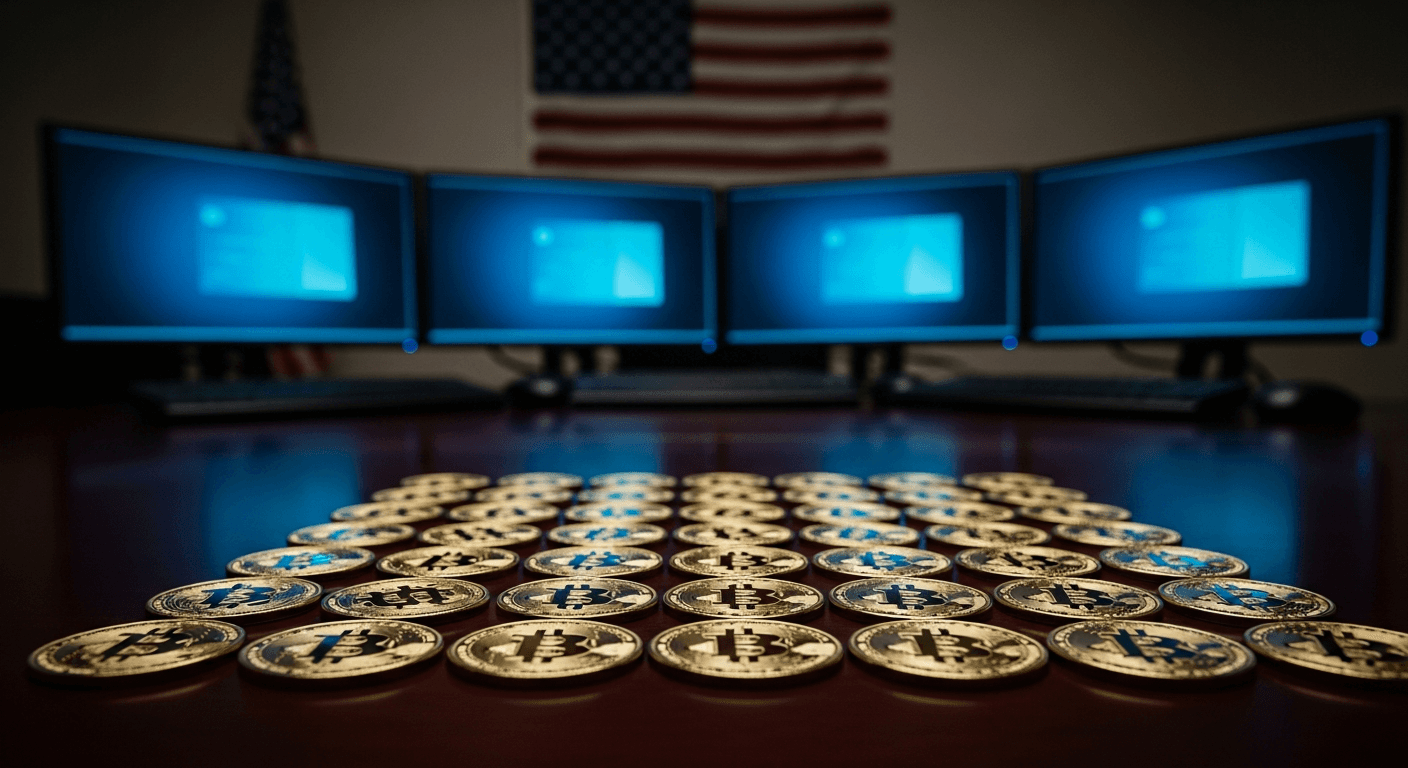
The promised "big announcement" is 10 weeks late. The 328,000 BTC is still locked. Here is where the reserve actually stands.
Key takeaways
- The White House confirmed on July 6, 2026 that the U.S. government is actively working to structure the Strategic Bitcoin Reserve and digital asset stockpile, per a statement first reported by Watcher.Guru.
- The U.S. holds an estimated 328,000 BTC (a figure that includes pending forfeitures alongside fully forfeited coins, with some on-chain trackers citing ~198,000 BTC for fully forfeited holdings only), all from criminal forfeitures, legally barred from sale by a March 2025 executive order; no standalone White House press release has been published as of this writing.
- White House crypto adviser Patrick Witt promised a "big announcement" within "a few weeks" on April 27. That window has elapsed, making today's statement a reaffirmation of ongoing work, not the structural reveal.
The White House stated on July 6, 2026 that "the U.S. government is working to structure the Strategic Bitcoin Reserve and digital asset stockpile," according to a report first reported by Watcher.Guru. No standalone .gov press release has been published to accompany the statement. The confirmation lands 10 weeks after Patrick Witt, Executive Director of the President's Council of Advisors for Digital Assets, told the Bitcoin 2026 conference in Las Vegas that a structural announcement was weeks away.
That gap between promise and delivery is the real headline.
What the Delay Actually Signals
Witt's April 27 remarks at Bitcoin 2026 were specific. "In the next few weeks, we'll be making a big announcement," he said, per CoinInsider's direct reporting. At Consensus Miami on May 6, he repeated the priority: "Number one is we want to get our own house in order. We want to properly safeguard, custody these assets before we discuss any details around it."
The announcement has not come. The July 6 statement confirms the work is still underway, not complete.
That is not stalling for the sake of it. The interagency problem is genuinely hard. Forfeited BTC sits across multiple federal agencies (DOJ, IRS, U.S. Marshals Service) under different legal authorities. Transferring those holdings to a unified Treasury custody structure requires determining which agency has legal authority to move what, whether those transfers require congressional approval, and how to secure private keys inside a government that was built to store gold in vaults and wire dollars over SWIFT. None of that infrastructure exists yet.
The urgency sharpened after a government contractor's son, John Daghita, allegedly stole more than $46 million in crypto from U.S. Marshals Service custody accounts, with an FBI arrest following in March 2026. The USMS theft transformed the reserve structuring from "policy priority" to "operational emergency." Federal agencies built for gold vaults and petrodollars are not equipped to custody private keys. The structuring work Witt describes is partly a scramble to not get hacked again before a formal announcement.
The moral case for Bitcoin as a reserve asset is being stress-tested in real time by the federal government's own operational failures.
The Supply Math Nobody Is Running
The U.S. government's roughly 328,000 BTC represents approximately 1.56% of Bitcoin's total circulating supply. That figure includes pending forfeitures alongside fully forfeited coins; on-chain trackers citing only fully forfeited holdings put the number closer to ~198,000 BTC. Every coin in that pile came from criminal forfeitures: Silk Road, the Bitfinex hack recovery, and other seizures. Not one satoshi was purchased on the open market.
The March 6, 2025 executive order bars Treasury from selling any of it. The White House fact sheet published the day after puts a number on why the old policy was indefensible: premature BTC sales by prior administrations cost U.S. taxpayers over $17 billion.
The EO also drew a line that matters for anyone still conflating the reserve with the broader "crypto" policy: Bitcoin gets reserve treatment under a dedicated vehicle; all other seized crypto (ETH, XRP, altcoins) sits in a separate Digital Asset Stockpile managed with more flexibility. The government, implicitly, has already decided Bitcoin is different from everything else.
On the legislative track, the American Reserves Modernization Act (ARMA), introduced in the House on May 21, 2026 by Rep. Nick Begich (AK-AL) and co-lead Rep. Jared Golden (ME-02), would go further: authorizing Treasury to purchase up to 200,000 BTC per year for five years, with holdings locked for a minimum of 20 years. The Senate companion (Lummis) is targeting a vote before the summer recess.
Post-halving issuance runs at roughly 450 BTC per day, or about 164,000 BTC per year. ARMA's proposed 200,000 BTC annual purchase rate would exceed new supply. That is not a trivial demand signal.
The question of whether a future president could undo this matters: an executive order can be revoked with a pen stroke. Statute cannot. That is precisely why the ARMA bill vote is the most important near-term trigger to watch, not the White House structuring announcement itself.
For further context on why sovereigns accumulating Bitcoin reshapes the demand picture structurally, the Joe Consorti analysis on sovereign accumulation dynamics is worth revisiting.
What to Watch
The falsifiable version of the capitulation thesis: if Witt's eventual announcement reveals only a rebranded custody memo with no new legal authority to permanently hold BTC, and if ARMA fails a floor vote in both chambers before the 2026 midterms, the reserve framework stays executive-order thin and reversible. If ARMA clears both chambers and Treasury announces open-market purchases in Q4 2026, the United States becomes the first sovereign nation to actively accumulate Bitcoin as a monetary reserve asset. Those are the two outcomes. Everything else is noise between them.
Watch the ARMA Senate floor vote timeline and whether Witt's announcement, when it arrives, includes new statutory authority or just operational custody changes.
Update, July 6, 2026
Bloomberg is reporting that the Trump administration's plan to create a Strategic Bitcoin Reserve has been complicated by two government departments vying to run it, alongside unresolved questions about which has the legal authority to do so.
The White House originally expected Treasury to oversee the reserve, with Bitcoin sourced from asset seizures conducted by different parts of the federal government. Lawyers then flagged uncertainty over whether Treasury was legally able to manage the crypto trove at all. One proposal now under active consideration would place the reserve under the Commerce Department instead, due to its broader trade and digital policy mandate, but shifting custodianship would require legal scaffolding to ensure seized assets can be retained rather than liquidated to satisfy restitution or other statutory requirements.
The Justice Department is formally in the mix as well. DOJ's Office of Legal Counsel stated it "is working closely with both the Treasury and Commerce departments to determine legally available options to accomplish the president's policy of establishing a strategic Bitcoin reserve." Prosecutors and victims who rely on asset forfeiture for restitution could see the handling of seized Bitcoin change materially, while Treasury officials warn a misstep could invite litigation that stalls the reserve and unsettles markets.
The statutory landscape helps explain why the dispute is so difficult to resolve administratively. Federal law routes forfeited assets into two separate funds: Treasury's Forfeiture Fund, managed by Treasury's own asset forfeiture office, and the DOJ's Assets Forfeiture Fund, managed by the U.S. Marshals Service. As the Conference Board noted earlier this year, an executive order cannot overturn a statute, leaving it genuinely unclear whether DOJ has the legal authority to move its holdings to Treasury at all.
Underneath the custody fight sits the volatility question. Existing government asset management statutes were designed around gold, foreign exchange reserves, and Treasuries, not a volatile digital bearer asset. Bitcoin acquired through forfeiture is ordinarily tied to law enforcement outcomes and prompt liquidation, not a permanent national reserve strategy. Officials are reviewing whether the government can legally hold Bitcoin indefinitely, as Trump's original executive order envisioned, given how sharply its price can swing.
The original executive order set a 30-day deadline for agencies to report holdings and a 60-day deadline for Treasury to deliver a full legal, custodial, and legislative evaluation. Both passed without public disclosure; the 60-day deadline expired May 5, 2025. As of early July 2026, no report has been delivered and no agency has been formally designated. Treasury Secretary Scott Bessent said publicly that the U.S. "won't be buying" additional Bitcoin in the near term, then partially walked that back on social media by saying Treasury is exploring "budget-neutral pathways" for expanding holdings. That contradiction reflects the same tension embedded in the executive order itself: the political appetite for accumulation is constrained by a fiscal rule that makes accumulation nearly impossible without either a market-neutral mechanism or an explicit congressional appropriation.
Patrick Witt acknowledged the depth of the problem back in January, telling a podcast that the reserve "seems straightforward, but then you get into some obscure legal provisions, and why this agency can't do it, but actually, this agency could." That staff work has now escalated to OLC. When OLC gets pulled in to referee an interagency dispute over asset volatility and holding authority, the timeline slips by months, not weeks. Trump said Monday that the United States has no choice but to lead the crypto industry and warned that China would seize the lead if the U.S. stepped back. That is a harder case to make while OLC lawyers are still working out whether any agency has the authority to hold the coins at all.
BitcoinTreasuries data shows the U.S. government holding 328,372 BTC, worth about $20.7 billion as of July 7, ranking the U.S. as the largest known government holder of Bitcoin, ahead of China, the United Kingdom, Ukraine, and El Salvador. Not one structural question has been formally resolved.
That is precisely why ARMA carries more weight than any White House press release. The bill would consolidate custody and management of digital assets held across federal agencies under Treasury by statute, mandate a 20-year minimum holding period, introduce quarterly proof-of-reserve reports and independent third-party audits, and potentially allow the government to acquire up to 1 million BTC over five years without increasing the national deficit. Lawmakers including Sen. Cynthia Lummis and Rep. Nick Begich have argued that a durable reserve needs an act of Congress, since an executive order alone can be undone by a future president. The OLC involvement makes the Senate ARMA vote more consequential, not less. Without that statutory fix, the largest Bitcoin position any government has ever held stays in operational and legal limbo.
Sources
- White House Executive Order: Establishment of the Strategic Bitcoin Reserve (March 6, 2025)
- White House Fact Sheet: Strategic Bitcoin Reserve and U.S. Digital Asset Stockpile (March 7, 2025)
- Rep. Nick Begich press release: American Reserves Modernization Act (May 21, 2026)
- First reported by Watcher.Guru (July 6, 2026); no standalone White House .gov release has been published as of this writing.
Frequently Asked Questions
What is the difference between the Strategic Bitcoin Reserve and the U.S. Digital Asset Stockpile?
The Strategic Bitcoin Reserve holds only BTC, treats it as a permanent reserve asset, and bars Treasury from selling any of it. The Digital Asset Stockpile is a separate account for other seized crypto (ETH, XRP, altcoins) managed with more flexibility. The March 2025 executive order created both vehicles explicitly. Bitcoin gets reserve treatment; everything else gets a managed account. That separation is the government's implicit acknowledgment that Bitcoin is a different category of asset.
Does the U.S. government plan to buy more Bitcoin, or only hold what it already seized?
The March 2025 EO directs Treasury to explore "budget-neutral" strategies for acquiring additional BTC without deficit spending. The ARMA bill goes further, authorizing up to 200,000 BTC per year of open-market purchases over five years. If it passes, Treasury's first purchase is projected for Q4 2026, making the U.S. the first sovereign nation to actively accumulate Bitcoin as a reserve asset. That is a projection, not confirmed policy.
Can a future president undo the Strategic Bitcoin Reserve?
Yes. An executive order can be revoked by any future president without congressional approval. That is why the ARMA bill matters: legislative codification would enshrine the no-sale policy and any acquisition mandate in federal statute, requiring an act of Congress to reverse. Until that happens, the entire framework rests on a single executive order.