Utah FORGE Begins 90-Day Enhanced Geothermal Test as Fervo Targets 100 MW
Utah FORGE began its longest-ever enhanced geothermal circulation test on August 12, 2026. Fervo Energy's 500 MW Cape Station sits less than a mile away. The results will determine whether EGS graduates from research project to commercial power source.
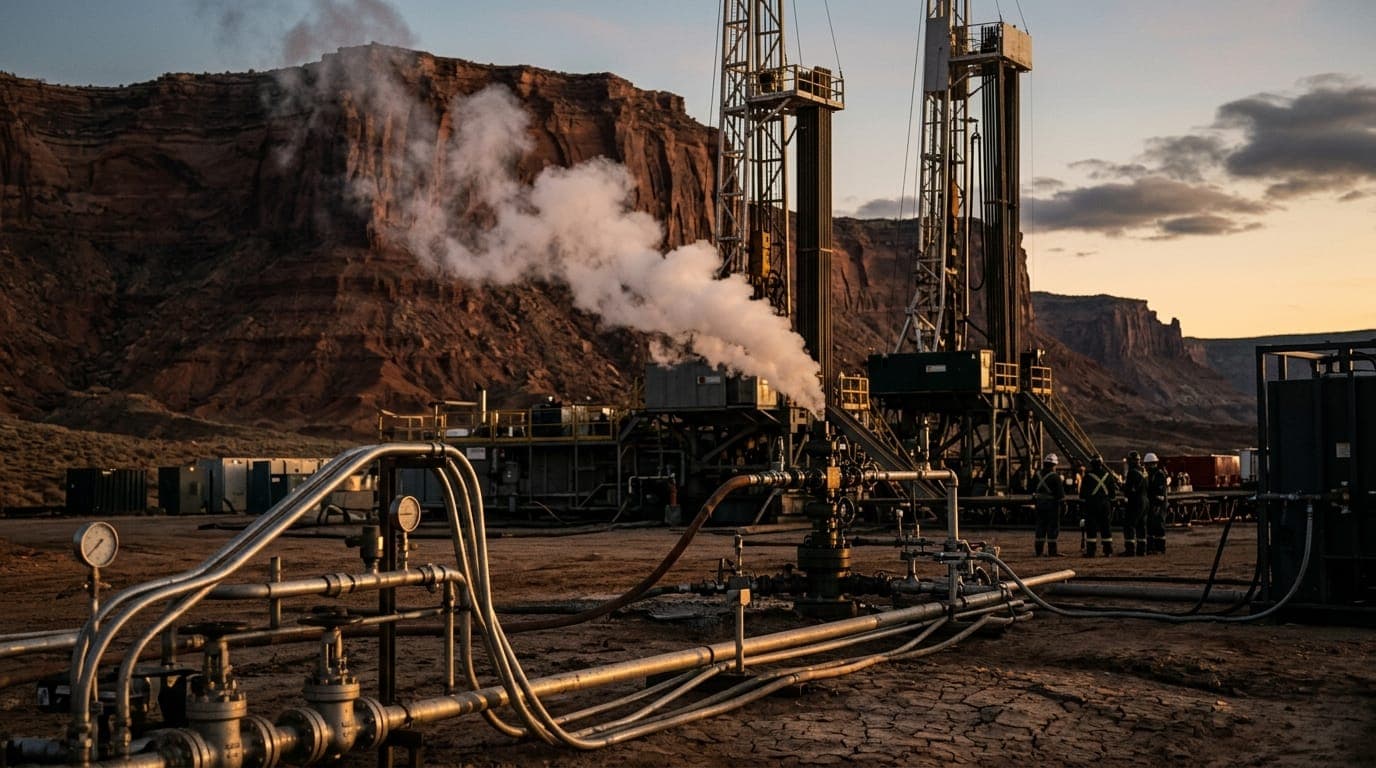
The longest continuous enhanced geothermal test in U.S. history just started in the Utah desert, and the results will determine whether firm baseload power from hot rock becomes real infrastructure for AI and Bitcoin.
Key takeaways
- Utah FORGE launched a 90-to-120-day extended circulation test on August 12, 2026, measuring thermal decline, water loss, and seismic activity at commercial injection rates for the first time.
- Fervo Energy's Cape Station, less than a mile from FORGE in Beaver County, Utah, is targeting its first 100 MW of commercial enhanced geothermal power to the grid in October 2026.
- The Trump administration continues to fund FORGE while pulling back on wind and solar subsidies, a policy signal that favors firm, dispatchable power over intermittent sources.
On August 12, 2026, the Utah FORGE (Frontier Observatory for Research in Geothermal Energy) site near Milford, Utah announced it had begun an extended circulation test expected to run 90 days, with potential extension to 120. The test is the first multi-month continuous-flow enhanced geothermal system (EGS) experiment in the facility's history. Its findings will either validate or break the commercial case for EGS at scale.
FORGE is managed by the University of Utah and funded by the U.S. Department of Energy. A prior 30-day test in August 2024 injected water at 420 gallons per minute, recovered roughly 90% of produced fluid, and held reservoir temperature at approximately 370°F. This new test runs three to four times longer, pushing into territory no prior controlled demonstration has reached.
What the Test Is Actually Measuring
Principal Investigator Dr. Kristie McLin put it plainly in the August 12 press release:
"This extended circulation will allow us to study heretofore unknown variables required to ensure long term EGS production remains commercially viable... there is still a great deal we do not know about thermal breakthrough and water loss over time."
Those unknowns are the three critical variables the test tracks: how fast the underground reservoir loses heat (thermal decline), how much injected water disappears into the rock (water loss), and whether sustained pumping produces problematic seismic activity. Pass all three at commercial injection rates over 90-plus days, and EGS graduates from promising to bankable. Fail any one, and the "geothermal everywhere" thesis gets pushed back at least a decade.
Fervo's Cape Station Changes the Stakes
Sitting less than a mile from FORGE in Beaver County is Fervo Energy's Cape Station, described in Fervo's SEC filings as a 500 MW enhanced geothermal development with BLM permits covering up to 2 GW. Phase I is 100 MW, targeted for grid delivery in October 2026, which would make it the first commercial-scale EGS project anywhere in the world. Phase II adds 400 MW, with a 2028 target.
Fervo's edge is the oil and gas playbook applied underground: horizontal drilling and multi-stage hydraulic fracturing, the same techniques that unlocked shale, now used to manufacture permeable rock networks in hot dry geology. Fervo broke ground on Cape Station in September 2023, completed its IPO in May 2026 raising approximately $1.89 billion, and controls a substantial geothermal lease portfolio. The proximity of Cape Station to FORGE is not coincidence. The two projects share geology, and FORGE's research data directly de-risks what Fervo is building commercially.
The Policy Signal and What It Means for Energy-Intensive Compute
The Trump administration has defunded offshore wind and remains openly hostile to the solar investment tax credit in its current form. FORGE kept its funding. The DOE called the August test "a significant feat," noting that "only a handful of EGS projects worldwide have reached this stage." Keeping FORGE funded is an implicit endorsement of firm, dispatchable power over intermittent generation, and for anyone operating 24/7 electrical load, that distinction is the whole game.
AI inference clusters and Bitcoin miners share the same fundamental power requirement: constant, uninterrupted megawatts that do not curtail during a heat wave, disappear at night, or require massive transmission buildout. Grid operators have already started forcing that reality into policy, with PJM proposing rules to cut AI data centers first during shortages, while Wood Mackenzie found 72% of U.S. AI data center power requests are phantom load, uncommitted and unreliable. Baseload geothermal is structurally immune to both problems.
The economic logic for miners co-located with geothermal is the same logic that makes stranded-gas mining viable: a mining operation or AI cluster is the anchor load that makes a power plant's economics work, providing a guaranteed buyer for generation that would otherwise struggle to find a grid connection. The oil-and-gas workforce angle reinforces this politically. The tech transfer story, fracking crews drilling for heat instead of hydrocarbons, is durable across administrations in a way that offshore wind subsidies are not.
The falsifiable thesis here is specific: if the FORGE extended circulation test reveals rapid thermal decline or unsustainable water loss at commercial injection rates, EGS scalability breaks. Watch for the data release at test conclusion, late November or December 2026.
What to Watch Through December
The 90-to-120-day test window closes between mid-November and mid-December 2026. Fervo's Phase I 100 MW delivery is projected for October 2026, before the FORGE results are public.
That sequencing is notable: the commercial project will be live and generating before the research data that underpins its replicability is in hand. If FORGE publishes strong results at the same moment Fervo is delivering power to the grid, the EGS commercial thesis accelerates sharply. A bad FORGE result while Cape Station is already operational creates a more complicated picture for Phase II financing and for every other EGS developer waiting on the sidelines.
Sources
Frequently Asked Questions
What is enhanced geothermal, and how does it differ from conventional geothermal?
Conventional geothermal requires naturally occurring permeable rock, heat, and underground water in the same location, rare geology limited to places like Iceland, The Geysers in California, or parts of Nevada. EGS manufactures those conditions by drilling deep into hot dry rock, fracturing it to create permeability, and circulating injected water through the fracture network. It works across vastly more geography, including most of the American West, wherever hot rock lies within drilling distance.
What is Utah FORGE, and who runs it?
FORGE stands for Frontier Observatory for Research in Geothermal Energy. It is a full-scale underground field laboratory managed by the University of Utah, located approximately 10 miles northeast of Milford, Utah, and funded by the DOE. It is the only facility in the world dedicated exclusively to de-risking EGS technology before commercial deployment. The program has bipartisan funding history, with DOE backing dating to a $140 million award announced in June 2018 under Secretary Rick Perry, following the Obama administration's initiation of the FORGE funding opportunity in 2014.
Can Bitcoin miners or AI data centers actually use geothermal power, and on what timeline?
Fervo's Cape Station Phase I targets 100 MW of firm baseload power to the grid in October 2026. That is enough capacity to run a meaningful Bitcoin mining operation or a mid-sized AI inference cluster with no curtailment risk and no dependence on transmission-heavy renewable buildout. Phase II adds 400 MW by 2028. Whether the technology replicates beyond this single site in Utah is what the FORGE test data, due late 2026, will begin to answer.