USAF Nuclear Sniffer Flies Near Taiwan Strait During China's Largest-Ever Blockade Drill
The USAF flew a WC-135R Constant Phoenix near Taiwan's southern approaches as China conducted its largest-ever unannounced blockade drills with more than 100 vessels. The mission is unconfirmed, but the deployment signals active US contingency monitoring, and the geopolitical compression couldn't
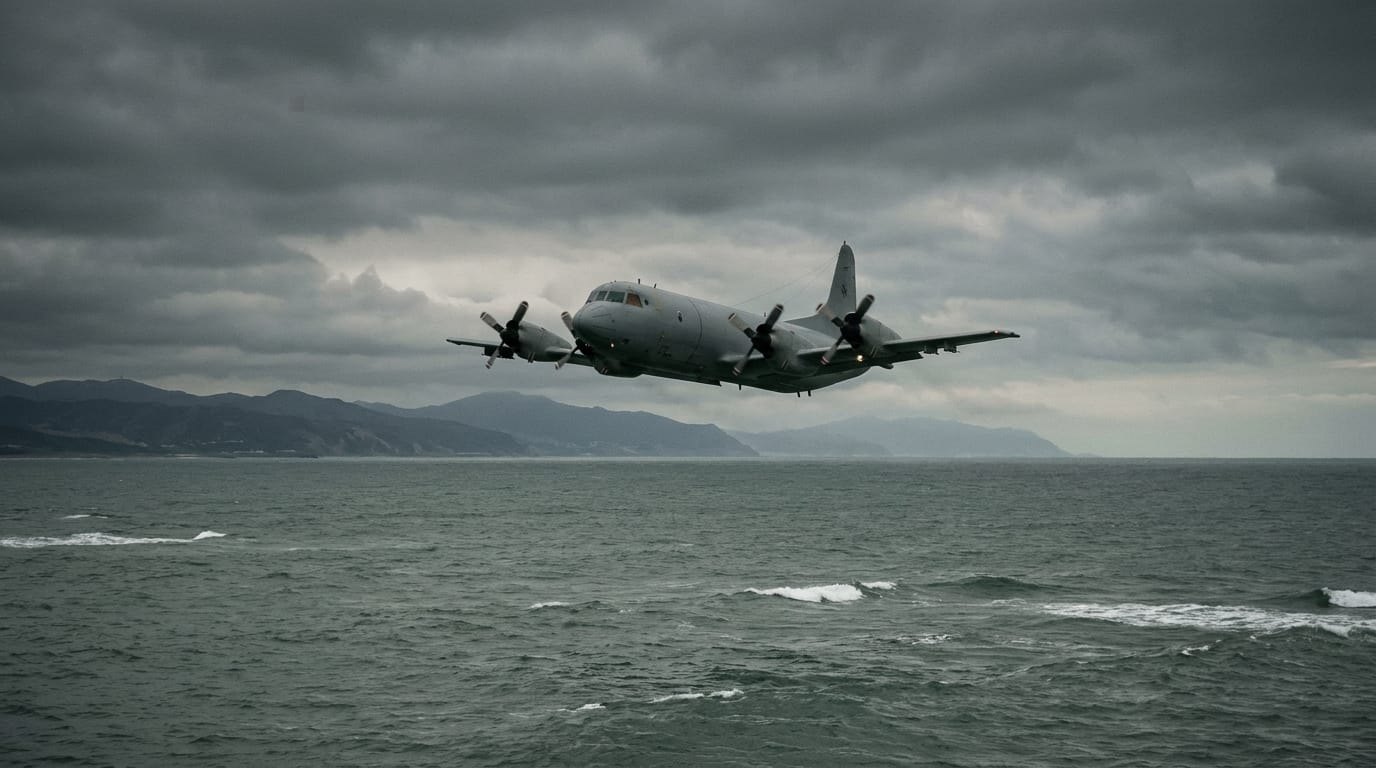
One of America's rarest ISR assets just appeared over the Taiwan Strait while China ran its biggest unannounced naval exercise on record.
Key takeaways
- A USAF WC-135R Constant Phoenix flew a round-trip from Okinawa into waters southwest of Taiwan, tracked via Flightradar24, coinciding with China's largest-ever unannounced blockade drills involving more than 100 naval and coast guard vessels.
- The aircraft's specific mission and any direct connection to China's exercises remain officially unconfirmed; the WC-135R collects airborne particulates to detect radioactive material but does not locate warheads or confirm a nuclear event occurred.
- Trump is scheduled to arrive in Shenzhen for the APEC summit November 18-19, with a trilateral meeting with Xi and Putin confirmed on the sidelines on November 19, compressing an already extraordinary geopolitical moment.
A US Air Force WC-135R Constant Phoenix, one of only three such aircraft in service, was tracked southwest of Taiwan on Sunday on a round-trip from Okinawa, per open-source flight data on Flightradar24. The flight came as China conducted what Taiwan's Defense Minister Wellington Koo characterized as "area denial drills", an unannounced exercise that began around November 2 and massed more than 100 naval and coast guard vessels across China's eastern, northern, and southern theater commands, per Reuters reporting republished by Taipei Times.
The USAF has not issued a statement on the mission. The WC-135R sighting was first reported by ZeroHedge.
What the Aircraft Does, and What It Doesn't Confirm
The WC-135R collects airborne particulate matter and gases to support national-level intelligence assessments of nuclear activity. It does not locate warheads, see inside underground facilities, or confirm a nuclear event. The USAF also conducts routine atmospheric sampling flights worldwide, so the presence of the aircraft alone establishes nothing definitive.
What it does establish: Washington chose to deploy one of its three available nuclear detection platforms into the southern approaches of the Taiwan Strait at the same moment China was running its largest-ever unannounced blockade exercise. That is not nothing.
An ISW researcher assessed that China's drill posture suggests Beijing "may also aim to demonstrate an ability to rapidly transition from a peacetime posture to combat operations, decreasing the time adversaries have to detect PLA preparations for a blockade or invasion of Taiwan." China's carrier Fujian departed its Hainan base during the exercise, per ISW analysis citing satellite imagery. A senior Taiwan security official, speaking anonymously, told Reuters that China also launched a submarine-based ICBM from the Yellow Sea into Chinese territory during the drills, a claim that, as a single-source anonymous report, warrants caution but cannot be dismissed.
The exercise was larger than "Justice Mission 2025," China's last formally named Taiwan-targeting drill.
Why This Matters Beyond the Flight Track
The contingency-signaling interpretation is straightforward: when the US sends a nuclear detection aircraft into a live-fire adjacent zone, it is communicating that it is actively monitoring whether the opposing military posture carries a nuclear dimension. That signal, regardless of what the sniffer found or didn't find, is itself an escalation in the credibility of the conflict scenario.
The timing cannot be separated from the diplomatic context. Trump is scheduled to arrive in Shenzhen for the APEC summit, with a Trump-Xi-Putin trilateral confirmed on the sidelines on November 19, per the Kremlin and White House. The US is flying nuclear surveillance assets in waters adjacent to China while the American president prepares to land in a Chinese city. That is an extraordinary compression of military posture and diplomatic engagement.
For the TFTC audience, the downstream math is not subtle. Taiwan accounts for the dominant share of the world's most advanced semiconductor production. A blockade lasting even weeks would crater global tech supply chains and trigger emergency fiscal responses, inflationary by construction. Fiat monetary systems have no clean response to that kind of supply shock. China has been methodically building alternatives to dollar-denominated trade routes. A Taiwan contingency, even a cold one, accelerates every de-dollarization dynamic already in motion.
Bitcoin sits outside both systems. When counterparty risk on the nation-state level becomes this acute and this visible, permissionless, seizure-resistant, self-sovereign money stops being a philosophical preference. The falsifiable version of that thesis: if the USAF publicly confirms this was a pre-scheduled routine sampling run with no relation to PLA activity, and if Flightradar24 data shows the aircraft has flown this identical route repeatedly without any correlation to Chinese military exercises, the contingency-signaling interpretation collapses. Until then, the deployment stands as evidence that US military planners are pricing in a tail risk that most market participants are not.
What to Watch
The APEC summit opens November 18. Any statement from the USAF or DoD on the WC-135R mission would be the most significant new data point. Watch whether China formally names or extends the exercise, and whether Fujian's movement can be independently confirmed via satellite. A Trump-Koo or Trump-Xi statement on Taiwan's status during the summit sidelines would reshape the entire picture quickly.
Sources
- Flightradar24, flight tracking platform
- ZeroHedge, first reported WC-135R sighting near Taiwan Strait
- Taipei Times, Wellington Koo "area denial drills" statement, November 14, 2026
- Taipei Times / Reuters, China's unannounced drills, November 13, 2026
- Anadolu Agency, Kremlin confirms Trump-Xi-Putin trilateral on November 19 in Shenzhen
- Institute for the Study of War (ISW), assessment on China's drill posture
Frequently Asked Questions
What does the WC-135R Constant Phoenix actually do?
The WC-135R is operated by the USAF's 45th Reconnaissance Squadron. It samples the atmosphere for radioactive particles and gases, allowing intelligence analysts to characterize nuclear activity in a region. It does not detect warheads directly or penetrate underground facilities. Its flights are both routine and mission-specific; context determines which interpretation applies.
Did China actually blockade Taiwan?
No. China conducted large-scale unannounced drills simulating blockade and attack scenarios. Civilian maritime traffic continued moving through the region. The distinction matters: drills are coercive signaling; an actual blockade would be an act of war. Taiwan's defense minister used the phrase "area denial drills," which describes practiced capability, not an enacted closure.
How would a Taiwan Strait conflict affect Bitcoin and global markets?
A serious Taiwan contingency would simultaneously shock semiconductor supply chains, disrupt roughly half of global container traffic, and trigger emergency fiscal responses from governments worldwide. Each of those vectors is inflationary. It would also accelerate de-dollarization timelines as counterparties globally accelerate exits from dollar-denominated systems. Bitcoin's fixed supply, permissionless settlement, and seizure resistance make it structurally positioned for exactly that environment.