Ukraine Hits 10 Russian Shadow Fleet Tankers in Two Nights
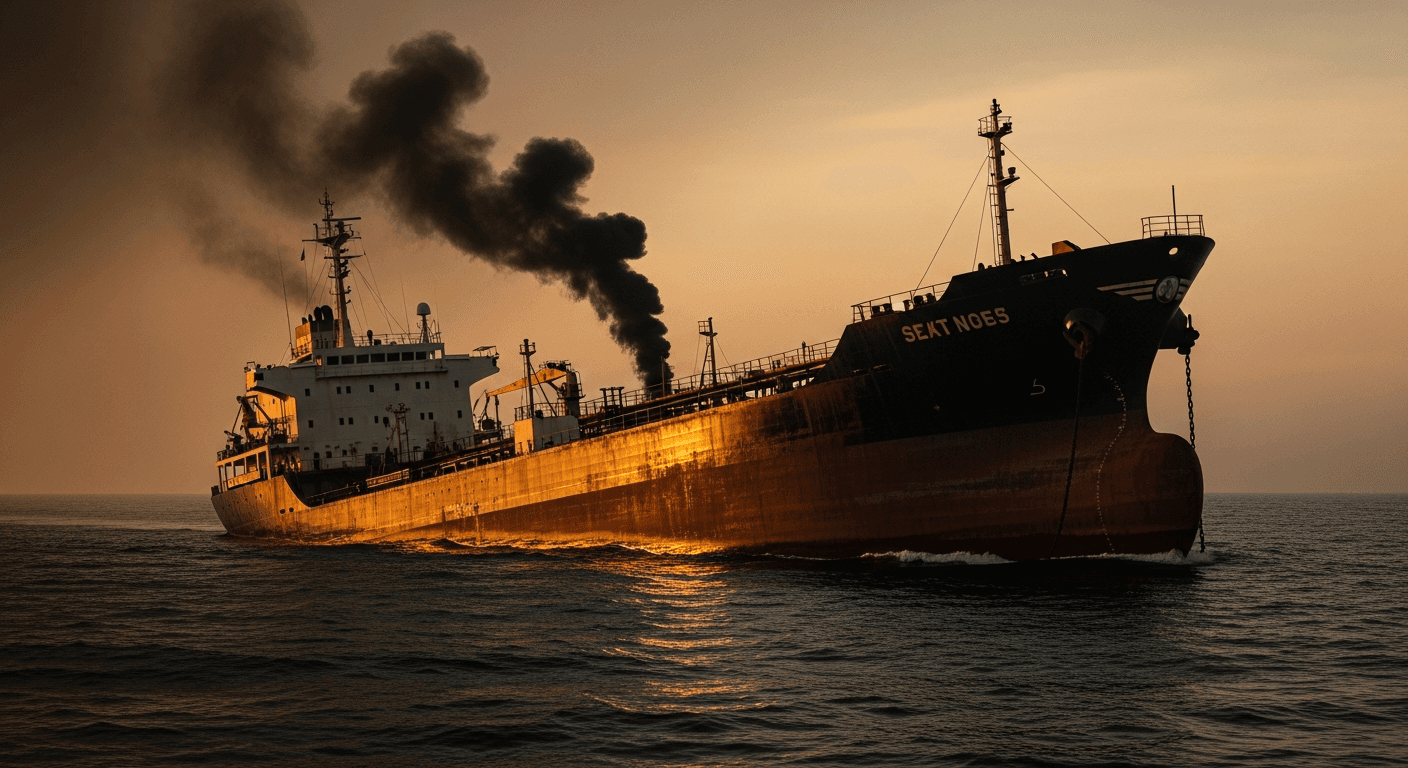
Ukraine's Unmanned Systems Forces struck eight sanctioned Russian shadow fleet tankers in the Sea of Azov overnight July 6-7, following two more strikes the previous night, as part of a sustained campaign to cut fuel and ammunition supplies to Russian-occupied Crimea.
Ukraine's drone war is doing what years of Western financial sanctions couldn't: physically destroying Russia's sanctions-evasion infrastructure one tanker at a time.
Key takeaways
- Ukraine's Unmanned Systems Forces struck eight sanctioned Russian shadow fleet tankers in the Sea of Azov overnight July 6-7, following two more the previous night, ten tankers hit in under 48 hours, per USF Commander Robert "Madyar" Brovdi.
- Ukrainian drones have struck Russian oil refineries at least 194 times since January 1, 2026, an 11-fold increase year-over-year, per Financial Times and Rochan Consulting data, triggering fuel rationing across more than half of Russia's regions, per The Moscow Times.
- Every tanker burning in the Azov is a barrel of sanctions-evading oil that never reaches Crimea. The structural question is whether this supply degradation is large enough to move global energy prices, and what that means for inflation and hard assets.
Ukraine's Unmanned Systems Forces struck eight Russian shadow fleet tankers in the Sea of Azov on the night of July 6-7, 2026, according to a Telegram statement from USF Commander Robert "Madyar" Brovdi. The strike followed a separate operation the previous night that hit two additional shadow fleet tankers in the same waters, bringing the two-night total to ten vessels.
"The shadow fleet is leaving the chat," Brovdi wrote. "Overnight, pilots of the 'Kairos' unit from the 414th Separate Brigade 'Madyar's Birds' struck eight tankers from Russia's shadow fleet. The battle for fuel supplies to Crimea in the Sea of Azov continues."
What Happened Overnight
The eight tankers are all under international sanctions, per Brovdi's statement. According to Brovdi, each vessel carries a deadweight of roughly 7,000 metric tons, measures approximately 140 meters in length, and was built between 2006 and 2012; these specifications have not been independently verified. Seven of the eight have been identified by name, per Ukrainska Pravda and United24: Venera-3, Sanar-1, Sanar-17, Klimena, Teti, Aleksey Savrasov, and Penelopa. The eighth vessel has not been confirmed.
The operation was carried out by pilots from the "Kairos" unit of the 414th Separate Brigade "Madyar's Birds." Ukrainian forces also struck one dry cargo ship, one ferry, and 58 additional military targets in Russia's operational rear during the same overnight window.
Ukraine's drone forces stated the objective plainly: "Striking the enemy's naval logistics complicates the supply of fuel and ammunition necessary to support the activities of Russian troops, primarily in the temporarily occupied territory of Crimea."
Brovdi described the tankers as "badly damaged and burning." Reuters, the Kyiv Independent, and Ukrainska Pravda all note they could not independently verify the damage claims. Treat them as Ukrainian military claims pending external confirmation.
Kyiv Independent, July 7, 2026
Kinetic Sanctions Enforcement
The shadow fleet exists precisely because the Western financial system's tools, SWIFT disconnections, price caps, asset freezes, proved too porous to enforce on their own. These tankers kept moving Russian oil under flags of convenience, building a parallel logistics network that paper rules couldn't reach.
Ukraine is now reaching it with loitering munitions.
This is the broader campaign in numbers. Since January 1, 2026, Ukrainian drones have struck Russian refineries at least 194 times, an 11-fold increase from the same period a year earlier, per Financial Times reporting citing Rochan Consulting data. May 2026 saw a record 16 successful refinery strikes in a single month. By late June, Rochan's analysts estimated that eight of Russia's ten largest oil refineries had been struck. Konrad Muzyka, the firm's director, described the campaign as having "evolved from a relatively narrow effort targeting oil infrastructure into a broader strategic interdiction campaign" against Russia's energy, logistics, industrial, and export systems.
Russia's domestic response tells the story. Fuel rationing measures were in place in at least 56 Russian regions as of late June, per The Moscow Times open-source analysis. Russia has begun importing gasoline by sea for the first time in years, sourcing from India and reportedly in talks with Kazakhstan for roughly 50,000 metric tonnes, per Financial Times. Rosstat, Russia's federal statistics agency, stopped publishing its domestic fuel price bulletin, per Ukrainska Pravda citing FT. When a state starts hiding commodity price data, it is not because things are going well.
The India-Russia oil relationship has been one of the primary escape valves for Russian energy exports throughout the sanctions era. Watching Russia now become an importer from that same corridor is a meaningful reversal.
The Macro Read
The thesis here is straightforward, but it has a real falsifiability condition.
If Crimea's fuel supply degrades meaningfully, and Russia's domestic energy crisis deepens further, the structural floor under crude prices rises. A sustained supply shock from one of the world's major oil producers feeds directly into consumer energy costs, which feeds CPI, which pressures central banks that are already navigating a difficult inflation environment. That is not a remote second-order effect. Bank of America is already calling three Fed hikes in 2026 as inflation gets "unambiguously worse." An energy supply shock is the clearest accelerant to that thesis.
There is also a cost-asymmetry point worth sitting with. Ukraine is interdicting 7,000-ton tankers with cheap loitering munitions. The economics of that trade are brutal for incumbents. Any major maritime chokepoint is now a credible target for low-cost drone swarms, and the risk premium embedded in every barrel of oil that transits contested waters is repricing upward, not as a temporary spike but as a structural repricing.
The falsifying trigger: if Russian oil export volumes to global markets hold flat or increase despite the refinery strikes and tanker losses (via rerouting through third-party intermediaries, sea-based gasoline imports proving sufficient, or the tanker damage proving less severe than Kyiv claims), the supply-shock thesis does not materialize and the energy-premium narrative collapses.
What to Watch
The immediate question is whether Ukraine can sustain this operational tempo through the Azov shipping season and whether the tanker losses force Russia to significantly reroute fuel logistics to Crimea overland, which is slower, more expensive, and more exposed. Watch the Rochan Consulting monthly refinery strike counts and any movement in Russian domestic fuel price data if Rosstat resumes publishing. Watch whether India's gasoline exports to Russia scale fast enough to offset the refinery degradation. If the import volume falls short, the domestic fuel crisis in Russia deepens and the operational pressure on Russian forces in occupied Ukraine grows.
Update, July 16, 2026
Ukraine's refinery campaign is now producing a measurable crude-market seizure. Nearly 135 million barrels of Russian crude oil are currently stranded at sea as a direct result of the drone strikes targeting domestic processing capacity.
Intensive strikes, including recent hits on the Gazprom Neftekhim Salavat and Afipsky facilities, have knocked out roughly one-third of Russian domestic refining capacity, bringing it to approximately 3.91 million barrels per day -- the lowest level since 2005, per Bloomberg data. Unable to process crude at home, Moscow is force-dumping raw barrels into export channels it cannot clear.
Tanker-tracking data from Bloomberg shows at least ten tankers carrying Russia's flagship Urals grade have ground to a halt off the Mediterranean coast of Egypt and in Indonesia's Riau archipelago near Singapore.
Many are masking destinations or sitting idle because international buyers increasingly refuse to touch sanctioned cargo due to secondary penalty risk.
A bipartisan group of U.S. senators has also signaled they have an agreement with the Trump administration to move ahead with new Russian sanctions legislation , which is keeping additional potential buyers on the sidelines.
The financial bleed is real and accelerating. This maritime gridlock has coincided with a decline in financial returns, with gross weekly export value falling to a four-week average of $1.68 billion, down $200 million from the prior period, per Argus Media price assessments cited by Bloomberg.
Over eight days, Ukraine's Unmanned Systems Forces reported hitting 105 Russian watercraft in the Sea of Azov and near occupied Crimea, and the disruptions have halted commercial vessel traffic through the Kerch Strait, further constraining the shipping corridors available for Russian seaborne oil exports. More barrels at sea, fewer buyers willing to take them, collapsing per-barrel revenue, and a kinetic campaign tightening the physical chokepoints: the supply shock is no longer theoretical.
Update, July 22, 2026
The conflict has now crossed a threshold that pulls in a major geopolitical actor previously sitting on the sidelines. India summoned a senior Russian diplomat and expressed "grave concerns" after Russia struck the Golden Leo, a Guinea-Bissau-flagged cargo ship departing Odesa, killing ten people including four Indian nationals.
Russian Chargé d'Affaires Vladimir Ladanov was called to India's Ministry of External Affairs and told that "the targeting of commercial shipping and the resulting loss of civilian lives was unacceptable."
India has maintained close ties with Russia dating back to the Soviet period, standing out among major democracies for its reluctance to criticize Putin, and has abstained from UN votes condemning the war. The diplomatic rupture signals that Russia's Black Sea escalation is now generating political blowback from partners it cannot afford to lose.
The Golden Leo strike is part of a broader tit-for-tat acceleration. At least half a dozen commercial vessels have been attacked in the Black Sea over the past two weeks alone, and the situation is, per ZeroHedge's framing, "almost becoming akin to a Hormuz crisis in its own right, as oil transit slows."
USF Commander Brovdi declared "the first round of the naval battle is over" with respect to the Sea of Azov and confirmed directly: "Now, the Black Sea," signaling Ukraine's campaign against oil and gas vessels is expanding to that corridor.
A separate commercial vessel, the Antigua and Barbuda-flagged bulk carrier Venturo, was disabled and left drifting in the Black Sea on July 17, with most crew evacuated by the Ukrainian Navy but one seafarer stranded in a lifeboat in open waters.
Russia has stepped up attacks in recent weeks on deepwater ports in southern Ukraine that handle the country's grain and other critical cargo. Two energy corridors are now simultaneously under kinetic pressure. Shipping insurers and international grain buyers face a risk calculus that was theoretical a month ago and is operational today.
Sources
- USF Commander Robert "Madyar" Brovdi, Telegram, July 7, 2026 (via @usf_army on X)
- Kyiv Independent, July 7, 2026
- Ukrainska Pravda, July 7, 2026
- Financial Times, July 5, 2026, citing Rochan Consulting data
- Reuters, July 7, 2026 (byline: Anna Pruchnicka and Dan Peleschuk)
- ISW / Critical Threats, Russian Offensive Campaign Assessment, July 6, 2026
Frequently Asked Questions
What is Russia's shadow fleet and why does it matter for oil prices?
Russia's shadow fleet is a collection of older tankers, typically operating under obscure flags of convenience, that move Russian oil outside the Western-aligned shipping and insurance infrastructure. The fleet was assembled specifically to circumvent the G7 price cap and SWIFT-based financial sanctions. It matters for oil prices because it represents a significant portion of Russia's export volume. Destroying these vessels does not immediately crater global supply, but it raises the cost and risk of Russian oil reaching world markets, and it tightens the enforcement of sanctions that had been largely symbolic on paper.
Is Ukraine's drone campaign actually hurting Russia's ability to export oil globally, or just creating domestic shortages?
The clearest near-term evidence is domestic: fuel rationing across more than half of Russia's regions, halted Rosstat price reporting, and Russia importing gasoline by sea for the first time in years. Whether export volumes to global buyers have fallen meaningfully is harder to verify independently. Rochan Consulting's assessment that eight of Russia's ten largest refineries have been struck points toward real productive capacity damage, but rerouting, stockpiles, and third-country intermediaries can absorb shocks for months. The distinction matters. Domestic shortages pressure Russia's war economy directly. A global export reduction would move prices.
How does Russia's fuel crisis connect to Bitcoin or broader macro markets?
The connection runs through inflation. Energy costs are the most direct input to consumer price levels globally. A sustained supply disruption from a major producer, layered on top of already-elevated inflation, pushes central banks toward tighter policy for longer, suppresses real economic growth, and increases monetary stress. Hard assets, including Bitcoin, have historically benefited from environments where fiat purchasing power is under structural pressure and state institutions lose credibility. Russia hiding its own fuel price statistics is a small but clear example of exactly the kind of state data suppression that makes the case for transparent, immutable settlement rails.