Trump's July 4th Nuclear Goal: Three Reactors Critical in 30 Days
The DOE confirmed three advanced microreactors achieved criticality before July 4th, 2026, fulfilling EO 14301. Deployable Energy's Unity went from kickoff to critical in roughly 150 days on a single-digit million dollar budget.
The DOE just proved private-sector nuclear iteration can compress decade-scale timelines into months.
Key takeaways
- Three privately developed microreactors achieved nuclear criticality in June 2026, fulfilling Executive Order 14301's July 4th deadline and making the U.S. the first country to go critical in three unique advanced microreactor designs within a single month, per the DOE.
- Deployable Energy's Unity reactor went from project kickoff at Idaho National Laboratory to criticality in roughly 150 days on a "single-digit million" dollar budget, an order-of-magnitude compression of conventional nuclear development timelines.
- If post-criticality commercialization tracks the demonstration pace, factory-built microreactors become viable baseload power for stranded Bitcoin mining sites, directly challenging AI hyperscalers competing for the same electrons.
The U.S. Department of Energy confirmed on July 1, 2026 that Deployable Energy's Unity microreactor achieved initial criticality at Idaho National Laboratory at approximately 11:55 PM MDT on June 30, the third reactor to do so under DOE authorization in a single month. The milestone fulfills the core mandate of Executive Order 14301, signed by President Trump on May 23, 2025, which directed the DOE to approve at least three reactors under a new pilot program with criticality achieved before July 4, 2026.
"America's nuclear renaissance is underway because of President Trump's bold vision and ambitious goals," said Secretary of Energy Chris Wright. "Yesterday, we accomplished a significant milestone on a timeline many thought was unachievable."
How Three Reactors Crossed the Line
EO 14301 set the policy backbone. The DOE followed with the Reactor Pilot Program, selecting 11 projects from 10 companies in August 2025, including Aalo Atomics, Antares Nuclear, Valar Atomics, Oklo (two projects), Radiant Industries, and others.
Antares Nuclear's Mark-0 microreactor was first, achieving zero-power criticality at INL on June 4, per a U.S. Army public affairs release. INL called it the first new reactor design to go critical there in more than 50 years.
Valar Atomics' Ward 250 gas reactor followed on June 18, at its San Rafael Energy Lab site in Orangeville, Utah, the first DOE-authorized reactor to achieve criticality outside a national lab. Valar went further than zero-power: the company produced tens of kilowatts of heat and streamed live safety tests. TFTC covered that milestone in detail.
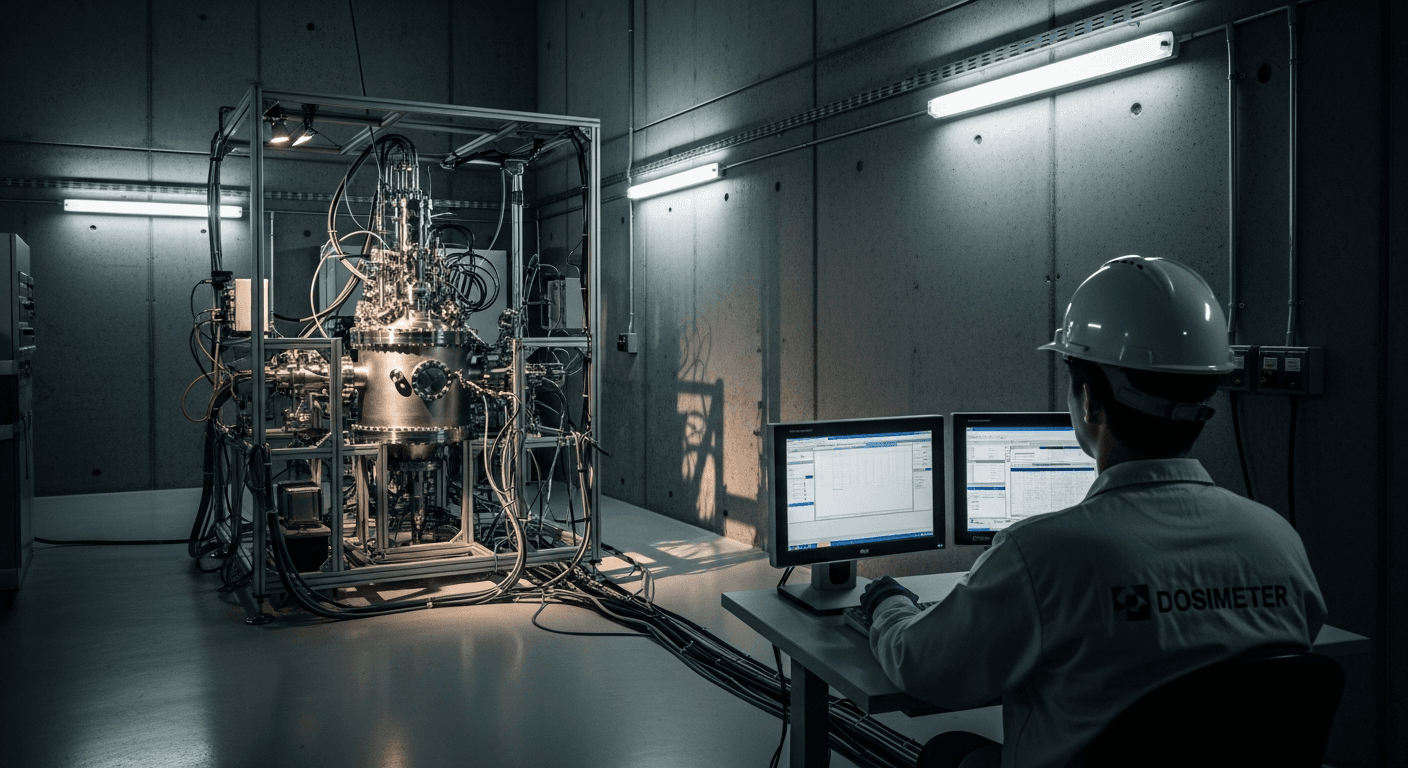
Deployable Energy's Unity completed the trifecta. The company's press release notes the test rig was transported from Houston to INL in a Ford F-150 truck. Unity is a 1 MWe commercial design, helium-cooled and graphite-moderated, using 4.95% enriched UO2 fuel and commercially available materials, built as a factory-produced nuclear battery. The zero-power criticality test confirmed a sustained fission chain reaction in the core; the 1 MWe figure is the planned commercial output, not what the demonstration unit produced.
The most notable wrinkle: Deployable Energy was not part of the Reactor Pilot Program. Unity qualified under the Nuclear Energy Launch Pad, a successor initiative launched in March 2026 that broadens the pipeline beyond the original RPP and Fuel Line Pilot Program selectees. "Deployable Energy has set a new benchmark for execution speed in the advanced nuclear sector," said Dr. John Wagner, Laboratory Director at Idaho National Laboratory.
The Number That Changes the Math
The DOE confirmed the U.S. is "the first country in history to achieve criticality in three unique advanced microreactor designs in a single month." The historical framing is significant, but the economic signal buried in Deployable Energy's announcement is the number that actually matters for what comes next.
Unity went from project kickoff with INL to delivered reactor, delivered fuel, and criticality in roughly 150 days on a "single-digit million" dollar budget, per CEO Bobby Gallagher in a video released after the criticality milestone. Every gigawatt-scale nuclear project in the U.S. runs $10 to $30 billion and takes 15 to 20 years. A reactor that clears the same fundamental physics milestone on a budget a well-funded startup can raise in a single seed round is a categorically different object.
Bobby Gallagher, Co-Founder and CEO of Deployable Energy, framed it directly in the DOE release: "We are proud to be a part of this historic achievement... We would not have been able to meet this moment without their brilliance, boldness, and grit."
For Bitcoin miners, the second-order read is straightforward. Miners today cluster near cheap hydro, stranded gas, or negotiated industrial grid rates. All three are congested, competed for, and politically exposed. The AI capex buildout has turned power scarcity into a genuine constraint at scale, and hyperscalers are bidding up the same electrons miners need. A factory-built 1 MWe nuclear battery that ships in a pickup truck, deploys in roughly 150 days, and can be sited without grid infrastructure makes stranded and remote sites economically viable at scale. That's a supply-side shift in mining's favor, provided the commercial economics track the prototype cost. Miners are the natural anchor customer for that model: flexible, interruptible, 24/7 load that doesn't require grid hookup. The sovereign mining thesis has always depended on access to dispatchable power outside the grid. Microreactors are the first technology that could actually deliver it.
The broader power supply picture is tight enough that DOE has been pushing on the grid from multiple directions simultaneously.
What to Watch
The thesis breaks if post-criticality regulatory friction reintroduces decade-scale delays. The DOE pilot programs explicitly bypass NRC licensing for the demonstration phase. Commercial deployment requires full NRC review, and that process has historically taken a decade or more. The falsifiable test: watch whether any of the three designs that hit criticality in June files for NRC commercial licensing within 18 months. If they do, the timeline compression is real. If the regulatory gate snaps shut, this is a demonstration record, not a supply-side shift. Oklo's subsidiary Atomic Alchemy and Radiant and Aalo are still working toward their own criticality milestones under the RPP, extending the pipeline further. The DOE separately committed $17.5 billion in conditional loans to larger baseload reactor projects, signaling the administration is pressing on multiple fronts simultaneously.
Update, August 7, 2026
Oklo's Groves Isotope Test Reactor became the fifth DOE-authorized reactor to achieve criticality, hitting that mark at 9:19 PM EDT on August 5 at the company's facility in Lockhart, Texas.
Groves is also the first reactor under the Reactor Pilot Program to achieve criticality on private land, built from the ground up on a greenfield site.
Oklo reached criticality less than a year after construction began, which the company believes is the fastest privately funded, privately sited nuclear reactor build in history.
The four prior RPP criticalities came from Aalo Atomics, Deployable Energy, Antares Nuclear, and Valar Atomics.
With Oklo's Groves reactor becoming the fifth to reach criticality in the last two months, Trump's five-year goal for 10 small reactor types to be validated is already halfway accomplished. The pace is worth sitting with: five certified reactor designs in roughly 60 days, after zero for more than half a century.
Oklo plans to build Groves-type reactors to order and "at scale" at its Lockhart plant, potentially by late 2026.
The project also established engineering practices, operating procedures, training programs, commissioning experience, and organizational capabilities that Oklo says will reduce uncertainty and execution risk across every future Oklo facility , including its Aurora Powerhouse commercial reactor and isotope production lines. For Bitcoin miners scouting off-grid baseload power, the pipeline of validated, factory-replicable designs is no longer a whitepaper argument.
Sources
- DOE press release: U.S. Department of Energy Meets President Trump's Goal, Delivers Third Advanced Reactor
- Deployable Energy press release via PR Newswire
- Executive Order 14301, GovInfo
- DOE Reactor Pilot Program
- U.S. Army public affairs: Antares Nuclear criticality
- DOE: American Nuclear Supply Chain Loans
Frequently Asked Questions
What does "criticality" mean, and are these reactors producing power now?
Criticality means the reactor core is sustaining a self-sustaining chain reaction of fissioning uranium atoms, the fundamental physics threshold that proves the design works. Antares and Deployable Energy both ran zero-power criticality tests, meaning the reaction was sustained at extremely low power levels with no meaningful heat output. Valar Atomics went further, producing tens of kilowatts of heat during its test. None of these reactors are currently connected to a grid or powering a facility. Criticality is the prerequisite for everything that follows, not the endpoint.
Do these microreactors need NRC approval before they can power a mining operation?
Yes. The DOE Reactor Pilot Program and Nuclear Energy Launch Pad allow developers to test reactor designs at national labs or approved sites without going through the full Nuclear Regulatory Commission commercial licensing process. That exemption applies to the demonstration phase only. Before any of these designs can generate power for a customer, including a Bitcoin mining operation, the developer must obtain NRC commercial licensing, a process that has historically taken a decade or more. Compressing that timeline is the next critical variable.
How does the Nuclear Energy Launch Pad differ from the Reactor Pilot Program?
The Reactor Pilot Program, launched under EO 14301, selected 11 projects from 10 companies in August 2025 for rapid iteration and testing. The Nuclear Energy Launch Pad, launched in March 2026, is the broader successor initiative that subsumes the RPP and the Fuel Line Pilot Program. Deployable Energy qualified under the Launch Pad, not the RPP, meaning it wasn't among the original 11 selectees. The distinction matters because the Launch Pad represents the long-term programmatic framework; the RPP was the sprint. Companies entering through the Launch Pad have a potentially cleaner path to the commercialization pipeline the DOE is building out.