South Korea's Won Collapse and the Fiat Leverage Spiral
Foreign investors pulled an estimated $57 billion from South Korean equities in May and June combined, sending the won toward 17-year lows and triggering a liquidity crunch built on three overlapping leverage layers. The Bank of Korea has no clean exit.
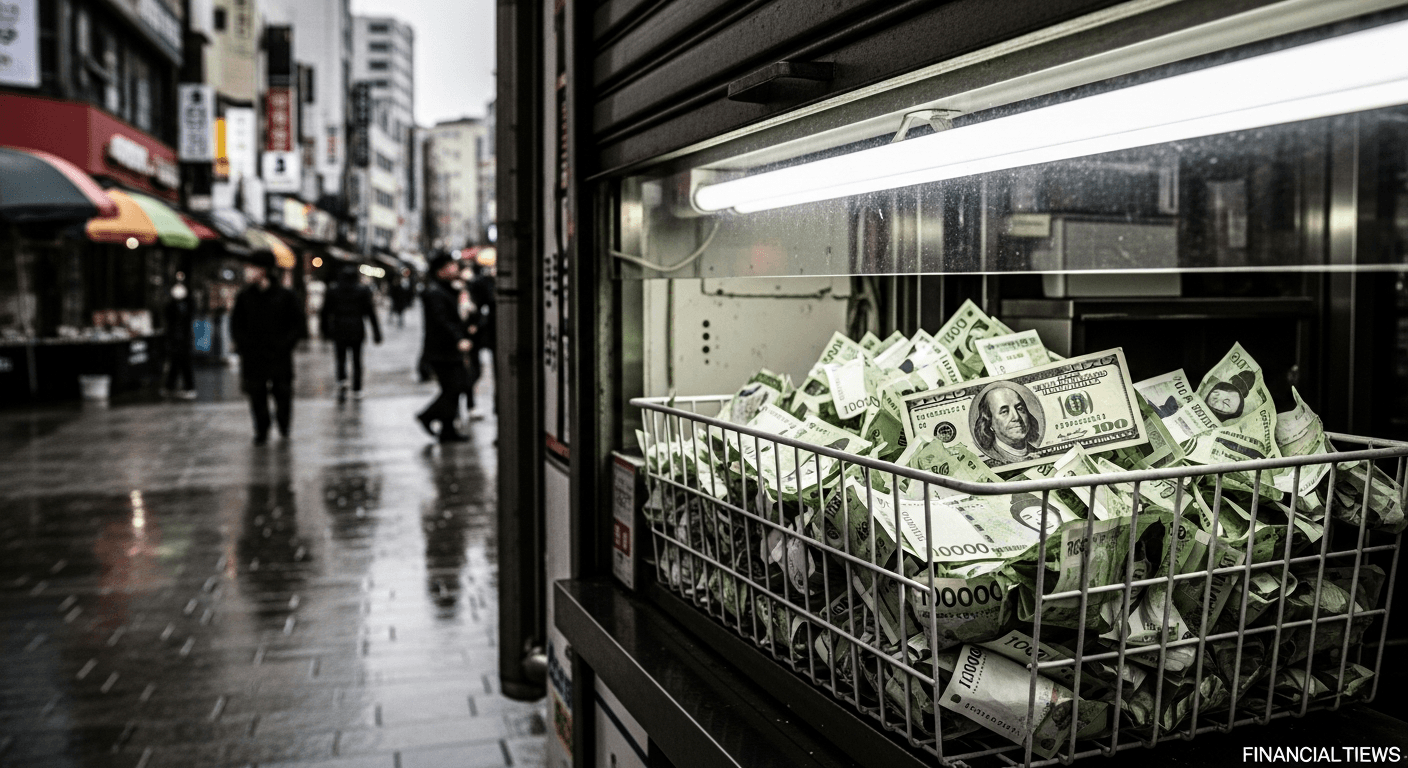
Foreign investors have pulled an estimated $57 billion from South Korean equities in two months, the won is trading near 17-year lows, and the Bank of Korea has no clean way out.
Key takeaways
- Foreign investors pulled roughly $57 billion from South Korean equities in May and June combined, per Goldman Sachs analysis, driving the won above 1,550 per dollar and forcing a reflexive margin-call spiral across three leverage layers.
- Samsung and SK Hynix now exceed the MSCI Korea 25% single-stock cap, meaning a combined 12-point rebalancing effort could trigger another $24 billion in forced outflows against an estimated $200 billion in AUM tracking the index, per Goldman Sachs analysis first reported by ZeroHedge.
- The Bank of Korea faces a classic fiat trap: hike rates to defend the won and fight 3.2% CPI, or hold and let tightening liquidity in the securities sector deepen. There is no escape-valve in this system.
The Korean won extended its losing streak to four consecutive days this week, with USD/KRW rising above 1,550 and approaching the 17-year low of 1,561.5 touched on June 5. The proximate cause is mechanical: overseas investors are selling Korean equities at a pace the currency market cannot absorb without sustained depreciation.
Goldman Sachs analysis, cited by CNBC, put net foreign outflows from KOSPI at roughly $62 billion through late May. Goldman's subsequent work, first surfaced by ZeroHedge, breaks the timing down further: approximately $27 billion in May, $30 billion in June through month-end, with $18 billion of that June figure concentrated in the final week of the quarter. These sub-figures are per Goldman analysis as reported by ZeroHedge and have not been independently confirmed from a public primary source.
Three Leverage Layers, One Crack
The outflow mechanism runs through two channels simultaneously.
First, MSCI index rebalancing. Per Goldman analysis first reported by ZeroHedge, Samsung and SK Hynix sit at roughly 32% and 30% of the MSCI Korea index respectively, each above the 25% single-stock concentration cap. With an estimated $200 billion in AUM tracking MSCI Korea (passive and active), Goldman analysts Timothy Moe and John Kwon estimate that each 1 percentage point increase in the combined Samsung-Hynix weight triggers approximately $2 billion in forced foreign selling. A combined 12-point rebalancing effort to bring both names back under the cap could produce another $24 billion in outflows, per the same Goldman analysis. UCITS rules and internal hedge fund concentration limits are layering additional pressure on top of the mechanical MSCI trigger.
Second, FX hedging demand is amplifying every equity move into currency pressure. Goldman estimates foreign investors held roughly $1 trillion in Korean equity exposure at the end of March. The KOSPI's roughly 68% expansion in market cap during Q2 alone pushed the associated FX hedging need up by an estimated $68 to $102 billion, the bulk of it flowing through the offshore non-deliverable forward market. Quarter-end rebalancing concentrated that demand into a short window.
The third layer is the most dangerous. Korean securities firms sold USD-denominated total return swaps on leveraged underlying equity to offshore clients, hedging those exposures in the NDF market. Simultaneously, a surge in domestic retail margin trading and leveraged single-stock ETFs drove securities firms' own funding needs sharply higher. Local commercial paper and short-term bond issuance by securities firms exceeded KRW 100 trillion per month in recent months, accounting for roughly 80% of short-term bond issuance, per local Korean media reports cited in the Goldman analysis.
As the won falls, the KRW value of collateral those firms post to offshore counterparties shrinks. That triggers more margin calls. Which requires more KRW borrowing. Which pressures the won further. Nomura Asia-Pacific equity strategist Chetan Seth described the dynamic plainly to CNBC on June 8: "This is essentially forced selling that we are seeing from our investors and clients."
A version of this loop played out in late 2022, when KRW and Korean Treasury bonds sold off simultaneously during the prior BOK hiking cycle.
Barclays, per Investing.com, estimates every $10 billion in foreign equity outflows translates to roughly 0.73% of won depreciation. Back-of-envelope: $57 billion in May-June outflows implies approximately 4.2% of mechanical currency pressure from outflows alone, before any broader USD strength is applied.
The BOK Trap
The Bank of Korea is boxed in. June CPI hit 3.2% year-over-year, the fastest pace in roughly 2.5 years. At its May 28 meeting, BOK Governor Shin Hyun-Song said a rate hike "could have been justified today" and that conditions "all support hikes in the coming months," per ING's policy snap. Goldman's base case puts the first hike at the July 16 meeting, with the policy rate currently sitting at 2.50%.
The problem is that hiking raises borrowing costs for the exact securities firms already under acute funding pressure. A rate increase tightens the liquidity environment that is already close to breaking. Holding invites further won depreciation and keeps real rates deeply negative against a 3.2% CPI print. Neither path is clean.
Korea Exchange CEO Jeong Eun-bo offered the institutional view to CNBC on June 11: "As a general rule, foreign institutional investors maintain set portfolio allocation targets... rebalancing is inevitable." That is accurate as a mechanical description. It does not address what happens when the rebalancing trigger, the currency pressure, and the liquidity squeeze are all running at once.
This is what the unwind of a fiat-denominated AI trade looks like at the sovereign currency level. Samsung and SK Hynix were the world's hottest AI-adjacent equity story. The leverage stack built on top of that story, retail margin, leveraged ETFs, NDF hedging chains, is now unwinding in layers. Global liquidity dynamics make the external environment worse, not better, as peak global liquidity reduces the cushion for EM currency dislocations.
Julius Baer's Mathieu Racheter put the structural point directly: "The latest market moves send an important warning about concentration risk. When investor positioning becomes crowded, sustained high volatility should be expected."
Korea is a top-15 global economy with a substantial current-account surplus and semiconductor export dominance, and the NDF dislocation, won depreciation, and leveraged-securities-sector stress are happening to that economy, not to a fragile frontier market, which is the signal worth sitting with. Japan, Taiwan, and India share structural similarities: AI-concentrated equity rallies, retail leverage exposure, and FX hedging chains running through derivatives markets.
What to Watch
Goldman's own framing is the clearest guide. If Korean equities keep rising, MSCI rebalancing outflows continue and NDF points stay elevated. If equities fall, broad-based outflows replace the mechanical selling, and the FX impact from unwinding hedges provides only partial offset. The only scenario that relieves currency pressure is a sustained, orderly decline in Samsung and Hynix that also unwinds leveraged positions without triggering a broader KOSPI collapse. The BOK's July 16 rate decision is the next forcing function. If the hike arrives and NDF spreads normalize within 60 days without EM contagion spreading to Taiwan or Japan, the structural fragility thesis is wrong and this was a contained mechanical rebalancing. If it doesn't, the feedback loop has more room to run.
Update, July 16, 2026
The Bank of Korea pulled the trigger on its first rate hike in three and a half years today. The Monetary Policy Board voted unanimously to raise the benchmark rate 25 basis points to 2.75 percent, ending a yearlong pause and marking the first tightening since January 2023.
Governor Shin Hyun-song signaled the hike is not a one-off, saying "we will continue to respond with monetary policy until we are confident that inflation is converging sustainably toward our target" and adding that he expects inflation to "remain above our target for a considerable period." The timing is brutal: the BOK is tightening into an equity market that is already breaking retail traders.
The retail damage is now quantifiable. South Korea's margin-call-to-receivables ratio has spiked to roughly 5 percent, the third-highest level on record, more than four times its typical range of 1 to 2 percent over the past two years.
Approximately 1.2 million trading accounts have triggered margin calls, with 320,000 to 360,000 ultimately forcibly liquidated by brokers. The leverage that built up through the single-stock leveraged ETF boom is now being force-fed back into the market as sell orders.
Regulators convened an emergency response. On July 14, the Korea Financial Investment Association called an emergency meeting with major brokerage CEOs, and participants agreed in principle to raise the minimum margin threshold from 10 million won to 50 million won for single-stock leveraged ETF investments.
South Korea's "F4" high-level coordination body, comprising the Ministry of Economy and Finance, the Bank of Korea, the Financial Services Commission, and the Financial Supervisory Service, convened today to formalize those countermeasures. A central bank hiking rates while its regulatory apparatus scrambles to contain a retail margin cascade is not a controlled landing. It is a system under simultaneous pressure from every direction.
Sources
- Goldman Sachs June 2026 analysis via CNBC (secondary source citing Goldman)
- CNBC: Why foreign investors are selling KOSPI (June 8, 2026)
- Barclays FX model via Investing.com
- ING: Bank of Korea rate hike signal (May 28, 2026)
- Korea CPI and Goldman chip outflow warning, investinglive.com (July 1, 2026)
- Bank of Korea official site
Frequently Asked Questions
Why is the South Korean won falling if Korea runs a trade surplus?
A current-account surplus provides a structural tailwind for a currency but does not override large, rapid capital outflows. Goldman's analysis shows foreign equity outflows in May and June alone reached an estimated $57 billion. The BOK's own research has documented a structural break since 2023 where capital-account dynamics have increasingly dominated over trade flows in setting the won's near-term direction. Exports staying strong doesn't offset $30 billion in equity selling in a single month.
What is an NDF and why does it matter for the Korean won?
A non-deliverable forward is an offshore derivative contract used to hedge currency exposure where the underlying currency (here, KRW) is not freely convertible outside the country. Foreign investors holding Korean equities hedge their won exposure through the NDF market rather than the onshore spot market. When hedging demand surges, as it has with KOSPI's rapid expansion and subsequent equity outflows, NDF points spike and the offshore rate can diverge sharply from the onshore rate, amplifying pressure on the spot won and creating an additional reflexive feedback loop.
Could a similar squeeze hit other AI-rally markets like Japan or Taiwan?
The preconditions are present elsewhere. A concentrated AI-equity rally inflating index weights above passive-fund caps, a domestic retail leverage ecosystem on top of that rally, and FX hedging chains running through offshore derivatives markets are structural features across multiple Asian markets. The specific MSCI cap mechanics are Korea-specific, but the broader dynamic of leveraged positioning in AI-concentrated equities creating a reflexive unwind risk is not. The energy and structural inputs that feed the AI trade globally are the same inputs concentrated in Korean semiconductors.