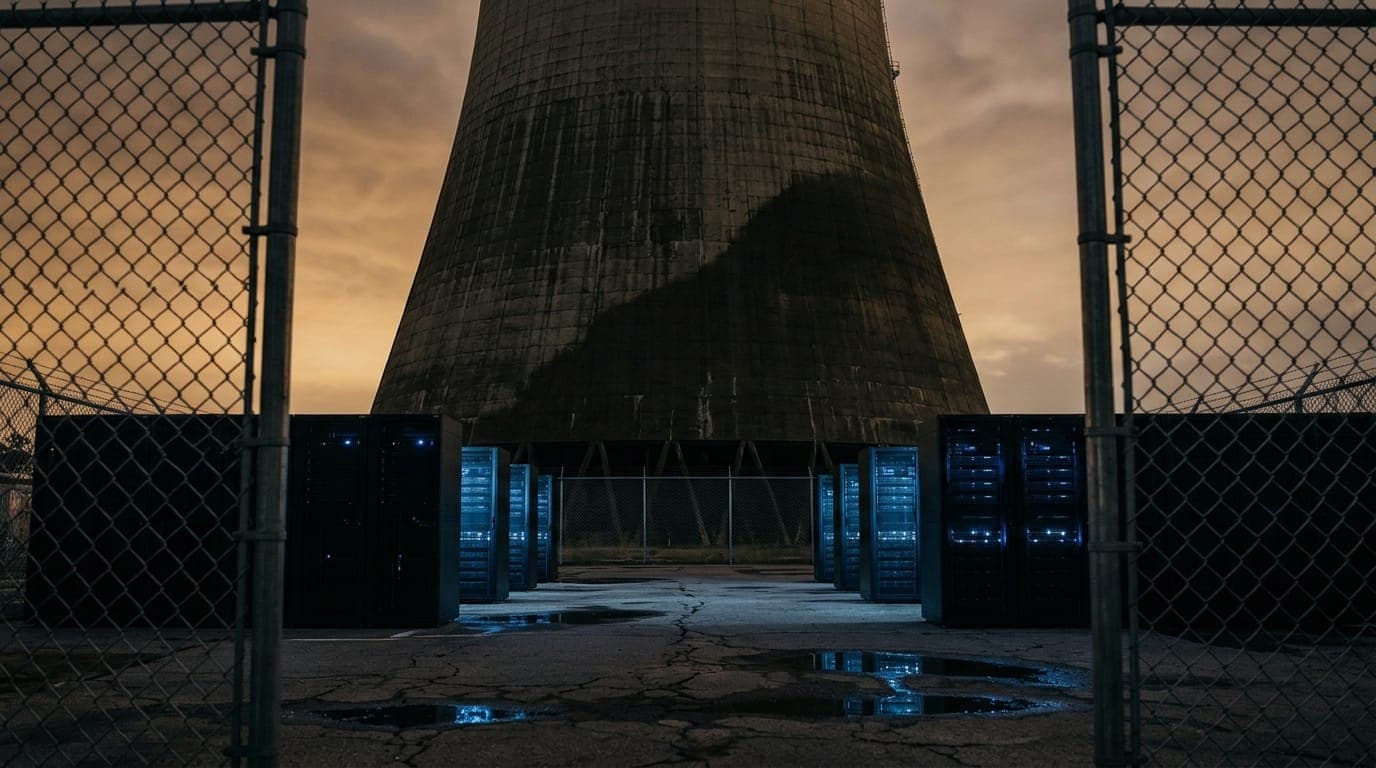
Satellite Images Catch Microsoft's $5B AI Capex Gap at Source
Microsoft's Q1 FY2027 capex missed analyst expectations by roughly $6.5 billion. Satellite imagery of IREN's Texas campus and Nebius's New Jersey site shows incomplete construction as the cause. The same grid and permitting bottlenecks choking AI delivery are the ones Bitcoin miners navigate every
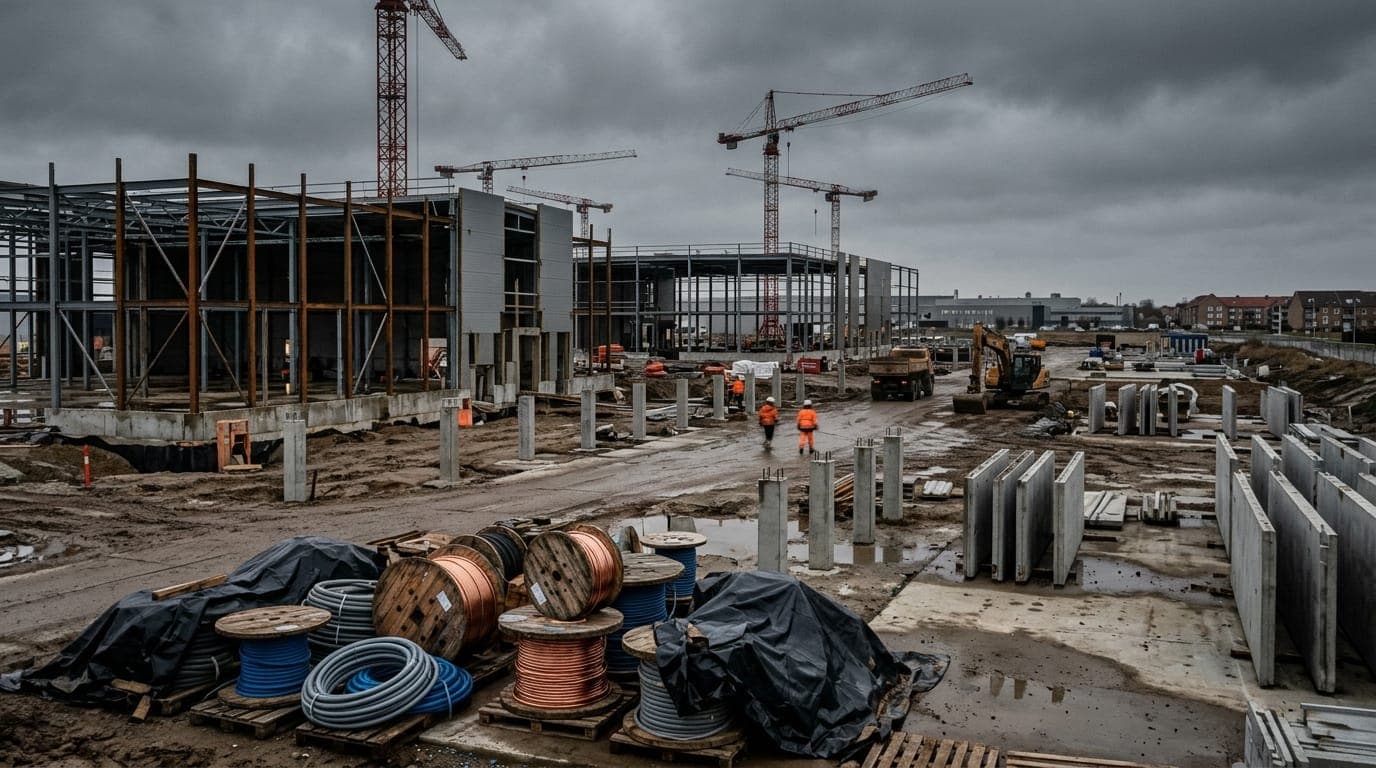
Orbital cameras are now doing what earnings calls don't: showing the actual state of the AI buildout on the ground.
Key takeaways
- Microsoft CFO Amy Hood attributed a Q1 FY2027 capex miss of roughly $5 to $6 billion below analyst consensus to delayed deliveries from third-party neocloud partners, cutting full-year guidance by $5 billion to $170 billion.
- Satellite analysis from Aterio, first reported by Business Insider, flagged unfinished construction at IREN's Childress, Texas campus and estimated approximately 140 MW at Nebius's Vineland, New Jersey project could slip into 2027.
- The bottleneck is physical: grid interconnection timelines, permitting walls, and construction schedules, the same constraints Bitcoin miners have always faced, are now showing up directly in hyperscaler earnings.
Microsoft reported Q1 FY2027 capital expenditures of $45.2 billion on its October 28 earnings call, below analyst consensus expectations of roughly $50.67 billion per StreetAccount. CFO Amy Hood pinned it directly on partners: "Capital expenditures were $45.2 billion as some third-party capacity deliveries we expected in Q1 were delayed." The company cut its full-year 2026 capex guidance by $5 billion, from $175 billion to approximately $170 billion, and guided Q2 above $50 billion.
Now there's satellite evidence showing what "delayed" looks like on the ground.
Construction on Camera
Aterio, a satellite analysis firm, conducted flyovers using imagery dated through October 21, 2026, and identified incomplete construction at two neocloud sites tied to Microsoft. Business Insider, which first reported the Aterio findings, identified the two partners under pressure: IREN at its Childress, Texas campus and Nebius at a project in Vineland, New Jersey. Aterio estimated approximately 140 MW at the Nebius New Jersey site could slip into 2027.
IREN's exposure is documented in black and white. Per IREN's SEC 8-K filing from August 13, 2026, the company holds a five-year, $9.7 billion cloud services contract with Microsoft structured as four 50 MW "Horizon" deployments at Childress. IREN confirmed delivery of Horizon 1 on August 13.
Horizons 2 through 4 were expected later in 2026. IREN CEO Daniel Roberts said at the time: "We look forward to building on this momentum with Microsoft as we work to deliver Horizons 2-4 later this year." The satellite images suggest that timeline is under stress.
Neocloud stocks reacted accordingly. CoreWeave fell 5.8%, Nebius dropped 6.3%, IREN slid 5.3%, and Applied Digital lost 4.3%.
The Physical Ceiling the Numbers Reveal
The mainstream read on this story is a neocloud equity event. The more important read is a structural fragility story about what actually constrains the AI buildout.
Microsoft is not retreating from AI demand. Hood confirmed Q2 capex will exceed $50 billion. The capital is there.
What isn't there, on schedule, is the physical infrastructure: completed buildings, energized grid connections, permitted sites. Janus Henderson put it plainly in a recent institutional note: "Announced capacity is not the same as executable capacity." The firm cited more than 120 U.S. datacenter projects worth approximately $200 billion that were blocked or delayed in the first half of 2026.
TD Cowen has separately estimated that Microsoft walked away from up to 2 GW of datacenter capacity through lease cancellations and deferrals. SemiAnalysis has offered a counter-read, according to analysts tracking the firm's work: those cancellations were largely non-binding letters of intent, while Microsoft holds approximately 5 GW under binding contracts for 2025 through 2028. Both data points can be true simultaneously and still land at the same conclusion: a reported multi-gigawatt power shortfall through 2028 is already showing up in one hyperscaler's quarterly earnings.
For Bitcoin miners, the signal is worth internalizing. IREN is Iris Energy, a former Bitcoin miner that repurposed its Texas infrastructure for AI GPU workloads. The grid interconnection queues, local permitting processes, and construction timelines that slowed Horizons 2-4 are the same friction miners face when bringing new capacity online.
Every megawatt that gets committed to AI on paper and then sits in permitting limbo is a megawatt that could have been flexible, interruptible mining load. The AI crowd is running into what miners have navigated for years.
The broader macro implication: four hyperscalers are projecting roughly $650 billion in 2026 datacenter spend. If physical delivery lags the financial commitment across the sector, the energy and power market calculus shifts. AI capex that hits cash-flow negative while simultaneously missing deployment targets puts pressure on the neocloud financing model.
IREN and Nebius won multi-billion contracts from a hyperscaler but are now under satellite surveillance to prove delivery. If they can't perform, those contracts don't just slip in a spreadsheet. They unwind, equity craters further, and debt capital for datacenter construction reprices.
What to Watch
The thesis here is falsifiable. If IREN delivers Horizons 2 through 4 by year-end and Nebius's Vineland 140 MW comes online in Q1 2027 without further slippage, this reads as normal construction lumpiness and Microsoft's Q2 reacceleration above $50 billion confirms no structural crack. Watch IREN's next SEC filing for a Horizon 2 delivery confirmation and Nebius's next earnings for updated site timelines. If both slip again, the gap between announced and executable AI capacity is a trend, not a quarter.
Sources
Frequently Asked Questions
Is Microsoft pulling back on AI investment?
No. Microsoft guided Q2 capex above $50 billion and attributed the Q1 miss entirely to third-party delivery delays, not reduced AI demand. The capital commitment is intact. The constraint is on the supply side: physical infrastructure that partners have not yet delivered.
What is IREN and why does it matter to Bitcoin miners?
IREN (Nasdaq: IREN) is the company formerly known as Iris Energy, a Bitcoin miner that pivoted its infrastructure toward AI cloud workloads. Its Childress, Texas campus was Bitcoin mining infrastructure repurposed for hyperscaler GPU deployments. The permitting, grid, and construction bottlenecks now delaying its Microsoft deliveries are structurally identical to the ones Bitcoin miners contend with when expanding capacity. IREN's delivery problems are a live case study in the shared physical constraints across both industries.
How does satellite imagery track datacenter construction progress?
Firms like Aterio use high-resolution commercial satellite imagery to monitor construction site activity over time, comparing building footprints, equipment presence, and earthwork progress against expected delivery schedules. When a site shows incomplete structures weeks before a contracted delivery date, it surfaces delivery risk before any company disclosure. It is the same methodology infrastructure investors and intelligence analysts have used on industrial sites for years.