The Nuclear Company's 6.6 GW Kentucky Campus Puts Bitcoin Miners First in Line
The Nuclear Company announced Prosperity One, a proposed six-reactor AP1000 campus in Lewis County, Kentucky capable of 6.6 GW. Bitcoin miners already operating in Kentucky should be paying close attention.
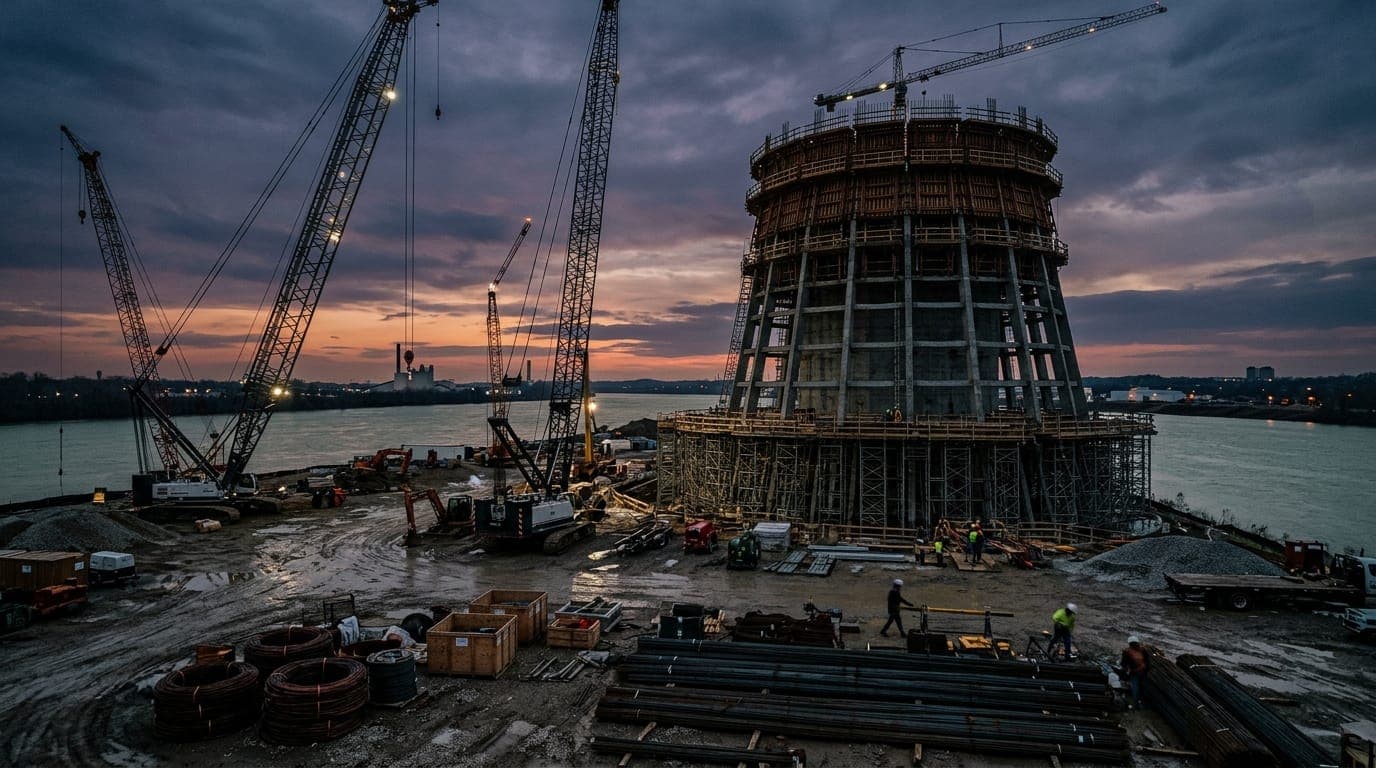
Prosperity One would be the largest nuclear plant in the U.S. Kentucky already has the mining infrastructure to absorb it.
Key takeaways
- The Nuclear Company announced Prosperity One on October 21, a proposed six-reactor, 6.6 GW AP1000 campus in Lewis County, Kentucky, targeting federal construction approvals by 2028.
- The NRC renewed the AP1000 design certification on October 14, locking Vogtle's 200 field-proven amendments into the reference design through 2066 and removing a major source of cost uncertainty for every future builder.
- Kentucky already hosts active Bitcoin mining infrastructure; miners who negotiate offtake or co-location agreements at Prosperity One ahead of hyperscaler competition lock in energy rates that won't exist once AI data centers enter the bid queue.
The Nuclear Company announced Prosperity One on October 21, a proposed campus of up to six Westinghouse AP1000 reactors on 4,200 acres along the Ohio River in Lewis County, Kentucky, with a combined capacity of approximately 6.6 GW. If fully built, it would be the largest nuclear plant in the United States. Kentucky currently has zero operating commercial reactors.
The first phase targets two units, with TNC aiming to secure federal approvals to begin construction in 2028. No NRC application has been filed yet, and no PJM interconnection request is public.
What TNC Is Actually Betting On
Landowner Sam Howard, a lifelong Lewis County resident, is partnering with TNC on the project.
TNC's chief nuclear officer Joe Klecha is a Vogtle construction veteran. His cost thesis is straightforward: build the same reactor repeatedly and drive down unit costs through repetition. The NRC action on October 14 made that thesis structurally sounder. The agency renewed the AP1000 design certification through 2066, folding in approximately 200 amendments accumulated during Vogtle's construction and startup. NRC Chairman Ho Nieh called it "the regulatory foundation for America to move from building individual reactors to deploying them at scale," per ANS Nuclear Newswire.
Those field lessons are now baked into the reference design. Future builders inherit Vogtle's hard-won fixes rather than discovering them mid-pour. The cost-learning curve is regulatory canon, not a startup's pitch.
Klecha's cost targets and the Vogtle unit-to-unit comparison were first reported by Heatmap. TNC has not yet disclosed a cost estimate, financing plan, or ownership structure, though the company says offtake negotiations are underway and expects deals in 2026.
The project's two-unit first phase aligns with the DOE's structure for a $17.5 billion conditional commitment for long-lead AP1000 equipment, built around up to five two-reactor sites, first reported by Heatmap. TNC has not confirmed a connection.
The Kentucky Energy Arbitrage
This is where the story gets relevant to Bitcoiners, and most coverage will stop before it gets here.
Kentucky already has active Bitcoin mining infrastructure. Riot Platforms operates a 60 MW facility in Paducah. Legacy facilities from Blockware and Block Mining are on the grid. The state built the playbook on cheap, stranded-power mining, and as of October 2021 represented 18.7% of U.S. hashrate, second in the country at the time.
Prosperity One's Lewis County site is in eastern Kentucky, in PJM territory. That is the topology miners want: massive dispatchable baseload, a state regulatory regime that removed restrictions on new nuclear construction, and geographic proximity to data-center demand corridors in the Ohio Valley. A significant power shortfall is already bearing down on AI data center buildouts through 2028. Hyperscalers will eventually enter any viable power queue. The question is who gets there first.
Miners who negotiate co-location or offtake agreements at Prosperity One before TNC locks anchor tenants lock in rates that cease to exist the moment a hyperscaler submits a competing bid. The NRC certification renewal tightened the construction cost picture. The DOE conditional commitment, if it converts, tightens the financing picture. Each step that de-risks TNC's build also shrinks the window for early offtake agreements.
The falsifiable thesis: Prosperity One's PJM-adjacent site plus the freshly renewed AP1000 certification marks the first time the structural prerequisites for industrial-scale dispatchable nuclear in Kentucky are simultaneously in place, and miners who position in the Ohio River corridor ahead of the hyperscaler queue will carry a structural cost-of-energy advantage. The trigger that breaks it: if TNC cannot close offtake or financing before the DOE's long-lead equipment commitment expires, or if PJM grid queue timelines extend past 2030 for this region, the advantage does not materialize.
What to Watch
Lewis County's county council voted to pursue a "nuclear ready community" designation under the Kentucky Nuclear Energy Development Authority in July 2026. TNC's stated milestones are offtake agreements by year-end and NRC filings to support 2028 construction approvals. The NRC certification renewal becomes effective December 28, 2026, contingent on no significant adverse comments by November 13. Watch for the first interconnection filing in PJM and any anchor offtake announcement. Those two data points will determine whether Prosperity One is a real build or a very large press release.
Sources
Frequently Asked Questions
What is The Nuclear Company and who is behind it?
The Nuclear Company is a startup developing Westinghouse AP1000 reactor projects in partnership with Brookfield, which owns 51% of Westinghouse alongside Cameco's 49%. Brookfield has also been advancing a proposal through Santee Cooper to complete VC Summer Units 2 and 3 in South Carolina, two half-built AP1000s abandoned in 2017 after approximately $9 billion was spent. Brookfield and Santee Cooper are working through a feasibility process, and no final investment decision date has been publicly confirmed.
How does the AP1000 design certification renewal affect cost and timeline for Prosperity One?
The NRC's October 14 renewal incorporated roughly 200 amendments approved during Vogtle's construction into the AP1000's reference design. That means TNC does not need to process those lessons as license amendments during construction, which reduces both the regulatory queue and a major source of cost uncertainty. The certification runs through 2066, covering the full operating life of reactors built under it.
Could Bitcoin miners actually use power from Prosperity One?
TNC has not disclosed its offtake model, but dispatchable baseload nuclear is compatible with both firm power agreements and interruptible industrial load structures that miners use. Kentucky's existing mining operations run on similar large-load industrial tariffs. The question is timing: TNC is still in the pre-filing stage, and no power will flow before the mid-2030s at the earliest. The opportunity for miners is early offtake negotiation, not near-term power delivery.