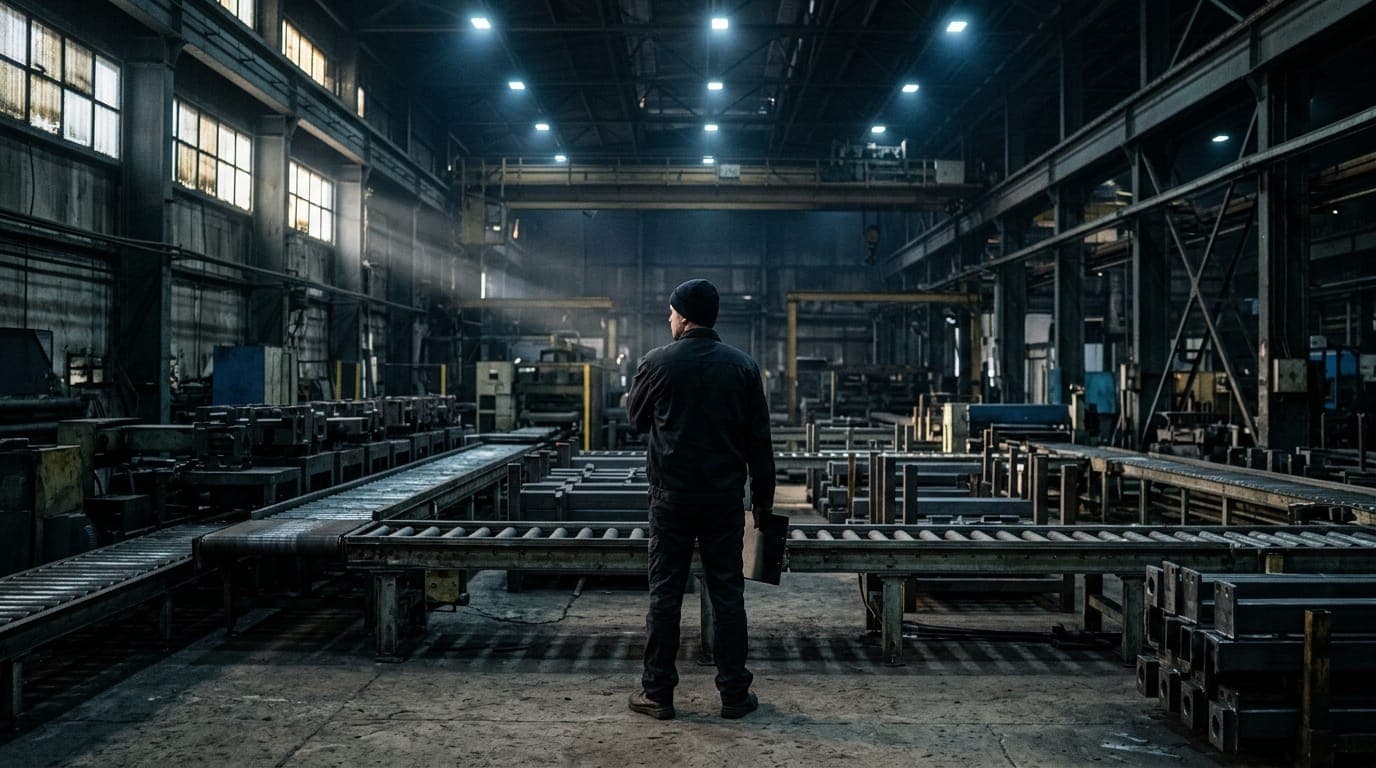
Peter St. Onge: Revenge of the Blue Collars
Peter St. Onge on why the AI bubble still has a year or more to run, why blue-collar workers are the surprise winners of the AI era, and why Kevin Warsh's let-companies-fail Fed stance is exactly what the economy needs.

↓ Jump to the video and timestamps
Peter St. Onge texted me the morning of this recording and said he wanted to talk about AI. I told him I was more than willing. We've been building out a company brain and an agentic system at TFTC that every one of our employees can interact with, and it's allowed us to expand the breadth of what we cover in ways that weren't possible before. So I had skin in this conversation before we even hit record.
What I didn't expect was how quickly AI would loop back into everything else: Bitcoin's crab walk, the labor market, Kevin Warsh's first moves at the Fed, and three overt socialists winning New York primaries in the same week. These aren't separate stories. They all run back to the same place, which is what happens to the economy when the fiat era's winners suddenly find themselves on the wrong side of a productivity revolution.
Peter's been right about markets before, and his read here is the most coherent frame I've heard for what's actually happening right now.
Key takeaways
- Bitcoin's thesis is intact. The crab walk is maturity, not death. St. Onge's point is that gold has been doing this for 50 years (doubling, dropping in half, boring for stretches) and nobody calls it dead. The number-go-up crowd is distracted by AI. That's fine. The fundamentals are unchanged.
- The AI bubble is real and still has room to run. St. Onge's day-for-day overlay of the AI semi bubble against dot-com puts us somewhere around 1998-99. His call, gun to his head: another year to a year and a half. But unlike dot-com, the picks-and-shovels players are printing real profits, not eyeballs.
- Blue-collar workers are the surprise winners of the AI era. While generalist white-collar workers face displacement, construction and trades are surging. One widely cited industry estimate puts AI data center build-out at 4.7 million construction jobs, plus roughly 700,000 permanent roles to run the facilities.
- Kevin Warsh's Robin Hood monetary policy is the right move. Sell the Fed's balance sheet instead of hiking rates. Take from Wall Street, don't strangle Main Street. Marty's explicitly for it, and Warsh's stated no-more-bailouts stance is the part that matters most.
- The Democratic Party is being captured by overt socialists, and the silver platter problem is real. Every governance structure Trump builds gets handed to whoever comes next. Zohran Mamdani won the New York City mayoral primary. Three other socialist candidates won New York state races the same night. This isn't hypothetical anymore.
- The Industrial Revolution wiped 80-90% of jobs. The losers are 50x richer today. Cubicle jobs aren't worth mourning. The blue-collar renaissance is the story of the next decade, and the transition pain for psychology majors with Yale diplomas is not an argument against it.
Bitcoin in a Crab Market: Why the Thesis Hasn't Changed
Bitcoin was sitting around $58,000 when we recorded this, down from $120,000 before the Iran war. The sentiment right now is probably the worst I've felt since 2015, when people legitimately thought it was going to die.
I've been in this for 13 years. $58,000 after $120,000 is noise to me, not a crisis.
St. Onge's framing is useful here. He points out that gold has been going through the same thing for 50 years: sometimes it triples, sometimes it drops in half, and nobody calls gold broken. The volatility isn't a flaw; it's what happens to a hard asset that isn't yet the dominant money. The market is thin compared to what it will be, and speculation drives it in ways that have nothing to do with the underlying thesis.
The number-go-up crowd is currently partying in AI. That's fine. AI has longer legs than AMC or whatever was capturing the hot money in 2021. It'll hold their attention for a while.
But the case for Bitcoin, in a world where central banks are tripping over themselves to devalue their currencies, is untouched. The only scenario where Bitcoin takes another massive step up in price is if it takes meaningful market share from gold or fiat.
The AI Bubble: Real, But Still Has Legs
St. Onge cut his investment teeth on dot-com. He bought Yahoo at $60 in 1996 when everyone including Paul Krugman was calling it a bubble. Split-adjusted, it went to roughly $1,000. He retired at 25. He also eventually lost most of it when the whole thing collapsed, which is why he leads with "scale out gradually."
His read on AI is that it's both a genuine bubble and still has room to run, and those two things aren't in conflict.
The key insight, from the economist Andrew Lo's empirical work on bubbles as St. Onge recalled it, is that the main determinant of a bubble's end is time, not price multiples. Not price-to-earnings, not how much something went up. Just time. Bubbles end when they end.
So he does a day-for-day overlay of the AI semi bubble against dot-com, using the Netscape IPO and the ChatGPT release as the respective start points. His conclusion: we're somewhere around 1998, maybe early 1999. He's calling another year to a year and a half of upside. He says watch it blow up tomorrow, but that's his best guess.
The reason this cycle is different from dot-com comes down to one thing: the picks-and-shovels players are actually making money. Nvidia is minting profits you can put in your pocket. St. Onge's recollection is that internet stocks as a group produced effectively no collective profits throughout the entire 1990s. They were all eyeballs and reinvestment stories. The AI semis today are not that.
I keep grappling with the dark fiber analogy that gets thrown around. The argument goes that dot-com built out broadband capacity nobody could use for a decade, and AI capex is the same thing. I don't buy it. A highway with 10,000 lanes costs roughly the same to build as one with four lanes, so during dot-com they overbuilt massively and waited for traffic to catch up. AI compute doesn't work that way. Companies will take every bit of compute they can get their hands on.
There's reportedly a story floating around about a major tech company (Uber is the name attached to it) that blew through a $500 million AI compute budget without really noticing. That is not the dark fiber dynamic. That's unlimited demand meeting constrained supply. And it's not just replacing things that were already being done. The mom-and-pop taco shack that couldn't afford a marketing analyst or a custom website can now get both for next to nothing. That's entirely new demand, not displacement of existing spend.
What AI Does to the Labor Market: The Blue Collar Renaissance
This is the part of the conversation I'm most bullish on, and it's also where I think most of the AI commentary gets it completely wrong.
The popular narrative is that AI is coming for everyone's job equally. That's not what the data shows, and it's not what the economics suggests.
St. Onge's read is that for the next 10 to 20 years, the primary victims of AI displacement are generalist white-collar workers. The person graduating this year with a psychology degree or a general economics degree (a credential that functioned as an IQ test rather than a concrete skill set) is going to get absolutely shafted. Those cubicle jobs at aircraft parts manufacturers, government agencies, and big corporate HR departments are exactly what AI eats first.
If you're coming out of school without a concrete skill (engineering, programming, health, anything physical) you're paying $150,000 for a signal that's about to be worthless.
The winners are blue collars. We're already seeing some of the strongest blue-collar wage growth in decades. St. Onge cited an estimate of 4.7 million construction jobs coming from AI data center build-out, plus hundreds of thousands of permanent roles, because somebody has to maintain the infrastructure, manage the energy systems, and handle the water cooling. And it's not just data centers in isolation (it's the power plants, the transmission lines, the fiber, all of it).
Everybody talks about AI data centers as if they materialized from alien spaceships. Somebody built them, and it wasn't HR directors with sociology degrees.
According to a Brookings figure St. Onge cited, around 84% of workers on the front lines of AI displacement are women, specifically because women disproportionately hold generalist administrative and white-collar support roles. That's not a value judgment. It's a labor market fact, and it has downstream implications.
I said it on tape and I'll say it here: all these cubicle-bound women with master's degrees are going to have to go find their electrician husbands. The electrician is making $150,000 a year right now. The philosophy major between jobs is not.
That's not a tragedy. That's a fertility rate fix, and it's the blue-collar renaissance completing a loop that the fiat era broke open over 50 years.
Blue collars got wiped out by China. China was massively deflationary. St. Onge points out that a pool table used to cost hundreds of dollars and now costs $70, and that a microwave that cost $50 in 1977 would be roughly $1,000 in today's money. Great for consumers. Brutal for the people who used to make those things.
Now the productivity revolution is running in the other direction.
The Industrial Revolution Precedent: Why the Jobs Panic Is Overblown
The Office Space framing St. Onge uses here is exactly right. The movie ends with the protagonist digging a hole in the sun. He's happier than he was in the cubicle. In the AI future St. Onge is describing, the hole digging pays twice what the cubicle did.
The Industrial Revolution wiped something like 80 to 90% of all jobs that existed before it. Every job except merchants and doctors, basically. And here's what happened: the people who were in the absolute bullseye of that disruption (the ones moving rocks for a living, the lowest-skilled workers imaginable) are 50 times richer today than their pre-industrial counterparts were.
St. Onge's New York story lands this. He was walking around the city a few years ago and saw two guys unloading cinder blocks from a truck. One of them was loud-talking about his vacation to Brazil. That is the bottom of the labor market in the world's most expensive city, and the guy vacations internationally. The US-to-India house painter wage ratio he gives is roughly 9-to-1.
Both are doing largely the same physical work with roughly comparable tools. The difference is the productivity that surrounds them (the machinery, the infrastructure, the capital accumulation that makes every unit of labor more valuable).
Humans have a hierarchy of needs. When technology frees workers from one rung of the ladder, they step down to the next rung, but the escalator itself is moving up. Freed-up labor plus rising productivity lifts everything.
The near-term transition pain is real. The fresh Yale psychology grad who can't find a cubicle job and won't work at Panera is going to have a rough few years. St. Onge points out that an adjunct humanities professor currently earns roughly the same hourly rate as a babysitter, many of whom are 16 years old.
The holdout is going to get increasingly expensive to maintain. When the smoke clears on the other side, dog walking will pay $100 an hour because most people won't be working. Getting someone off their couch to come walk your dog is going to require serious compensation. That's not a dystopia. That's what widespread productivity gains actually look like when they run all the way through.
Kevin Warsh, the Fed, and the Robin Hood Monetary Policy
I had a conversation on this show the day before this recording about Warsh explicitly saying he doesn't want to do bailouts anymore. His definition of a recession is businesses failing on their own volition. If companies overextend on debt and can't pay it back, they should fail. We desperately need that discipline back in the system.
St. Onge's read on Warsh is "cautiously optimistic." If you look at his history, he was hawkish during the 2008 crisis, pushing for rate hikes when unemployment was at 8%, which is old-school Austrian thinking. Let the malinvestments get purged. That's Volcker-adjacent.
The Robin Hood framing Warsh was using immediately before taking the job is worth understanding. The Fed has accumulated roughly $7 trillion in assets on its balance sheet since 2008. Treasuries and mortgage-backed securities bought up during every crisis and taper tantrum represent approximately 25 to 30% inflation parked in a battery.
The question is whether you release that by selling the assets (which hits Wall Street's profits and brings prices down without costing jobs) or by hiking rates, which strangles the economy and costs roughly a million jobs per point, by St. Onge's rule of thumb. The Robin Hood play: sell the Fed's garbage, take it from Wall Street, don't strangle Main Street. You can lower inflation without choking off business investment and hiring.
The complication right now is the war. Oil spiked after the Iran conflict started, and headline inflation ran hot in the first months. The good news, per St. Onge, is that so far (four months in) the inflation hasn't bled outside of energy. Companies haven't been raising prices broadly.
Truflation, the private-sector alternative that scrapes real-time data instead of running BLS models, had US inflation at about 0.7% annualized before the war. That is as good as it gets. If Warsh can hold the line and resist the political pressure to panic-hike on headline inflation, the fundamentals are actually in a very good place.
The 1920-21 recession is the reference point here. Right after World War I, the government let the adjustment rip. No bailouts. The acute phase was painful but short, and the economy came out of it clean.
James Grant's book on it is essential reading. Warsh appears to know this history. The question is whether he holds that line when the headlines turn ugly.
I locked in a 6.75% mortgage in February. I think we got the house about 20% under market because the previous owners wanted to give it to a growing young family. The monthly payment isn't small, but I actually hope rates stay where they are or higher.
The sticker prices on houses are absurd for any millennial trying to save a down payment. Prices need to normalize. Rates at 6 to 7 percent aren't some historical anomaly (that's roughly where healthy housing markets sat in the 1990s). The problem was rates near zero for years that locked people into mortgages they can't trade out of without doubling their payment.
The Socialist Takeover of the Democratic Party
The silver platter problem is real and it's not abstract anymore.
Zohran Mamdani won the New York City Democratic mayoral primary. He's an overt socialist. Three other socialist candidates won New York state races the same night, with state legislative and senate primaries going to people who want to seize the means of production and redistribute wealth. Hasan Piker is riding high. There is a genuine fire in this wing of the Democratic Party that the Gavin Newsom-adjacent establishment simply does not have.
St. Onge's party realignment thesis is sharp. The old Democrat Party was blue-collar union guys (the people Clinton later called "deplorables"). The old Republican Party was Monty Burns wanting lower taxes. Trump broke the GOP in four years flat. Romney in 2012, then bam.
The same disruption is coming for the Democrats. The faculty-professor wing has no fire. The Mamdani-Piker wing does. By 2028, St. Onge thinks the Democratic nominee could genuinely be someone from that faction. The Mamdani natural-born citizenship question came up on tape.
St. Onge looked it up live and found he was born in Kampala, Uganda, so the nomination path closes on him specifically. But his acolytes won't have that problem.
Here's what bothers me. Every AI governance infrastructure, every data center partnership, every regulatory framework Trump builds right now gets handed on a silver platter to whoever comes next. Trump has David Sacks and competent people around him who aren't going to abuse it. But he's not going to be president forever.
If what's coming is communism versus nationalism as the defining fault line of American politics, then building centralized AI infrastructure with government partnership is building the perfect tool for the side you don't want winning. I'm glad Trump is pro-AI and hands-off on content. God bless anyone in that office who doesn't try to put a political commissar inside Anthropic. But the structure being built has to be evaluated against who inherits it. That's the part that keeps me up.
Gen Z, AI Companions, and What Comes Next
St. Onge dropped one stat near the end of the conversation that I found genuinely depressing: reportedly, spending on AI companions has now exceeded spending on traditional dating apps. The waifus are here. Japan called this years ago and nobody listened.
I'll say what I said on tape. That's depressing. Japan was the leading indicator, and we're following the same script.
St. Onge's take on Gen Z overall is more optimistic, and I share it. He describes his own kids, 15 and 17, as more extreme in their distrust of official sources than he is. If they hear something from an authority, the knee-jerk reaction is skepticism, then they go look it up themselves. That's the right instinct. As a millennial who's always felt like an outlier in my own cohort, I love seeing Gen Z take the reins with that level of distrust baked in.
The concern is that a lot of them are still mid-brainwash, literally still in school, still required to parrot whatever their professors are pushing. If they're already this based while that's happening, the trajectory when they're fully out is something.
My read is that Gen Z splits roughly in half: trad and based on one side, nihilistic streamers trying to run out the clock on the other. The first half is going to be fine. Better than fine. And the AI companions issue notwithstanding, the blue-collar renaissance we spent most of this conversation on is going to give the productive half of that generation a material world that actually rewards them.
The arc of human history is constant change, up and to the right. That's still the bet.
About Peter St. Onge
Peter St. Onge is an economist who writes and speaks on monetary policy, trade, and economic history. He runs a widely followed economics commentary operation at profstonge.com and posts daily on X. He has been a recurring guest on TFTC. He cut his investment teeth during the dot-com era and draws heavily on that experience in his analysis of current market cycles.
His work spans Austrian business cycle theory, labor economics, and the political economy of AI and technology.
Sources mentioned
- Truflation: private-sector alternative inflation tracker that scrapes real-time data; cited for the pre-war US annualized inflation figure of approximately 0.7%
- James Grant, "The Forgotten Depression": the account of the 1920-21 recession and the last time the US government let the economy self-correct without intervention; recommended by St. Onge on tape
- Federal Reserve H.4.1 Statistical Release: current Fed balance sheet data; the $7 trillion figure cited by St. Onge is the approximate size of Fed assets accumulated since 2008
- Data center frenzy is spurring a jobs boomlet for blue-collar workers (CBS News): the documented industry projection behind the 4.7 million construction jobs figure discussed on tape
- Peter St. Onge's daily economics commentary: his newsletter and video work referenced throughout the conversation
Watch the conversation
Timestamps
- 0:07 - Intro: Bitcoin in a world of devaluing currencies
- 0:45 - Bitcoin's crab walk and the AI distraction
- 4:11 - Thirteen years in, and why $58K is not a crisis
- 6:08 - The AI bubble: dot-com overlay, day-for-day
- 10:57 - Why the AI technology itself is 10x the Internet
- 18:30 - Dark fiber vs. unlimited compute demand
- 24:00 - Government-AI partnership and the silver platter problem
- 31:00 - Socialist wins in New York and the Democratic Party realignment
- 38:00 - Kevin Warsh, Robin Hood monetary policy, and the Fed
- 51:00 - Blue-collar renaissance and AI job displacement
- 1:04:00 - Industrial Revolution precedent and the Office Space future
- 1:18:00 - Gen Z, AI companions, and what comes next
Sponsors
- Bitkey: Bitcoin self-custody hardware with no seed phrases, two-of-three multisig, and a full screen for verifying transactions and addresses. Code TFTC for 10% off. bitkey.world
- Aven: a Bitcoin-backed Visa card and line of credit up to $1M, no rehypothecation, custodied by BitGo, fixed rates for up to 10 years starting at 7.99% APR, 2% unlimited cash back. aven.com/bitcoin
- Lygos Finance: non-custodial lending on Bitcoin's base layer, your keys your collateral, verifiable on-chain. Tell them TFTC sent you.
- Salt of the Earth: pink Himalayan salt electrolyte mix, no sugar, available in pink lemonade, orange, and more. Marty's been drinking it every day for two years. Code TFTC for 15% off. drinksote.com/tftc
Frequently Asked Questions
Is AI displacing blue-collar or white-collar workers first?
White-collar generalists are on the front lines of AI displacement right now, not blue-collar workers. Administrative roles, general management positions, and credential-heavy jobs without concrete technical skills are the ones AI can replicate cheapest and fastest. Blue-collar construction and trades jobs are actually growing sharply due to the physical infrastructure AI requires (data centers, power plants, fiber, cooling systems). The robots that would threaten physical labor are a separate wave, and capital deployment for physical automation moves far slower than software.
How does the current AI bubble compare to the dot-com bubble?
The AI semi bubble looks like dot-com in terms of price trajectory but is fundamentally different in one key way: the leading companies are producing real profits, not eyeballs and reinvestment stories. Nvidia, Broadcom, and Micron are generating earnings you can put in your pocket. Internet stocks as a group effectively produced no collective profits throughout the 1990s.
Overlaying the AI bubble day-for-day against dot-com using ChatGPT's release as the analog to the Netscape IPO, Peter St. Onge's estimate is that we're currently in the equivalent of 1998-99, with roughly another year to a year and a half of upside before the inevitable correction.
What is Kevin Warsh's Robin Hood monetary policy?
Warsh's pre-appointment pitch was that the Fed should fight inflation by selling off its roughly $7 trillion balance sheet rather than by hiking interest rates. Selling the Fed's accumulated assets hits Wall Street's profits but doesn't strangle Main Street lending or cost jobs. Hiking rates, by contrast, raises the cost of capital for businesses and by St. Onge's rule of thumb costs roughly a million jobs per percentage point. The Robin Hood framing: take from Wall Street's balance sheet gains, give back to the broader economy in the form of lower prices, without crushing employment.
Why is the Bitcoin price flat while AI stocks surge?
Bitcoin is in a crab walk right now, but the thesis hasn't changed. The number-go-up crowd has found a new party, and AI is a genuinely compelling story with real profits behind it. Bitcoin has gone through this before (2015 was worse in terms of sentiment, and that cycle also had people calling it dead).
St. Onge's framing is that gold has been doing the same thing for 50 years: it triples, it halves, it bores everyone for stretches. The volatility is a feature of being a hard asset in a thin market, not a signal about the underlying case. The next major step in Bitcoin's price will come from meaningful adoption as a reserve asset, not from the current distraction cycle ending.
How many construction jobs will AI data centers create?
A widely cited 2025 industry analysis projected 4.7 million temporary construction jobs tied to US data center build-out, plus roughly 697,000 permanent positions for ongoing operations. That figure doesn't include the adjacent infrastructure (the power generation, transmission, water systems, and fiber networks that data centers require). The physical build-out of AI infrastructure is one of the largest single drivers of blue-collar employment demand in decades.
What happened after the 1920-21 recession, and what does it tell us about letting companies fail?
The 1920-21 recession (covered in depth in James Grant's book "The Forgotten Depression") was the last time the US government essentially stepped back and let the economy purge its own malinvestments without a bailout. The acute phase was painful but short, and the economy emerged clean and set up for the 1920s boom.
The lesson is that when companies fail due to their own overextension, the assets don't disappear (they get bought by someone who can use them better). Shareholders get wiped out, which is how capitalism is supposed to work. Kevin Warsh appears to understand this history, and his stated no-bailouts position reflects it.
Are AI companions replacing dating apps?
Reportedly, spending on AI companions has now exceeded spending on traditional dating apps. Japan has been a leading indicator of this trend for years. The combination of high work pressure, social atomization, and technology access produced the waifu phenomenon there before it arrived in the West. Whether this is a temporary novelty or a durable behavioral shift depends largely on whether the broader social fabric recovers. The blue-collar renaissance thesis is actually relevant here: if the labor market rebalances in a way that raises the economic and social status of men who work with their hands, the underlying conditions that push people toward AI companionship may ease somewhat.