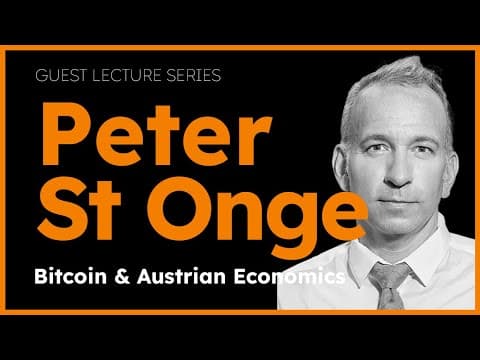
Peter St. Onge

Guest

Peter St. Onge

Senior economist at The Heritage Foundation · Economics commentator

Peter St. Onge is a senior economist at The Heritage Foundation and a former MBA professor who publishes daily commentary on economics and freedom. He holds a PhD in economics from George Mason University. His five TFTC interviews since 2023 examine government spending, the banking system and Bitcoin, with AI's effects on work joining the discussion in 2026.

Role
Senior economist, The Heritage Foundation
Education
PhD economics, George Mason University
Previously
MBA professor, Feng Chia University
Publishes
Daily economics videos and articles
Perspective
Austrian economics
On TFTC
5 interviews · May 2023 – Jul 2026
Updated

St. Onge brings Austrian economics to current policy arguments. He focuses on who creates money, who gets it first and what happens when governments can spend beyond what voters will accept in direct taxes. Before his policy work he taught international trade and marketing at Feng Chia University in Taiwan and worked in corporate marketing and strategy. His daily videos turn that background into short explanations of prices, jobs and the institutions shaping them.

The TFTC series begins with the banking crisis in May 2023 and a discussion of public debt later that year. In 2024 the question was whether removing income tax could help rebuild the productive economy; in 2025 it was the political organizations sustained by government funding. By June 2026 he was arguing that AI could reverse part of the advantage white-collar workers had enjoyed for decades. All five conversations have written episode pages below, separate from his authored articles and other shows' interviews.

On TFTC · 5 interviews

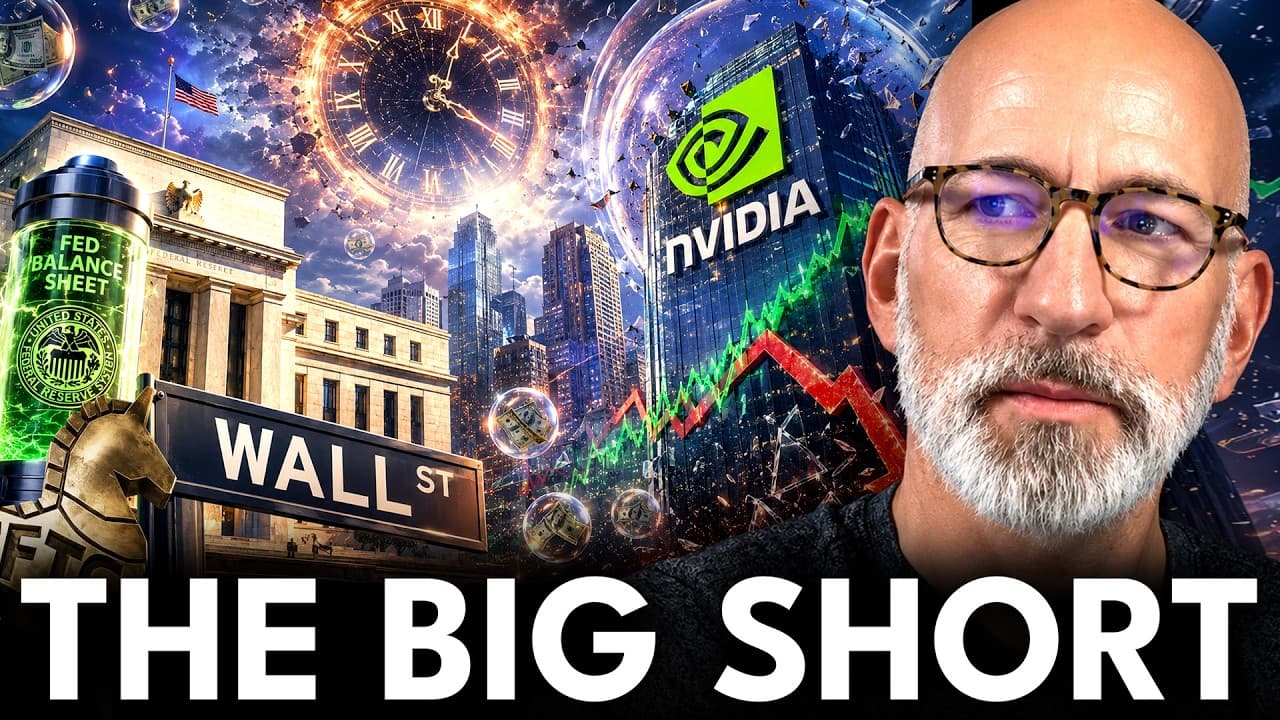
Peter St. Onge and Marty Bent on the TFTC podcast discussing AI, blue-collar jobs, and the Federal Reserve

Latest

Peter St. Onge: Revenge of the Blue Collars

Peter St. Onge on why the AI bubble still has a year or more to run, why blue-collar workers are the surprise winners of the AI era, and why Kevin Warsh's let-companies-fail Fed stance is exactly what the economy needs.

What Peter argues

Positions drawn from Peter’s TFTC appearances, grouped by theme. Quotes are from TFTC’s own recordings and are dated.

Treasury auctions expose the cost of rolling the debt

In November 2023 St. Onge used a weak Treasury auction to explain how much routine refinancing the government requires. The important distinction was between borrowing for new spending and replacing debt that was already coming due. He treated a poor auction as a warning, while acknowledging that subsequent auctions had cleared. That context matters: his concern was the vulnerability created by repeated refinancing, rather than a claim that one bad sale had already ended the government's ability to borrow.

“Most of that is refinancing old debt and then about 2 trillion in fresh debt.”

“Now, subsequent auctions have been fine.”

Commercial-bank credit belongs in the inflation discussion

St. Onge argues that focusing only on the Fed's balance sheet leaves out an important source of monetary expansion. Commercial banks create deposit money through lending, while government borrowing gives the financial system a large and continuing demand for credit. In April 2025 he paired that monetary explanation with a political one: state spending is backed by coercive power. His criticism is aimed at the incentives of the system, not simply the personality of the current central-bank chair.

Tax and regulatory choices shape the trade problem

Asked in June 2024 about replacing income taxes with tariffs, St. Onge located the underlying problem in domestic policy. He argued that American businesses had been made less competitive by taxes and regulation before foreign competition arrived. His support for a smaller tax burden follows from that diagnosis. The conversation's title emphasizes eliminating income tax, but his answer ranges more broadly over the choices that determine whether people can produce and build in the United States.

“I don't blame China so much as I blame Washington.”

“Every last one of [America's problems] is a choice.”

Political institutions have budgets and incentives too

The April 2025 interview applies his economic method to activism and education. St. Onge argued that public funding can sustain organizations whose apparent political independence deserves scrutiny. He used the same reasoning for universities, which he sees as supplying intellectual support for government expansion. These are his claims about institutional incentives. The episode's useful question is who funds an activity and what that funding rewards, rather than assuming an organization is independent because it describes itself that way.

“What looks like a revolution on the left is really just an intimidation racket with a payroll.”

“Universities are the state religion. They’re the intellectual bodyguards of the government.”

AI may reverse the advantage of generalist office work

In the 2026 conversation St. Onge expected a disruptive change in which skills command a premium. He argued that generalized white-collar work was directly exposed to AI, while the physical work required to build its infrastructure would remain in demand. This is the basis of the episode's blue-collar framing. He did not describe the transition as painless: the occupations that benefited most from an earlier economic order could face a difficult adjustment while other workers gained bargaining power.

“So I think what we're looking at is the next 10 years or so, generalist white collars are gonna get gutted.”

“And what I think is fun is that effectively the blue collars are taking the jobs from the white collars, right?”

Housing supply is a policy question as well as a rate question

St. Onge's housing discussion follows the same argument as his trade discussion: high costs are partly the result of rules that restrict production. In 2026 he criticized the Fed's large swings in interest rates and pointed to construction regulation as another constraint that policy could change. His proposal is to let more housing be built and lower the cost of adding it. The focus is the physical supply of homes, rather than treating a lower mortgage rate as the only possible route to affordability.

“And, you know, of course, the problem in housing is that the Fed yo-yoed rates, right?”

“Like there's regulation you could do that could that could probably drop the price of new construction by fifty, even a hundred thousand.”

A sideways Bitcoin market does not settle the monetary thesis

In June 2026 he argued that Bitcoin's weak price action did not invalidate the case for an alternative money. He compared its volatility with gold's behavior when gold is held as an asset alongside a dominant fiat currency. A relatively thin market and shifting speculative demand can produce large moves. His view was that another major step in adoption could change the scale of the market, while the underlying argument should be assessed separately from a recent trading range.

“I think the underlying argument for Bitcoin is unchanged.”

“I think it has nothing to do with the sort of fundamental thesis of Bitcoin.”

Policy can change because people can choose differently

His bleak descriptions of public finance are paired with a persistent claim that the results are reversible. In June 2024 he pointed to El Salvador as a challenge to the idea that political dysfunction is inevitable. In April 2025 his closing emphasis was on retaining the willingness to act. The recommendation is political and practical: identify the choices producing a bad outcome, then change those choices, rather than treating a country's decline as a natural law.

“The United States is one of the richest countries on earth. If a country like El Salvador can fix that, there's absolutely no excuse.”

“This is the golden age. The only way we lose is if we lose hope.”

Peter’s writing on TFTC

  • Are We Already in Recession?

    Are We Already in Recession?

    Broken economic indicators and underreported inflation suggest the U.S. may have been in a hidden recession for nearly five years.

  • House Prices hit New Record

    House Prices hit New Record

    Prices are sky high but nobody's buying

  • Federal Debt Interest Crosses $1 Trillion

    Federal Debt Interest Crosses $1 Trillion

    For the first time in American history, interest on the national debt has crossed $1 trillion, with projections indicating it could reach $3 trillion in just five years.

  • American Consumers Hit a Wall

    American Consumers Hit a Wall

    American consumers are facing a financial wall as incomes stagnate, savings deplete, and debt levels hit record highs.

  • Bitcoin Goes Mainstream

    Bitcoin Goes Mainstream

    Hedge funds, corporations, and President Trump endorse Bitcoin, signaling a significant shift towards mainstream adoption.

  • Renters and Owners Living in Separate Economies

    Renters and Owners Living in Separate Economies

    A Federal Reserve study exposes how its policies fuel a widening wealth gap, favoring homeowners and leaving renters in the dust.

Elsewhere

Notable appearances on other shows, newest first.

Common questions

Who is Peter St. Onge?
Peter St. Onge is a senior economist at The Heritage Foundation and a former MBA professor at Feng Chia University in Taiwan. He earned his economics PhD at George Mason University and publishes daily videos and articles on economics and freedom. His commentary draws on Austrian economics and focuses on money, government spending and regulation.
What is his view of government debt?
He argues that a large debt stock makes the government dependent on repeated refinancing and increases pressure for monetary intervention when markets resist. In November 2023 he used a weak Treasury auction as a warning about that dependence, while explicitly noting that later auctions had gone better.
Does he blame only the Fed for inflation?
No. In April 2025 he emphasized the role of commercial banks creating money through fractional reserve lending. His broader criticism links bank credit with government spending and the incentives of institutions that benefit from it. The Fed is part of that framework, rather than its only actor.
Why does he support eliminating income tax?
He sees taxes and regulation as obstacles to domestic production and investment. In the June 2024 interview about replacing income taxes with tariffs, he argued that Washington's own policy choices had weakened American competitiveness. The discussion examines that proposed shift in the context of reducing the government's burden on the productive economy.
What does he expect AI to do to jobs?
In the June 2026 conversation he expected major pressure on generalist white-collar roles and stronger demand for physical work needed to build infrastructure. He described it as a reversal of some of the advantages office workers had enjoyed. That is a forecast about a disruptive transition, with gains and losses across different occupations.
How many times has Peter St. Onge been on TFTC?
Five interviews from May 2023 through June 2026, all listed here. The newest written episode page was published in July after the June feed release. His six authored TFTC articles and the site's summary of a Stephan Livera interview are separate from those five conversations.
Where can I follow his work?
His daily articles and videos are at stonge.substack.com and peterstonge.com. His institutional research is on The Heritage Foundation's site, and he posts as @profstonge on X. His name also appears as Peter St Onge, without punctuation.

Peter’s own work