Oracle Force Majeure on Project Jupiter Exposes AI Capex's Structural Fragility
Oracle's force majeure notice on Project Jupiter reveals the structural brittleness of centralized AI infrastructure: a 0.6-mile right-of-way denial cascaded into a six-month pipeline delay, $18B in distressed debt, and a formal legal shield on the Stargate program's flagship campus.
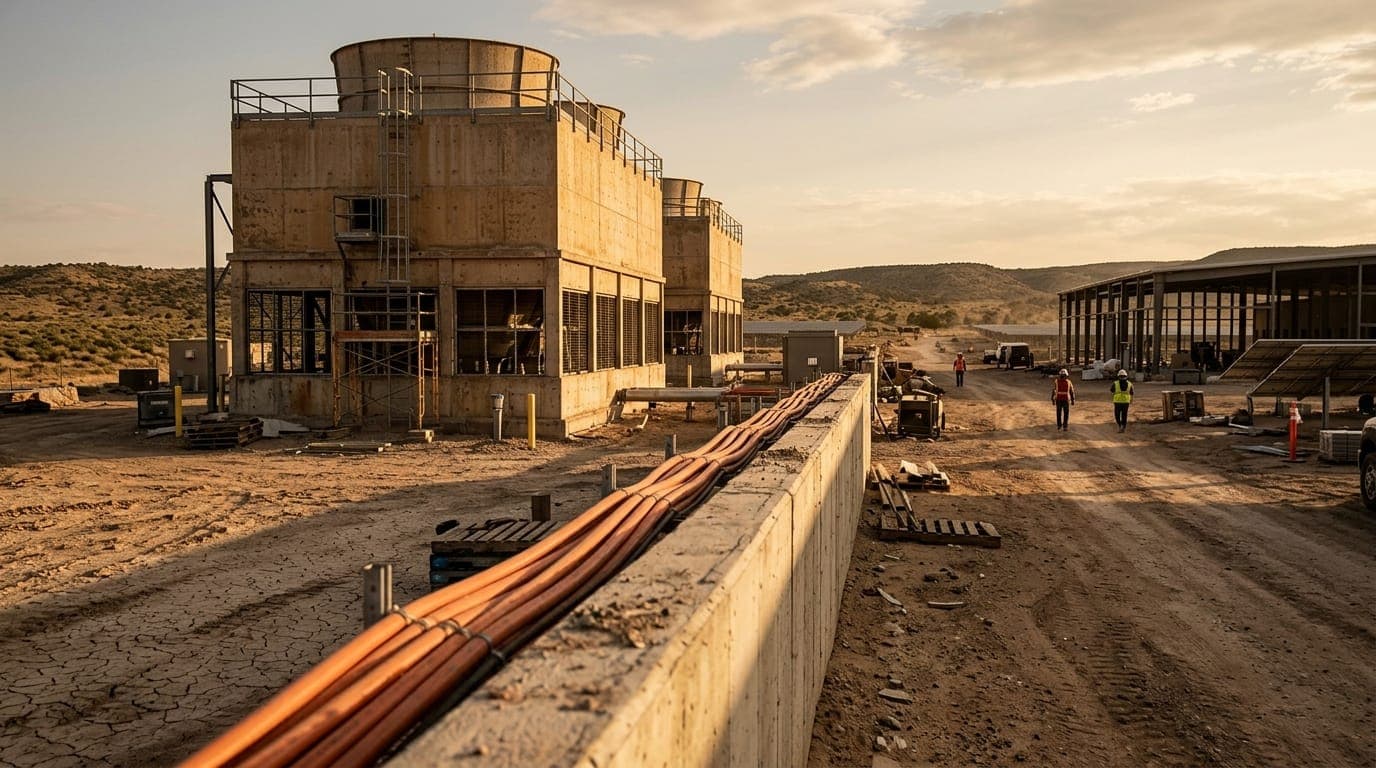
Oracle's legal shield on its New Mexico AI campus reveals what "build first, solve power later" looks like when the physical world pushes back.
Key takeaways
- Oracle issued a formal force majeure notice to Stack Infrastructure (a Blue Owl Capital portfolio company), seeking to defer payment obligations on Project Jupiter, a 2.45 GW AI campus in Doña Ana County, New Mexico, after repeated state-level denials blocked the natural gas pipeline needed to power it.
- Oracle shares fell roughly 4% on the news; $18 billion in project debt is already trading below 90 cents on the dollar, signaling that markets are pricing real schedule risk into the Stargate program's flagship campus.
- The force majeure is a contractual mechanism to limit Oracle's financial exposure if the project misses its target date, and both Oracle and Blue Owl say the project remains on track.
Oracle issued a formal force majeure notice to Stack Infrastructure, the Blue Owl Capital (NYSE: OWL) portfolio company developing Project Jupiter, as first reported by Bloomberg on September 23, 2026. The move gives Oracle a legal basis to defer payment obligations if the 1,400-acre campus in Santa Teresa, New Mexico fails to come online by its target date. It is not an exit. Oracle told CNBC directly: "Project Jupiter remains on our planned schedule. We are fully committed to New Mexico and confident in our path forward."
Blue Owl echoed the stance: "This notice does not change the financial commitments to this multi-year project." But the debt markets are less sanguine. Approximately $18 billion in project loans, spread across roughly 20 banks, is trading below 90 cents on the dollar, a spread that reflects genuine concern about whether a campus designed to handle 2.45 gigawatts of power capacity can hit schedule.
The Pipeline Problem at the Root of It
The immediate cause is a natural gas supply bottleneck, and it has a name: the Green Chile Project. Energy Transfer's proposed 17-mile, 24-inch pipeline was designed to carry up to 400 million cubic feet of natural gas per day from El Paso to Project Jupiter, feeding the Bloom Energy fuel cells Oracle planned to use as its primary power source on site.
New Mexico State Land Office Commissioner Stephanie Garcia Richard denied the pipeline twice: once in March 2026 and again on July 14, 2026. Her stated rationale was blunt. Per the July denial letter, Garcia Richard wrote that the pipeline "appears to offer very little benefit to the State Land Office's beneficiary institutions, the local community or New Mexico as a whole," and flagged concerns about water depletion and emissions.
The pipeline is now delayed at least six months, with a Transwestern Pipeline regulatory filing before FERC and subsequent reporting pointing to an earliest-possible service date of February 1, 2027. The New Mexico Supreme Court unanimously rejected two emergency legal challenges to the project, allowing the permitting process to resume, though broader litigation continues. The ABQ Journal noted that air quality permitting has also stalled in direct connection with the pipeline denial.
A Regulatory Denial, a Cascade of Risk
Project Jupiter is the anchor campus of the Stargate AI program, the initiative Trump unveiled alongside Oracle's Larry Ellison, OpenAI's Sam Altman, and SoftBank's Masayoshi Son in January 2025. The project sits at the center of a broader AI data center capex wave requiring trillions in global infrastructure investment through the coming decades.
That scale assumption runs directly into what is happening in New Mexico. A state land commissioner's right-of-way denial cascaded into a six-month pipeline delay, which cascaded into $18 billion in project debt trading at distress, which forced a force majeure notice on what was supposed to be the crown jewel of the administration's AI legacy. That chain of causation exposes the centralized-campus model's core vulnerability playing out in real time.
Oracle's ORCL shares fell roughly 4% on the news. Bloom Energy, Oracle's planned fuel-cell supplier for the site, also traded lower. Blue Owl dipped.
The SoftBank debt structure underpinning Stargate has its own stress fractures. None of these are isolated data points.
The broader pattern is consistent: Texas halted 1,800 AI data center projects as grid math broke down. Microsoft was ordered to halt a New Jersey AI campus running 45 unpermitted gas generators. PJM filed a 50 MW curtailment rule that would cut AI data centers first during grid shortages. The "demand is insatiable, build anywhere, solve power later" assumption is being stress-tested at every grid interconnect and every state land office in the country.
Bitcoin miners solved a version of this problem structurally, not by accident. Modular deployment, behind-the-meter power, co-location with stranded or curtailable energy, no single-site concentration risk, the ability to plug in or unplug on hours' notice. The AI data center industry is now trying to pour hundreds of billions into fixed-geography, single-grid, permit-dependent campuses and discovering that state regulators have both the legal tools and the political incentive to block energy infrastructure indefinitely.
The falsifiable version of this thesis: if Oracle resolves the pipeline via a reroute or federal override, Project Jupiter comes online on its 2028 schedule, and the $18B debt trades back to par, then the regulatory friction was transient. If Bitcoin miners face equivalent or worse permitting friction at scale (ERCOT interconnection queues, state-level moratoria), the comparative advantage weakens materially. Watch both.
What to Watch
The immediate pressure points are the Green Chile Project reroute application (currently under FERC review), whether a federal override of Garcia Richard's denial becomes politically viable, and where the $18 billion in project loans trades over the next 60 days. If debt recovers toward par after the September news cycle, markets are treating this as a solvable delay. If it continues to deteriorate, the Stargate program's financing assumptions come under real scrutiny, and so does every other centralized AI campus running the same playbook.
Sources
Frequently Asked Questions
What does a force majeure notice actually mean for Project Jupiter, is it canceled?
No. A force majeure notice is a contractual mechanism, not a cancellation. It allows Oracle to defer payment obligations and limit financial liability if the project fails to meet its target completion date due to circumstances outside its control (in this case, regulatory blockage of the energy supply pipeline). Oracle remains the anchor tenant and has publicly reaffirmed its commitment to the project.
Why can't Oracle just use a different power source for Project Jupiter?
Oracle's current power plan relies on Bloom Energy fuel cells, which require natural gas. The Green Chile Project pipeline was designed specifically to supply that gas at the scale the campus needs. Without it, there is no practical fuel supply for the fuel cells at 2.45 GW scale. A reroute of the pipeline is reportedly under consideration, but any new route would require fresh permitting, additional right-of-way approvals, and FERC review, adding months to an already delayed timeline.
What is Stargate and why does Project Jupiter matter to it?
Stargate is the AI infrastructure program announced in January 2025 by Oracle, OpenAI, and SoftBank, with Trump at the White House. The headline figure attached to the broader multi-campus program is $500 billion in planned investment, with OpenAI citing over $400 billion committed across campuses as of mid-2025. Project Jupiter in New Mexico was positioned as the anchor site of that buildout, the largest and most advanced of the planned campuses. A meaningful delay at Project Jupiter is therefore a delay at the center of gravity of the entire Stargate program.