The Oil Is Still Moving
John Arnold and I examine Venezuela's rising U.S. crude flows, dark Hormuz transits and how long America can absorb the fuel bill in its competition with China.


TFTC - Truth for the Commoner The Commoner | |||||||||||||||||||||||||||
Monday, September 21, 2026 | |||||||||||||||||||||||||||
Sup, freaks. John Arnold and I dug into the oil market on today's Ten31 Timestamp. The fuel bills are painful, but more crude is reaching the United States from Venezuela and more oil is getting through Hormuz. I want to look at what that means for the domestic economy and the larger competition with China. | |||||||||||||||||||||||||||
WHAT TO EXPECT IN THIS NEWSLETTER
| |||||||||||||||||||||||||||
Marty's Bent | |||||||||||||||||||||||||||
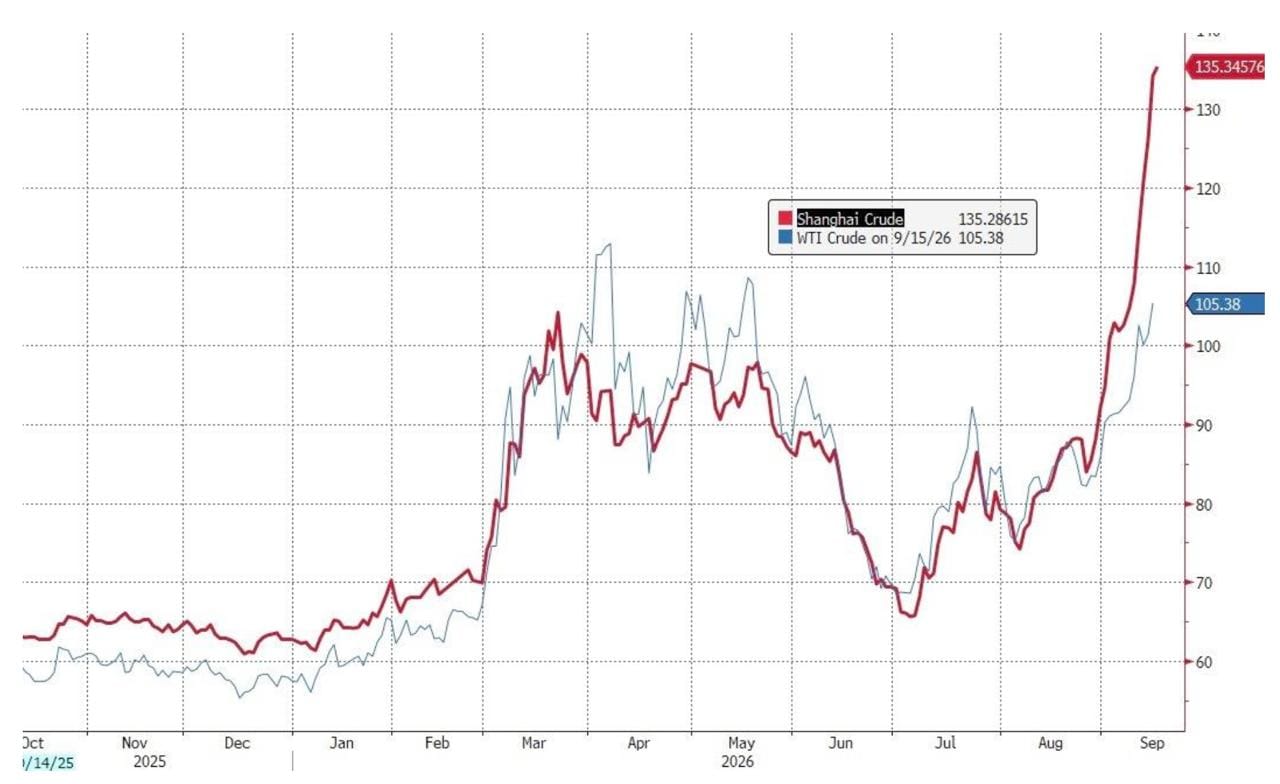
The Oil Is Still MovingJohn Arnold and I spent a good chunk of today's Ten31 Timestamp talking about the oil market and the larger game being played between the United States and China. I've been looking at all of this through that lens for a while now. Energy, industrial capacity, the push to build out AI. How much of what we're watching is a competition to put the other country in a weaker position? And how much pain are Americans going to be asked to absorb along the way? You can feel that last part at the pump. AAA's national average for diesel reached a record of roughly $6.51 a gallon today. Regular gasoline is around $4.48. Diesel is particularly important here because it goes into moving goods around the country and running the heavy equipment you need to build things. It's hard to get excited about reindustrializing the country while the fuel bill for doing it keeps climbing. But I think there are a few data points getting lost in the fear about a looming supply shortage. We talked through them this morning, and I want to put the charts in front of you. The Shanghai crude and WTI comparison below is what got us onto the question of relative leverage. The Shanghai series has pulled sharply away from WTI in September. John framed this as a competition over who can withstand the pressure longer. I think that's a useful way to look at it. Americans can be hurting while energy is becoming an even bigger problem for a competitor. Whether that makes the trade-off worthwhile is a separate question, and I'm not going to pretend we have the answer yet.
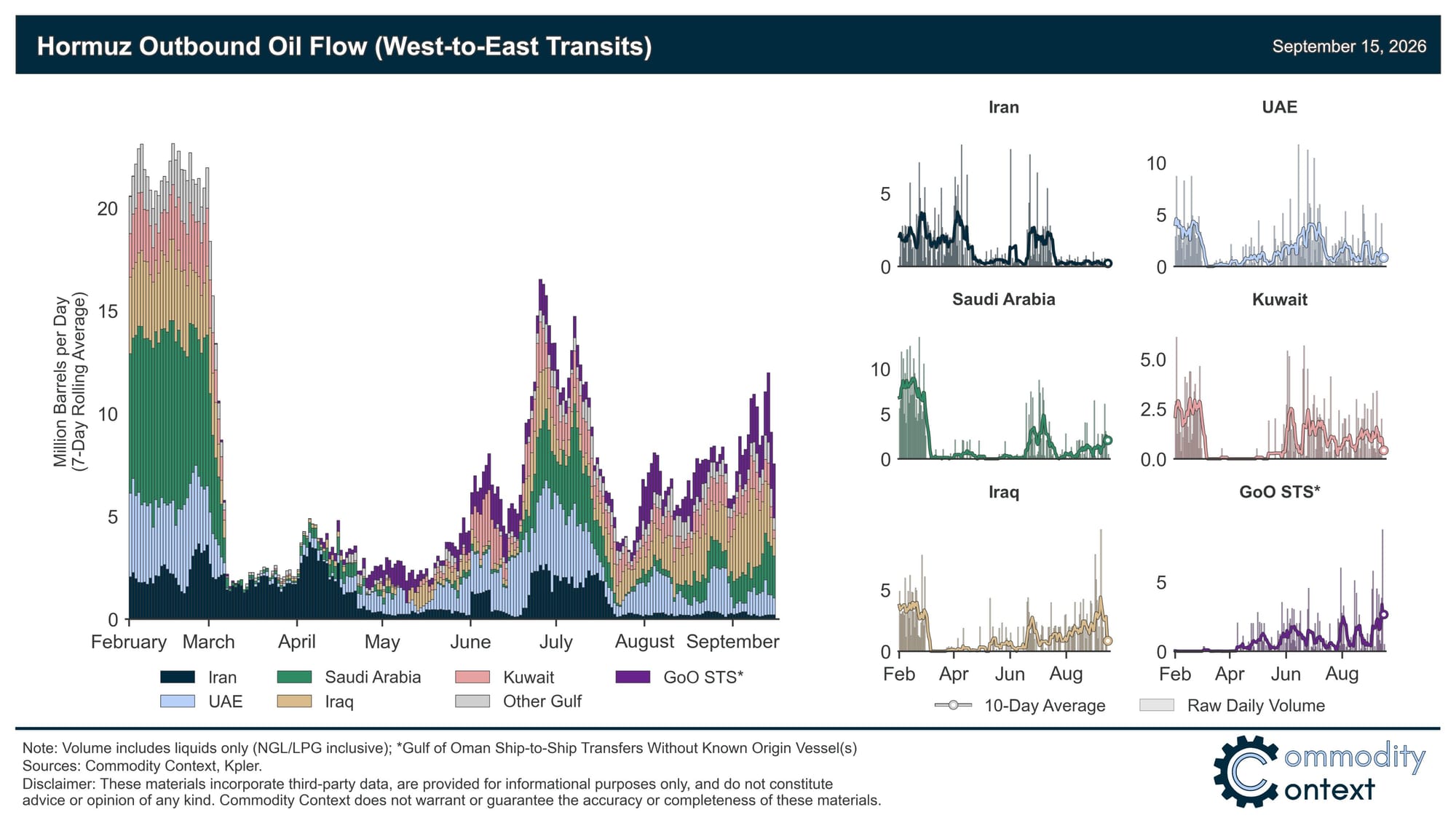
Supplied Shanghai Crude / WTI comparison, labeled September 15, 2026. Contract months and currency-conversion details are not supplied; shown as an illustration rather than a verified benchmark spread. Then there is the Strait of Hormuz. If you spend enough time reading the headlines, you could come away thinking nothing is making it through. Rory Johnston's September 15 chart, using Kpler data, puts the seven-day average of outbound liquids flows near 12 million barrels a day as of September 13. That is a lot of oil moving through a waterway people keep describing as shut.
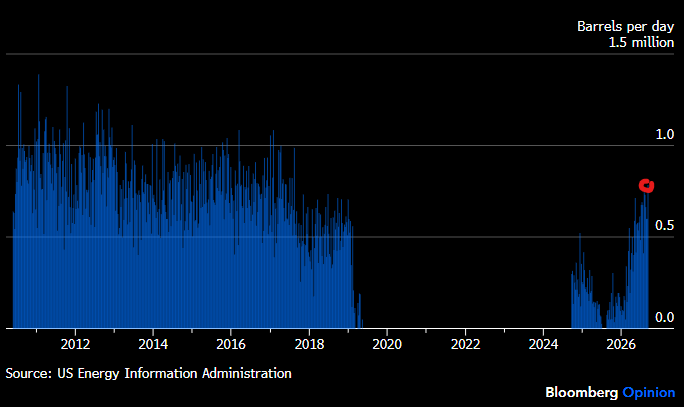
Rory Johnston / Commodity Context, using Kpler data. Main panel: seven-day average, millions of barrels per day. Country panels use ten-day averages. Liquids include NGLs and LPG; recent observations are subject to revision. Some of those barrels are moving through dark transits. Johnston tracks cargoes that appear in ship-to-ship transfers in the Gulf of Oman before the vessel that brought them through Hormuz has been identified. He initially counts those likely crossings separately, then reassigns them when the original voyage is found. Looking only at the ships you can identify crossing today can leave you with a pretty incomplete picture. John's read was that the chokehold may be loosening. The flow data gives us a reason to take that possibility seriously. Johnston also puts this recovery at less than 60% of prewar flows, so there is still a considerable hole to fill. I'm interested in whether this keeps improving, because the argument that nothing has changed becomes harder to make as more barrels get through. The Venezuela chart is the one I find particularly encouraging for the domestic economy. Javier Blas highlighted the increase in crude arriving in the United States, which he describes as the highest rate since mid-2017. The EIA's preliminary weekly estimate puts imports at 782,000 barrels a day for the week ended September 11, up from 599,000 the week before.
U.S. crude imports from Venezuela. Chart: Javier Blas / Bloomberg Opinion. Data: U.S. EIA; latest weekly estimate is September 11. My question to John was how much of that crude we can refine here. The EIA has described Gulf Coast refineries as well-suited to Venezuela's heavy crude. John made the same point, while acknowledging that he didn't know how quickly those refineries could take on more. That's the part I want to keep digging into. More crude reaching the United States is encouraging. Turning it into the diesel people need, at a price they can afford, is what would make the difference. These import figures measure barrels coming here, not an equivalent increase in worldwide production. You can have very strong objections to American intervention abroad and still recognize that these flows matter to the domestic energy picture. I think the Venezuelan numbers deserve more attention than they're getting. If they can keep growing while more oil makes it through Hormuz, that gives us something concrete to watch beyond another prediction that everything is about to grind to a halt. John kept coming back to duration. How long can diesel stay this expensive before it undermines the industrial growth the administration wants? Can the supply response arrive quickly enough to take pressure off American businesses and families? I find the import numbers encouraging, but whether the larger strategy is worth the cost is still an open question. We shall see. | |||||||||||||||||||||||||||
SIGNAL | |||||||||||||||||||||||||||
BITCOIN The buyers are showing upJames Check's latest note makes a constructive case for bitcoin, with spot accumulation doing more of the work than speculative leverage. The U.S. spot ETF flows finished last week strongly: roughly $592.5 million came in Thursday and Friday. That repaired earlier outflows, leaving the full week only about $6.2 million positive. Check is watching for a weekly close above May's $83,000 high as confirmation. An intraday move through that price doesn't satisfy his test. I like seeing buyers absorb supply after a rough start to the week. Whether they keep doing it is worth watching more closely than another round of price-target arguments. | |||||||||||||||||||||||||||
OWNERSHIP Steak 'n Shake wants passive votes to be passiveSteak 'n Shake is calling for index funds to mirror the votes of retail and active institutional shareholders, rather than letting fund managers decide how to wield that voting power. The proposal would split passive funds' votes in proportion to those other owners. I think it's a worthwhile discussion. Millions of people buy an index fund to save, then someone else exercises the corporate votes attached to their savings. The restaurant's parent-company chief, Sardar Biglari, has his own longstanding battle with Cracker Barrel's board, which helps explain the target of the post. Set that fight aside for a moment and the question remains: how much corporate control should come with administering other people's passive investments? | |||||||||||||||||||||||||||
FINANCIAL MARKETS Tokenized stocks get an openingThe SEC has granted temporary, conditional relief for qualifying venues trading tokenized U.S. stocks and certain liquidity providers. The exemptions expire five years after publication and come with trading limits and investor-protection conditions. This gives some substance to the financial changes Jordi Visser has been writing about: assets becoming easier to move, settle and use as collateral, potentially with software agents doing the work. There is real potential to reduce friction and idle balances. The interesting question is how much productive activity follows. I'd like better settlement systems and more people able to use them. I'd also like those people to understand the difference between a claim on a stock and bitcoin they hold themselves. | |||||||||||||||||||||||||||
POWER Duke gets emergency access to more generationThe Department of Energy's September 18 order gives Duke Energy Carolinas emergency generation authority through today. Duke cited unusually hot weather, high expected demand and generating units constrained by permit limits. The order allows specified resources to operate under emergency conditions and opens access to customer-owned backup generation as a last resort before, or during, an Energy Emergency Alert 3. That includes equipment at data centers and other large commercial and industrial sites. The practical response involves both finding more supply and reducing demand. Duke told DOE it had secured additional capacity and expected its demand-reduction measures to help. Owning a generator and being able to dispatch it when needed are two different things. | |||||||||||||||||||||||||||
BITCOIN WALLETS Read the ZEUS migration warningPeople using ZEUS on multiple iOS devices should read the warning in v13.2.2-rc1 before trying this release candidate. The maintainers say a dependency bug stored wallet data, including seeds and connection credentials, in the iCloud-synced keychain instead of device-only storage. The migration saves a local copy, then deletes the synced copies. That deletion can remove configurations from another device that has not completed migration. Back up seeds and export configurations on each device before updating, as the release instructs. ZEUS reports no indication of exposure and notes that iCloud Keychain is end-to-end encrypted. This is a migration warning, not a recommendation that everyone install a release candidate. | |||||||||||||||||||||||||||
| |||||||||||||||||||||||||||
| |||||||||||||||||||||||||||
⚡ FREEDOM TECH CORNER | |||||||||||||||||||||||||||
Make sure the backup can bring you backIf you run LNbits with PostgreSQL, review the stable v1.6.2 release. It fixes a backup path that could package an archive even when the database dump failed. The updated code checks whether that dump succeeded and stops with an error if it didn't. Follow your deployment's upgrade procedure, make a fresh backup and test restoration in a separate environment. Don't overwrite your running database to find out whether a backup works. Having a file called backup sitting on a drive can give you a lot of confidence right up until the moment you need to use it. | |||||||||||||||||||||||||||
DATA SNAPSHOT | |||||||||||||||||||||||||||
As of September 21, 2026, 1:57 p.m. ET. MVRV and realized price are daily observations dated September 20 UTC. | |||||||||||||||||||||||||||
| |||||||||||||||||||||||||||
Sources: CoinGecko for price, rolling 24-hour change and market cap; mempool.space for network estimates; Alternative.me for daily sentiment; Bitcoin Lab for MVRV and realized price. MVRV compares market capitalization with realized capitalization. Realized price values coins at the prices when they last moved. | |||||||||||||||||||||||||||
| |||||||||||||||||||||||||||
| |||||||||||||||||||||||||||
If you know someone who would enjoy The Commoner, forward this to them. Stay frothy, Marty | |||||||||||||||||||||||||||
Marty Bent · TFTC · Nostr |