Nvidia and Valar Atomics Run Blackwell AI Chips Off a Microreactor
Nvidia and Valar Atomics ran Blackwell AI chips off the Ward 250 microreactor in Utah on July 1, claiming the first-ever small reactor to power a data center. The real story: AI capex is now energy-constrained, and the industry is going behind the meter to escape the grid.
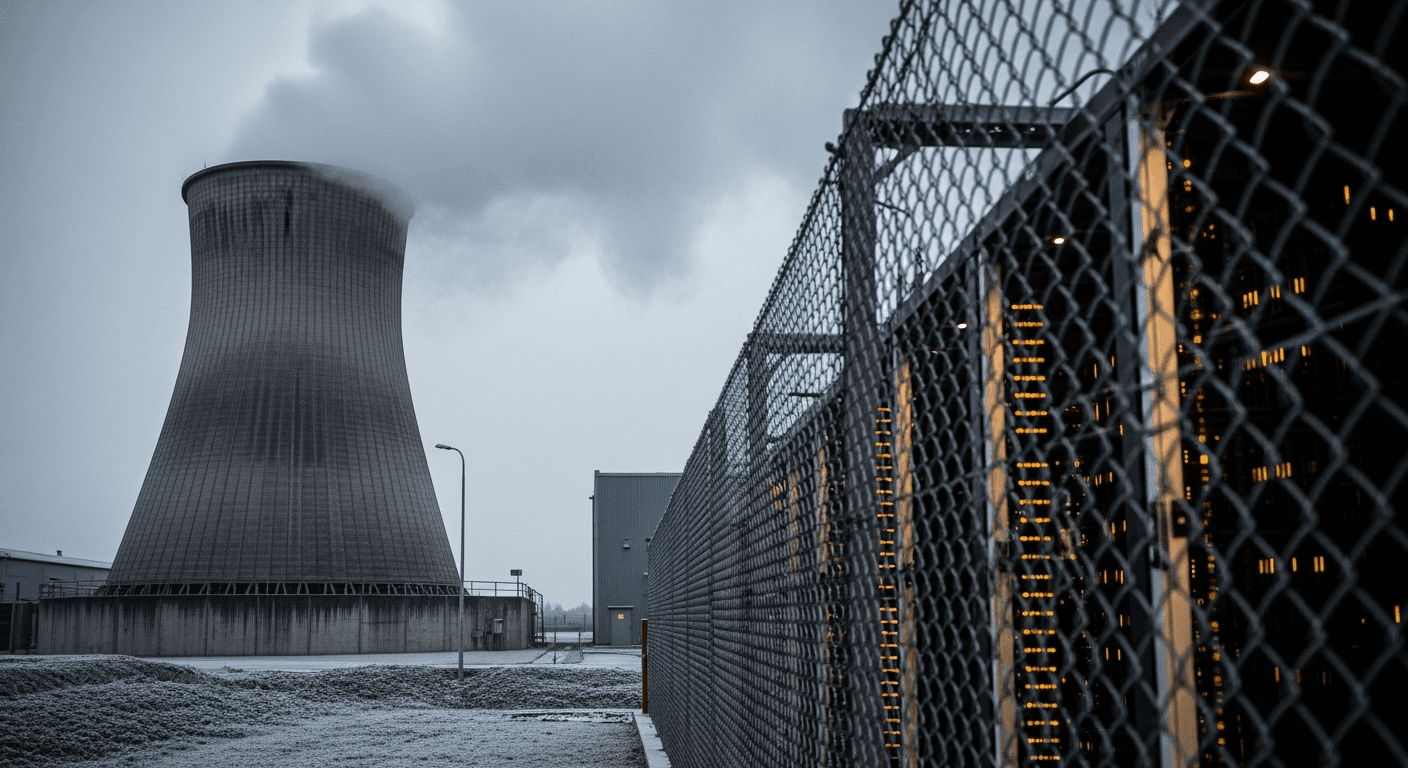
The first small reactor claimed to power a data center signals AI compute is now energy-constrained, not chip-constrained.
Key takeaways
- Nvidia and Valar Atomics ran Blackwell AI chips from the Ward 250 microreactor at Valar's Utah site on July 1, in what the companies describe as the first time a small reactor has powered a data center.
- The demonstration, combined with Nvidia's simultaneous push for waterless data center cooling, is a public acknowledgment that the grid cannot serve AI at scale, forcing the industry toward behind-the-meter nuclear.
- Valar is racing a two-day clock: the DOE's Nuclear Reactor Pilot Program set a goal to demonstrate three small reactors reaching criticality by July 4, 2026.
On July 1, Nvidia and Valar Atomics announced a partnership to develop a nuclear-powered AI data center in Utah, and ran a live demonstration powering Nvidia's Blackwell chip architecture off Valar's Ward 250 microreactor, what the two companies describe as the first time a small reactor has powered a data center. First reported by Reuters, the demonstration took place at Valar's San Rafael Energy Research Center in Emery County, Utah.
The reactor output during the demo was small. Bloomberg described it as "just a trickle of electricity," with the Ward 250 temporarily hosting a website as proof of concept. What matters is not the kilowatts produced but who showed up to produce them.
The Grid Cannot Serve AI at Scale
Nvidia Global Vice President John Josephakis made the stakes explicit in a statement accompanying the announcement: "Through this work with Valar Atomics, Nvidia is exploring how behind-the-meter, waterless advanced nuclear systems could support future AI factories built for the scale and reliability accelerated computing requires."
Behind the meter. Waterless. Off the public grid entirely.
That framing is an admission. The dominant GPU maker is not waiting for utilities to build out capacity, instead pursuing nuclear generation that bypasses the grid altogether. Nvidia simultaneously announced its DSX data center design, which uses closed-loop liquid cooling the company says can reduce facility-cooling water consumption toward near zero. Valar's Ward 250 is a helium-cooled, TRISO-fueled high-temperature gas reactor, also effectively waterless. The two designs pair precisely.
Deseret News reports the partnership is exploring a 30 MW nuclear-powered data center in Utah. That is a small footprint by hyperscale standards, but the point is not the size of this project, it is the direction the largest AI capex spender in the world is pointing.
The Stargate AI buildout has already begun repricing power beneath Bitcoin miners. The DOE has already ordered AI data centers onto backup generators as grid demand hits records. Nvidia going behind the meter with nuclear is the next step in the same pressure curve.
What This Means for Dispatchable Energy Competition
The Nvidia/Valar demonstration is the clearest data point yet that AI capex has shifted from chip-constrained to energy-constrained. When the dominant GPU vendor partners with a pre-commercial nuclear startup to run its flagship chip architecture off a microreactor, the bottleneck has moved.
That matters directly to Bitcoin miners. Miners have always competed on energy cost and access. Every behind-the-meter nuclear gigawatt built for an AI data center is a gigawatt that does not flow to the public grid and cannot be accessed by operations relying on curtailed renewables or stranded gas. If this pathway matures, the marginal cost of AI compute begins to converge toward a nuclear floor, potentially more stable than the energy inputs anchoring mining economics today.
That does not kill Bitcoin mining. It pressures the industry toward efficiency and toward energy sources AI data centers cannot easily replicate: flared gas, stranded hydro, waste heat. The longer-run effect could be positive for Bitcoin's geographic and energetic decentralization. The short-run competitive dynamic for the same off-grid electrons is real and tightening. Bitcoin miners who have already begun pivoting infrastructure toward compute have a window. That window is compressing.
The falsifiable version of this thesis: if Nvidia's Valar partnership produces no follow-on capacity commitment, and if the DOE pilot program misses its July 4 criticality deadline, this remains a science fair project. The thesis holds only if Valar clears NRC licensing on a compressed timeline, Nvidia formalizes nuclear sourcing at scale, and behind-the-meter generation becomes a real cost input for data center construction.
What to Watch in the Next 72 Hours
Valar reached zero-power (cold) criticality in November 2025 at the Nevada National Security Site under Project NOVA, becoming what it describes as the first venture-backed company to do so. The company is one of approximately ten startups participating in the DOE's Nuclear Reactor Pilot Program under Executive Order 14301, which set a goal of three small reactors reaching criticality by July 4, 2026. That deadline is two days away.
Whether Valar achieves full criticality by that date, whether Nvidia converts this demonstration into a formal procurement commitment, and how quickly the NRC moves on licensing (Executive Order 14300 directs the agency to establish 18-month caps on licensing decisions for new reactors) will determine whether July 1 was a market signal or a milestone photo.
Update, September 21, 2026
Nvidia's energy positioning goes well beyond its Valar microreactor work. Nvidia has committed $1.5 billion into SB Energy, joining existing investors SoftBank Group and OpenAI. The deal locks in serious compute supply: Nvidia will secure up to 8 gigawatts of AI computing capacity at an Ohio campus being built by the data center developer for OpenAI.
The structure of the investment reveals the mechanics. Nvidia agreed to invest $1.5 billion through a separate private placement of non-voting shares, priced at the same level as SB Energy's IPO.
Nvidia will also provide up to $105 billion in credit to help build the facility, which could scale from an initial 4.25 gigawatts to 8 gigawatts, according to SEC filings. On the power side, SB Energy and SoftBank plan to build at least 10 GW of new power generation and invest $4.2 billion in Ohio grid infrastructure to support AI data centers.
SB Energy will build a 9.2 gigawatt natural gas power plant on the site.
Read alongside the Valar microreactor play, a pattern is forming. Nvidia is simultaneously pursuing behind-the-meter nuclear for boutique AI factories and locking up massive grid-connected gas generation at hyperscale campuses. The deal is part of a broader strategy where Nvidia is financing the ecosystem consuming its chips, as leading tech firms increasingly tie together chips, power, and data center development to secure infrastructure for power-hungry AI models. Every gigawatt Nvidia pre-commits, whether off a microreactor in Utah or a gas plant in Ohio, tightens the available supply for everyone else competing on the same grid, Bitcoin miners included.
Sources
- Valar Atomics DOE Program Selection
- Valar Atomics Project NOVA
- Bloomberg: Nvidia AI Chip Gets Power from Valar's Nuclear Reactor
- First reported by Reuters (Valerie Volcovici and Timothy Gardner, July 1, 2026)
Frequently Asked Questions
What is the DOE Nuclear Reactor Pilot Program and who is involved?
The Nuclear Reactor Pilot Program operates under Executive Order 14301, signed by the Trump administration. It includes approximately ten nuclear energy startups and set a goal to demonstrate three small reactors reaching criticality by July 4, 2026, America's 250th birthday. Valar Atomics confirmed its selection in DOE program documentation published on its site.
How does a microreactor-powered data center reduce water consumption?
Conventional data centers use evaporative cooling towers that can consume millions of gallons of water per megawatt of capacity annually. Valar's Ward 250 is helium-cooled and produces no steam or water discharge. Paired with Nvidia's DSX closed-loop liquid cooling design, the combined system is engineered to approach zero facility-cooling water use.
What does behind-the-meter nuclear mean for Bitcoin miners?
Behind-the-meter generation means the power source connects directly to the facility and bypasses the public utility grid entirely. For Bitcoin miners, the consequence is competitive: as AI data centers secure dedicated nuclear generation off-grid, the pool of accessible dispatchable power shrinks. Miners positioned at stranded or flared energy sources that AI operators cannot easily reach are best insulated from that squeeze.