Nvidia and PreussenElektra Eye Germany's Idle Nuclear Sites for AI Data Centers
PreussenElektra, E.ON's nuclear decommissioning arm, announced Wednesday it is working with Nvidia to evaluate former German nuclear plant sites as AI data center locations. No deal terms were disclosed. The grid-infrastructure land grab has direct consequences for where Bitcoin mining can compete.
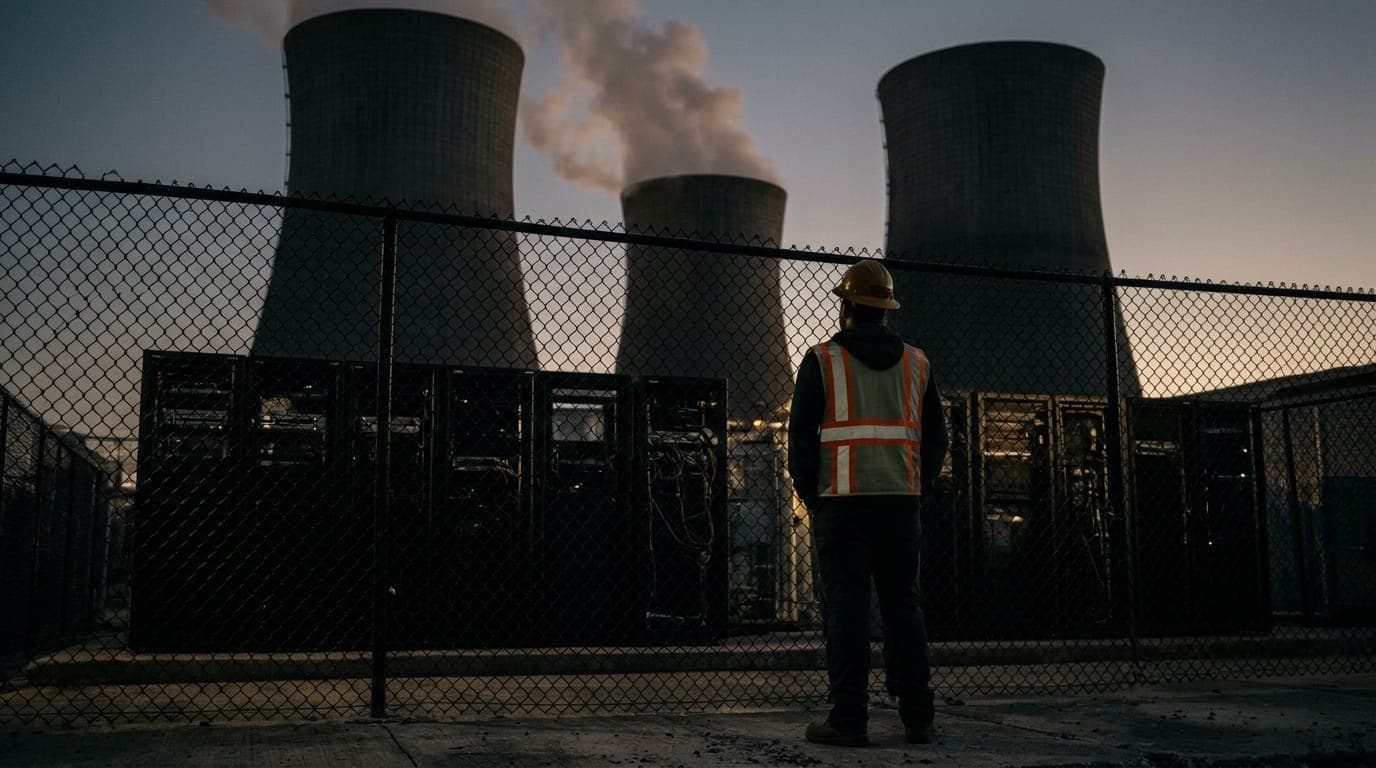
E.ON's nuclear decommissioning arm is partnering with Nvidia to assess whether former reactor sites can host AI data centers, with no deal terms disclosed and the grid-infrastructure clock ticking.
Key takeaways
- PreussenElektra GmbH, the nuclear decommissioning subsidiary of German utility E.ON, announced Wednesday it is working with Nvidia to evaluate whether former German nuclear plant sites can be converted into AI data centers.
- Germany shut its last reactors on April 15, 2023; the decommissioned sites retain high-voltage grid connections and physical infrastructure that make them attractive for power-hungry AI buildouts.
- No financial terms, specific sites, or timeline were disclosed. The partnership is exploratory, but the direction is clear: incumbent utilities are routing decommissioned nuclear infrastructure toward centralized AI compute, not open or distributed alternatives.
PreussenElektra GmbH, the nuclear decommissioning arm of German utility E.ON SE, announced Wednesday it is partnering with Nvidia to assess whether several former German nuclear plant sites could be repurposed as AI data centers, first reported by Bloomberg. The company disclosed no financial terms, no timeline, and no specific sites under consideration.
The move lands at the intersection of two converging pressures: AI's insatiable appetite for dispatchable power, and a growing inventory of high-voltage grid infrastructure sitting idle across Europe after Germany's politically driven nuclear exit.
Why These Sites Are Worth Fighting Over
Germany shut its last operating reactors on April 15, 2023 (Federal Office for the Safety of Nuclear Waste Management), the final act of an energy policy reversal triggered by Fukushima and executed under Chancellor Angela Merkel. The sites are mid-decommission, but the grid connections, structural capacity, cooling systems, and land remain. That bundled infrastructure is exactly what an AI data center buildout requires and takes years to permit and construct from scratch.
Trade outlet energate-messenger.com reports seven PreussenElektra nuclear station sites are under exploration; other trade coverage has cited a different figure. PreussenElektra has not confirmed a specific number publicly. No capacity figures, no megawatt targets, and no capex commitments have been disclosed by either company.
The structure of the announcement is important: this is an assessment, not a signed lease. Nvidia is evaluating suitability. But evaluation is how land grabs begin.
The Bitcoin Mining Read
The AI capex supercycle has been consuming power assets globally, and this deal is a concrete European data point. Bitcoin miners have quietly co-located at or near nuclear-adjacent infrastructure for years because the power is firm, clean, and often underutilized. That arbitrage is now being contested at scale by the most capital-heavy buildout in the history of computing.
The thesis here is falsifiable. If PreussenElektra and Nvidia conclude the sites are unsuitable, whether due to structural barriers, regulatory constraints, or grid-interconnection costs, the "AI wins the nuclear land grab" framing breaks. If German energy policy reserves decommissioned sites for grid balancing or distributed energy use rather than private hyperscaler buildout, the window reopens. A Bitcoin miner signing a comparable agreement at a German nuclear site would also change the picture.
But right now the political and commercial momentum runs one direction. The same regulatory apparatus that shut Germany's reactors in 2023 is now comfortable redirecting those sites toward Nvidia-backed AI factories. There is no equivalent political coalition forming to push those locations toward distributed compute. Nvidia's growing grip on grid-adjacent infrastructure is not a coincidence; it is the strategy.
Grid infrastructure is the finite asset. High-voltage interconnects, cooling, structural capacity, and permitted land do not come back once committed to a hyperscaler buildout. The window closes for years. That dynamic, playing out at several sites simultaneously across Germany, structurally limits where European Bitcoin hashrate can find firm, grid-connected baseload power. It does not kill the network, but it does concentrate mining further toward jurisdictions with stranded or low-cost energy and away from stable, baseload-connected sites.
What to Watch
PreussenElektra has not published an English-language press release confirming the Nvidia partnership at time of publication. Check PreussenElektra's newsroom (German) and Nvidia's press releases for any attributed executive statement or confirmed site list; no specific release was surfaced there at time of drafting. The assessment phase will determine whether this remains exploratory or moves toward permitting. Any German regulatory guidance on permissible uses for decommissioned nuclear land will be the clearest signal of whether AI or any alternative use can actually advance at these sites.
Sources
- First reported by Bloomberg (Eva Brendel, Oct. 22, 2026)
- energate-messenger.com
- Federal Office for the Safety of Nuclear Waste Management, The nuclear phase-out in Germany
Frequently Asked Questions
Why are former nuclear plant sites attractive for AI data centers?
Decommissioned nuclear sites carry infrastructure that would otherwise take years and significant capital to build: high-voltage grid interconnections, structural foundations, cooling water access, and permitted land with existing utility relationships. AI data centers require enormous amounts of reliable, dispatchable power delivered at high voltage. Nuclear sites already have that wiring in place, which makes them a faster and cheaper path to capacity than greenfield builds.
Could Bitcoin miners use Germany's decommissioned nuclear sites?
Theoretically, the same infrastructure advantages apply. In practice, three barriers stand in the way: regulatory (German energy policy is set by the same political class that killed the reactors and is now engaging hyperscalers, not miners); commercial (Nvidia and E.ON represent counterparties with the scale and relationships to move through permitting); and political (there is no visible coalition in Germany advocating for Bitcoin mining at former nuclear sites). The window is not legally closed, but it is effectively narrow.
What happened to Germany's nuclear power plants?
Germany phased out nuclear power as a direct policy response to the 2011 Fukushima disaster, a decision executed under Chancellor Angela Merkel. The last three operating reactors, including Isar 2, were shut down on April 15, 2023 (base.bund.de). The sites are currently undergoing decommissioning, a process that takes years, but their grid connections and physical infrastructure remain in place throughout.